Skip to content
When you're a parent in Atascocita going through a divorce or separation, you will hear the terms "custodial parent" and "non-custodial parent." These labels are common, but they can be a bit misleading and create unnecessary tension. Here in Texas, the law is designed to keep both parents actively involved. The primary difference comes down to one key right: the custodial parent is usually the one who gets to decide where the child lives, while the non-custodial parent has a set visitation schedule along with specific rights and duties. Understanding how Texas law defines these roles is the first step toward building a stable, cooperative new reality for your family.
Defining Custodial and Non-Custodial Roles in Texas
For families in Humble, Atascocita, and throughout northeast Harris County, it's crucial to understand that Texas family law doesn't officially use the terms "custodial" or "non-custodial" parent in its statutes. Instead, the Texas Family Code uses a concept called conservatorship to outline a parent's legal rights and responsibilities. The entire framework is built with the goal of keeping both parents as involved as possible in their child’s life, which we know is essential for a child's well-being.
When a judge finalizes a custody order, they will appoint the parents as conservators. This is where the practical distinction between the two roles really takes shape.
Types of Conservatorship
In Texas, there are three main types of conservators. Your designation will dictate your rights and responsibilities.
- Sole Managing Conservator (SMC): This is when one parent has the exclusive right to make nearly all decisions for the child. This is not the norm in our community. Judges typically reserve this for serious situations, like proven family violence, neglect, or substance abuse.
- Joint Managing Conservator (JMC): This is by far the most common outcome in Texas courts and what we see most often for families in the Atascocita area. Both parents share the rights and responsibilities of raising their child. Even in a JMC arrangement, however, the judge will name one parent as the "primary" JMC. This person has the exclusive right to decide where the child lives, which effectively makes them the custodial parent.
- Possessory Conservator (PC): This parent has the right to "possess"—or have physical custody of—the child based on a court-ordered schedule. While a Possessory Conservator has many parental rights, their authority is more limited than a Managing Conservator's.
The Texas legal system operates on a strong presumption that naming parents as Joint Managing Conservators is in the child's best interest. This approach is designed to foster cooperation and keep both parents at the center of their child's life, which is a value we share at our firm.
The table below translates these official legal terms into the more familiar "custodial" and "non-custodial" language you’ll likely hear. If you want to dig even deeper into these legal distinctions, you can read more about the difference between legal and physical custody in Texas.
Custodial vs Non-Custodial Parent in Texas Terms
| Common Term | Texas Legal Term | Typical Role and Key Right |
|---|---|---|
| Custodial Parent | Primary Joint Managing Conservator (JMC) | Has the exclusive right to determine the child's primary residence (e.g., within Atascocita or Humble ISD). |
| Non-Custodial Parent | Other Joint Managing Conservator (JMC) or Possessory Conservator (PC) | Follows a possession (visitation) schedule, like the Standard Possession Order, and has specific decision-making rights. |
Getting a firm grasp of this legal language is the foundation for successfully navigating your custody case. It empowers you to communicate clearly with the court and your co-parent and to advocate for an arrangement that truly works for your child. If you're feeling overwhelmed by all these terms, please know that you are not alone. The compassionate attorneys at The Law Office of Bryan Fagan are here to help. Schedule a free consultation at our Atascocita office to go over your specific situation and get the clarity you need to move forward.
A Detailed Comparison Of Parental Rights And Duties
Once you get past the official Texas legal jargon, the real question for parents in Atascocita becomes clear: what does being a custodial versus a non-custodial parent actually look like from one day to the next? Let’s break down the practical differences in your rights and duties after a court order is in place.
These aren't just labels on a court document. They define who handles school pickups in Humble, who pays for braces, and who ultimately makes the critical life decisions for your child. The distinctions directly shape your family's new rhythm and routine.
To start, let's connect the common terms you hear with their official legal meanings under Texas law.
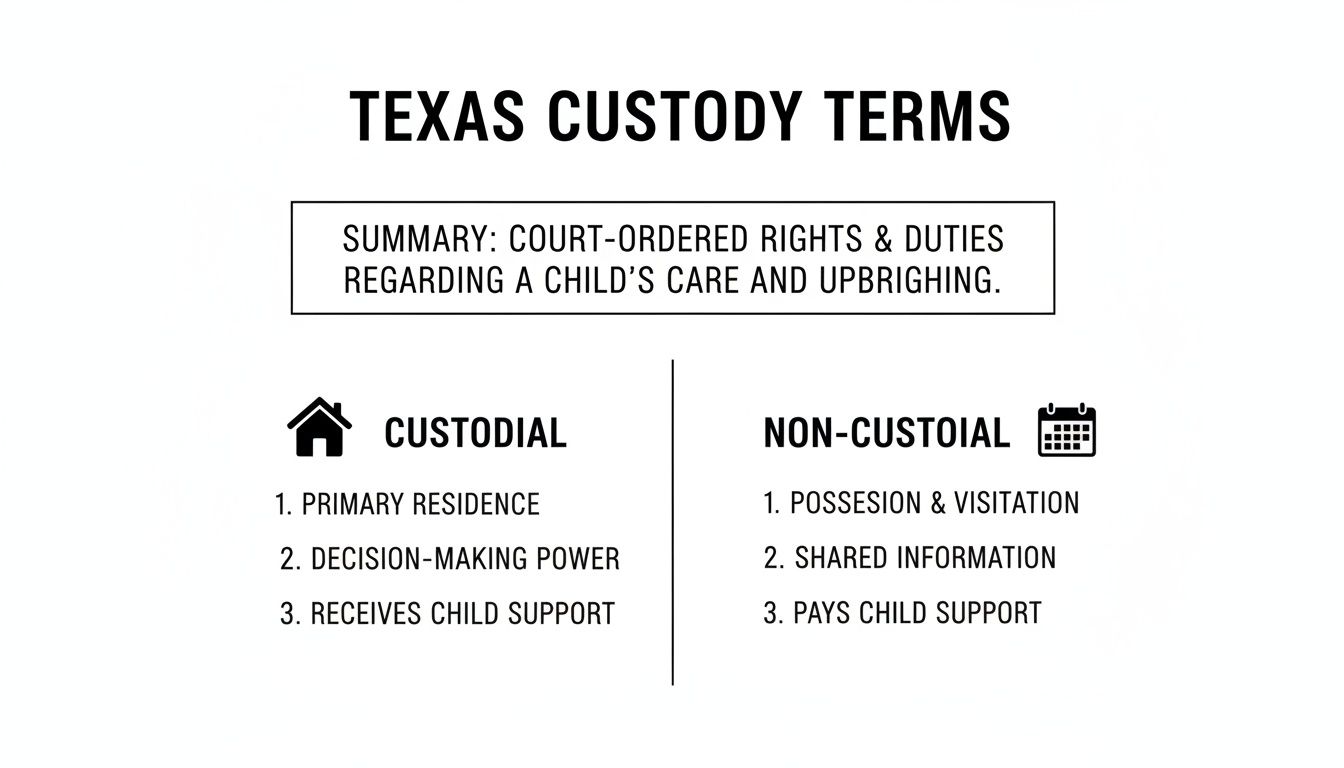
As you can see, the core difference boils down to this: the custodial parent is the one who establishes the child's main home base, while the non-custodial parent’s role is typically structured around a specific possession schedule.
Decision-Making Authority
In most Texas cases, courts name parents as Joint Managing Conservators (JMCs). On the surface, this sounds like you share all decision-making power equally, but that's not always the reality. A court order will spell out which parent has the final say on key issues if you simply can't agree.
The "custodial" parent, who is legally the primary JMC, almost always holds the most powerful right: to determine the child’s primary residence. This single right has a domino effect, influencing many other aspects of your child's daily life.
Generally, though, both parents share many important rights. You both typically have the ability to:
- Make joint decisions about your child’s education and healthcare needs.
- Consent to emergency medical and dental treatment.
- Access your child's school and medical records.
- Attend school activities and speak with teachers.
Even though both parents have the right to be involved, the primary parent's address is what usually determines which school district the child attends, like Humble ISD. This is a crucial detail for families living in communities like Atascocita, Kingwood, or the surrounding areas.
Physical Custody And Parenting Schedules
This is where the difference between the two roles is most obvious. The custodial parent has the child for the majority of the time, while the non-custodial parent has a set visitation schedule.
In Texas, this schedule is most often the Standard Possession Order (SPO). The SPO is a detailed calendar that lays out exactly which weekends, holidays, and summer weeks the non-custodial parent will have the child. The goal is to provide a clear, predictable routine, which is vital for a child's sense of stability.
For example, a non-custodial parent in Atascocita might have their children on the first, third, and fifth weekends of a month, rotate major holidays each year, and have them for 30 days during the summer break.
Financial Responsibilities And Child Support
Financial duties are also clearly divided. The non-custodial parent (the "obligor") is typically ordered by the court to pay monthly child support to the custodial parent (the "obligee").
These payments are intended to help the custodial parent cover the costs of the child's daily needs. This isn't just "extra" money; it goes toward:
- Housing and utilities
- Food and clothing
- School supplies and activity fees
In addition to child support, the court will also order one parent to provide health insurance for the child. Often, this duty falls to the non-custodial parent. If the custodial parent provides the insurance instead, the non-custodial parent may have to reimburse them for the monthly premiums.
To make these roles even clearer, here's a side-by-side look at the typical rights assigned to each parent in a Texas custody order.
At-A-Glance Rights And Responsibilities Of Texas Conservators
| Area of Responsibility | Primary Managing Conservator (Custodial Parent) | Other Managing/Possessory Conservator (Non-Custodial Parent) |
|---|---|---|
| Primary Residence | Right to designate the child's primary residence (usually within a specific geographic area). | Must return the child to the primary parent's residence after possession periods. |
| Child Support | Receives child support payments to cover the child's basic needs. | Pays monthly child support to the primary parent. |
| Decision-Making | Often has the exclusive right to make certain decisions if parents disagree (e.g., non-invasive medical care). | Shares the right to make joint decisions, but may not have the final say. |
| Daily Logistics | Manages the child's day-to-day schedule, appointments, and school-related activities. | Manages the child's activities and needs during their scheduled possession periods. |
| Information Access | Has the right to access all medical, dental, and educational records. | Also has the right to access all medical, dental, and educational records. |
| Health Insurance | May provide health insurance; if not, receives proof of coverage from the other parent. | Often ordered to provide and pay for the child's health and dental insurance. |
This table shows how Texas law tries to ensure both parents remain actively involved, even when their day-to-day responsibilities look quite different.
Day-To-Day Logistics
Think about all the coordination it takes to raise a child. The custodial parent is the one who usually handles the minute-by-minute logistics simply because the child lives with them most of the time. This includes everything from scheduling doctor's appointments in Atascocita to arranging carpools for soccer practice in Humble.
While the non-custodial parent is absolutely an essential part of the child's life, the custodial parent carries the weight of most of the everyday planning and execution.
National trends are slowly shifting these traditional dynamics. There are approximately 13 million custodial parents in the United States. While studies show that in 51% of cases, both parents agree the mother should have primary custody, that isn't the full picture. With 40% of U.S. states now aiming for equal custody time, there's a growing movement toward shared parenting models that help children maintain strong bonds with both mom and dad. You can explore more child custody statistics and see how these trends might influence family law.
Ultimately, whether you are the custodial or non-custodial parent, your active and positive involvement is what matters most for your child's well-being. At The Law Office of Bryan Fagan, we help parents in Atascocita advocate for custody arrangements that protect these vital relationships. If you have questions about your rights and duties, call us to schedule a free consultation.
Understanding Child Support Obligations In Harris County
For parents in Atascocita, Humble, and across Harris County, the financial side of a separation is often one of the most stressful parts. It's a topic loaded with anxiety, but when you're sorting out the roles of custodial vs. non-custodial parents, the conversation about child support is unavoidable. Gaining a clear understanding of how it all works can provide much-needed peace of mind.
At its core, the system is there to make sure kids get the financial backing they need from both parents, no matter which home they live in most of the time. In Texas, we have specific terms for this: the parent who pays is the "obligor," and the parent who receives the payments is the "obligee." In most cases, the non-custodial parent is the obligor and the custodial parent is the obligee.
How Texas Calculates Child Support
Texas courts don't just guess at a number. They use a clear, statutory formula to arrive at a predictable child support amount. The whole calculation hinges on the obligor's net monthly resources—that's most of their income after taxes and the cost of the children's health insurance premiums are taken out.
The percentage of that net income is then determined by how many children are involved:
- 1 Child: 20% of net resources
- 2 Children: 25% of net resources
- 3 Children: 30% of net resources
- 4 Children: 35% of net resources
- 5 or more Children: 40% of net resources
As a practical example for our community, let's say a non-custodial parent in Humble brings home $5,000 in net monthly resources and has one child. The guideline child support amount would be $1,000 per month (20% of $5,000). These funds go to the custodial parent to help pay for everything from housing and groceries to school supplies and clothes. If you want to get a better idea of the numbers, you can explore how much child support you might expect in your case.

Medical and Dental Support
Child support isn't just about the monthly check. The court will also order one parent to provide health and dental insurance for the child. More often than not, this duty falls to the non-custodial parent. However, if the custodial parent has a better or more affordable plan through their job, they might be ordered to carry the coverage, with the non-custodial parent ordered to reimburse them for the premiums.
What about things insurance doesn't cover, like co-pays, deductibles, or braces? These uninsured medical expenses are typically split between the parents as outlined in the court order, often on a 50/50 basis.
It's crucial for both parents to understand that child support is a right that belongs to the child, not a payment to the other parent. Its purpose is to ensure the child's quality of life is maintained as consistently as possible after a separation.
Enforcement When Payments Are Missed
We understand that for many custodial parents, the financial situation can be tough. In the U.S., there are about 13 million custodial parents, and 80% of them are mothers. With only 25% of single-mother families actually receiving the support they're owed, this gap can create real hardship. In Harris County, Texas, the fact that 87.9% of support agreements are formalized through court orders provides a critical legal backbone to protect a parent's rights.
When an obligor stops paying or falls behind, the obligee isn't helpless. In Harris County, you can take action by filing an enforcement case with the court. A judge has serious tools to collect that past-due support, including:
- Garnishing wages directly from their paycheck
- Placing liens on property or bank accounts
- Suspending the obligor's driver's license and any professional licenses they hold
- In serious cases, even ordering jail time for contempt of court
Navigating the ins and outs of child support can feel overwhelming, but you shouldn't have to face it alone. The compassionate attorneys at The Law Office of Bryan Fagan are here to protect your rights and ensure your child has the financial security they deserve. If you're in Atascocita or the surrounding communities, give us a call for a free consultation to talk about your situation.
How The Standard Possession Order Shapes Parenting Time
The parenting schedule—known in legal terms as a "possession order"—is essentially the new roadmap for your co-parenting life in Atascocita. It's the key to creating the predictability and stability that kids need to thrive after their parents separate. In Texas, courts usually start with what's called the Standard Possession Order (SPO), which is a detailed calendar spelling out exactly when each parent has the children.
The SPO is designed to be a fair and practical solution for most families, especially when parents live relatively close. For families in Humble, Atascocita, and the surrounding areas, this usually means living within 100 miles of one another. The SPO creates a clear rhythm for your family, outlining weekends, holidays, and summer vacation.

A Typical SPO Calendar For Local Parents
For a non-custodial parent living within 100 miles of the custodial parent, the SPO provides a very consistent schedule. The entire point is to make sure both the custodial vs non-custodial parent can keep a strong, active presence in their child's life.
A basic schedule typically lays out the following:
- Weekend Possession: The non-custodial parent usually has the children on the first, third, and fifth weekends of any given month.
- Holiday Possession: Major holidays like Thanksgiving and Christmas are split, alternating between the parents each year. This ensures both of you get to build those special holiday memories over time.
- Summer Possession: The non-custodial parent generally has the children for 30 days during the summer. This can be taken all at once or broken up if both parents agree.
This standardized framework is the court's go-to starting point because it's widely considered to be in the child's best interest. It gives everyone—you, your co-parent, and most importantly, your child—a clear idea of what to expect. You can find a more in-depth explanation in our guide to the Texas Standard Possession Order.
The goal of the Standard Possession Order is to remove guesswork and minimize potential conflict. By having a clear, court-ordered schedule, parents have a reliable structure to follow, which helps foster a more peaceful co-parenting relationship.
When The Standard Order Isn't The Right Fit
While the SPO works for a lot of people, it's certainly not a one-size-fits-all solution. Every family is unique, and a cookie-cutter schedule might not work for your situation. The law thankfully recognizes this and allows for customized possession orders that better serve a child's best interests.
Think about a parent who works as a firefighter in Atascocita on a rotating 24-hour shift schedule. The standard "first, third, and fifth weekend" model is completely unworkable for them. In a scenario like this, parents can negotiate a custom schedule that actually lines up with that parent’s unique work calendar.
Other common reasons to move away from the standard order include:
- A child’s special needs that demand a very consistent daily routine.
- A child’s extracurriculars that clash with the standard schedule, like a travel sports team based in Kingwood or Humble.
- The age of the child, especially for infants and toddlers under three who have different needs and usually follow a special, phased-in possession schedule.
- Parents living more than 100 miles apart, which triggers a different version of the SPO to make up for the travel time and expense.
In these situations, you and your co-parent have the ability to create a custom order through agreement or mediation. If you just can't see eye-to-eye, you can present your case to a Harris County judge, providing evidence that shows why the standard order is impractical or not in your child’s best interest.
Crafting a possession schedule that truly works for your family is one of the most critical parts of any custody case. If you're facing this, you don't have to figure it out on your own. The experienced attorneys at The Law Office of Bryan Fagan are here to help you understand your options and fight for a schedule that protects your relationship with your child. Call our Atascocita office today for a free, compassionate consultation.
Modifying or Enforcing Your Custody Order in Harris County
Life doesn’t stand still, and what works for your family today might not work tomorrow. A custody order that was a perfect fit for your family in Atascocita two years ago could be completely impractical now. Thankfully, Texas law recognizes this and provides clear pathways for parents to either modify an existing order or enforce it when the other parent isn't holding up their end of the bargain.
Knowing how these processes work is crucial, whether you are the custodial or non-custodial parent. The Harris County legal system has specific procedures for both scenarios, and understanding your next steps can bring a sense of clarity during what is often a very emotional time.
When Can You Modify a Custody Order?
You can’t just go to court and change an order on a whim. To successfully petition a judge in Harris County for a modification, you have to prove there has been a "material and substantial change in circumstances" since the last order was put in place. This legal standard is there for a reason—it keeps the courts from getting bogged down with minor disagreements and promotes stability for your child.
So, what actually counts as a material and substantial change? It can be any number of major life events that directly affect your child's well-being.
- Job Loss or a Big Income Shift: If a non-custodial parent loses their job or gets a massive pay cut, they might need to adjust their child support obligation.
- Relocation: A custodial parent landing a dream job in another state is a classic example that would require modifying the possession schedule.
- Your Child’s Evolving Needs: If a child develops a new medical condition that requires specialized care located closer to one parent, that could be grounds for a change.
- A Parent Remarrying: The introduction of a new stepparent and potentially stepsiblings can shift the family dynamic enough to justify revisiting the custody arrangement.
No matter the reason, the single most important factor a judge will consider is the best interest of the child. Your personal wishes will always come second to what the court believes will best support your child’s emotional and physical health.
There's also a growing movement toward shared parenting that's influencing how courts look at these cases. More and more research shows that children do better when they have significant time with both parents after a divorce. This trend is alive and well in Texas, affecting families in Atascocita and Humble. As divorce rates have seen a slight dip, the focus has shifted more toward cooperative co-parenting. You can see how different states stack up in the 2025 Shared Parenting Report Card.
What to Do When Your Order Is Violated
It is incredibly frustrating when your co-parent ignores a court order. Whether the custodial parent is denying your court-ordered visitation time or the non-custodial parent has simply stopped paying child support, you have legal recourse. The tool for this is called an enforcement action.
An enforcement action is a legal filing asking a judge to compel the other parent to follow the order. If the court agrees that the other parent willfully violated the terms, the consequences can be serious. They could face:
- Substantial fines
- An order to pay your attorney's fees
- Mandatory make-up visitation time
- In extreme cases, even jail time for contempt of court
The process begins when you file a Petition for Enforcement with the Harris County District Clerk. This document has to be precise, outlining exactly how, when, and where the violations occurred. Given the high stakes and the stress involved, getting guidance from a compassionate local attorney can make all the difference.
If you feel your circumstances have changed or your co-parent is violating your court order, don't just wait and hope things get better. The Law Office of Bryan Fagan is here to help you understand your rights. Schedule a free, no-obligation consultation with us at our Atascocita office today.
Common Questions About Custody Roles in Texas
When you're trying to make sense of the difference between a custodial and non-custodial parent, it's easy to get overwhelmed. For parents here in Atascocita and Humble, these questions aren't just about legal terms; they're about the real-world, day-to-day challenges of raising a child across two homes. We hear these concerns every single day, and our job is to give you direct, straightforward answers that bring a little more clarity and confidence.
Let's walk through some of the most common questions our attorneys are asked. We'll skip the legal jargon and focus on what this all means for you and your family.
Can the Non-Custodial Parent Make Decisions About School or Doctors?
This is a big one, and the short answer is usually: yes, but with some key limitations. The reality in Texas is that most parents are named Joint Managing Conservators (JMCs). That's the court's way of saying you both share the right—and the responsibility—to be involved in your child's life.
Unless your court order specifically takes away these rights, the non-custodial parent can almost always:
- Talk to your child’s teachers and show up for school events.
- Get medical and school records directly from the doctor's office or school.
- Consult with the custodial parent before making a non-emergency medical decision.
- Give consent for emergency medical care if the child is with them when it happens.
The key difference, however, usually comes down to who has the final say. The primary JMC (the custodial parent) often holds the ultimate tie-breaking authority. For instance, if you live in Atascocita and your co-parent lives in a different school district, a disagreement over enrollment will typically be settled by the primary parent. That’s because they have the exclusive right to decide where the child lives.
What Happens If the Custodial Parent Wants to Move?
A potential move by the custodial parent is a frequent source of conflict, as it can drastically change the non-custodial parent's access to the child. Most Texas custody orders contain a geographic restriction, which spells out exactly where the primary parent is allowed to live with the child.
For families in our area, this often means the child's residence is restricted to Harris County and its adjacent counties. If the custodial parent wants to move outside that zone—say, from Atascocita to Austin—they have to get the non-custodial parent's written agreement or go back to court and get a judge’s permission.
If you’re a non-custodial parent and you learn your co-parent is planning a move that violates your order, you need to act fast. You have the right to object and ask a court to stop the relocation if it's not in your child’s best interest.
Does Having Joint Custody Mean No One Pays Child Support?
This is a major misconception. In Texas, "joint custody" really means Joint Managing Conservatorship, which is all about sharing parental rights and duties. It has nothing to do with eliminating child support.
Child support is a separate calculation based mainly on the non-custodial parent’s income and how much time they have with the child. Even in a 50/50 possession schedule where time is split right down the middle, a judge can still order child support if one parent earns significantly more than the other. The court’s primary goal is to ensure the child has a similar standard of living in both households.
How Can I Get More Time With My Children As The Non-Custodial Parent?
This is a question we hear a lot, and it comes straight from the heart. If you're on a Standard Possession Order but feel you want and deserve more time, you have a couple of paths forward.
First, you can always try to work out an informal agreement with the other parent. If you have a decent co-parenting relationship, you might be able to add extra dinners or weekends just by asking. Just remember, these handshake deals aren't legally enforceable if the other parent changes their mind.
For a permanent, enforceable change, you'll need to file a Petition to Modify the Parent-Child Relationship. To win, you must show the judge two things: that there has been a material and substantial change in circumstances, and that giving you more time is in your child's best interest. With shared parenting becoming more and more the norm, courts are often very open to giving non-custodial parents more time, especially when it clearly benefits the child.
Figuring out the roles of a custodial vs. non-custodial parent can feel incredibly complex, but you don't have to navigate it on your own. The legal team at The Law Office of Bryan Fagan – Atascocita TX Lawyers is here to provide residents of Atascocita, Humble, and northeast Harris County with the support and clear guidance they need. If you have questions about your rights or just want to talk through your situation, we invite you to schedule a free, no-obligation consultation with us.