Skip to content
When your child's safety and stability are on the line, understanding your legal options is the most critical first step you can take. For families here in Atascocita, Humble, and northeast Harris County, the complexities of Texas family law can seem daunting. One of the most important concepts is sole managing conservatorship, a legal arrangement that gives one parent the exclusive authority to make the big decisions for a child's life—from where they attend school in Humble ISD to the medical care they receive. This isn't the standard outcome; it's a specific legal tool reserved for serious situations where co-parenting is simply not in a child's best interest.
Understanding Conservatorship in Our Community

For families here in Atascocita, walking into a child custody case can feel overwhelming, especially with all the legal jargon. One of the first things to know is that Texas law doesn't use the term "custody" in court orders. Instead, we talk about "conservatorship," which lays out the specific rights and duties each parent has. Think of it as the legal blueprint for raising your child after a divorce or separation.
No matter the circumstances, the court's one and only focus is protecting the "best interest of the child." That single principle guides every decision a Harris County judge will make in your case, and it's our guiding principle at The Law Office of Bryan Fagan as we support local families.
The Default Starting Point: Joint Management
Texas law begins with a strong belief: it's usually best for a child to have both parents actively involved in their life. The standard arrangement is called Joint Managing Conservatorship, where parents share the rights and responsibilities of making major decisions together. But we know that this model only works if both parents can cooperate and provide a safe, stable environment.
When that's not the case, the court must consider a different path. Under Texas Family Code Section 153.131(b), the preference for joint management can be set aside if there's credible evidence of serious risks, such as family violence, substance abuse, neglect, or abandonment. Forcing a co-parenting relationship in these situations would harm the child, which is something no court wants.
When Is Sole Managing Conservatorship the Right Call?
It’s important to understand that this arrangement isn't about punishing a parent. It’s a protective measure. Its sole purpose is to create a stable and secure world for a child when one parent's actions make joint decision-making unworkable or dangerous.
A Harris County judge will typically only consider this path if a parent has a documented history of:
- Family violence or abuse
- Drug or alcohol abuse
- Extreme conflict and a total inability to co-parent
- Child neglect or abandonment
The court steps in to appoint one parent as the sole, reliable decision-maker, shielding the child from chaos and ensuring their needs are met. For a deeper dive into the specific rights involved, you may find our guide on conservatorship in Texas helpful.
If you believe your child's well-being is at risk and that sole conservatorship might be necessary, our team at The Law Office of Bryan Fagan – Atascocita TX Lawyers is here to help you understand your options. Schedule a free consultation with us at our Atascocita office to discuss your family’s unique situation.
Sole vs Joint Conservatorship: The Key Differences
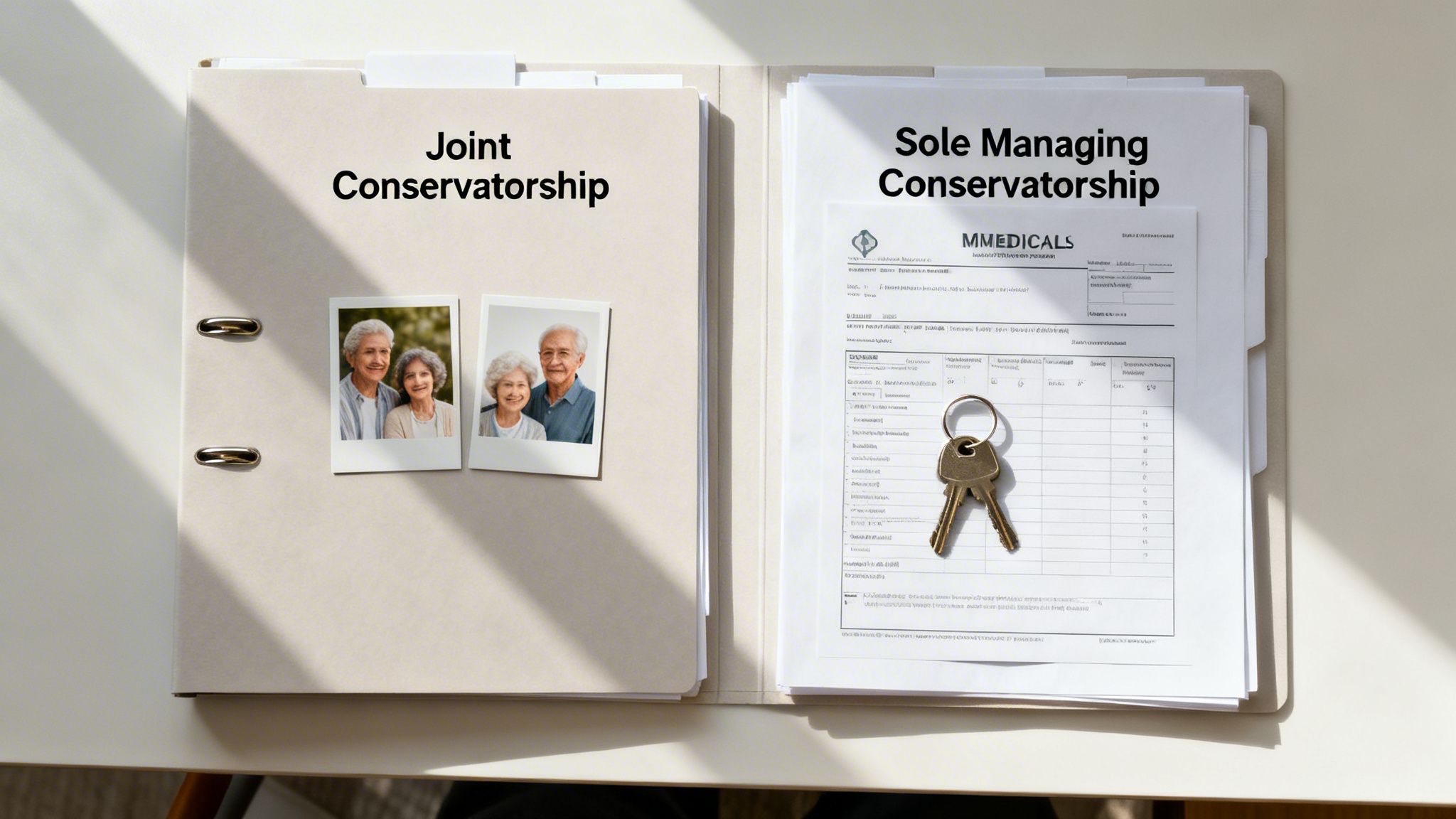
Trying to understand the legal jargon around sole and joint managing conservatorship can be overwhelming, especially when you're already going through a stressful time. We want to break it down in simple, plain English terms for you.
Think of joint managing conservatorship as a partnership where both parents are co-CEOs of "Parenting, Inc." For any major decision affecting your child's life, you both need to agree. This is the default in Texas because the state believes it's best for a child to have both parents deeply involved. For many families in Atascocita and Humble, this teamwork model works well.
On the other hand, sole managing conservatorship is more like a company with a single CEO who has the final say. In this setup, the court gives one parent the exclusive authority to make the big decisions.
Decision-Making Power: The Core Distinction
The real difference boils down to one thing: who holds the ultimate decision-making power.
In a joint arrangement, you and the other parent are legally required to confer and agree. If you can't agree on which school in Atascocita is best for your child, you could find yourselves at a stalemate, potentially heading back to court for a judge to decide.
A sole managing conservator doesn't have that problem. They hold the legal authority to make the final call on their own.
This doesn't mean the other parent is erased from the child's life. That parent is usually named the possessory conservator and still has crucial rights, like scheduled time with the child (visitation) and the right to access information about their health and education. What they lose is their vote on the major life decisions.
The fundamental shift from joint to sole conservatorship is about centralizing decision-making authority in one parent to protect a child from conflict, instability, or harm. It replaces a required partnership with a clear chain of command.
Exclusive Rights of a Sole Managing Conservator
When a Harris County judge appoints a sole managing conservator, that parent gains a specific bundle of exclusive rights—powers that the other parent simply doesn't have.
These critical rights often include the power to:
- Designate the child's primary residence without any geographic restriction.
- Consent to medical, dental, and surgical treatment, which includes psychiatric and psychological care.
- Make all decisions about the child's education, such as where they go to school.
- Consent to the child's marriage or enlistment in the armed forces.
- Receive and manage child support payments on behalf of the child.
Let's put these two arrangements side-by-side to make the differences crystal clear.
Sole vs Joint Managing Conservatorship: A Quick Comparison
The table below breaks down how key parental rights and responsibilities are handled under both a Sole Managing Conservatorship and the standard Joint Managing Conservatorship here in Texas.
| Parental Right or Responsibility | Sole Managing Conservatorship | Joint Managing Conservatorship |
|---|---|---|
| Designating Child's Residence | One parent has the exclusive right to decide where the child lives. | Usually one parent is given this right, but it is often restricted to a specific geographic area (e.g., Harris County). |
| Medical Decisions | The sole managing conservator has the exclusive right to make decisions. | Both parents have the right and must confer with one another. |
| Educational Decisions | The sole managing conservator has the exclusive right to make decisions. | Both parents have the right and are required to consult on school choice and other matters. |
| Receiving Child Support | The sole managing conservator receives payments from the other parent. | The parent with the right to determine residence typically receives support. |
| General Decision Making | One parent has the final say on all major life choices. | Both parents must agree on major decisions, requiring cooperation. |
Ultimately, the court's only goal is to create a safe, stable, and predictable environment where your child can flourish. If your situation involves family violence, substance abuse, or extreme conflict, understanding these legal differences is the first step toward protecting your child.
Our legal team at The Law Office of Bryan Fagan is here to help you navigate these complex choices. Schedule a free consultation at our Atascocita office to discuss which path is right for your family.
When Does a Judge Grant Sole Managing Conservatorship?
A Harris County judge won't take the decision to grant sole managing conservatorship lightly. The entire Texas Family Code is built on a foundational belief: kids do best when both parents are actively and meaningfully involved. This is why joint managing conservatorship is the default starting point for virtually every custody case in our community.
To move a judge away from that standard, you must do more than prove you and the other parent don’t get along. You have to convince the court that a joint arrangement would be damaging or even dangerous to your child's physical health or emotional well-being. It’s a high bar to clear, and it requires solid proof.
What Kind of Situation Justifies This?
For families in Atascocita, Humble, and across northeast Harris County, certain toxic situations make healthy co-parenting impossible. A judge isn't looking for minor disagreements. They are looking for a documented history of specific, harmful behaviors that put a child's welfare at risk.
The court needs to be convinced that one parent's actions are endangering the child. Here are the most common reasons a judge might award sole managing conservatorship:
- A History of Family Violence: This is the most direct route to a sole managing conservatorship. If there's credible evidence of physical, sexual, or emotional abuse toward the child or the other parent, the law is clear. Under Texas Family Code § 153.004(b), a judge is prohibited from naming parents as joint conservators if family violence is proven. A single documented event, like a conviction or a police report from an incident in your Atascocita home, can be enough to establish a "history" of abuse.
- Serious Substance Abuse: We aren't talking about a parent who enjoys a drink socially. This involves a parent's struggle with drugs or alcohol that prevents them from safely caring for a child and creates a chaotic home. Evidence is key here: DUI convictions, court-ordered drug test results, or credible testimony from people who've seen the parent impaired while responsible for the child.
- Child Neglect or Abandonment: If a parent has failed to provide basics like food, a safe place to live, or necessary medical care, a judge will take notice. The same goes for a parent who has been absent from the child's life for a long time. For instance, a parent who moves away from the Humble area, cuts off contact, and stops providing support could be seen as having abandoned their parental responsibilities.
- Extreme, Unworkable Conflict: All divorced parents disagree from time to time. But some situations are so full of conflict that any attempt to co-parent just exposes the child to constant fighting and emotional trauma. When every single decision turns into a battle, a judge might conclude that naming one parent as the sole decision-maker is the only way to give the child peace.
It Always Comes Back to the "Best Interest of the Child"
It's critical to understand that the court’s decision is never about rewarding one parent or punishing the other. Every document and piece of evidence is viewed through a single lens: what is in the best interest of the child?
Think of it this way: the court’s job is to build a safe harbor for the child. When one parent's behavior creates a storm of instability or danger, the judge will appoint the other parent as the sole captain to steer the ship and get the child to a calm, secure future.
Your job is to build a compelling case showing exactly why the standard joint model would be harmful. This isn't about name-calling; it's about evidence. You'll need things like police reports, medical records, or testimony from teachers or counselors in our community who have seen the negative impact on your child. Simply telling the judge that the other parent is "difficult" won't be enough. You have to prove that their specific actions are a direct threat to your child's physical or emotional health.
If you are in a situation where you believe your child is not safe, you need to understand these legal standards. The team at the Law Office of Bryan Fagan offers compassionate, experienced guidance to families in Atascocita and the surrounding communities. schedule a free, confidential consultation to discuss what's happening and learn how we can help protect your child.
How to Build a Strong Case in Harris County
Winning a sole managing conservatorship case in Harris County isn't about telling a judge you're the better parent. It’s about proving it with solid evidence. You have to build a compelling, fact-based story for the court, piece by piece, that leaves no doubt why this arrangement is necessary for your child's well-being.
The court needs to see a clear pattern of behavior or a significant, dangerous event that makes joint decision-making harmful. Your job is to demonstrate that reality.
Step 1: Gathering Foundational Evidence
Think of yourself as building a case file on behalf of your child. The more organized and credible your evidence, the stronger your position becomes. Start with official records, as judges give significant weight to documents from neutral, third-party sources.
Here's what you should be looking for:
- Police Reports: If you ever had to call law enforcement for incidents in Humble, Atascocita, or anywhere in Harris County related to family violence or drug use, get copies of every report.
- Medical and School Records: These documents can tell a story. Do they show a pattern of missed school days when the child is with the other parent? Are there records from a doctor or therapist detailing injuries or emotional distress?
- Digital Communications: This is often a goldmine. Save every text message, email, and social media post that reveals threats, instability, admissions of substance abuse, or a clear disinterest in the child's life.
Step 2: Identifying Credible Witnesses
Documents are crucial, but firsthand testimony from a believable witness can bring your case to life. A credible witness is someone who can testify about specific events they personally saw or heard.
This could be a teacher from Humble ISD who noticed a sharp decline in your child's grades. It might be a family counselor in Kingwood who can speak to the emotional damage caused by the other parent's actions. It could even be a neighbor in your Atascocita community who witnessed dangerous situations firsthand. Their testimony provides a real-world context for the documents you present.
Your case is a story, and your evidence and witnesses are the chapters that bring it to life. Each piece should contribute to the central theme: protecting your child's best interest.
Step 3: Leveraging Professional Expertise
When cases are contentious, a Harris County judge will often bring in neutral experts to get an unbiased view of the family dynamics. The reports from these professionals carry immense weight.
- Custody Evaluator: A licensed mental health professional who interviews you, the other parent, the child, and other important people (like teachers or grandparents), reviews evidence, and provides a detailed recommendation to the court.
- Amicus Attorney: An attorney appointed by the court with one job: to represent the best interests of the child. They act as the court’s “eyes and ears,” investigating the situation and advocating for the safest outcome.
Putting together a solid case is a meticulous process. It’s vital to have a clear strategy and an experienced guide who knows the local court system.
Building a winning case for sole managing conservatorship requires a strategic, methodical, and evidence-driven approach. If you are facing this difficult journey in Atascocita or the surrounding communities, you don't have to do it alone. The Law Office of Bryan Fagan is here to help you gather the necessary proof and fight for your child's safety. Contact us for a free consultation to discuss your step-by-step plan.
Navigating the Legal Process Step by Step
Facing the Harris County court system can feel overwhelming. But when you understand the process is a series of logical steps, the path forward becomes much clearer. Knowing what's coming next can help you stay focused on what really matters: protecting your child.
The journey to secure a sole managing conservatorship follows a specific legal road map designed to ensure every decision is made with careful consideration for your child's well-being.
Step 1: Filing Your Petition
Everything starts when one parent files an Original Petition with the court. This document officially kicks off your case. It lays out the essential facts for the judge: who is involved and what you're asking the court to do—in this situation, to name you as the sole managing conservator. Once filed at the Harris County Civil Courthouse, it must be officially delivered to the other parent ("service") so they have a fair chance to respond.
Step 2: Securing Immediate Protection with Temporary Orders
A full custody case can take months, but sometimes a child's safety can't wait. That’s where Temporary Orders are vital. Right after filing, your attorney will likely push for a Temporary Orders hearing, which is a mini-trial focused on immediate needs. The goal is to get temporary rules in place for custody, visitation, and support while the full case moves forward. For families in Atascocita facing urgent issues like abuse, these orders are a lifeline. You can learn more about how Temporary Orders work in Texas to see how critical they can be.
Step 3: Gathering Facts During the Discovery Phase
With temporary orders in place, the case shifts into the discovery phase. This is the formal process of gathering evidence from the other side. It’s about ensuring both parents have all the relevant facts before any final decisions are made. Common tools include asking for documents, sending written questions that must be answered under oath, and conducting depositions.
This infographic breaks down the three pillars of building a solid case during this phase.
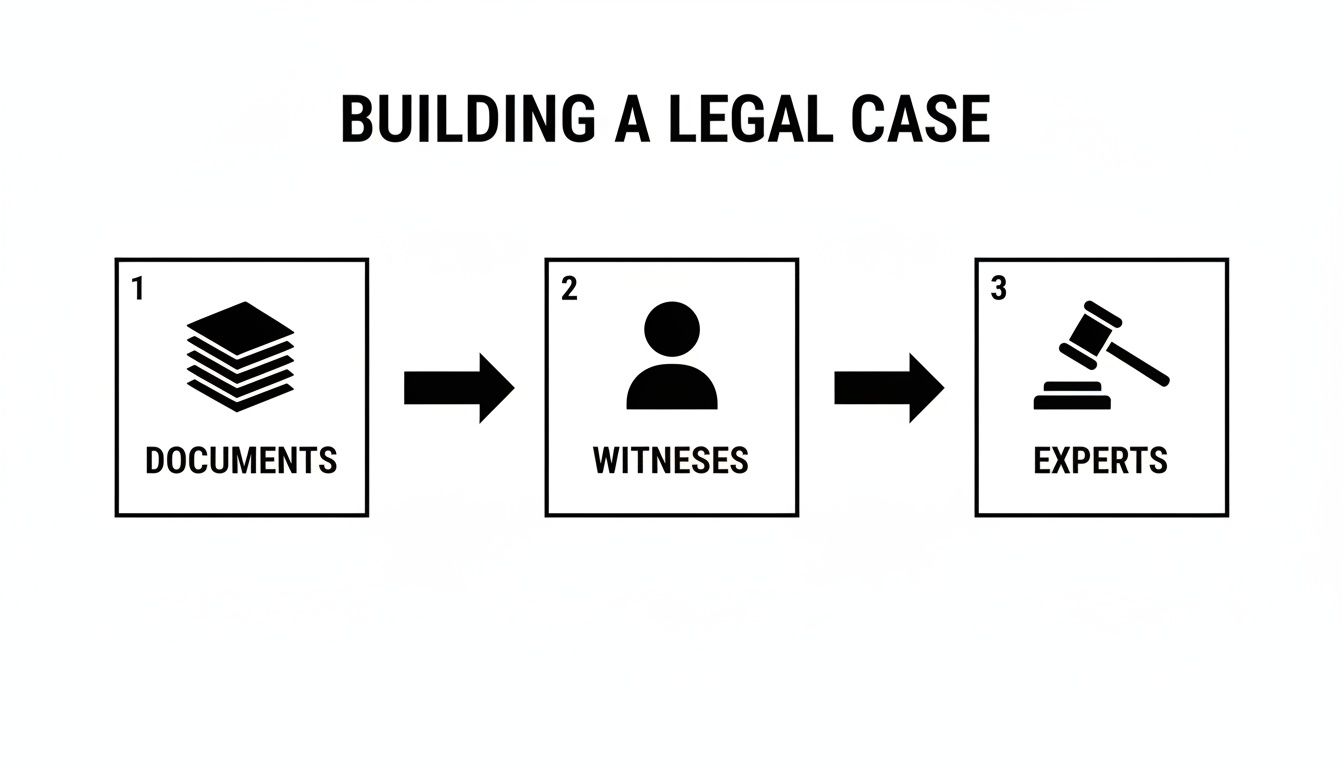
As you can see, a powerful legal argument rests on a foundation of documented evidence, credible witness testimony, and, when needed, expert opinions.
Step 4: The Mandatory Step of Mediation
In Harris County, you can’t just go straight to a final trial. The court will almost always require you and the other parent to first attend mediation. This is a private, confidential meeting guided by a neutral professional—the mediator—whose job is to help you find a way to settle your case. Mediation puts the power back in your hands, allowing you to craft an agreement that works for your family instead of leaving every detail up to a judge.
Mediation provides a crucial opportunity to find common ground and craft a solution tailored to your family's unique needs, away from the formal pressures of the courtroom.
Step 5: The Final Trial or Hearing
If you can't reach a complete agreement in mediation, the final step is a trial before the judge. This is your day in court. Here, your attorney will present all the evidence, call witnesses to testify, and make your case. After listening to all the testimony, the judge will make a final decision based on the best interest of the child. That ruling is then put into a Final Order, which becomes the legally binding rulebook for your family.
Understanding these steps helps take the mystery out of the legal process. If you believe seeking a sole managing conservatorship is the right path for your child, our team at The Law Office of Bryan Fagan is here to guide you. Schedule a free consultation at our Atascocita office to discuss your family's future.
How Our Atascocita Lawyers Can Protect Your Family

Deciding to pursue a sole managing conservatorship is a massive step, often born out of a desperate need to protect your child. You've learned about the standards and the process, but facing the legal system alone can feel overwhelming, especially with such a high burden of proof on your shoulders. You don't have to walk that path by yourself.
Here at the Law Office of Bryan Fagan, we are part of the fabric of the Atascocita and Humble communities. Our purpose is to offer clear, compassionate, and experienced guidance to families navigating the most difficult time of their lives. We know what Harris County judges need to see, and we know how to build a case that puts your child's well-being front and center.
Your Local Partners in Child Protection
When your child's safety is on the line, having a legal team with local, on-the-ground experience is critical. Our attorneys are in the Harris County courts every day. We know the local rules, the court staff, and the specific nuances of how these cases are handled here, giving you a real advantage.
We stand beside families in our community by:
- Strategically gathering evidence, from police reports and school records to text messages that tell the real story.
- Preparing you for every single step, so you know exactly what to expect in temporary orders hearings, mediation, and in the courtroom.
- Connecting you with trusted local experts, like child custody evaluators or therapists who are respected by the courts.
- Crafting a compelling narrative that clearly demonstrates to the judge why this protective order is essential for your child's safety.
Your child's future is not just another case file to us. We are your neighbors, and we are deeply committed to helping you build the safe, stable home life that every child deserves.
If you believe it's time to take action, we invite you to schedule a free, confidential consultation with our Atascocita team. Let us stand with you and help you secure the peaceful future your family needs.
Answering Your Top Questions About Sole Managing Conservatorship
When you're dealing with a Texas custody order, the legal terms can feel confusing, but the real-world questions are usually much more direct. Parents in Atascocita and Humble often come to us with practical concerns about what a sole managing conservatorship means for their family day-to-day. Let's walk through some of the questions we hear most often.
Does the other parent still have to pay child support?
Yes, absolutely. A parent’s duty to financially support their child is completely separate from their role as a conservator. Just because one parent is making the major decisions doesn't let the other parent off the hook financially.
The court will almost always order the non-primary parent, who is usually named the possessory conservator, to pay monthly child support. The amount is calculated using Texas guidelines, based on that parent's net monthly income. Decision-making rights and financial obligations are two different things in the eyes of the law.
Will the other parent still get to see our child?
For the vast majority of cases, the answer is yes. Many people mistakenly believe that naming a sole managing conservator means the other parent is cut out of the child's life. That's rarely the case. This legal setup is about who has the final say on the big decisions.
The possessory conservator still has a legal right to possession and access—what most of us call visitation. The court will lay out a specific schedule, often a Standard Possession Order, detailing when the child will be with that parent. The only time this changes is if there's a serious risk to the child's safety. If a judge sees evidence of potential harm, they can order that all visits must be supervised.
Is it possible to change a joint custody order to a sole one?
Yes, but it's not easy. To modify a joint managing conservatorship to a sole one, you must file a formal modification suit and prove two critical things to the judge:
- A material and substantial change has occurred in the circumstances of the child or one of the parents since the last order was signed.
- Making this change is now in the child's best interest.
What counts as a "material and substantial change"? We're talking about major life events, not minor disagreements. Things like a parent developing a drug problem, being convicted of family violence, or showing a new pattern of neglect would all qualify.
A modification hearing isn't a do-over of your original custody case. The court needs to see new, powerful evidence that proves the current arrangement is no longer working or is unsafe for your child.
How old does my child have to be to decide who they live with?
This is a common question. In Texas, a child doesn't get the final say on where they live until they turn 18. However, the law does give older children a voice.
Once a child turns 12, they have the right to speak with the judge in private about which parent they prefer to have the right to decide where they live. A Harris County judge will listen carefully and give the child's wishes serious consideration, but that preference isn't the deciding factor. The judge’s ultimate decision must always be based on what is in the child's overall best interest.
Finding the right legal path to protect your child can feel like an uphill battle, but you don't have to climb it alone. The team at The Law Office of Bryan Fagan – Atascocita TX Lawyers is here to help families in our community navigate these tough situations with confidence. If you believe a sole managing conservatorship is what's needed to keep your child safe and secure, schedule a free, confidential consultation with us today.