A neighbor forwards you a screenshot. A parent at school pickup says they saw your name in a Facebook post. A customer stops returning calls after a nasty Google review pops up. In Atascocita, Humble, and the rest of northeast Harris County, bad information travels fast because people know each other. One false statement can end up in church groups, neighborhood chats, school circles, and local business referrals before you've even figured out what happened.
If you're searching for a defamation lawyer in Atascocita, TX, start with the hard truth. Texas generally gives defamation plaintiffs only 1 year to file suit, and that deadline usually runs from the first publication of the statement, not from the day you finally discover how far it spread, as explained in Freeman Law's discussion of Texas defamation limitations. That rule catches people off guard all the time.
This is the practical version of the problem. You need to preserve proof, avoid making the situation worse, decide whether a retraction demand makes sense, and figure out whether the case is strong enough to justify filing in Harris County. Around here, those decisions matter whether the lie hit your family life, your work, or your business.
Our office also helps local families with divorce, custody, criminal defense, estate planning, and probate. That overlap matters because defamation claims often show up in the middle of a custody fight, after a criminal accusation, or during a business breakup. Texas family law can get very concrete very quickly. For example, in divorce cases with children, the standard possession schedule often gives the non-primary parent time on the first, third, and fifth weekends, a Thursday during the school year, alternating holidays, about 30 days in summer, and alternating spring break, according to Texas Legal Guide on divorce with children. When someone spreads lies during that kind of case, reputation damage isn't abstract. It can affect parenting decisions, school relationships, and position in court.
When a False Statement Changes Life in Atascocita
At 6:30 on a Tuesday morning, a parent in Eagle Springs gets a screenshot from the class group chat. By 8:00, other parents have seen it. By lunch, the school office knows about it. By that evening, a false accusation has moved from a phone screen into real relationships, real work problems, and real money.
That is how these cases usually start in Atascocita. Fast, local, and personal.
A false post about a Humble ISD employee can reach school families before the person accused even knows it exists. A rumor in an HOA Facebook group can turn a neighbor into a suspect overnight. A fake claim that a youth coach, nurse, realtor, or contractor was arrested can spread through group texts, church circles, and neighborhood apps in a single day.
Small-community damage hits harder because the same people see you in more than one place. They know you from the school pickup line, the ball field, the clinic, the subdivision page, or the business you run off referrals. One lie can touch all of it at once.
You do need to check the posting date right away, because Texas gives you a short filing window and waiting can kill an otherwise serious claim.
Why some local cases are worth filing and some are not
Here is my blunt view. Hurt feelings are not enough. A mean post, vague trash talk, or obvious opinion usually does not justify a lawsuit. Cases worth filing tend to involve a clear false statement, an identifiable speaker, proof the statement was shared with others, and a real consequence such as losing clients, being put on leave, getting removed from a volunteer role, or taking a hit in a custody fight.
That last point matters around here. In Atascocita, false accusations often show up in family disputes, school conflicts, business fallouts, and neighborhood feuds. I have seen the practical version of this problem. Someone gets called abusive, dishonest, dangerous, or criminal, and then has to explain that lie to an employer, a principal, a co-parent, or a judge.
Practical rule: Treat the first 72 hours like evidence recovery, not reputation cleanup.
Do three things first. Save the post, the comments, the profile name, the date, and the full URL if there is one. Save the text thread or email chain exactly as it appeared. Then stop talking publicly about it. Angry replies hand the other side new material and muddy the record.
After that, make a hard assessment. Is this a case with real proof and real damage, or is it ugly gossip that will waste your time and money if you chase it in court? In Harris County, that distinction matters. A disciplined first response gives you options. Panic usually takes them away.
How Texas Law Defines Defamation
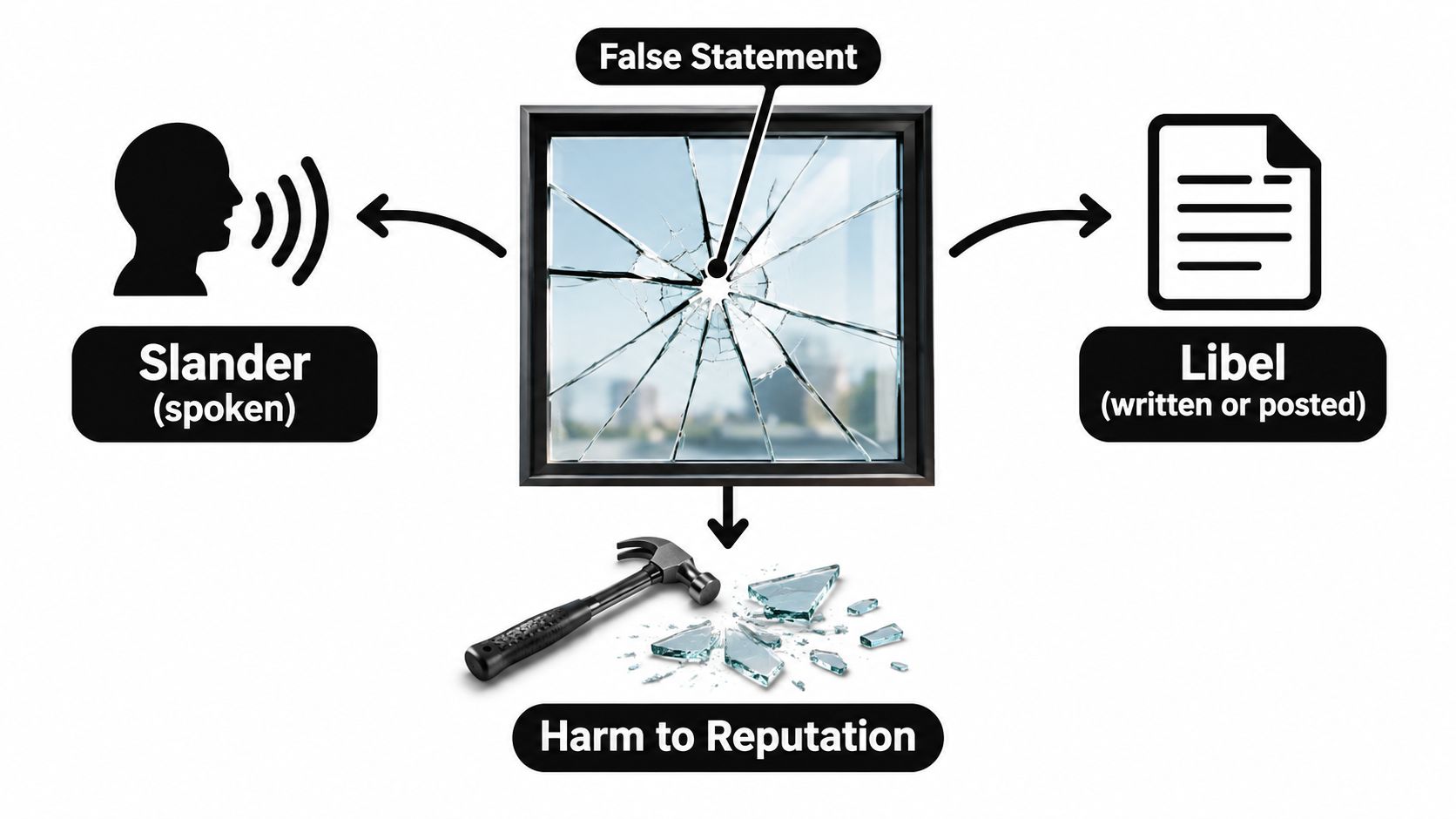
Defamation is easier to understand if you stop thinking like a law book and think like a homeowner. A false statement is like a crack in a front window. The damage is the same whether someone threw the rock by speaking or by posting. The law just uses different names depending on how the crack happened.
If the false statement is spoken, that's slander. If it's written, printed, texted, emailed, posted, or reviewed online, that's libel. A rumor repeated at an HOA meeting is one kind of case. A false Google review about an Atascocita restaurant is another. Same injury. Different form.
Statements Texas treats as especially serious
Some statements are so damaging that Texas courts treat them differently. The classic categories include false statements accusing someone of:
- Criminal conduct
- A loathsome disease
- Unchastity
- Conduct that injures someone in their trade or profession
Those categories matter because the harm may be treated differently than in an ordinary insult case. A post saying “I think he's rude” usually won't carry a lawsuit. A post saying “he steals from clients” is a different animal.
Defamation and business disparagement are not the same
Small business owners often get tripped up. Texas also recognizes business disparagement as a separate claim. If someone attacks your product, service, or business, you may not be dealing with ordinary personal defamation at all.
The proof problem is tougher there. Texas courts require special damages for business disparagement, meaning a concrete financial loss such as lost sales or lost contracts, as discussed in the Texas Supreme Court opinion addressing defamation and business disparagement proof.
Some false statements hurt your feelings. Others cost you customers. Texas law treats those categories differently, and that difference decides cases.
For an Atascocita business owner, that distinction matters right away. If a viral rumor says your restaurant gave people food poisoning, your legal theory has to match your evidence. If it doesn't, the case can fall apart even if the speaker was wrong.
What to Do in the First 72 Hours
The first three days matter more than many realize. Not because the law requires some magic move in that window, but because that's when posts get edited, messages get deleted, and people start telling competing stories.
Here's the first rule. Don't delete anything and don't start a public fight. Your angry reply may feel good for five minutes. It can hurt you for months.
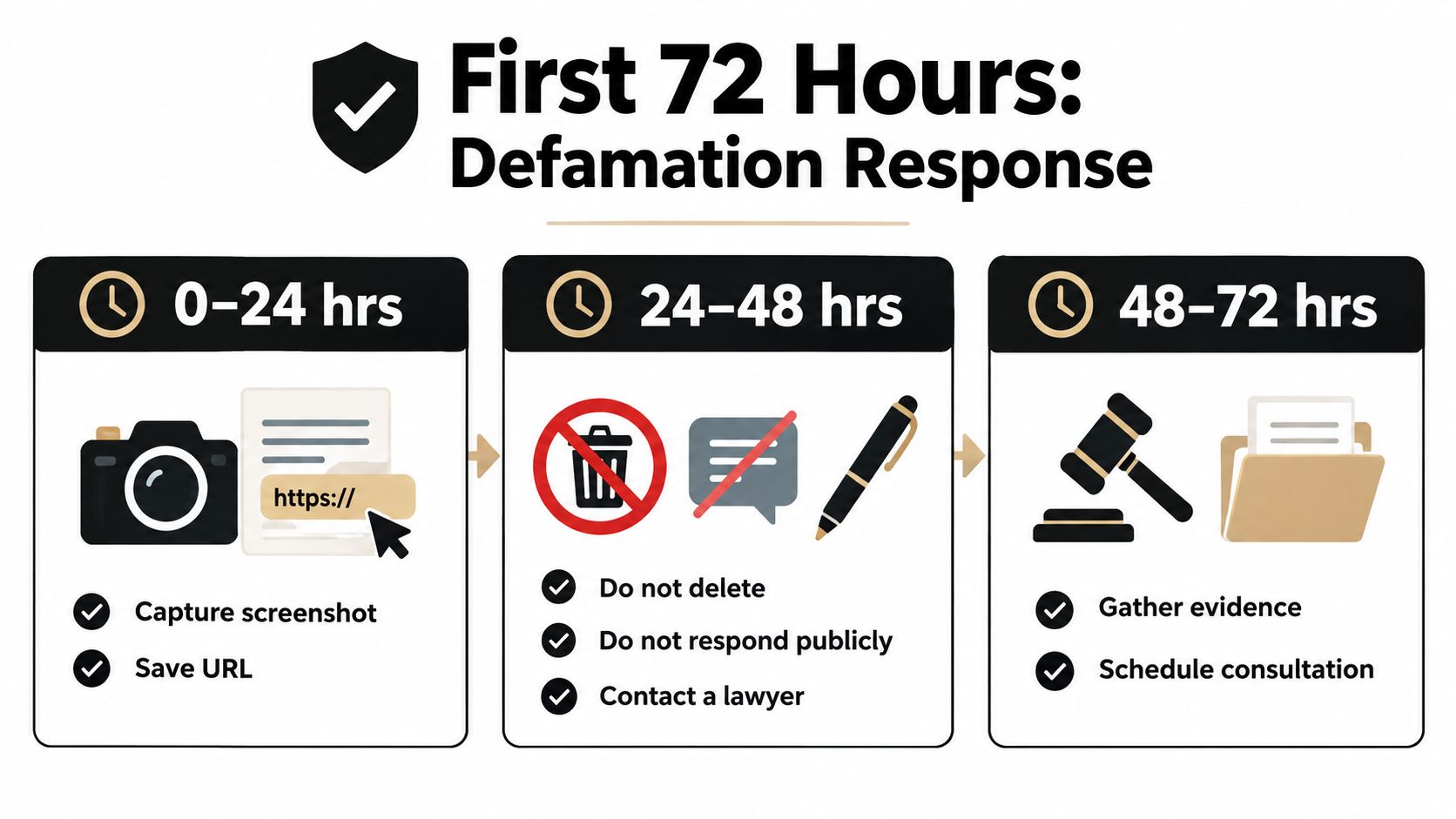
Hours 0 through 24
Start collecting proof before you contact the speaker.
- Capture the post: Screenshot the full post, comments, profile name, date, time, and visible URL.
- Save the page: Print the page to PDF and save it in more than one place.
- Record context: If comments or stories disappear quickly, ask a trusted friend to record a video scrolling through the full thread.
- Preserve direct messages: Export texts, emails, and private messages where possible.
- Save audio: Keep voicemails and audio files exactly as received.
For in-person defamation, write down who said what, where, who heard it, and when. If the false statement was made at a workplace, school event, or HOA meeting, list every witness you can identify while the memory is fresh.
Hours 24 through 48
This is usually when people make the biggest mistake. They confront the speaker too soon.
Don't do that until your evidence is locked down. Once the other side knows you're serious, they may delete posts, tighten privacy settings, or start reshaping the story.
A related civil dispute may also be in the background. If the false statement overlaps with a broken deal, contractor fight, or unpaid invoice, you may need to compare defamation strategy with other claims such as those discussed in this guide on how to sue for breach of contract.
Here's a short overview that fits this exact problem:
Hours 48 through 72
By this point, organize what you have into a clean file.
- Create a timeline: First appearance, who saw it, what changed afterward.
- List the defendants: The poster, the re-poster, the person who texted it around.
- Separate platform from speaker: In many online cases, Section 230 generally means you usually can't sue the platform itself. The target is usually the individual poster, as noted in this Texas defamation overview discussing online disputes and Section 230.
- Stop posting about it: Defensive posts often become evidence too.
If you're looking for a defamation lawyer in Atascocita, TX, this is the point to get the file reviewed before the trail gets colder.
The Four Elements You Must Prove in Texas
A lot of people think the whole case turns on whether the statement was false. That matters, of course. But weak defamation cases usually break down somewhere else.
Texas generally requires proof of publication of a false statement of fact to a third party, that the statement was defamatory as to the plaintiff, fault, and in some cases damages, as summarized in this Texas defamation cause of action overview.
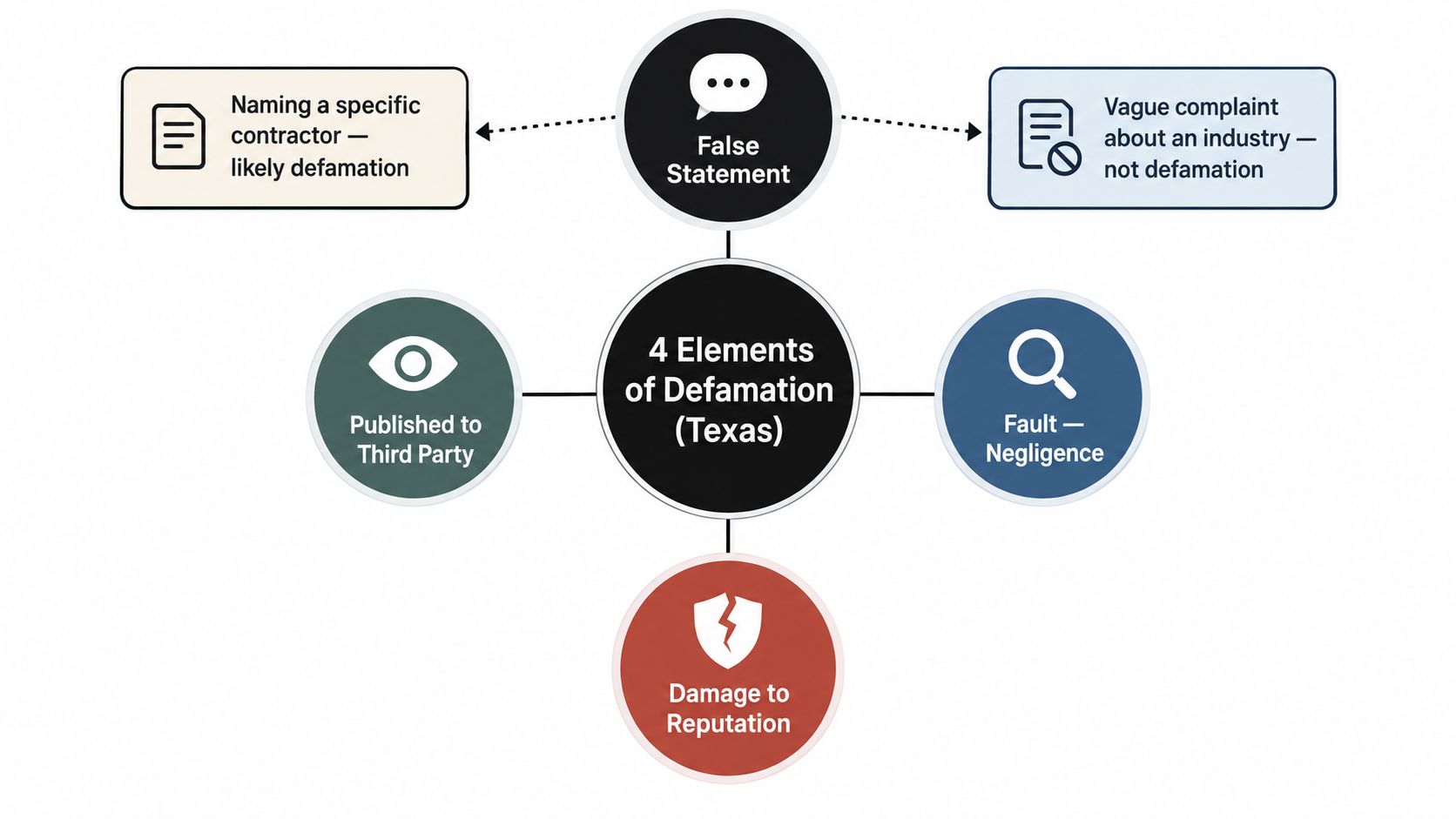
A local diner example
Take a hypothetical diner in Atascocita. A Google review says, “The owner knowingly served spoiled food and hid a health violation.” If that's false, the owner still has work to do.
The owner must show these pieces:
| Element | What it means in plain English | Example |
|---|---|---|
| False factual statement | Not opinion, not exaggeration, but a provably false claim | “Knowingly served spoiled food” |
| Publication to a third party | Someone else saw or heard it | A public Google review |
| Defamatory meaning about the plaintiff | The statement points to this diner or owner | The review names the business |
| Fault and damages | The speaker acted with the required level of fault, and the plaintiff can support harm where required | Lost customers, reputational harm, or stricter proof in a business claim |
Where cases usually get weak
Identification is one weak point. A vague rant about “restaurants around Lake Houston” usually isn't enough if readers can't tell who the speaker meant.
Fault is another. A private person may only need to prove negligence. A more public figure faces a steeper standard. If the statement attacked the business itself rather than the owner personally, you may be closer to business disparagement than ordinary defamation. And that means stronger proof of actual economic loss.
A false statement is only the start. You still need a clean path from the words to the legal elements.
That's why pleading theory matters. If you choose the wrong claim, the court may never get to the part where you prove the statement was false.
Remedies, Damages, and the 90-Day Retraction Window
A false post can wreck an Atascocita business on Monday and feel old by Friday. The legal clock does not care. If you learn about a libelous publication and sit on it, you can give up advantages that matter later, especially on exemplary damages.
Texas has a retraction statute that trips people up. Under certain libel rules, a plaintiff who wants exemplary damages needs to make a timely request for a correction, clarification, or retraction within 90 days after learning of the publication. The statute is Texas Civil Practice and Remedies Code § 73.055. In practice, that means your first 72 hours in Atascocita should include preserving the post, identifying the speaker if you can, and deciding quickly whether a written retraction demand needs to go out.
Do not treat that request like an angry email. Treat it like evidence.
What you can actually recover
Texas defamation remedies are real, but courts do not hand them out because you were embarrassed or furious. You need a damages theory that matches the facts and proof.
| Remedy | What it covers | What usually makes or breaks it |
|---|---|---|
| Actual damages | Lost income, reputational harm, mental anguish in the right case, and other proven losses | Clean evidence that ties the statement to real harm |
| Presumed damages | Damage the law may presume in some defamation per se cases | A statement that fits a recognized per se category |
| Exemplary damages | Punitive-type damages in the right case | A strong liability case plus compliance with the retraction process where it applies |
| Injunctive or other court relief | Limited situations involving ongoing harm | A specific reason money alone will not fix the problem |
The remedy you chase should fit the courthouse reality in Harris County. Judges want specifics. If you claim lost business, bring records. If you claim a ruined job opportunity, bring the emails, the withdrawal, or the timeline that connects the statement to the loss.
Which cases are worth filing
Here is the plain answer. Some defamation cases are morally strong and legally weak. Those are expensive cases to file.
A case is usually worth serious money and effort when the statement is clearly false, the speaker is identifiable, the publication reached real people, and the harm can be shown without guesswork. That often means lost contracts, lost customers, a firing, a pulled deal, or a measurable hit to a business reputation. If the facts point harder toward a broken deal than a reputation tort, a contract-based claim may do more work for you. This overview of breach of contract remedies shows how that analysis can shift.
Some cases are filed for principle. I do not recommend that unless the client fully understands the cost, the stress, and the risk of giving the statement a bigger audience.
The practical call in Atascocita
If your goal is to get the post down, stop the spread, and preserve the right to seek better damages later, act early and act in writing. The one-year Texas deadline is already short. The 90-day retraction window is shorter. People miss it because they assume they have time.
They usually do not.
Common Defenses and Why They Win Cases
You are ready to sue. Then the defense lawyer points to one problem and the case starts to wobble. That is common in Harris County defamation cases. People focus on how ugly the statement was. Courts focus on whether a defense ends the case early.
The defense that wins most often is truth. If the speaker can show the statement was substantially true, your claim usually fails even if the wording was unfair, exaggerated, or meant to embarrass you. Close enough often counts. That is why I tell Atascocita clients to stop arguing about tone and start collecting proof.

The defense chart in plain English
| Defense | Why it wins |
|---|---|
| Truth | A true statement usually is not defamation |
| Opinion | A personal view is different from a false factual claim |
| Privilege | Some settings, including court-related communications, carry protection |
| Limitations | File after the deadline and the case is often over |
Opinion is the next fight, especially online. “I would never hire him again” usually reads like opinion. “He stole from me” reads like a factual accusation that can be proved true or false. The hard cases sit in the middle, where someone dresses up a factual claim as a review, rant, or “just my opinion” post.
Privilege also knocks out a lot of claims. Statements tied to lawsuits, reports to law enforcement, and some workplace communications can be protected because Texas law gives people room to speak in those settings without getting sued every time the other side is angry. Clients hate this defense because it feels unfair. It still wins.
Then there is Section 230. If the post is on Facebook, Google, Nextdoor, or another platform, the website usually is not the defendant you can collect from. The person who wrote or republished the statement is the target. Chasing the platform wastes time, and in the first year, time is the one thing you do not have much of.
The deadline defense is brutally effective. Texas gives you one year for defamation claims, and people miss it because they spend months arguing in comments, waiting for an apology, or assuming the clock restarts when the post gets shared again. Usually it does not. In Atascocita matters, that mistake kills otherwise decent cases.
A separate point matters in local practice. Some cases that feel strong at the kitchen table look weak once a judge asks four questions. Was it factual? Was it false? Can you prove who said it? Can you show actual harm without guessing? If the answer to any one is soft, the defense side has room to win.
Public figure rules can make the case even harder. A private resident dealing with neighborhood gossip has a different burden than someone who has stepped into public controversy, local politics, or a very public business fight. That issue needs an honest answer early, not after filing.
My advice is simple. Before you pay a retainer, ask which defense is most likely to beat your case and what proof would overcome it in the next 72 hours. That question gets you closer to your practical goal than another hour spent talking about how offensive the statement was.
How Bryan Fagan Can Help You Take the Next Step
By the time someone calls a lawyer about defamation in Atascocita, the problem usually feels personal and urgent. A post is still live. A customer backed out. A co-parent is using the accusation against you. The right consult should cut through that fast and tell you one thing above all: file, press for a retraction, or stop before you spend money on a case that will not hold up in Harris County.
That is the value of a good first meeting.
A lawyer should review the statement, pin down the publication date, identify the defendant, and give you a straight answer about whether the case is worth filing before the one-year deadline sneaks up on you. In this area of law, delay hurts more than outrage helps.
What a local consultation should cover
The meeting should answer practical questions, not recycle general rules:
- What exactly was said: A factual accusation, loose opinion, or a statement that implies undisclosed facts.
- What proof you have: Screenshots, links, witnesses, business records, or message history that can still be authenticated later.
- Who should be targeted: The original speaker, someone who repeated the statement, or no one at all if proof is thin.
- What response fits the facts: Retraction demand, cease-and-desist, quiet preservation work, or a lawsuit.
- Whether the claim has economic sense: Winning on paper and collecting in real life are two different things.
If the facts fit another kind of dispute better, you should hear that immediately. Some matters belong under broader civil law representation in Atascocita instead of being forced into a weak defamation claim.
Where defamation overlaps with other cases
In Atascocita, these cases often show up inside another fight. Divorce. Custody. A business breakup. A criminal accusation that spills into Facebook posts or neighborhood group messages.
That overlap matters because a bad move in one case can damage another. Filing a loud civil claim during a custody dispute can inflame the family case. Sending a careless demand letter while criminal allegations are still in play can create problems you did not need. Strategy has to be coordinated from the start.
If the defamation issue grew out of a marriage or custody fight, Divorce Lawyer in Atascocita, TX addresses divorce representation for clients in Atascocita and Harris County.
My recommendation if you are on the fence
Ask for an early case-strength review built around the first 72 hours, not a sales pitch. You need to know what must be preserved now, what defense is most likely to beat the claim, and whether local court practice makes the case worth the filing cost.
Law Office of Bryan Fagan, Atascocita TX Lawyers, offers a free initial meeting. That is useful here because defamation cases turn on timing, proof, and judgment. You should leave with a clear recommendation on next steps, expected cost, and the weak spots in your case.
Fee clarity matters. So does candor.
If you are looking for a defamation lawyer in Atascocita, TX, use a simple standard. Pick the lawyer who will tell you, without theater, whether your case belongs in court or belongs in a demand letter and a file folder. If a false statement is hurting your name in Atascocita, Humble, or northeast Harris County, get that answer quickly.