A traffic stop near Atascocita Town Center turns tense when an officer finds a small bag, vape cartridge, or gummies in the vehicle. The driver may not know whether the product is marijuana, hemp, or a concentrate under Texas law, but the immediate fear is clear: arrest, jail, court, and a record that could affect work, housing, or a professional license.
A marijuana possession case in Atascocita is handled under Texas law and within the Harris County criminal justice system. The amount and type of product matter, but so do the search, the evidence, the officer's conduct, and what the accused says after the encounter. This guide explains the basic rules in plain language and identifies practical decisions that can protect your rights.
Introduction to Local Marijuana Charges
Consider a resident returning home to Atascocita after visiting Humble. During a traffic stop, an officer asks about a smell in the car and searches the vehicle. The officer finds a small amount of plant material in a shared center console. The driver says it belongs to someone else, but the officer makes an arrest anyway.
That person's anxiety is understandable. A charge can affect family responsibilities, transportation, employment, housing, and immigration concerns. Even a low-level allegation deserves careful attention because Texas doesn't treat every marijuana possession case as one uniform offense.
The first questions usually include what was found, how much it weighed, where it was located, and whether the search was lawful. A lawyer must also examine whether the State can prove the person knowingly possessed the substance and whether testing establishes that the material was marijuana rather than a hemp-derived product.
Practical perspective: A small bag can create a serious legal problem, but an arrest is not the same as a conviction.
Harris County procedures also matter. The case may move through a misdemeanor court or a felony court depending on the alleged amount and substance. Acting early gives an attorney more opportunity to preserve evidence, evaluate the stop, and address release conditions before the case develops.
Understanding Texas Marijuana Laws and Hemp Rules
A product's label can create confusion in an Atascocita possession case. Texas asks two separate questions: what the product is and how much allegedly was possessed. Classification identifies marijuana, hemp, or another THC product. Weight or quantity usually determines the seriousness of a traditional marijuana charge.
Texas hemp law uses a 0.3% Delta-9 THC threshold. Material at or below that limit is treated as hemp rather than marijuana, making laboratory testing an important issue. Texas Public Radio's coverage of hemp possession uncertainty describes the uncertainty surrounding possession of some hemp products. The threshold does not resolve every question involving flower, vape products, gummies, oils, or concentrates. Public guidance has been conflicting, especially for smokable hemp flower and concentrate.
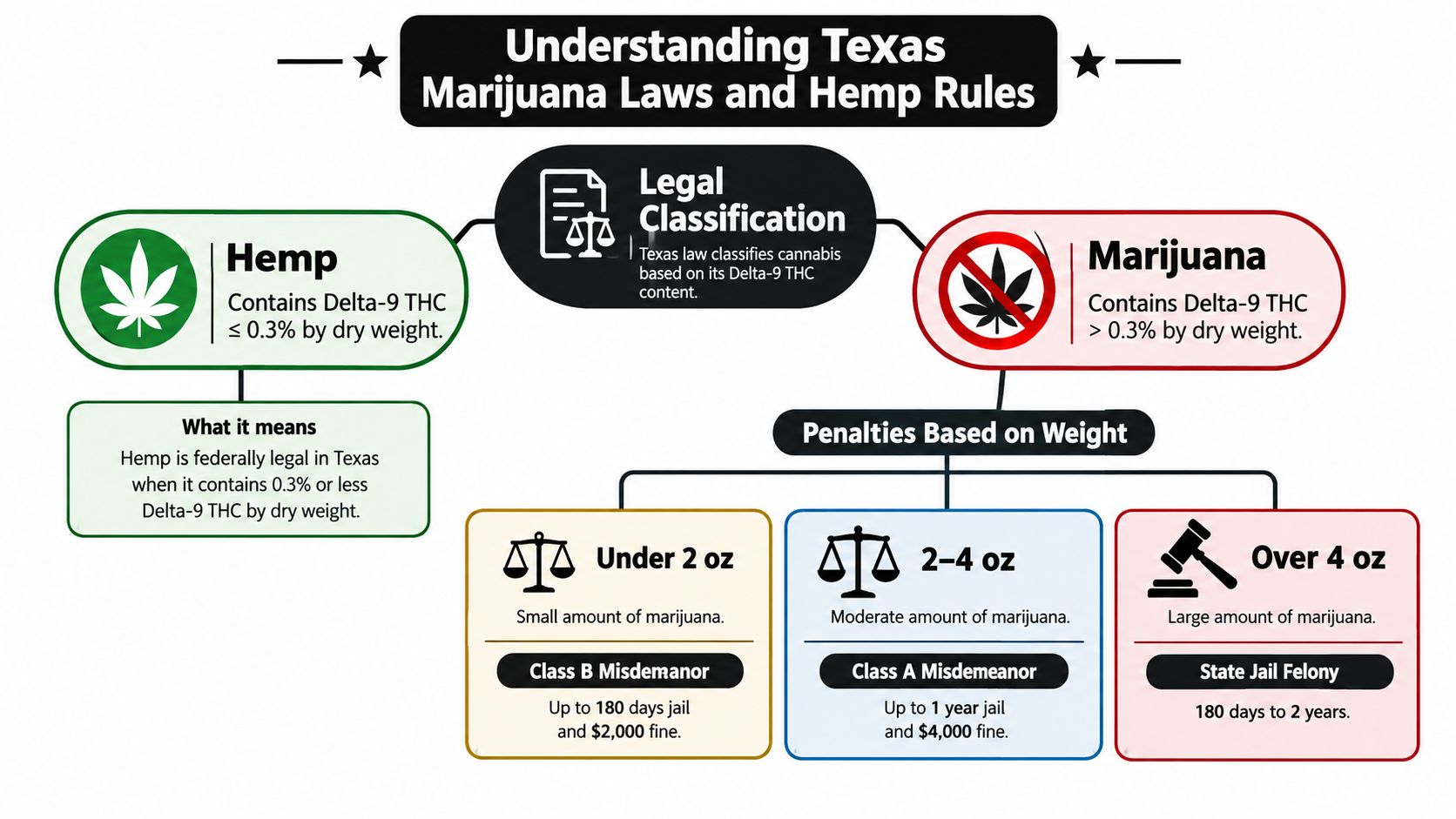
The marijuana weight ladder
For traditional marijuana, the basic misdemeanor tiers are:
- Two ounces or less: A Class B misdemeanor, punishable by up to 180 days in jail and a fine of up to $2,000, according to Texas possession offense information.
- More than two ounces but no more than four ounces: A Class A misdemeanor, punishable by up to one year in county jail and a fine of up to $4,000. The same general penalty structure is summarized in Texas Health and Safety Code possession guidance.
The threshold changes after four ounces. Possession of more than four ounces but no more than five pounds becomes a state jail felony, carrying 180 days to two years in a state jail facility and a fine of up to $10,000, as stated in Texas Health and Safety Code Section 481.121.
Weight works like a staircase. Crossing one threshold can move a case from misdemeanor treatment to felony exposure. For a different legal process, an Uncontested Divorce Lawyer in Atascocita handles cases for agreeing couples, so residents should not assume every court matter follows the same rules.
The firm's explanation of possession of a controlled substance in Atascocita offers additional local context. Concentrates require separate attention because Texas may classify oils, extracts, and similar products differently from plant material.
How Atascocita and Harris County Handle Possession Cases
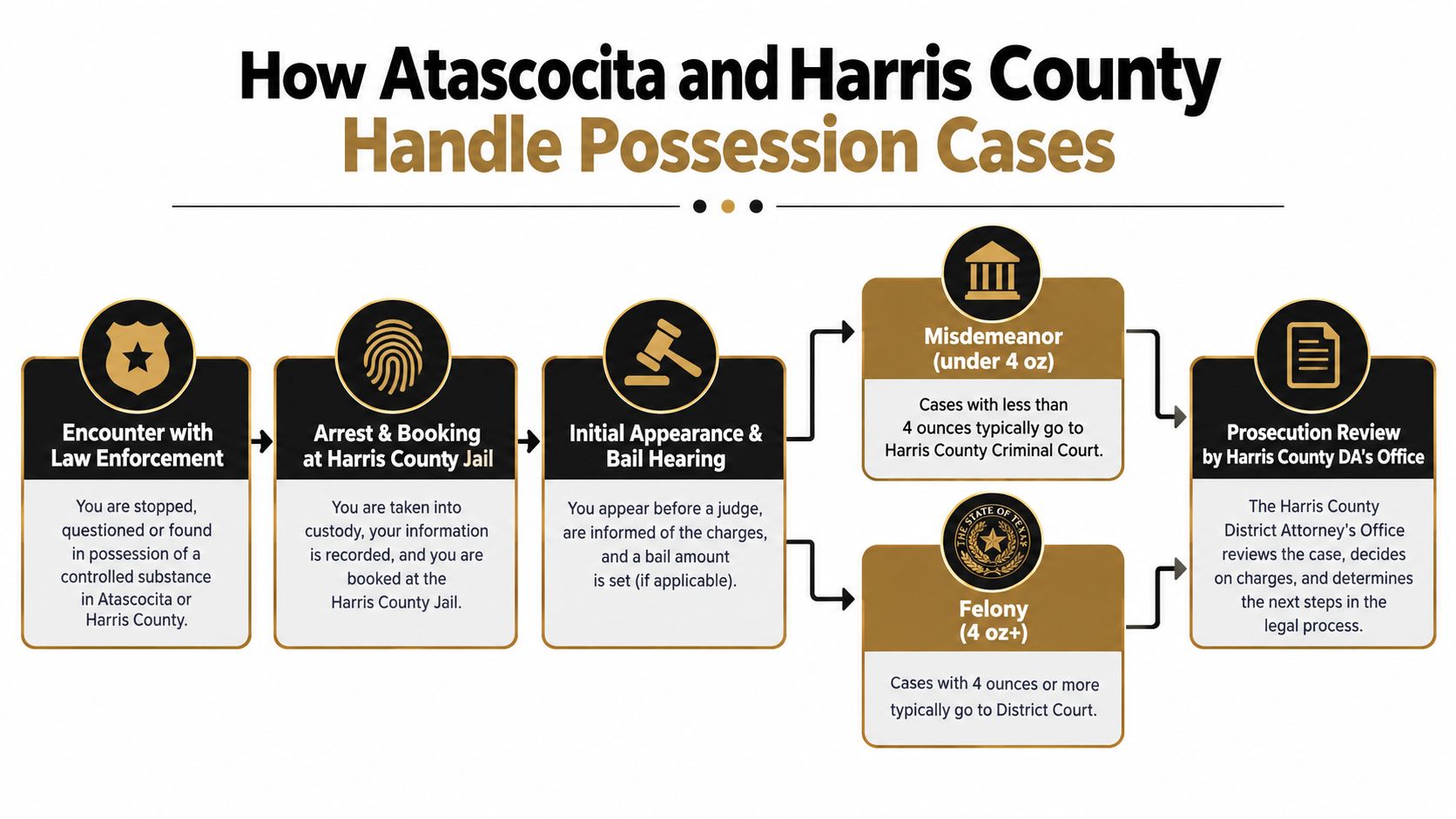
A possession case often begins with an encounter involving an Atascocita or Harris County law-enforcement officer. The encounter may arise from a traffic stop, a warrant, a consent search, or another investigation. The legality of that first step can influence everything that follows.
After an arrest, the person is booked, personal information is recorded, and the alleged offense is processed. A magistrate then addresses the charge, rights, and release conditions. The first appearance is not a trial. It's the point at which the court begins managing the person's immediate custody and bond status.
Where the case goes
The alleged classification affects the court path. A misdemeanor allegation generally proceeds through a Harris County criminal court, while a felony allegation is handled in district court. The Harris County District Attorney's Office reviews the file and may consider the substance, amount, laboratory information, statements, search circumstances, and criminal history.
A felony threshold can change the practical stakes. Under Texas marijuana penalty information, possession of five to 50 pounds is a third-degree felony, possession of 50 to 2,000 pounds is a second-degree felony, and possession of more than 2,000 pounds receives enhanced first-degree felony treatment.
The process can feel slow after release. That delay doesn't mean nothing is happening. Evidence may be reviewed, laboratory testing may be requested, and the prosecutor may decide how to file or proceed. A defense lawyer can use this period to identify weaknesses rather than waiting passively for the next setting.
For Atascocita and Humble residents, the most important early decision is often whether to speak with counsel before discussing the facts with investigators or appearing for later proceedings. Local court procedure and the individual evidence file can matter as much as the label printed on the citation or booking paperwork.
Common Defenses Against Marijuana Possession Charges
A strong defense begins by separating the State's assumptions from what it can prove. Prosecutors generally must connect the accused person to the substance and establish the substance's legal identity. A bag found somewhere nearby doesn't automatically prove knowing possession.
The search may be challenged
A lawyer can examine whether officers had legal grounds to stop, detain, or search. Suppose officers search a vehicle's trunk without consent, a warrant, or facts supporting probable cause. The defense may ask the court to suppress evidence obtained through an unlawful search. If the court excludes the substance, the prosecution's case may weaken substantially.
The analysis depends on the facts. A person should preserve the location, reason for the stop, statements made by officers, and whether anyone consented. Video from a patrol vehicle, body camera, or nearby business may also become important.
Possession must be knowing
Texas cases can involve direct possession, such as an item in someone's pocket, or constructive possession, such as an item found in a shared car or home. Constructive possession often raises questions about access, control, fingerprints, ownership, and whether other people could reach the item.
A defense lawyer may challenge the State's claim that the accused knew about the substance or exercised control over it. The precise facts matter more than a general accusation that the item was “near” the person.
Hemp creates a testing issue
The 0.3% Delta-9 THC threshold creates an evidentiary question because the State may need reliable testing to show that material falls outside hemp classification, as discussed in reporting on Texas hemp and marijuana uncertainty. Packaging that says “hemp” may not end the case, but it can help identify what product the person possessed and what testing questions need to be asked.
The product label, laboratory method, chain of custody, and alleged THC composition can all matter.
Concentrates create another layer of risk. Texas controlled-substance tables treat oils, extracts, and concentrates differently, with less than one gram classified as a state jail felony, one to four grams as a third-degree felony, four to 400 grams as a second-degree felony, and 400 grams or more as a first-degree felony, according to Texas drug-possession penalty information. A defense must identify the actual product and the testing evidence instead of relying only on what a retailer called it.
Immediate Steps to Take After an Arrest
The first hours after an arrest can shape the defense. Atascocita residents should focus on protecting their rights and preserving accurate information, not trying to persuade officers through repeated explanations.
- Invoke the right to remain silent. Give basic identifying information as required, then clearly state that you want to remain silent and speak with a lawyer. Don't argue about ownership, explain where the product came from, or guess about its contents.
- Request an attorney immediately. Say that you want a lawyer before answering questions or participating in investigative procedures. Read about the protection against custodial questioning in this guide to Miranda rights in Texas.
- Don't consent to searches or field tests. Don't physically resist. Instead, calmly say that you don't consent. Don't volunteer to identify a substance or agree to procedures without legal advice.
- Write down the encounter. As soon as possible, record where the stop occurred, who was present, what officers said, what was searched, where the item was found, and what paperwork you received. Ask family members to preserve messages, location information, or video that may help.
The infographic's arraignment deadline should be treated seriously. The provided guidance identifies 48 hours after arrest as the critical period for bringing the person before a magistrate. That proceeding addresses the alleged charge, rights, and bail or release conditions.
Protect the record: Don't post about the arrest, discuss details in group messages, or assume that an informal conversation is private.
Contact a family member or a bail-bond provider as soon as practical, but don't let release logistics replace the need for legal advice. Keep every bond document, court notice, property receipt, and release condition together.
Comparing Possible Case Outcomes
A marijuana possession case can end in different ways. The right option depends on the evidence, the alleged offense, the person's history, the prosecutor's position, and the court's requirements. No lawyer can responsibly promise a particular result before reviewing the file.
| Possible outcome | What it may require | Timing and practical effect | Long-term concern |
|---|---|---|---|
| Dismissal | A legal defect, weak evidence, testing problem, or successful suppression motion may support dismissal. | The case ends without a conviction, but the process may require hearings and negotiations first. | Record consequences can still require separate advice about eligibility for clearing or restricting records. |
| Negotiated plea | The accused accepts an agreed resolution after reviewing the risks of trial and available evidence. | The case may resolve before trial, subject to court approval and required conditions. | A conviction or plea can affect employment, housing, licensing, and reputation. |
| Diversion program | Eligibility may depend on the charge, history, facts, and program rules. Completion may be required before the case is dismissed or otherwise resolved. | The person must comply with all conditions and deadlines. | The final record treatment depends on the specific program and later legal steps. |
| Probation | The court may impose supervision and conditions instead of immediate incarceration, when legally available. | Supervision continues until the court's conditions are completed or modified. | A violation can create additional exposure, and the underlying resolution may remain important in background checks. |
| Trial verdict | The defense challenges the State's proof before a judge or jury. | Trial preparation can involve evidence review, motions, witnesses, and court settings. | An acquittal differs significantly from a conviction, and a conviction can carry lasting personal and professional effects. |
The table is a decision framework, not a prediction. A person may also need to compare the certainty of a negotiated resolution with the risks of litigation. Early review of the search, laboratory report, body-camera footage, and possession theory helps make that comparison realistically.
When to Contact a Criminal Defense Lawyer
Contacting a lawyer early can protect options that become harder to use later. Counsel may evaluate suppression issues, challenge the alleged possession theory, investigate hemp classification, seek a charge reduction, or assess diversion eligibility before the case settles into a routine path.
Residents comparing counsel can use this guide on how to find a good criminal defense attorney. The Law Office of Bryan Fagan – Atascocita TX Lawyers provides criminal defense representation for individuals facing misdemeanors and felonies in Atascocita, Humble, and Harris County. A free consultation gives you a chance to explain the stop or search, identify urgent deadlines, and understand possible next steps.
The Law Office of Bryan Fagan – Atascocita TX Lawyers can review the alleged marijuana or THC product, the search, the testing evidence, and the Harris County court path. Schedule a free consultation at the Atascocita office before you make statements or miss a critical deadline.