Skip to content

A set of red and blue lights appears in your mirror while you're driving near FM 1960, Will Clayton Parkway, or another busy Atascocita corridor. You wonder whether the officer is stopping you, whether you have a safe place to pull over, and whether continuing for another moment will make things worse. A decision made under pressure can turn an ordinary traffic encounter into an evading arrest or detention charge.
If you're searching for information about evading arrest in Atascocita, TX, you're probably worried about more than the label. You may want to know whether the charge is a misdemeanor or felony, how Harris County handles the case, what happens after booking, and whether your record can eventually be protected. The answer depends on the exact signal, your awareness, the reason for the stop, how far you traveled, whether a vehicle was involved, and your prior record.
A Real Atascocita Scenario You Might Recognize
The traffic is moving unevenly along FM 1960 near Humble. A driver notices headlights behind him, then red and blue lights flickering across the side mirror. The radio is on, traffic is loud, and the driver hesitates. He wonders whether the lights are meant for him or for another vehicle.
He continues toward a better-lit area instead of stopping immediately. Behind him, the officer reports the movement to dispatch. The dispatcher's voice comes through the radio as the officer follows along Will Clayton Parkway. The driver finally pulls over after a short pursuit, but by then the officer treats the delay as intentional flight rather than simple confusion.
The driver is removed from the vehicle, handcuffed, and taken into custody. A routine stop has become a criminal case that may be filed under Texas Penal Code § 38.04, which covers intentionally fleeing from a peace officer or federal special investigator who is lawfully attempting to arrest or detain someone. The law applies even when the officer is trying to detain the person, not complete a formal arrest. Texas Penal Code § 38.04 is the starting point for understanding what prosecutors must prove.
Atascocita residents often find themselves dealing with a Harris County process involving an offense report, vehicle video, dispatch records, booking, bond, and a court appearance. The most important question isn't merely whether the driver eventually stopped. It's what the driver knew, what the officer signaled, and whether the driver deliberately fled.
Practical rule: Once you're stopped, don't explain the entire event at the roadside. Stay calm, provide required identifying information, and ask to speak with a lawyer before answering investigative questions.
The question after handcuffs and booking is straightforward: what exactly is the person charged with, and what happens next?
What Texas Law Means by Evading Arrest
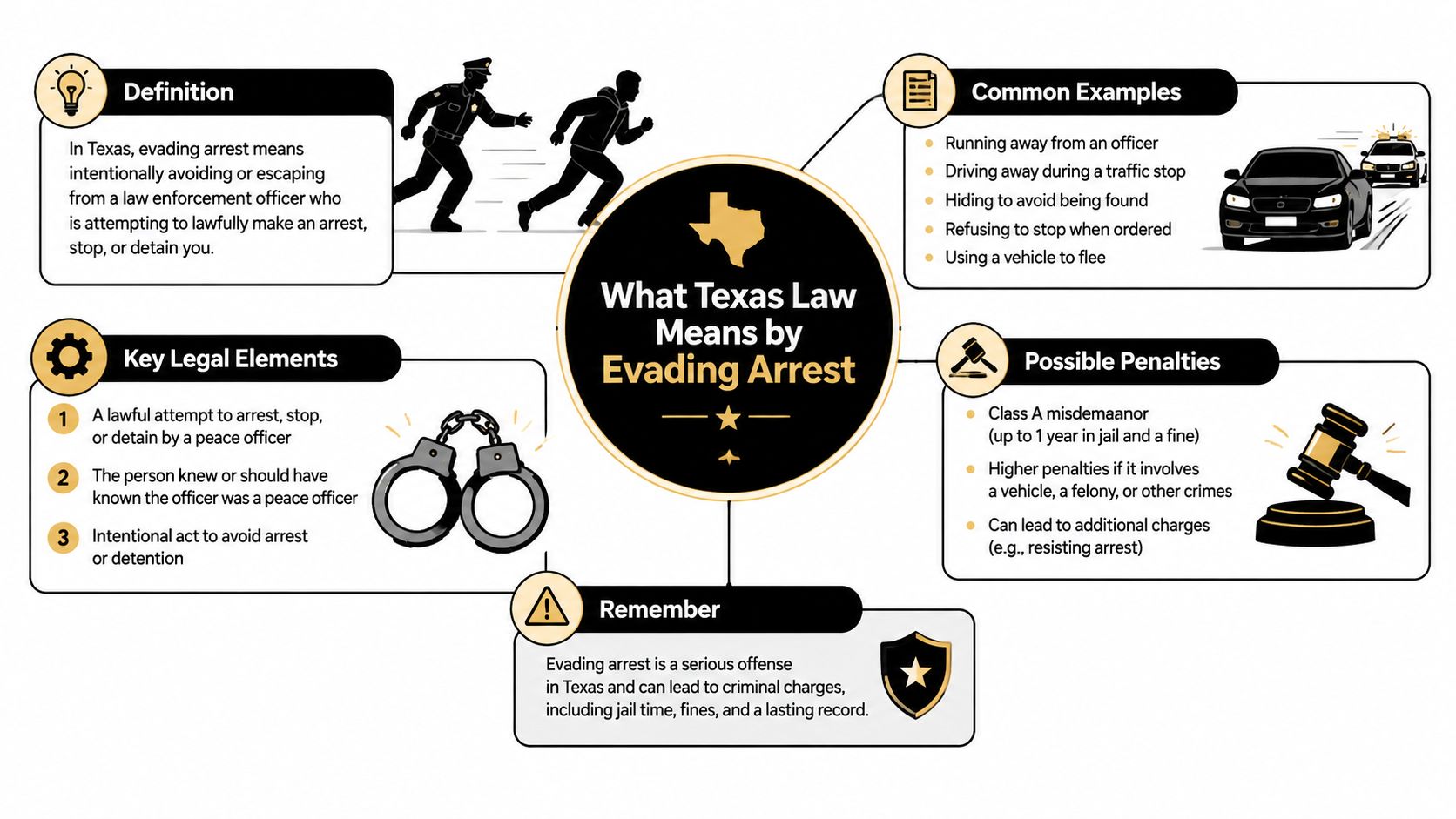
Texas law treats evading arrest or detention as more than driving away from a police car. Under Texas Penal Code § 38.04, the State generally must prove that the person intentionally fled, knew the person pursuing them was a peace officer or federal special investigator, and that the officer was lawfully trying to arrest or detain them. Texas Penal Code § 38.04 identifies the officer's signal, the person's awareness, and intentional flight as central evidence issues.
Think of a crossing guard holding up a hand. The hand signal matters, but so does whether the driver could see it and understood that it was directed at them. A police light, siren, hand gesture, loudspeaker command, or other visible or audible signal can serve a similar role. The prosecution still has to connect that signal to the driver's knowledge and conduct.
The three questions in a typical case
Did the officer signal a stop? The State may rely on emergency lights, siren, a marked patrol vehicle, verbal commands, or other circumstances showing an attempted detention.
Did the person know the signal came from a peace officer? A driver may raise questions about darkness, traffic, road noise, an unmarked vehicle, obstructed mirrors, tinted windows, or multiple cars nearby.
Did the person intentionally flee? Continuing briefly while looking for a safe stopping location isn't automatically the same as deliberately trying to escape. The surrounding facts matter, including speed, distance, turns, lane changes, and how quickly the person stopped once the situation became clear.
The statute applies to on-foot flight and vehicle-based flight. That distinction can change the offense level sharply. A person who runs from an officer on foot may face a misdemeanor classification, while using a vehicle can create felony exposure.
If the incident involves questions about locating someone after an arrest or bond issue, a resource describing a Texas recovery agent from One Call may help explain the separate role of recovery services. That isn't a substitute for a criminal defense lawyer, and it doesn't determine whether the State can prove evading.
Evading also differs from resisting arrest. Resisting focuses on force used against an officer, while evading focuses on intentional flight. If your case includes allegations of physical resistance, the distinction deserves separate review through resisting arrest information for Atascocita.
Misdemeanor Versus Felony and the Tiers in Between
The phrase “evading arrest” doesn't tell you the punishment by itself. Texas law changes the classification based on how the person fled, whether there was a prior conviction, and whether serious injury or other aggravating facts are alleged.
On-foot evasion is generally a Class A misdemeanor. It can carry up to 1 year in county jail and a fine up to $4,000. The offense remains serious because a conviction can affect employment, housing, licensing, and family stability.
Vehicle use raises the stakes. Texas legal summaries commonly describe a first vehicle-based evading case as a felony, with exposure reported as 2 to 10 years in prison and a fine up to $10,000. The exact classification and punishment depend on the charging subsection and facts, so the indictment or information matters.
A prior evading conviction can create another escalation path. Updated legal materials also discuss subsection (b-1), effective 2024, which can change punishment exposure when serious injury or other specified facts are involved. That means a short vehicle movement, a prior case, or an injury allegation shouldn't be evaluated from a general internet summary alone.
| Tier | Triggering Facts | Offense Level | Maximum Punishment | Maximum Fine |
|---|---|---|---|---|
| On-foot flight | Intentional flight from a known officer during a lawful arrest or detention attempt | Class A misdemeanor | Up to 1 year in county jail | Up to $4,000 |
| Vehicle or watercraft used | Intentional flight while using a vehicle or watercraft | Felony level, classification depends on the applicable subsection | Commonly reported exposure of 2 to 10 years in prison in vehicle-based cases | Up to $10,000 |
| Prior evading conviction | A prior conviction is alleged and proven | State jail felony or higher felony exposure depending on the facts and subsection | State jail or prison exposure may apply | Up to $10,000 where the applicable tier provides for it |
| Serious injury during flight | Serious bodily injury or another statutory aggravating fact is alleged | Higher felony tier under the applicable subsection, including the 2024 enhancement path | Punishment depends on the charged subsection and proven facts | Depends on the applicable felony tier |
The table shows why a lawyer must review the actual charging language. A person might assume that a first case is automatically minor, but vehicle use can create prison exposure even when there was no collision or injury allegation. Conversely, the State still has to prove every required element and any enhancement beyond a reasonable doubt.
The hidden costs can also be substantial. A case may affect transportation, work attendance, insurance, family responsibilities, and future applications. If the allegation involves a vehicle, prosecutors may focus heavily on the public-safety narrative even when the distance traveled was limited.
The classification is only the beginning. The evidence supporting the signal, awareness, intent, vehicle use, and prior history determines how the case should be defended.
Why Harris County Treats This Charge Seriously
An Atascocita traffic stop can become a Harris County criminal case quickly. The arresting agency may be the Harris County Sheriff's Office, a municipal department, or another law-enforcement agency. After booking, the case can involve prosecutors, court settings, bond conditions, and repeated review of the same disputed moment.
According to aggregated public booking records from OpenArrest, not court conviction data, there were 381 Harris County bookings in the prior 30 days, a 1% increase from the preceding 30-day period, and 1,802 public booking records for Houston and Harris County overall. The database listed 2,174 total records on file, including 434 cases with known outcomes. Of those cases, 85% were dismissed or dropped, while 15% ended in sentencing or deferred adjudication. These figures describe booking records and reported outcomes, not a statewide conviction report. Harris County evading arrest booking data
The practical point is volume, not a guaranteed result. Harris County agencies and courts have established procedures for these allegations, so early evidence review matters. A missing recording or unclear signal may be easier to address before memories fade and evidence becomes harder to locate.
Evidence prosecutors may present
| Evidence Type | Typical Source |
|---|---|
| Dispatch audio | Police communications and call records |
| Emergency-light timing | In-car camera, body-worn camera, or CAD records |
| Vehicle movement | Dashcam, bodycam, traffic cameras, or witness accounts |
| Driver awareness | Officer observations, statements, gestures, and surrounding conditions |
| Identity and route | License-plate information, GPS-related records, and officer reports |
| Public-safety impact | Witness statements, collision evidence, roadway conditions, and injury records |
A grand jury or trial jury may hear testimony about eye contact, hand signals, lane changes, acceleration, turns, and the moment the driver stopped. A defense lawyer should compare that account with patrol video, body-camera footage, dispatch audio, road conditions, and the timing of the alleged signal. The officer's report is evidence to examine, not the entire case by itself.
The database also listed 920 evading arrest bookings statewide in the prior 30 days and 4,168 public booking records across Texas, with ages from 17 to 83 and a median age of 30. Houston and Harris County records showed ages from 17 to 83, with a median age of 29. Those figures are aggregated public booking information, not conviction totals.
A booking is not a conviction. A filed charge also does not prove that the State can establish intentional flight beyond a reasonable doubt. For an Atascocita defendant, the questions are what signal was given, whether the driver recognized it, what the vehicle did afterward, and whether the available recordings support the allegation.
Defenses That Actually Work in Evading Cases
A defense usually begins with the client's account of the moment before the stop. The question isn't whether the explanation sounds convenient. The question is whether the State can prove each legal element with reliable evidence.
“I never saw the lights or heard the siren”
That statement targets the signal and awareness elements. If the emergency equipment wasn't activated, was blocked, or couldn't reasonably be heard or seen under the conditions, the State may have difficulty proving that the driver knew an officer was directing a stop at them.
Video matters here. A lawyer may compare the officer's report with the patrol recording, road layout, lighting, traffic, weather, vehicle position, and audio quality.
“I didn't know the person behind me was a cop”
Knowledge can be disputed when the pursuing vehicle is unmarked, the emergency equipment is unclear, or several vehicles are traveling together. A driver may have believed another motorist was following aggressively rather than a peace officer attempting a detention.
The defense isn't required to prove a perfect alternative explanation. It can focus on whether the prosecution's evidence leaves a reasonable doubt about what the driver knew.
“I pulled over as soon as it was safe”
A short delay isn't automatically intentional flight. A driver may slow down, activate a signal, move away from a narrow shoulder, or continue to a safer location. The surrounding facts include speed, distance, route, traffic, and whether the driver stopped without trying to hide or abandon the vehicle.
“The stop itself was illegal”
Texas law requires a lawful arrest or detention attempt for this offense. A defense lawyer may examine whether the officer had a lawful basis for the initial traffic stop and whether later evidence resulted from an unconstitutional seizure. Fourth Amendment issues can include pretextual or race-based stops, although the legal analysis depends on the facts and available evidence.
“The prior conviction isn't proven”
A prior allegation doesn't establish a prior conviction. The State must prove the required prior offense using legally sufficient records. If it can't, the enhancement should not apply, even if the current evading allegation remains disputed separately.
Family-law enforcement is a different legal subject, but families dealing with multiple court obligations may also need information about Enforcement of Court Orders in Atascocita, which concerns enforcing divorce decree and custody order provisions in Harris County.
What Happens After the Arrest in Harris County
The Harris County process can feel confusing because several events happen through different offices. The sequence below gives a practical framework, but the exact path depends on the agency, charge level, holds, bond conditions, and court assignment.
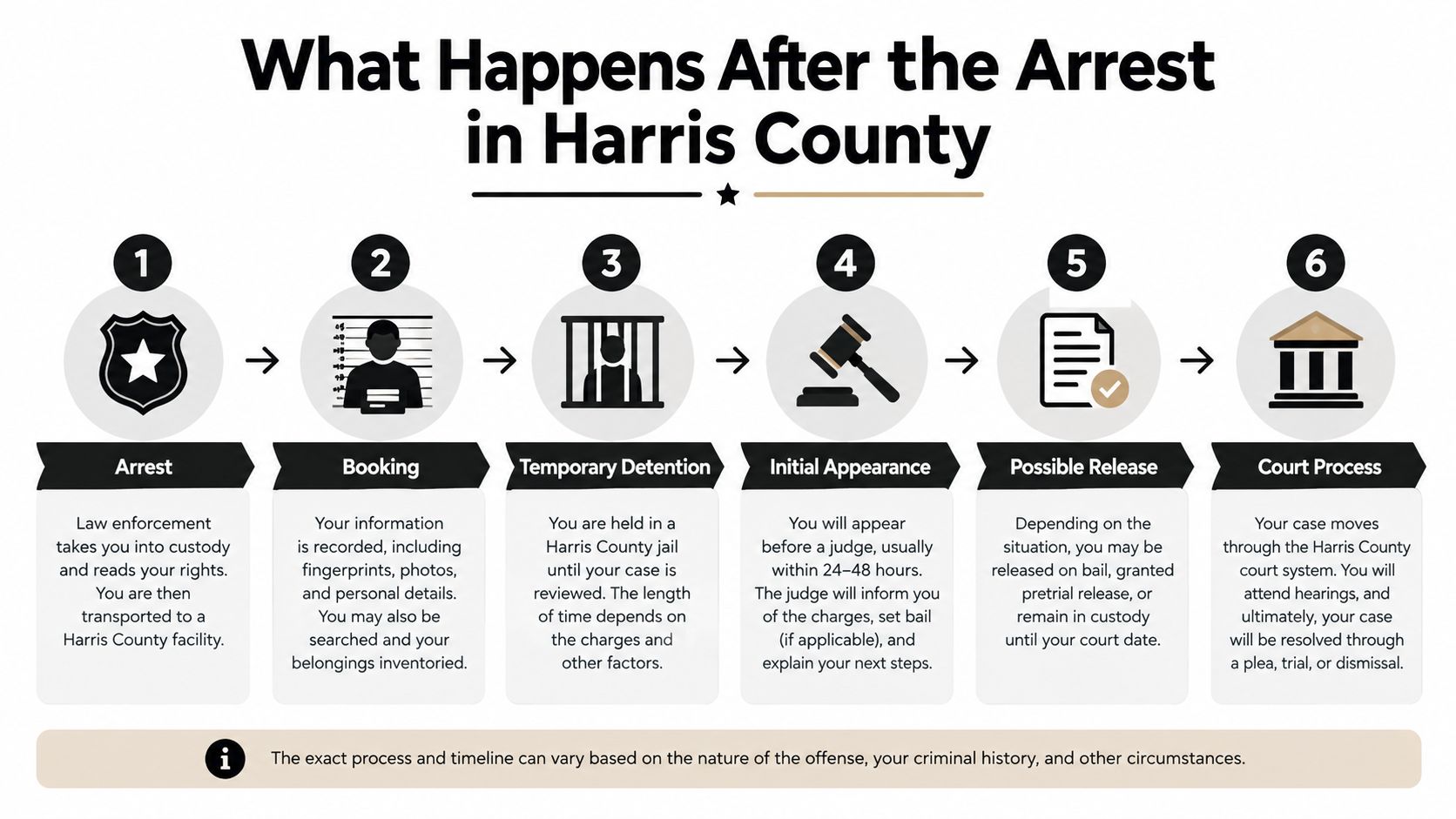
Arrest and transport. The person may be taken to the Joint Processing Center on Baker Street or held through a local precinct process before transfer. Officers prepare an offense report and supporting paperwork.
Magistration. A magistrate reviews the probable-cause affidavit, explains basic rights, considers bond, and checks for protective-order or hold issues. Texas law requires prompt judicial review of an arrested person's detention, and the timing can depend on the circumstances and facility procedures.
Bond decision. The court may consider a personal recognizance bond, a surety bond, or a cash bond. The charge level, prior history, safety concerns, residence, employment, and alleged pursuit conduct can affect the conditions.
Arraignment. The case is assigned to the appropriate county or district court. The defendant typically enters a plea, receives appointed counsel if indigent and eligible, or confirms retained representation.
Pretrial litigation. Counsel requests records, reviews video and dispatch evidence, investigates witnesses, evaluates suppression motions, and discusses any State offer. The defense may challenge the stop, signal, awareness, identity, intent, or enhancement allegations.
Resolution. The case may end through dismissal, diversion, a negotiated plea, or trial. Harris County timelines vary, but a misdemeanor may take several months and a felony can take substantially longer.
Don't discuss the facts of the pursuit on recorded jail calls or social media. Messages can be preserved and reviewed. Write down your own memory promptly, including where you were, what you saw, what you heard, whether the police vehicle was marked, and when you first realized the officer wanted you to stop.
A lawyer can also ask whether a video-preservation request is necessary. Recordings may be especially important when the written report doesn't establish when the signal began or whether the driver could perceive it.
Outcomes That Can Protect Your Record
The result of an evading case affects more than whether you spend time in custody. It can influence background checks, licensing, employment, housing, insurance, and how a later prosecutor views your record.
| Outcome | Effect on Record | Typical Trigger |
|---|---|---|
| Dismissal | No conviction; possible expunction depends on statutory eligibility and the reason for dismissal | Suppression issue, evidentiary weakness, or negotiated dismissal |
| Pretrial diversion | Case may be dismissed after the person completes required conditions | Eligibility, compliance, and prosecutor or court agreement |
| Deferred adjudication | Avoids a final conviction if successfully completed, but the case remains important for future legal analysis | Negotiated resolution with community supervision |
| Straight probation | Conviction remains on the record, even though incarceration may be avoided | Plea or finding of guilt followed by probation |
| Trial acquittal | No conviction for the tried charge; expunction may be available under applicable law | Jury or judge finds the State failed to prove guilt |
A dismissal or acquittal can create a path toward expunction under Texas Code of Criminal Procedure Chapter 55A, but eligibility is technical. The timing, charging history, arrest records, limitations, and whether another related case remains pending can all matter.
Deferred adjudication is different. It may offer a way to avoid a final conviction if completed, and a non-disclosure order under Texas Government Code § 411.072 may be available in qualifying circumstances. But deferred adjudication can still matter if the State later alleges a prior evading conviction or uses the case in another legal proceeding. A lawyer should explain the long-term consequences before you accept it.
Restitution and financial obligations may also affect the practical result. Certain court costs, surcharges, and driver-related consequences can involve separate rules, including provisions associated with Texas Code of Criminal Procedure article 708. Don't assume that dismissal of a related traffic matter automatically erases every separate obligation.
For a closer comparison of two common negotiated pathways, see deferred adjudication versus pretrial diversion in Atascocita. The right outcome depends on the stop, the evidence, the charging tier, your history, and the conditions the State proposes.
How a Local Atascocita Defense Lawyer Helps
The first days after an arrest are useful for preserving evidence and preventing avoidable mistakes. A lawyer familiar with Harris County practice can request the offense report, obtain the magistrate hearing record, identify available recordings, and compare the written allegations with the actual footage.
For an Atascocita or Humble family, local familiarity also helps with practical coordination. The lawyer may review bodycam, dashcam, CAD records, dispatch audio, and vehicle damage photographs. A preservation letter can ask agencies to retain relevant video before routine retention practices create a problem.
Early case tasks may include
- Collecting the records: Request the offense report, probable-cause affidavit, bond paperwork, and available video.
- Testing the timeline: Compare the reported signal time with the driver's movements and the moment of the stop.
- Reviewing bond issues: Present residence, employment, family responsibilities, and other lawful mitigation when seeking a recognizance or reduced surety bond.
- Protecting the defense: Tell the client what not to post, text, or discuss on recorded calls.
- Evaluating resolution: Compare dismissal, diversion, deferred adjudication, probation, and trial based on the specific charge.
The Law Office of Bryan Fagan, Atascocita TX Lawyers handles criminal defense alongside family law, estate planning, and civil matters for residents of Atascocita, Humble, and Harris County. Its Harris County criminal defense attorney resource provides a starting point for people seeking local representation.
Bring the charging paperwork, bond receipt, names of witnesses or passengers, copies of relevant messages, and any medical or employment documentation that may support mitigation. Don't wait to gather every item before calling. A lawyer can begin with your account and identify what needs to be preserved.
The Atascocita office offers free consultations, and the firm makes itself available for new arrests at all hours. A consultation doesn't decide the result, but it can clarify the charge, identify immediate deadlines, and give your family a practical plan.
If you're facing an evading arrest charge near Atascocita, Humble, or elsewhere in Harris County, contact Law Office of Bryan Fagan – Atascocita TX Lawyers for a free consultation. Bring your bond and charging documents if you have them, and let the team review the stop, the evidence, and the record consequences with you.