Skip to content

You're shaken, your shoulder is starting to ache, and your motorcycle is sitting damaged beside FM 1960 or Will Clayton Parkway. The other driver's insurer may already be calling, asking for a recorded statement before you know how badly you're hurt. In Atascocita, the right move isn't to guess about fault or accept a quick payment. It's to protect your health, preserve the evidence, and understand which insurance coverage may pay for the harm.
Texas riders face serious consequences in even ordinary-looking collisions. TxDOT reported 557 motorcyclists killed and 2,468 seriously injured in Texas crashes during 2025, roughly two rider deaths every day on state roads (TxDOT motorcycle safety data). The same reporting shows that motorcycle claims in Atascocita and Harris County often involve serious injury records, insurance disputes, and comparative-fault arguments. This guide explains what to do, what evidence matters, and how a motorcycle accident lawyer in Atascocita, TX should approach the claim.
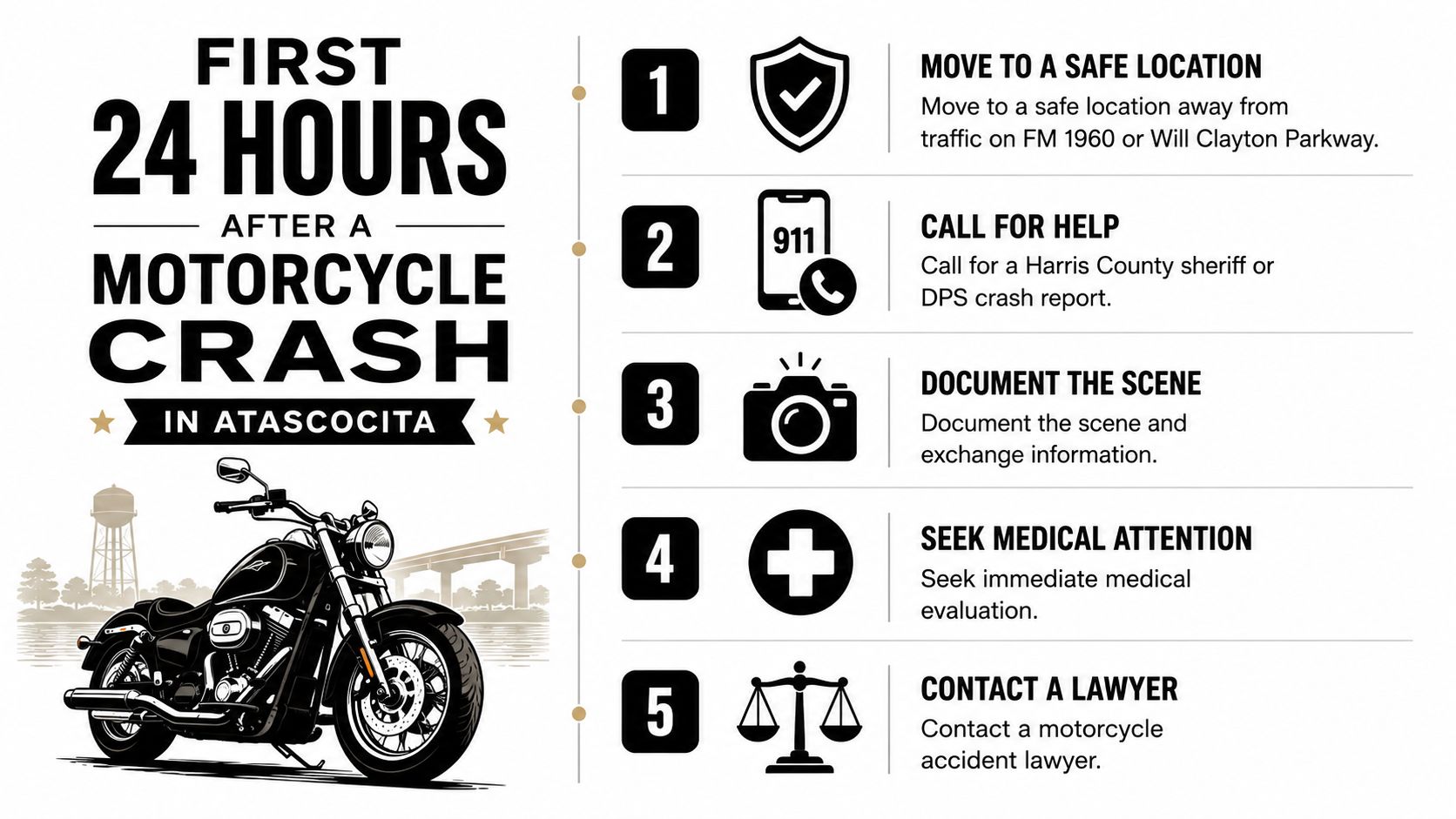
First 24 Hours After a Motorcycle Crash in Atascocita
A crash on FM 1960 or Will Clayton Parkway can leave you too rattled to think clearly. Follow the same order every time: get safe, call for help, document what you can, obtain medical care, and avoid making statements that can later be used against you.
Start with safety and an official record
If you can move without worsening an injury, get away from moving traffic. Don't stand between vehicles or remain in a travel lane to argue about what happened. Turn on hazard lights when possible and wait for emergency personnel in a protected location.
Call 911 and ask for medical assistance and a formal crash investigation. Depending on the location and circumstances, the responding agency may include the Harris County Sheriff's Office or the Texas Department of Public Safety. An official crash report creates an initial record of the roadway, vehicles, parties, and reported injuries. It isn't the final word on liability, but it's an important starting point.
Do not accept cash at the scene in exchange for “handling it privately.” A sore wrist can become a fracture diagnosis, and a damaged fork or frame can cost more to inspect than it first appears. A quick payment may also create an argument that you agreed the matter was finished.
Capture the scene before it changes
If your condition allows, take wide and close photographs before vehicles leave. Photograph lane markings, traffic signals, turn lanes, skid marks, debris, road defects, weather conditions, vehicle positions, visible damage, your helmet, riding gear, and any visible injuries. Ask witnesses for their names and phone numbers, but don't coach them or debate the other driver.
Practical rule: Document facts, not conclusions. Photograph the left-turn lane, the signal, and the damaged motorcycle. Don't post an accusation online.
Pain often develops after adrenaline fades. Delayed soreness the next morning deserves medical attention, not dismissal. A plain-language resource on when to seek help for delayed pain can help you recognize why symptoms that appear later still matter.
Expect the insurer to call quickly
An adjuster may contact you within hours. Be polite, but don't give a recorded statement, speculate about speed, apologize, or describe injuries as “minor” before you've been examined. Refer questions about liability and the full extent of your injuries to counsel.
If you need a lawyer familiar with the broader injury process in the area, review the Atascocita car accident lawyer resource. Before the next call, gather:
- Crash information: The report number, responding officer's name, agency, and badge number.
- Scene proof: Photos, videos, dashcam files, and road-condition notes.
- People and vehicles: Witness names, contact details, the other driver's insurance information, and license plate details.
- Medical records: Emergency-care paperwork, discharge instructions, prescriptions, and the names of current treating providers.
That small file gives you something concrete to work with tonight instead of relying on memory while you're hurt.
Texas Motorcycle Law Every Rider Should Know
Texas law changes the practical value of a motorcycle claim in two important ways. First, a rider's share of responsibility can reduce recovery. Second, a claim can expire if a lawsuit isn't filed on time.
Comparative fault changes every conversation
Texas follows a modified comparative-fault rule. If a jury assigns you some responsibility, your damages are reduced by that percentage. If the assigned responsibility reaches 51%, recovery is barred under the rule described in Texas civil-liability law.
That means your first conversation with an insurer matters. Saying “I probably came in too fast” or “I may have missed the light” can become evidence used to increase your assigned share of fault. Give accurate facts, but don't fill gaps with guesses. The other driver's lane position, turn path, signal timing, sight lines, and vehicle damage may tell a different story.
A helmet issue can also affect a claim when the alleged failure relates to the specific injury. It doesn't automatically decide who caused the collision. Helmet condition, applicable Texas requirements, and the relationship between head protection and the documented injury should be analyzed with the medical evidence, not treated as a shortcut to deny the whole claim.
Motorcycle insurance can matter just as much as the traffic facts. Liability coverage from the driver who caused the crash may be inadequate for catastrophic injuries. Your own uninsured or underinsured motorist coverage may become central, and policy language can control the order and scope of negotiations. Don't assume the other carrier's acceptance of fault resolves the coverage question.
Put the filing deadline on the calendar
Texas Civil Practice and Remedies Code section 16.003 generally gives an injured person two years to file a personal-injury lawsuit, measured from the crash date (Texas limitations statute). Waiting for treatment to finish, an insurer to “get back to you,” or a repair estimate to settle can consume the time needed to investigate and file.
Limited circumstances can affect the deadline, including certain disability, minority, or governmental-claim issues. They're fact-specific and shouldn't be assumed. A lawyer should identify the correct deadline early, preserve claims against each responsible party, and avoid relying on informal negotiations to stop the clock.
The sensible rule is simple: report the crash, seek care, preserve records, and obtain legal advice before making substantive statements. Don't let a comparative-fault admission or a missed limitations deadline decide a serious Atascocita claim.
Building the Evidence in a Harris County Motorcycle Case
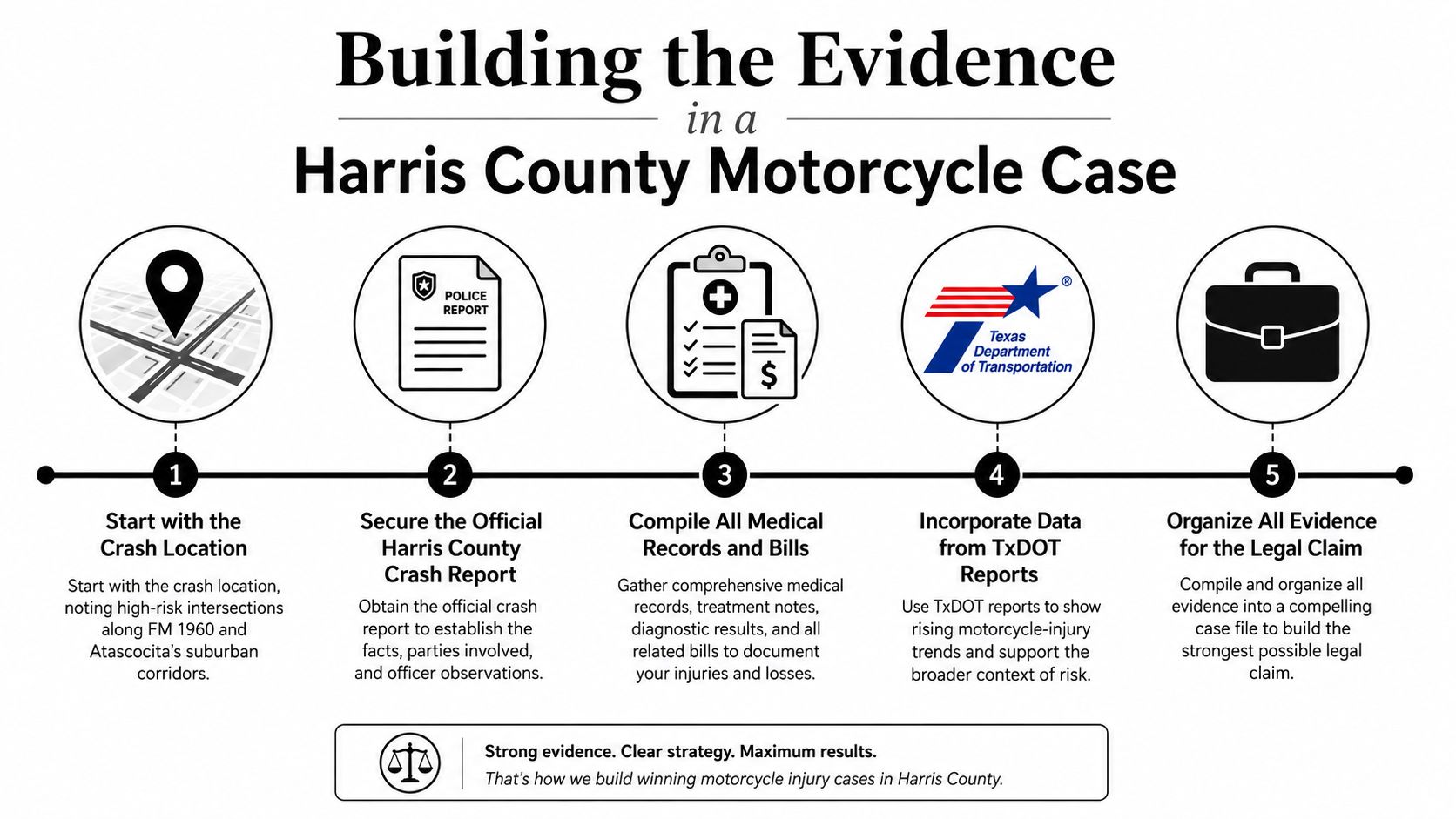
A Harris County motorcycle claim is often won or lost through evidence that disappears before anyone asks for it. TxDOT reported that more than half of fatal motorcycle crashes in 2025 involved collisions with other vehicles, while its 2025 reporting recorded 557 rider deaths and 2,468 serious injuries (TxDOT crash statistics). At intersections along FM 1960 and busy suburban corridors around Atascocita, the central question may be whether a driver saw the motorcycle, yielded, turned across its path, or changed lanes without a clear view.
Preserve the scene before the scene is gone
A lawyer should send preservation requests quickly to the parties and businesses that may control evidence. Many recordings are overwritten on routine cycles. The exact retention period varies, but waiting 30 to 90 days can allow important material to disappear.
The evidence checklist should include:
- 911 audio and dispatch logs: These can capture spontaneous descriptions of vehicle movement, injuries, and the location.
- Traffic and storefront video: Cameras may show the signal phase, approach speed, lane position, or the moments before impact.
- Vehicle data: An event-data recorder or ECM download from a car or truck may help evaluate speed, braking, and deployment events.
- Motorcycle records: ECM information, service records, inspection notes, and dealer data can address mechanical-condition arguments.
- Navigation records: Google Maps and Waze timestamps may help establish route, timing, or arrival sequence when properly obtained.
- Written preservation letters: Known insurers, vehicle owners, businesses, and governmental custodians should receive a clear request not to destroy relevant material.
Every item should answer a legal question. Signal footage can address right of way. Vehicle data can test a driver's version of braking. Motorcycle inspection records can counter an argument that a mechanical defect caused the crash. Medical records connect the collision mechanics to the injury pattern.
Build the damages record alongside liability
The official report is only one piece. Keep emergency records, imaging reports, therapy notes, prescriptions, work restrictions, wage documentation, and photographs of healing injuries in one organized folder. Preserve the motorcycle exactly as it was after the crash until a qualified inspection is complete, unless storage or safety concerns require another arrangement.
For ownership, prior condition, and damage documentation, riders may also find a motorcycle title and damage records resource useful when gathering the bike's history. If the claim involves a commercial vehicle or trucking company, the evidence process may also overlap with a truck accident lawyer in Atascocita investigation.
TxDOT's historical reporting adds context. Motorcyclist deaths increased 7% from 2022 to 2023, and intersection fatal crashes increased 21% during that period (TxDOT statewide motorcycle reporting). Those figures don't prove fault in your crash. They do reinforce why an intersection case needs signal evidence, witness canvassing, measurements, and reconstruction rather than a quick conclusion based only on the driver's statement.
Damages and Insurance in a Texas Motorcycle Claim
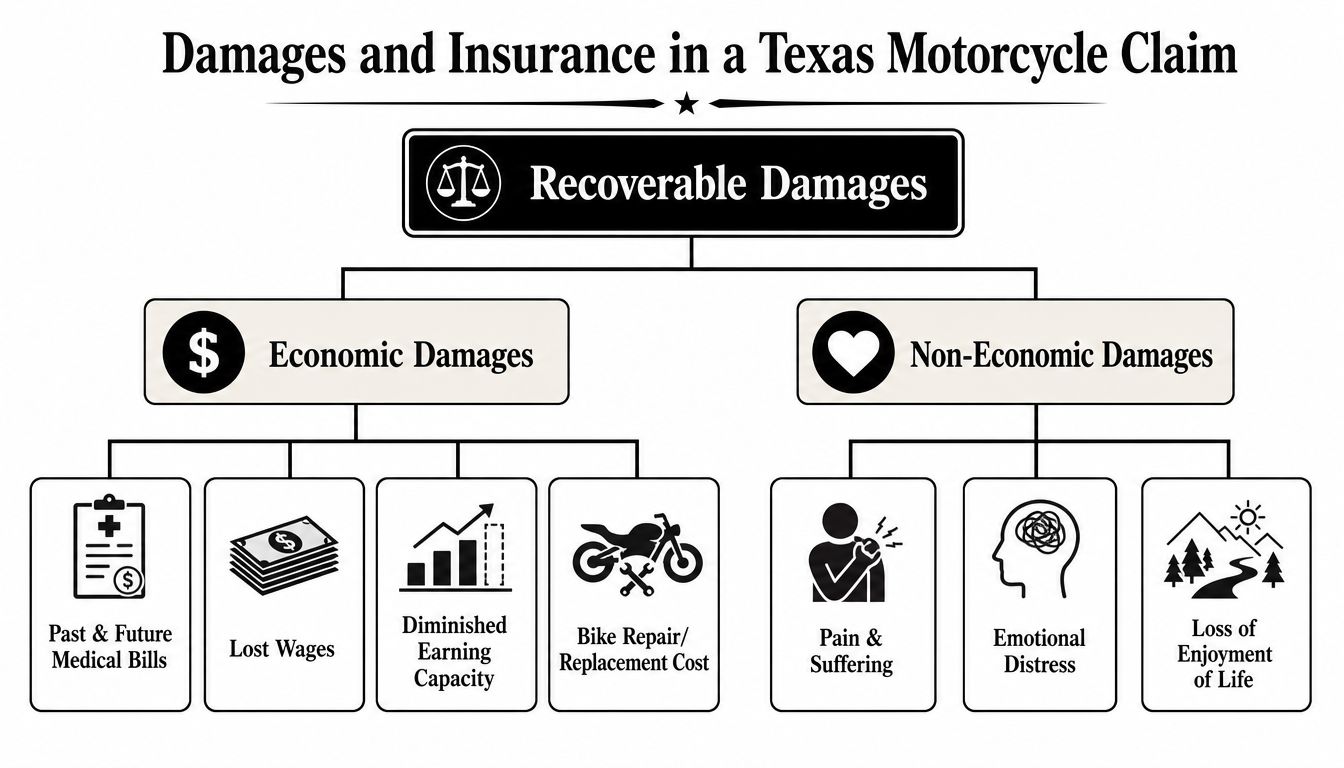
A serious motorcycle claim isn't limited to the first hospital bill. The financial picture may include treatment already received, care doctors expect later, time away from work, reduced earning capacity, motorcycle damage, and the daily cost of living with pain or permanent change.
Separate the losses into usable categories
Economic damages are losses that can be documented through bills, records, and financial proof:
- Medical care: Emergency treatment, surgery, rehabilitation, medication, and reasonably supported future care.
- Employment losses: Past wages, future lost income, and diminished earning capacity when the injury limits the work you can perform.
- Property damage: Motorcycle repair or replacement, riding gear, towing, storage, and rental or alternate-transportation costs when supported by the claim.
- Out-of-pocket costs: Travel for treatment and other necessary expenses tied to recovery.
Non-economic damages address the human consequences. Pain, emotional distress, scarring, disfigurement, physical impairment, and loss of enjoyment of life can matter even when they don't appear on a receipt. A rider who can no longer work, sleep, exercise, ride, or participate in family activities may have a substantial quality-of-life claim.
The biomechanics also deserve attention. NHTSA research reports that the motorcycle's initial impact point was the front in 67% of motorcycle fatalities and an estimated 42% of incapacitating injuries, while head injuries remain a significant concern even for helmeted riders (NHTSA biomechanics research). Injury-pattern matching, helmet condition, collision angle, and reconstruction can help explain how the crash caused the medical condition.
Identify every possible insurance layer
The at-fault driver's liability policy is usually the first layer. It may not be the last. A rider's underinsured motorist coverage can become important when the liability limits don't cover the full injury value, even if the other carrier accepts responsibility.
Other possible sources include:
- Uninsured motorist coverage: Relevant when the responsible driver has no applicable liability insurance.
- Medical payments coverage: May help with qualifying medical expenses under the policy terms.
- Personal injury protection: May apply only if the rider has applicable coverage and the policy provides it.
- Umbrella coverage: A household or business umbrella may provide additional protection when its conditions are met.
- Health insurance and liens: Health insurers, Medicaid programs, hospitals, and providers may assert reimbursement or lien rights against settlement proceeds.
Texas stacking rules and policy language require careful review. Don't treat multiple policies as automatically additive, and don't sign a release before liens, reimbursement claims, and UIM rights are evaluated. Riders planning ahead can also review practical guidance on insuring your bike in the Southeast, while remembering that an insurance education page isn't a substitute for examining the policy that applies to the crash.
Settlement or Trial and How Texas Lawyers Decide
Settlement and trial are not competing slogans. They're different risk-and-control decisions that should be made with a clear record, realistic valuation, and an understanding of the evidence.
What settlement gives you
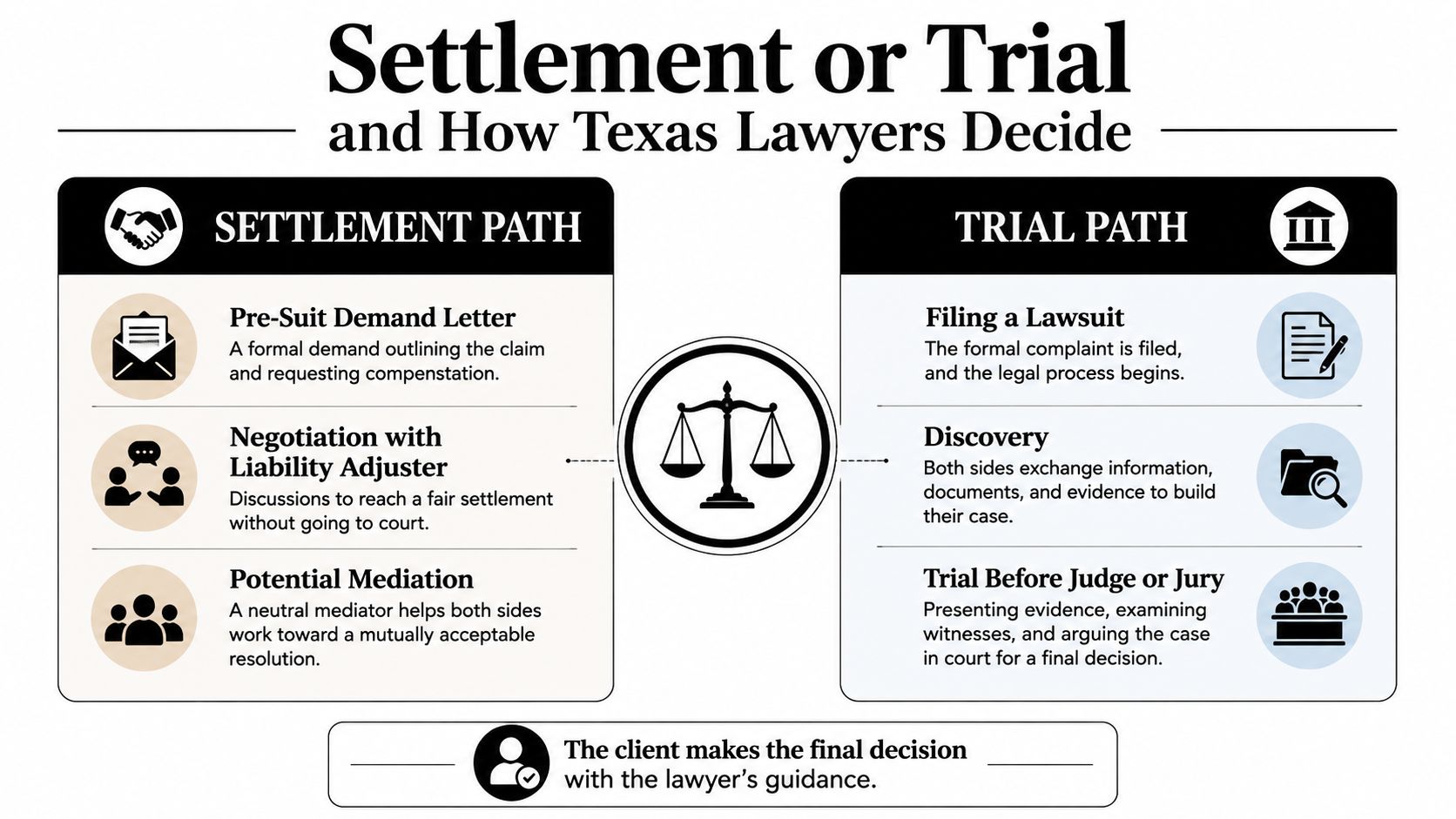
A pre-suit demand usually organizes the liability proof, medical records, wage evidence, property loss, and a proposed resolution for the liability adjuster. Negotiation may involve written responses, additional documentation, and eventually mediation, where a neutral mediator helps the parties assess the gap.
| Settlement path | Trial path |
|---|---|
| Faster certainty if the parties agree | More control over presenting the evidence |
| Avoids courtroom and appeal risk | May produce a larger verdict, but no result is guaranteed |
| Usually reflects a compromise | Takes longer and requires litigation expense |
| No jury decides disputed facts | Judge or jury decides liability and damages |
Settlement often makes sense when the evidence is strong but available insurance is limited, medical treatment is reasonably understood, and the client values certainty. It may be a poor choice when the insurer discounts permanent injuries, blames the rider without support, or refuses to account for future care.
What filing suit changes
A lawsuit allows formal discovery. Lawyers can request records, question witnesses under oath, inspect vehicles, designate experts, and test the defendant's version of events. A Harris County district court case can take substantial time, and litigation may require expert fees, deposition costs, reconstruction work, and other expenses.
Trial also carries uncertainty. Comparative-fault findings, venue, jury attitudes toward motorcycles, the strength of the medical evidence, and the defendant's policy limits all affect the decision. A lawyer should explain the likely range, the weak points, the costs, and the risks before asking the client to choose.
A settlement can also affect family-property questions. Someone dealing with divorce should understand how a personal-injury recovery may be characterized, as discussed in characterizing a personal injury settlement in divorce. Separately, Enforcement of Court Orders in Atascocita concerns enforcing divorce decree and custody order provisions in Harris County, not evaluating the motorcycle claim itself.
The client makes the final settlement decision. A prepared lawyer's job is to present the evidence and consequences plainly, not to substitute personal preference for the client's judgment.
Choosing the Right Motorcycle Accident Lawyer in Atascocita
Before signing a retainer, ask direct questions. Motorcycle cases can draw unfair assumptions from insurers and jurors, so general personal-injury experience isn't enough by itself.
Questions that expose the real fit
Ask the lawyer:
- Local motorcycle experience: How many motorcycle cases have you handled in Harris County during the last five years?
- Practice focus: What percentage of your practice is personal injury rather than family, criminal, estate, or other work?
- Daily responsibility: Who will investigate, communicate, and work on the file?
- UIM handling: Will you personally handle the underinsured-motorist claim, or refer it elsewhere?
- Financial terms: What's the fee structure, how are case expenses handled, and what timeline is realistic?
- Trial commitment: Will you take the case to trial if the offer is unfair and the evidence supports that decision?
The answers matter because the insurer is evaluating counsel from the first letter. A lawyer who treats the claim as a routine vehicle-damage dispute may miss the motorcycle's injury mechanics, the rider bias that can affect valuation, or the need to separate liability coverage from UIM negotiations.
A local northeast Harris County firm can also understand the practical setting around Atascocita and Humble, including suburban intersections, nearby medical providers, and the court system where a dispute may proceed. That local familiarity should support, not replace, disciplined investigation and candid advice.
The Law Office of Bryan Fagan – Atascocita TX Lawyers handles personal-injury matters as part of a broader local practice serving Atascocita, Humble, and Harris County. Its intake path can begin with a free consultation and a records review, giving a rider an opportunity to discuss the crash facts, available documents, medical treatment, and insurance issues before deciding whether representation makes sense.
Don't choose based only on a confident advertisement. Choose the lawyer who can explain the evidence plan, the coverage plan, the cost structure, and the reason a case should settle or proceed toward trial.
Schedule a Free Consultation With the Law Office of Bryan Fagan
You don't need a polished legal file before calling. A hurt rider or family member can begin with the information already available, then add records as they arrive.
Bring the documents that answer the first questions
Gather these items if you have them:
- Crash records: The police or crash report number, responding agency, officer information, and citations.
- Scene materials: Photographs, videos, dashcam recordings, witness contacts, and motorcycle damage images.
- Insurance details: The other driver's policy information, your motorcycle policy, UIM or uninsured-motorist declarations, and any adjuster letters.
- Medical information: Health insurance or Medicaid details, hospital paperwork, current medications, and a list of treating physicians.
- Work records: Recent pay stubs, employer contact information, work restrictions, and a short description of missed duties.
- Communication history: Text messages, emails, letters, claim numbers, and notes from insurer calls.
These materials help counsel identify immediate preservation needs and determine whether the claim involves liability coverage, UIM benefits, medical liens, wage loss, or a disputed injury connection. Don't delay the call because one document is missing.
Know what the first meeting should accomplish
The consultation should give you a practical next step, not pressure to make a decision before you understand the case. The discussion can cover how the crash happened, what the medical records show so far, which evidence may disappear, what insurers have requested, and whether the firm is a suitable fit.
The Law Office of Bryan Fagan can arrange an appointment through its Atascocita-area office, satellite Harris County locations, or video conference when travel is difficult. Ask about the current meeting location and weekday hours when you call so you can speak with a real member of the firm rather than guess about logistics.
Consultation and case review cost nothing until the firm takes on the claim, according to the publisher's stated intake approach. The firm's local roots and full-service practice also mean a client can ask about related family, criminal, estate-planning, or civil concerns without confusing those matters with the injury claim.
Before you call tonight, use this short preparation list:
- Save the evidence: Put photos, videos, reports, and adjuster messages in one folder.
- Write the timeline: Record where you were riding, what you saw, what happened, and when symptoms began.
- List the losses: Include treatment, work restrictions, motorcycle damage, and daily activities you can't perform.
- Protect your statement: Don't speculate to the insurer or sign a release before legal review.
- Schedule the review: Have your report number and current doctor information ready.
The Law Office of Bryan Fagan – Atascocita TX Lawyers provides local guidance for injured riders evaluating liability, evidence, insurance coverage, damages, and settlement decisions after an Atascocita motorcycle crash. Visit Law Office of Bryan Fagan – Atascocita TX Lawyers to request a free consultation and discuss your claim with a local legal team.