Skip to content

A call from an Atascocita school can turn an ordinary family evening into a criminal investigation. Your teenager may have posted an alarming message, repeated a violent joke in a hallway, or sent an angry text during an argument. Then a school administrator says law enforcement wants to talk, and suddenly you're wondering whether a student-discipline issue has become a terroristic threat charge in Atascocita, Texas.
Treat it as a criminal matter from the start. Texas law focuses on the alleged threat and the speaker's required intent, not only on whether anyone was physically injured. In Harris County, recent school-related reporting shows that these cases can move quickly from campus referrals to arrests and felony allegations. A calm response, preserved evidence, and early legal advice can protect your child's rights while the facts are still available.
A Knock at the Door in Atascocita
The call often comes from a school administrator before a parent hears from police. A teenager at an Atascocita-area campus allegedly made a violent statement in a group chat, posted a message online, or said something during a heated argument. The school may remove the student from class, contact Humble ISD officials, and refer the matter to law enforcement.
That statement might have been dark humor, venting, fictional dialogue, or an attempt to impress friends. It might also be a serious threat. Parents shouldn't decide which one it is before reviewing the complete context.
Officers may ask to interview the student, inspect a phone, contact classmates, or learn who was present. Your child may feel pressure to explain everything immediately. That pressure can produce an incomplete or inaccurate account, especially when the student is frightened and doesn't understand that school personnel may share the interview or written records with prosecutors.
Practical rule: Don't let your child give a detailed statement about the allegation before you've obtained criminal-defense advice.
Review your child's Miranda rights and avoid treating the school interview as harmless. Parents should stay calm, avoid admissions, and ask what policy or threat-assessment process the school is using. Don't delete messages, change account settings, tell your child to recreate conversations, or encourage anyone to “get their stories straight.”
Preserve the complete story
Save the phone and the surrounding communications. Keep screenshots, full message threads, usernames, timestamps, relevant videos, and posts rather than only the sentence the school identified. Write down who was present and what happened before and after the alleged statement.
The legal question isn't just whether a sentence sounded frightening. Texas Penal Code § 22.07 requires a violent threat plus a listed intent. Tone, audience, history, timing, and the way the words were communicated can become central evidence.
Harris County schools have faced a measurable enforcement problem. A 2025 local report identified 95 terroristic-threat arrests at Harris County schools since 2022, while separate Houston-area reporting showed juvenile charges tied to school threats and violence rising from 7 between August 1 and September 19, 2023, to 22 during the same period in 2024, a more than 214% year-over-year increase (local Harris County terroristic-threat reporting). Those figures don't prove that a particular student committed an offense, but they show why families should respond promptly.
What Texas Law Actually Calls a Terroristic Threat
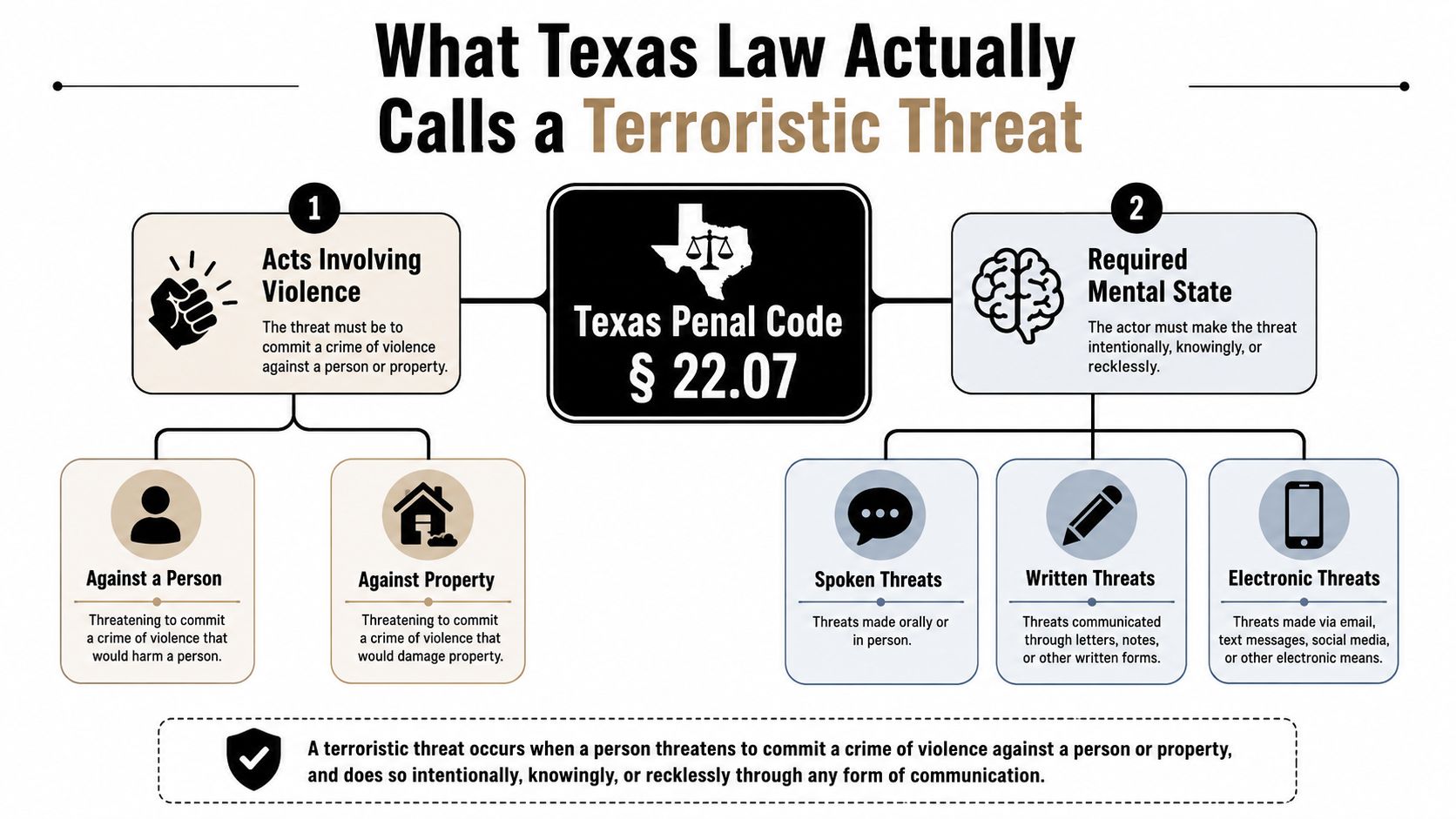
Texas Penal Code § 22.07 is narrower than the everyday meaning of “threat.” The statute addresses a threat involving violence against a person or property, combined with intent to produce one of the results identified by law (Texas Penal Code § 22.07).
A prosecutor must connect the alleged words or conduct to a statutory purpose. The statute includes purposes involving emergency responses, fear of imminent serious bodily injury, disruption of buildings or public places, interference with public utilities or communications, and influencing government conduct. The law doesn't require the threatened violence to occur. The prosecution still has to prove the required intent.
The six practical questions
Use these questions to understand why a statement may draw attention under § 22.07:
Was the statement tied to violence against a person or property? “Someone will get hurt” presents a different issue from ordinary profanity or an insult.
Was it intended to cause an emergency response? A message designed to make police, firefighters, or other emergency personnel respond may fall within the statute.
Was it intended to cause fear of imminent serious bodily injury? A direct statement to a named person, delivered during a confrontation, may be treated differently from an abstract or fictional comment.
Was it intended to disrupt a building or public place? Telling people to leave a cafeteria because someone will be injured could be examined under this theory.
Was it aimed at public utilities, transportation, communications, or government conduct? Threats involving public services or government operations receive particular attention because the alleged target extends beyond one private dispute.
Was it intended to terrorize someone or cause a school to cancel classes or activities? A bomb-related message made to shut down a campus can create serious exposure even if no device exists.
Context may determine whether the words communicate a true threat or merely express anger, exaggeration, fiction, or political opinion. Investigators may examine the full conversation, prior interactions, the audience, whether the speaker had access to a weapon, and how recipients understood the message.
Words aren't the whole case
Electronic communication creates additional evidence. A clipped screenshot may omit a previous message that changes the meaning. A repost may be attributed to the wrong person. A joke may be copied from a movie or game without an intent to threaten anyone.
A defense lawyer should obtain the original device and review the full digital record before advising the family about police or school interviews. The statute's focus on intent makes context more than background information. It can determine whether the allegation fits § 22.07 at all.
Penalties and How Charges Get Upgraded
The basic offense can be a Class B misdemeanor, with punishment of up to 180 days in county jail and a fine of up to $2,000 (Texas terroristic-threat punishment overview). That starting point doesn't tell you what will happen in a particular Harris County case. The alleged target, purpose, and surrounding facts can move the charge into a higher classification.
Texas law provides several penalty tiers. A threat made with the intent to cause fear of imminent serious bodily injury is generally a Class B misdemeanor, but it becomes a Class A misdemeanor when the alleged victim is a family or household member or a public servant. Threats involving disruption of a public building or place may be a Class A misdemeanor, or a state jail felony when the alleged pecuniary loss reaches at least $1,500. Threats aimed at disrupting public services or influencing government conduct are third-degree felonies (Texas Penal Code § 22.07).
| Charge Level | Typical Trigger | Possible Punishment |
|---|---|---|
| Class B misdemeanor | Basic statutory terroristic-threat allegation | Up to 180 days in county jail and a fine of up to $2,000 |
| Class A misdemeanor | Certain enhanced circumstances, including an alleged family or household member or public servant target | Up to one year in county jail and a fine of up to $4,000 |
| State jail felony | Certain public-place disruption allegations involving the required pecuniary loss | State jail punishment and felony consequences |
| Third-degree felony | Alleged disruption of public services or influence over government conduct | A felony classification with substantially greater exposure |
Why school facts matter
School allegations can involve emergency responses, canceled activities, disruption of a public place, or fear of serious injury. The same sentence can therefore be evaluated under different statutory theories depending on what investigators say the speaker intended.
Harris County reporting identified felony terroristic-threat cases among school-related charges, which is why an Atascocita family shouldn't assume the case will remain a disciplinary referral. A prosecutor may review the victim's status, the exact message, prior law-enforcement contacts, alleged gang connections, and weapon-related evidence before deciding whether to accept, reject, or enhance a filing.
If a CPS investigation begins because of allegations involving a child or household, families may also need information about a CPS Defense Attorney in Atascocita, which concerns defense against CPS investigations for Atascocita families. That process is separate from the criminal case, but statements and records can overlap.
A charge is not a verdict. Counsel can challenge the statutory intent, classification, evidence, and investigative process before you consider a plea.
How a Case Moves Through Harris County Courts
An Atascocita arrest generally begins with booking and an initial appearance, not with a trial date. Depending on the circumstances, the person may be processed through an Atascocita-area law-enforcement location or the Harris County jail system, including the jail at 1200 Baker Street. The precise path depends on the arresting agency and charge.
The early sequence
Arrest and booking. Officers record the allegation, identify the accused person, collect basic information, and preserve the initial report.
Magistration. A magistrate reviews the arrest, explains rights, addresses probable cause, and considers bond. Texas law requires prompt presentation before a magistrate, and the commonly discussed 48-hour period is important, but the actual timing can depend on the circumstances and the available judicial process.
Bond conditions. The magistrate may impose no-contact provisions, geographic restrictions, weapon restrictions, reporting requirements, or orders barring contact with a school, alleged victim, or witness. Article 17.15 governs considerations in setting bail, including the nature of the accusation and the safety of the community.
A personal recognizance bond differs from a surety bond. A personal recognizance bond relies on the defendant's promise to appear, while a surety bond involves a bonding company or other financial security. The amount and conditions vary with the charge, the accused person's history, the alleged victim, and the magistrate's assessment.

Filing and court assignment
After the initial stage, the Harris County District Attorney's Office reviews the police report and supporting records. It may reject a filing, accept a misdemeanor, seek a felony filing, or present a felony allegation to a grand jury. The grand jury process matters because an indictment can place a case in district court and formalize a felony charge.
At arraignment, the accused person receives the formal charge and enters a plea. The case may then proceed through discovery, pretrial motions, negotiations, or trial. District-court assignment depends on the case and court administration. Atascocita residents may see cases connected with the 262nd or 263rd District Courts, but counsel should confirm the actual assignment rather than rely on a general expectation.
The process differs from family litigation. Harris County Family Courts: A Atascocita Resident's Guide describes how family-law cases proceed in the Harris County courts serving Atascocita. For the criminal case itself, review what happens at an arraignment hearing and follow every written bond condition.
Defenses That Hold Up Under Texas Law
The strongest defense usually begins with the words, but it doesn't end there. Texas Penal Code § 22.07 requires proof of a violent threat and a listed intent. A defense attorney should test whether the statement was a genuine expression of intended violence, whether the accused person made it, and whether the evidence supports the prosecution's interpretation.
Lack of statutory intent
This is often the central issue. A person may have been angry, sarcastic, quoting fiction, describing a hypothetical, or using exaggerated language without intending to cause fear, an emergency response, or a disruption identified by the statute.
The defense should compare the exact words with the surrounding conversation. A single screenshot can make a statement appear more direct than it was. Earlier messages, replies, jokes, emojis, voice recordings, and witness accounts may show a different meaning.
Constitutional arguments
A vagueness challenge argues that a law fails to give adequate notice of what conduct is prohibited or permits arbitrary enforcement. An overbreadth argument examines whether a law reaches protected speech beyond true threats. These theories require careful application to the specific charge, not slogans about free speech.
The First Amendment doesn't protect every threatening statement, but political rhetoric, fiction, venting, and hyperbole can raise constitutional questions. Federal law and Texas courts have examined what separates protected expression from a true threat. Counsel should analyze the charging language, the alleged purpose, and the evidence of intent before deciding whether a constitutional motion fits.
False reports and mutual conflict
Sometimes a statement is reported after a breakup, workplace dispute, neighborhood argument, or school conflict. That doesn't automatically make the report false. It does mean the defense should examine inconsistent accounts, motive, deleted messages, witness relationships, and whether both sides exchanged aggressive statements.
| Defense Theory | What It Argues | When It Works | Key Evidence Needed |
|---|---|---|---|
| Lack of statutory intent | The words didn't carry the required purpose | The full context shows venting, fiction, or hyperbole | Complete messages, recordings, witnesses |
| Vagueness | The application failed to provide fair notice | The charge relies on an unclear statutory application | Charging instrument and surrounding facts |
| First Amendment | The expression wasn't a true threat | Speech is political, fictional, rhetorical, or otherwise protected | Original post, audience, context, account records |
| False-report context | The allegation is incomplete, retaliatory, or inconsistent | The complainant's account conflicts with objective evidence | Prior communications, surveillance, neutral witnesses |
Preserve evidence before it disappears. Obtain a criminal defense strategy review that addresses the digital record, school or workplace materials, witness interviews, and available video.
Your First Steps After Being Charged
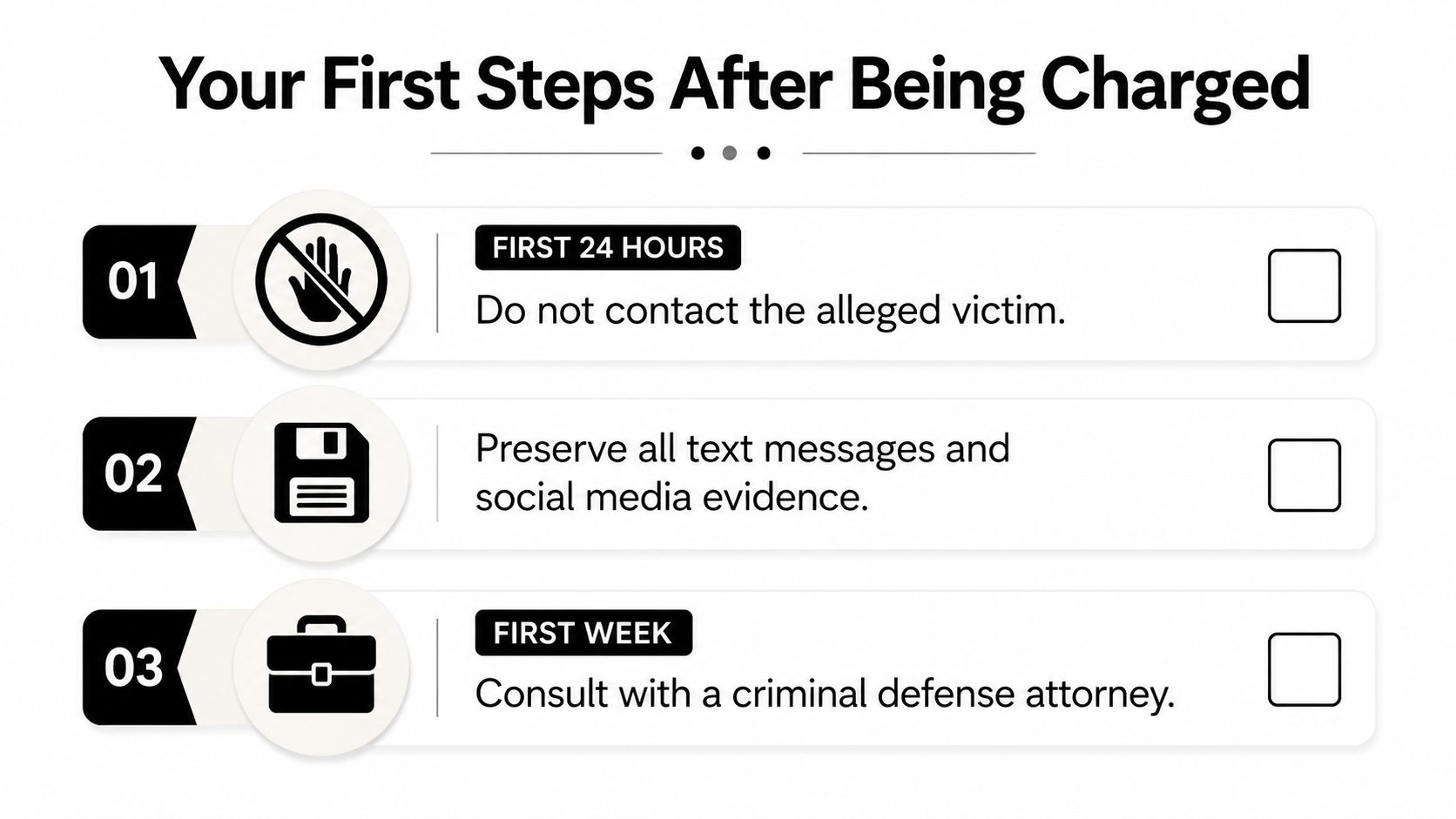
The first response should be organized, not emotional. Use this checklist in order.
During the first 24 hours
Stop direct contact: Don't contact the alleged victim, complainant, classmates, coworkers, or potential witnesses about the allegation. A bond order may prohibit contact, and even a well-intended message can be misunderstood.
Preserve everything: Keep the phone, full message threads, social-media posts, account information, photographs, recordings, and relevant school communications. Don't delete, edit, or reset anything.
Write a private timeline: Record what happened while memories are fresh, including who was present, what preceded the statement, and what happened afterward. Give that timeline to your lawyer, not to investigators or social media.
Limit discussion: Don't discuss the case in group chats, at school, at work, or online. Speak about the facts with your attorney.
During the first 72 hours
Retain a Harris County criminal-defense lawyer who can review the probable-cause paperwork, bond conditions, school records, and digital evidence. Attend every court setting, comply with no-contact and weapon restrictions, and ask counsel whether character information from teachers, coaches, employers, or community members should be preserved.
Parents should also separate support from coaching. Help your child locate records and remember events, but don't suggest what to say or ask them to contact friends for statements.
During the first 30 days
Counsel may evaluate a bond modification, pretrial diversion, a mental-health docket referral where appropriate, or a mitigation packet. The right option depends on the facts, age, history, school consequences, and prosecutor's position.
The biggest mistake families make is treating the campus investigation as separate from the criminal case. Police and prosecutors may rely on school interviews, threat-assessment records, disciplinary reports, and device reviews when evaluating the charge. Protect the criminal case while responding responsibly to the school process.
Consequences That Reach Beyond the Courtroom
A terroristic-threat allegation can affect a family before any judge decides guilt. A student may face removal from campus, disciplinary proceedings, or restrictions under school safety procedures. For a minor at an Atascocita-area or Humble ISD campus, the school process can continue on its own track while the criminal investigation proceeds.
A conviction creates additional consequences. A misdemeanor can affect employment applications, professional screening, housing decisions, and school participation. A felony conviction carries broader restrictions, including potential loss of federal and state firearm rights and greater difficulty obtaining or keeping work in regulated fields.
Immigration and professional licensing
Noncitizens need immigration advice before entering a plea. A criminal resolution can create immigration consequences, including possible removability under 8 U.S.C. § 1227, depending on the facts and immigration category. Visa applications and future immigration filings may also require disclosure of the arrest or disposition.
Healthcare workers, educators, security personnel, and law-enforcement applicants may face licensing or employment review. A deferred adjudication outcome isn't the same as a conviction for every legal purpose, but it may still appear in background checks. A Class C resolution may reduce criminal exposure, yet it can still leave a record visible to employers or licensing authorities.
| Area of Life | Misdemeanor Conviction | Felony Conviction |
|---|---|---|
| School | Possible discipline and educational disruption | Greater impact on placement, participation, and future applications |
| Employment | Background-check concerns | Broader screening and licensing consequences |
| Firearms | Restrictions depend on the specific disposition and law | Potential federal and state firearm-rights loss |
| Immigration | Possible consequences depending on facts and status | Serious immigration review, including potential removability |
| Probation | Conditions may include reporting and no-contact rules | More intensive supervision and longer-term consequences |
Harris County probation officers focus on compliance with court conditions, reporting, prohibited contact, and any required programs. A person who violates a condition can create a new problem even while the original allegation remains unresolved.
The practical point is simple. Don't evaluate a plea only by asking whether it avoids jail. Ask how the disposition affects school, immigration, firearms, employment, licensing, records, and future family decisions.
How the Law Office of Bryan Fagan Can Help
A terroristic-threat case demands attention at the earliest stage, especially when the allegation involves a student, family member, public servant, school, or emergency response. The Law Office of Bryan Fagan, Atascocita TX Lawyers handles criminal matters in Harris County and can address the case from the initial magistrate process through negotiations, diversion review, deferred adjudication discussions, or trial preparation.
The work should be practical. Counsel can review the charging language, bond conditions, school records, phone evidence, witness accounts, and police reports. The firm also handles broader legal needs for Atascocita and Humble families, including family law, CPS defense, estate planning, probate, and civil disputes, when related legal issues arise.
The office offers 24/7 availability for new arrests, free in-person or phone consultations, transparent flat-fee options for resolvable matters, and bilingual support when needed. The objective is to pursue the smallest sustainable outcome supported by the evidence, whether that means dismissal, pretrial diversion, deferred adjudication, a reduction, or trial defense.
Don't let a frightening message or school referral define the entire case before someone reviews the facts. Preserve the evidence, follow the bond rules, and speak with counsel before making statements.
If you're facing a terroristic-threat investigation or charge in Atascocita, Humble, or northeast Harris County, Law Office of Bryan Fagan – Atascocita TX Lawyers offers a free consultation to review the allegation, bond conditions, school involvement, and next legal steps. Call or schedule your consultation today so your family can respond with a plan instead of panic.