A child is hurt, and suddenly you're managing an ambulance ride, worried relatives, school administrators, insurance calls, and questions from investigators. Maybe the injury happened in a Humble ISD pickup line, at an Eagle Springs pool, or during a crash on FM 1960. In the days after an incident, you may not know whether you're dealing with a medical emergency, a civil claim, a criminal allegation, a CPS investigation, or all of them at once.
That overlap matters. A parent's explanation to a nurse, school employee, insurance adjuster, police officer, or CPS investigator can become part of a larger file. This guide explains what families in Atascocita, Humble, and northeast Harris County should do after a child is injured, how Texas law separates the different legal paths, and why early legal advice can protect both your child and your family.
The First 48 Hours After a Child Is Hurt in Atascocita
The back seat of an ambulance is a frightening place to make important decisions. Your child may be lying under a blanket while paramedics check vital signs after a collision on FM 1960. You may be leaving an Eagle Springs pool after a rescue, or standing in a Humble ISD parking lot while staff ask what happened. You're focused on getting your child safely treated, but the next two days can shape the civil, criminal, and CPS issues that follow.
Start with the basics. Keep medical care continuous, tell providers what you observed without guessing, and write down the names of people who witnessed the incident. Don't fill gaps in your memory with assumptions. A clean timeline is more useful than a confident but inaccurate explanation.
Practical rule: Treat every statement as if three audiences may later review it, the insurance company, a criminal investigator, and a CPS worker.
The first 48 hours also determine whether a hazard remains dangerous. If a pool gate is broken, a car seat is damaged, a vehicle has visible defects, or a school or daycare area remains unsafe, move your child away from the location. Photograph the condition when it's safe to do so, but don't put your child at additional risk to obtain evidence.
Why speed affects every legal path
A civil claim may involve a property owner, driver, school, daycare, or insurer. A criminal investigation may focus on whether a caretaker acted intentionally, recklessly, or with criminal negligence. CPS may ask whether a parent or another person responsible for the child's care failed to protect the child.
Those systems don't wait for a family to understand the law. If police or CPS contacts you, don't try to solve the situation through a long text message or an emotional phone call. Ask what agency is calling, what incident is being investigated, and whether you're being asked to give a recorded or formal statement. A parent facing an immediate safety dispute should also review emergency custody options near Atascocita.
The broader lesson is simple. When a crisis unfolds quickly, families need a reliable record and a safe communication plan. Resources discussing when seconds matter during disasters offer useful perspective on why preparation and fast decisions matter during emergencies, even though a child-injury case has its own legal rules.
Getting Medical Care and Stabilizing Safety
Call 911 for a serious injury, breathing problem, loss of consciousness, uncontrolled bleeding, suspected spinal injury, or any situation where moving the child could cause further harm. For urgent evaluation, Atascocita families may use facilities such as Memorial Hermann Northeast or Texas Children's Humble, depending on the child's condition and the instructions of emergency personnel.
The first medical record often becomes the foundation for the case. Tell the provider what you personally saw, identify where the child was hurt, and disclose relevant symptoms. Don't minimize pain because the child seems calmer, and don't claim certainty about fault while speaking with medical staff. Medical professionals need accurate health information, not a legal theory.
Follow-up care is part of protection
Read the discharge instructions before leaving. Schedule recommended follow-up with a pediatrician in Humble or Kingwood, keep every prescription and referral, and follow restrictions on sports, running, climbing, or weight-bearing. After a fall, crash, or sports impact, monitor the child for symptoms that may indicate a concussion. A parent looking for plain-language information about signs of concussions in young athletes can use that resource alongside professional medical advice.
Keep a dated symptom journal. Note headaches, vomiting, sleep changes, confusion, balance problems, mood changes, missed school, and limitations on ordinary activities. If symptoms worsen or the child develops an emergency warning sign, seek immediate medical care rather than waiting for a legal consultation.
Safety changes should happen immediately. Secure a backyard pool, replace a damaged car seat, notify the daycare or school, and keep the child away from an unrepaired railing, gate, vehicle, play surface, or other hazard. Send a written hazard notice to the property owner or responsible organization after the child is safe, and preserve a copy.
A child's injury can also affect parenting schedules, transportation, and support needs. If the injury changes the child's financial needs or care arrangements, the family may separately need information about Child Support Attorney in Atascocita, including establishing, modifying, and enforcing child support in Harris County.
Preserving Evidence and Reporting the Incident
Evidence disappears quickly. A wet pool deck dries, a damaged vehicle gets repaired, a parking lot is cleaned, and a child's bruising changes. Preserve what you can without interfering with treatment or an official investigation.
Take clear photographs of the injury, clothing, shoes, car seat, vehicle damage, pool area, parking lot, sidewalk, lighting, signs, gates, and visible hazards. Record a short video showing the surrounding layout if distance, visibility, or access matters. Save screenshots of texts, emails, social media posts, school messages, daycare communications, and location information connected to the incident.
Build a record that someone else can follow
Write a timeline while memories are fresh. Include when you learned about the injury, who contacted you, where the child was, what the child said in their own words, when medical care began, and what restrictions followed. Avoid coaching the child or repeatedly demanding an explanation. Preserve the child's spontaneous statements, but let trained professionals conduct formal interviews.
Obtain the official incident report from the Harris County Sheriff's Office or the appropriate local law-enforcement agency. Precinct 4 commonly serves much of Atascocita, while Texas DPS may handle or maintain records connected to a crash on FM 1960. Ask about the process for requesting the report, and keep the report number.
What you write in an incident report can be repeated to an insurer, defense attorney, police investigator, prosecutor, or CPS worker. Use facts you know. “I arrived and saw swelling on the child's arm” is different from “the caregiver intentionally hurt the child,” unless you personally witnessed conduct supporting that conclusion.
Notify the right organizations carefully
Give written notice to Humble ISD, the daycare director, the homeowner's insurer, or the auto carrier when appropriate. Don't agree to a recorded statement or sign a broad medical authorization before speaking with counsel. Track medical bills, mileage, prescriptions, missed work, therapy, school absences, and every communication about the injury.
If the incident raises a possible abuse or neglect concern, families should get advice before making inconsistent informal statements. A consultation with a CPS defense lawyer in Atascocita can help a parent understand how a child-protection investigation may interact with a criminal case.
Understanding Texas Law on Injury to a Child
Texas Penal Code § 22.04 applies when a person intentionally, knowingly, recklessly, or with criminal negligence causes bodily injury, serious bodily injury, or mental impairment to a child. The statute can also apply through an omission when the person has a legal duty or has assumed care, custody, or control of the child. The statutory language is available through the Texas Penal Code provision on injury to a child.
The mental state and alleged harm matter. Under the cited Texas punishment framework, intentional or knowing conduct causing serious bodily injury can be a first-degree felony, reckless conduct causing serious bodily injury can be a second-degree felony, criminally negligent conduct can fall to a state-jail felony, and intentional or knowing bodily injury is generally a third-degree felony. Those categories show why parents shouldn't assume that an injury's appearance alone determines the charge. The alleged conduct, the child's condition, and the prosecution's theory all matter. See the Texas Penal Code punishment classifications.
Family law uses a related but distinct framework. Texas Family Code § 261.001 addresses abuse and neglect, including conduct or omissions that harm a child or place the child in legally recognized danger. The definition can reach a parent, grandparent, babysitter, coach, or another person responsible for the child's care, depending on the facts. It also recognizes that an accident or reasonable discipline that doesn't expose a child to a substantial risk of harm may be treated differently from abuse. Review the Texas Family Code definitions of abuse and neglect.
Three Texas Pathways After a Child Injury
| Pathway | Governing Texas Law | Who Decides | Parent's Role |
|---|---|---|---|
| Civil claim | Texas negligence and premises-liability principles | Insurer, court, or jury | Preserve evidence, document losses, avoid premature settlement |
| Criminal case | Texas Penal Code § 22.04 | Police, prosecutor, and criminal court | Exercise legal rights and avoid unprepared statements |
| CPS matter | Texas Family Code Chapter 261 | DFPS and the family court when needed | Protect the child, cooperate carefully, and obtain representation |
Texas reporting rules add another layer. A person who has cause to believe a child has been adversely affected by abuse or neglect must report it, and the supplied Texas reporting guidance states that professionals must report no later than 48 hours after first suspecting abuse or neglect. Reports may go to DFPS, law enforcement, or the relevant facility operator, and good-faith reporting protections can apply under Texas law. Families facing safety concerns should also understand how a protective order may fit into broader family-protection planning.
The same broken arm at an Eagle Springs pool could support a premises claim against an owner, a criminal investigation if a caretaker's conduct is alleged, and a CPS response if neglect is suspected. Those outcomes aren't interchangeable, and one agency's decision doesn't automatically decide the others.
Statutes of Limitations, Deadlines, and Damages
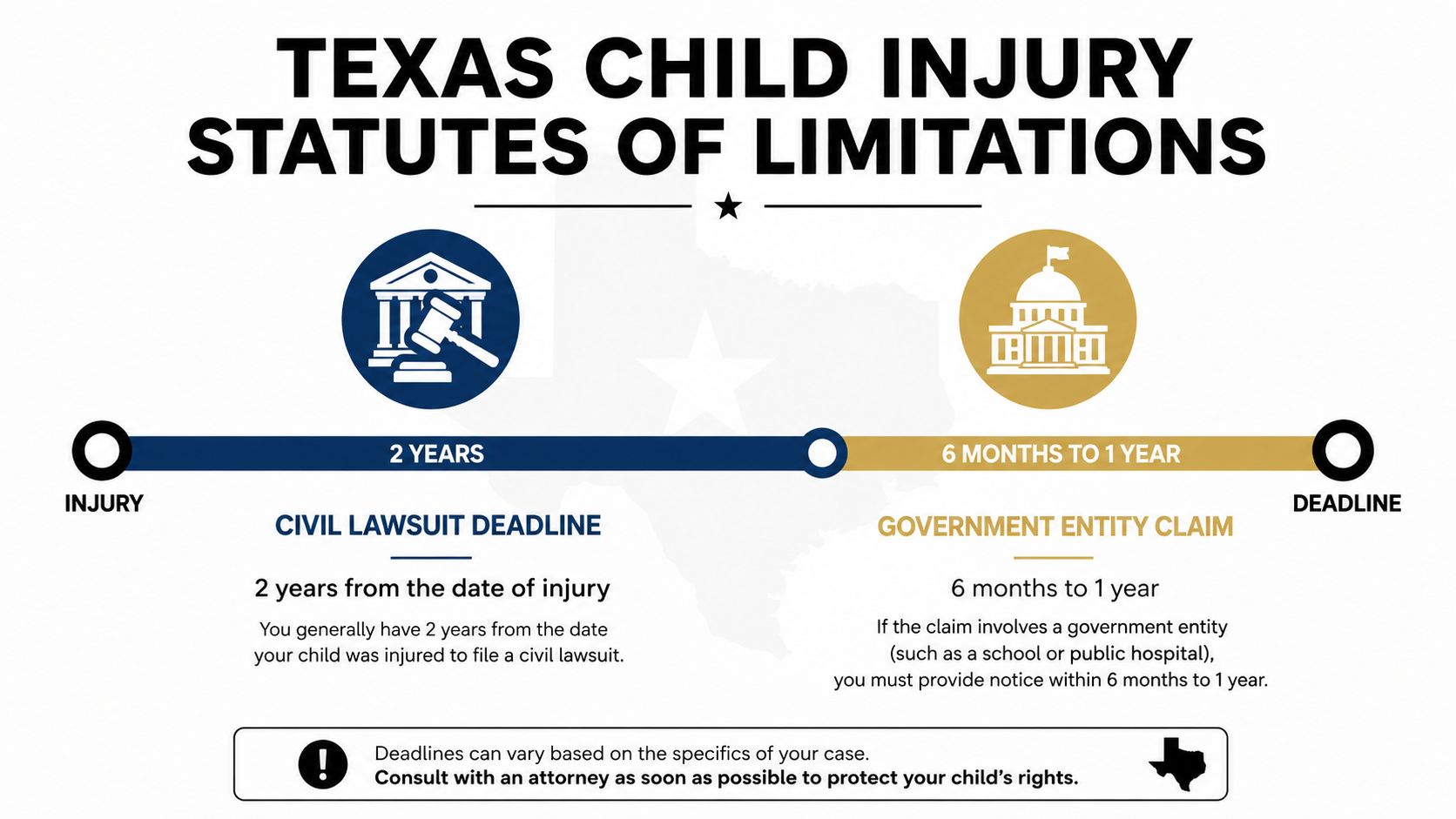
Deadlines control more than filing a lawsuit. They affect when a parent should notify an insurer, request records, preserve surveillance footage, and seek advice. A two-year limitations period generally applies to many Texas bodily-injury claims under the Texas Civil Practice and Remedies Code, although special rules can affect claims involving minors and government entities. For minors, limitations may be tolled until the child turns 18 in many situations, but parents shouldn't treat that rule as permission to wait.
Government claims can have much shorter notice requirements. A claim involving a public school district, public property, or another government entity may require notice within a period specified by law or local rules, and the timing can differ by defendant. Get legal advice before assuming the ordinary civil deadline applies.
CPS timing is separate from civil timing
The reporting clock is not a lawsuit deadline. The supplied Texas reporting guidance identifies a prompt reporting obligation, including a 48-hour rule for professionals under the referenced framework, while the provided Texas legal background also notes a 2025 change requiring certain professionals to report within 24 hours. Because the applicable rule can depend on the reporter and the date of the conduct, a professional should confirm the current requirement with DFPS or counsel rather than rely on a general internet summary.
CPS investigation timing also depends on priority and circumstances. The provided background identifies a 30-day completion window for Priority I and II allegations and a 45-day window for lesser-priority cases. Harris County child-protection personnel may contact parents, children, caregivers, schools, medical providers, and other witnesses during that process.
What a child-injury claim can include
Economic damages may include medical bills, future care, and lost parental wages connected to the child's treatment. Non-economic damages may include pain, suffering, disfigurement, and loss of enjoyment of life. A settlement involving a minor may require court approval under Texas law, and parents should not sign away a child's claim without understanding how the recovery will be protected.
Families comparing legal systems can also review this explanation of Pennsylvania law on minor injury deadlines, but Texas deadlines and procedures control an Atascocita case.
Working With an Atascocita Child Injury Attorney
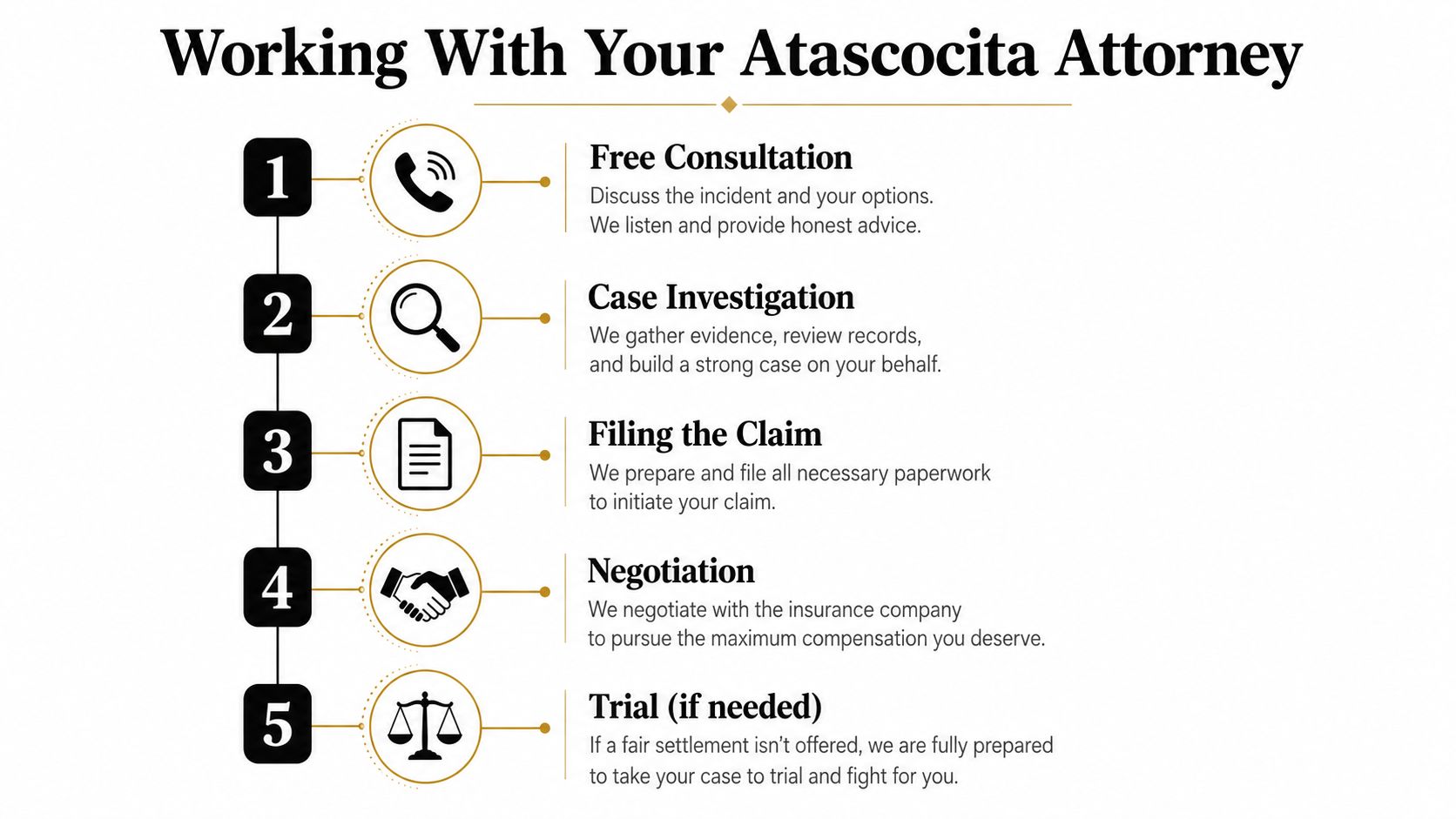
A useful first consultation should produce clarity, not pressure. The attorney will typically ask for medical records, discharge papers, photographs, witness information, the Harris County Sheriff's Office or Texas DPS report, insurance communications, school or daycare records, and any CPS paperwork. Bring a written timeline, even if it's incomplete.
Early investigation matters because conditions change. Surveillance from Atascocita Town Center, an Eagle Springs amenity area, a school parking lot, or FM 1960 may not remain available indefinitely. A lawyer may send preservation notices, identify responsible parties, evaluate insurance coverage, and separate facts relevant to a civil claim from facts that could create criminal or CPS exposure.
What the case process usually looks like
A representation letter tells insurers and other parties that the family has counsel. It doesn't erase deadlines or stop an investigation, but it can direct communications through the attorney and reduce the chance that a parent gives an incomplete recorded statement.
If negotiations don't resolve the claim, the attorney may file a civil petition in Harris County. The parties then exchange information through discovery, which may include written questions, document requests, depositions, medical evidence, and testimony from witnesses. Mediation may provide an opportunity to resolve the dispute, while trial remains available if the parties cannot reach an acceptable outcome.
Before representation, don't post details about the incident, speculate about fault, or argue with a school, daycare, driver, or insurer online. Don't delete existing posts or messages either. Preserve the record and let counsel assess what it means.
Fee arrangements vary by case and agreement. Ask exactly how fees, expenses, medical liens, court approval, and settlement distribution will be handled when a minor is involved. If the injury also creates a dispute about compliance with an existing divorce decree or custody order, Enforcement of Court Orders in Atascocita concerns enforcing those provisions in Harris County.
The Law Office of Bryan Fagan coordinates legal evaluation with the family's available medical documentation, including records from Memorial Hermann Northeast and Texas Children's Humble. The firm's broader practice also includes family law, criminal defense, and civil litigation, which can matter when the same incident creates overlapping proceedings.
A short video can help parents understand the general flow of legal representation:
Key Takeaways and Local Resources for Atascocita Families
After a child injury, focus on facts and safety before arguments about blame. Confirm that your child received appropriate care at Memorial Hermann Northeast, Texas Children's Humble, or another suitable facility, follow discharge instructions, and arrange follow-up when recommended.
Create one folder, physical or digital, containing medical records, bills, photographs, witness names, incident reports, school or daycare communications, insurance letters, and your dated journal. Preserve original messages and photographs. Don't edit the evidence to make it more persuasive.
Your practical local action list
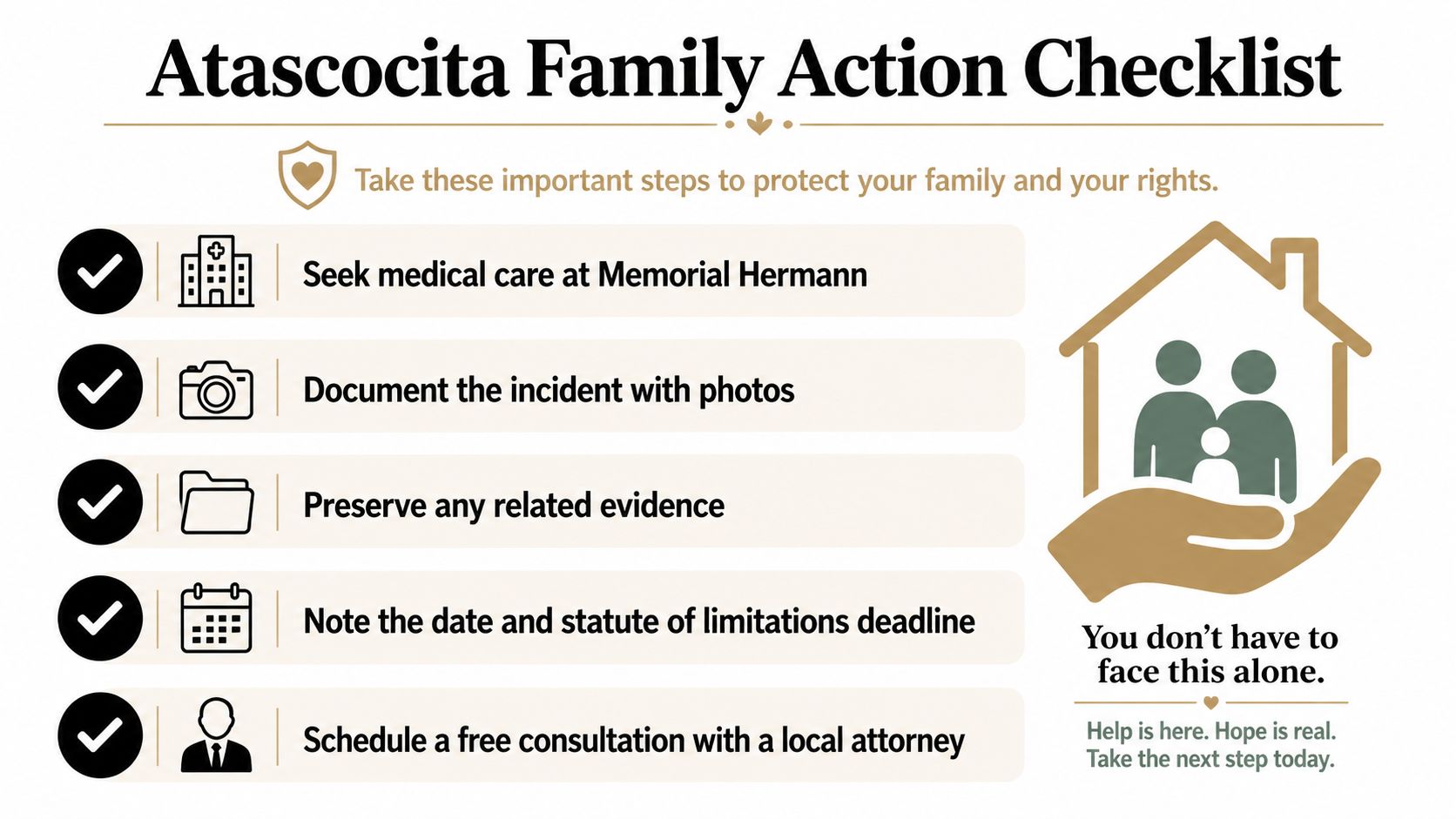
- Medical care: Follow the treating provider's instructions and document symptoms, restrictions, and missed activities.
- Incident record: Take dated photographs, preserve texts and reports, and write down what each witness personally observed.
- Safety response: Remove the child from any continuing hazard and notify the responsible school, daycare, property owner, or driver.
- Reporting: If you have cause to believe abuse or neglect occurred, use the Texas Abuse Hotline or contact law enforcement promptly. The supplied Texas reporting guidance identifies a 48-hour reporting requirement for applicable professionals, and current rules should be confirmed because reporting obligations can differ.
- Insurance communications: Decline recorded statements until you've received legal advice. Give basic claim information without guessing about fault.
- Deadlines: Track the civil limitations deadline, any government-claim notice requirement, and insurer-specific notice instructions. A two-year period often applies to bodily-injury claims, but exceptions can change the result.
For local follow-up, families may need information from the Atascocita Volunteer Fire Department, the Harris County Precinct 4 Constable's office, Humble ISD, a daycare director, or Texas DFPS Region 6. Ask each organization how to request records and keep the request and response in your case file.
A child injury can involve premises liability, an auto claim, negligent supervision, criminal defense, custody protection, or CPS advocacy. The right next step depends on who was responsible for the child, how the injury occurred, what the medical records show, and whether any agency has opened an investigation.
The Law Office of Bryan Fagan, Atascocita TX Lawyers, helps families evaluate child-injury claims, premises liability, auto collisions, negligent supervision, CPS overlap, and related custody or criminal concerns. Visit Law Office of Bryan Fagan – Atascocita TX Lawyers to schedule a free consultation and discuss the incident with a local legal team serving Atascocita, Humble, and Harris County.