Skip to content
At 9:17 p.m., your phone buzzes. Your child says they do not want to go back. A teacher has concerns. A relative sends photos from the other home, and what you see makes your stomach drop. You are in Atascocita, maybe down the road in Humble, and you need to decide what to do before this gets worse.
Start with the right priority. Protect your child first, then protect your case. Texas judges can sign emergency orders when a parent brings credible proof of immediate danger to a child. In Harris County, speed matters, but so does discipline. Rash texts, angry confrontations, and half-documented accusations can damage a strong case.
You are not looking for a law school lecture. You need a practical plan for the next 48 hours, focused on safety, evidence, and getting into the right courthouse with the right facts. If you are weighing whether to file on your own, read this guide on emergency custody without a lawyer in Texas in Atascocita before you make that call.
This article is built for that moment. Calm down, get organized, and act with purpose.
Your Child's Safety Is at Risk What Do You Do Now
When a parent calls in a panic, the facts are usually messy at first. The child missed school. The other parent stopped answering. There's talk of drugs in the home, violence in front of the child, or a medical issue that was ignored. In that moment, most parents do one of two things. They freeze, or they explode.
Neither helps your case.
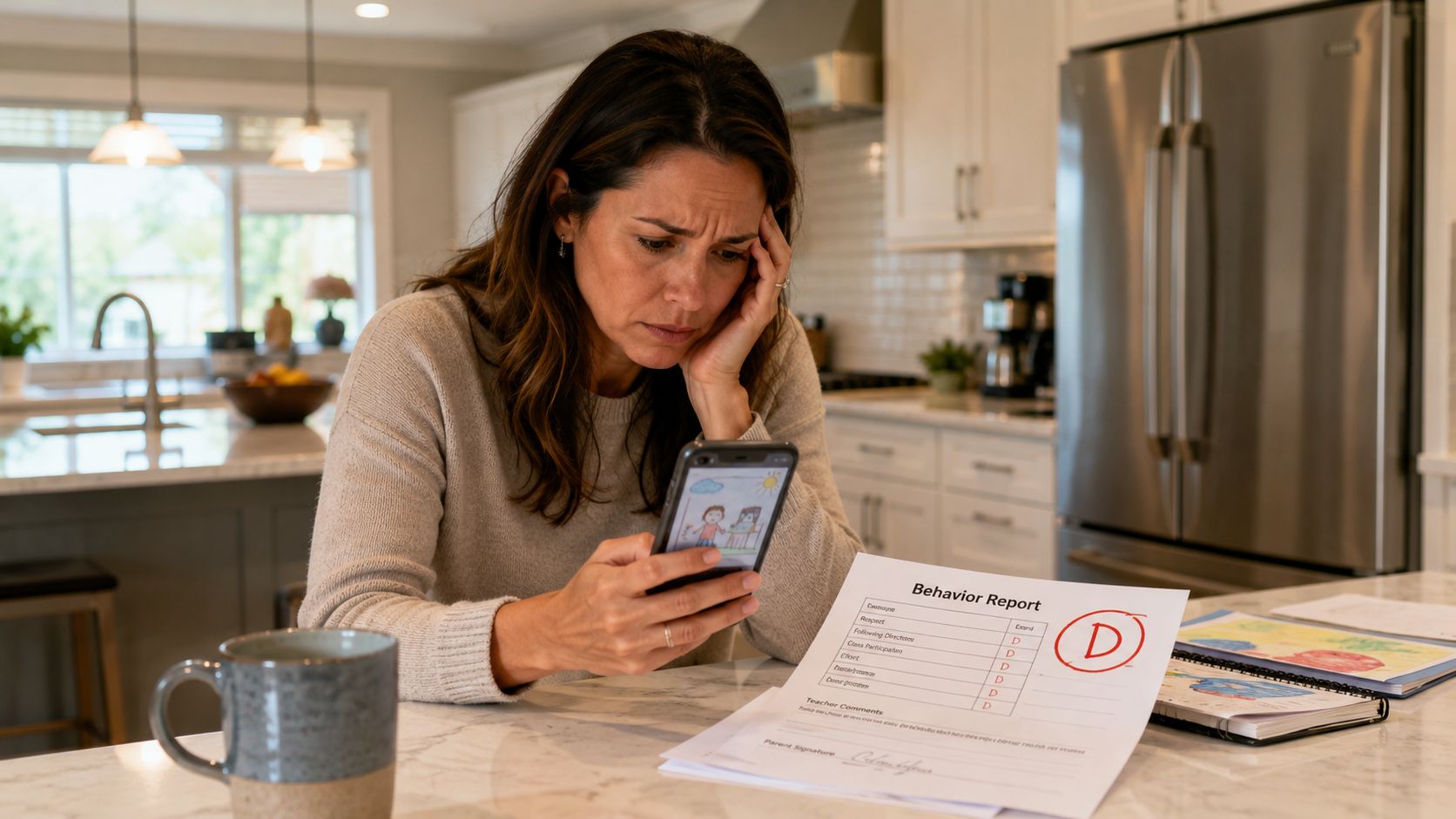
What helps is taking control. If the child is with you and safe, keep things calm and stable. If the child is not safe, contact law enforcement or the appropriate emergency authorities right away. Then start preserving evidence. The court will want dates, events, records, and sworn facts.
Many parents also want to know whether they can act on their own before getting legal help. If that's where you are, read this guide on emergency custody without a lawyer in Texas in Atascocita so you understand the risks and the process.
Practical rule: Panic is normal. Sloppy action is expensive. Slow your breathing and start building your proof.
Emergency custody is not a final victory. It's a short-term protective tool. The court's priority is protecting the child now and sorting out the broader custody dispute after that. If you act with discipline in the first hours, you give yourself a real chance to get in front of a Harris County judge with something solid.
What Constitutes a Child Emergency in Texas
Texas courts do not treat every custody problem as an emergency. They step in fast when a child faces present, specific danger. If you are in Atascocita and deciding whether to go to the Harris County courthouse right now, ask one question: what happened that puts your child at risk today, not someday?
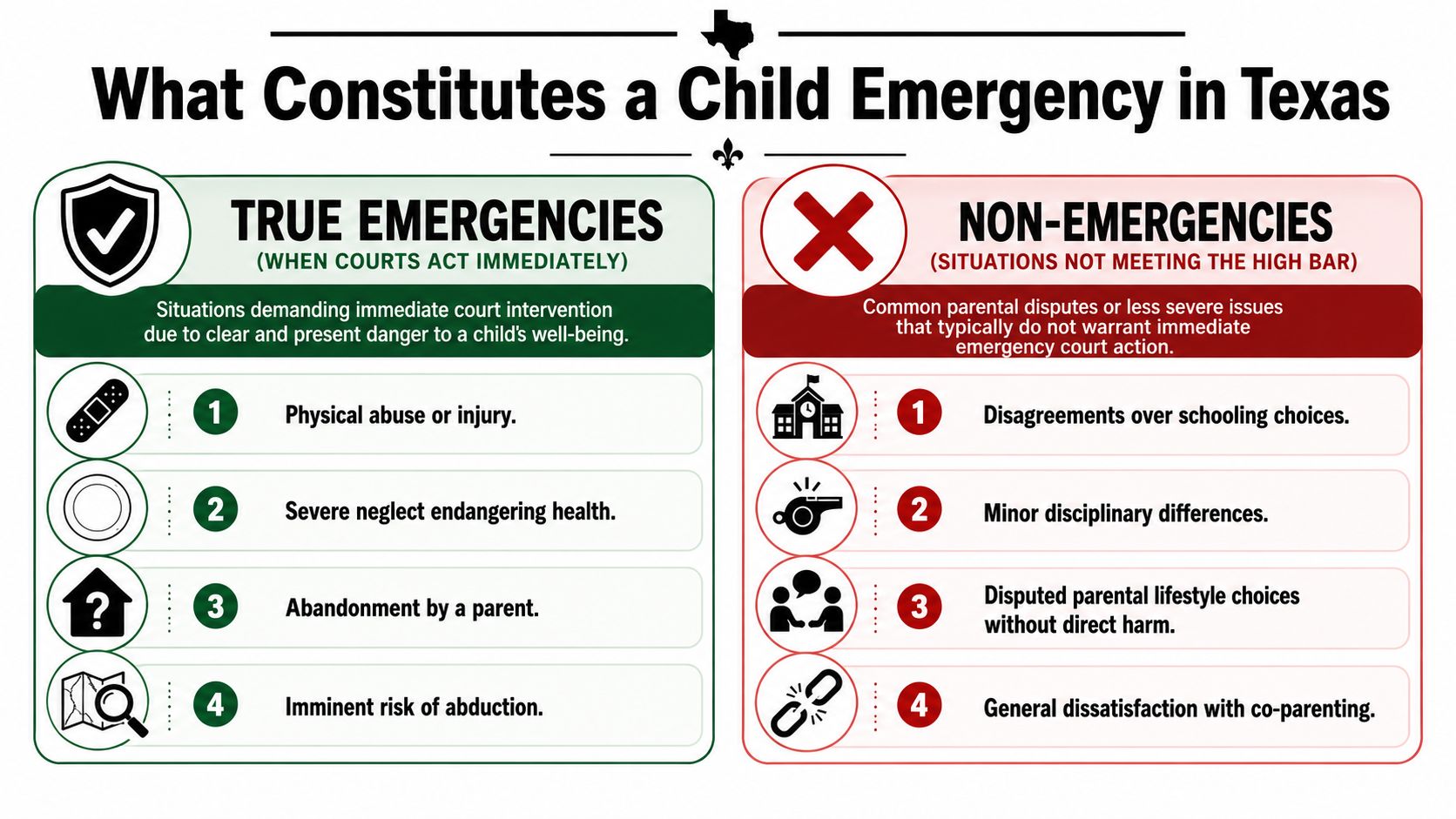
A judge wants facts that show immediate danger. Abuse. Serious neglect. Active drug use while caring for the child. Threats of taking the child and disappearing. Ignored medical needs. Unsafe people in the home with a real connection to the child's safety. The court is not looking for a long history of bad co-parenting. It is looking for a current problem that cannot wait for the normal custody process.
Situations that usually support emergency action
These cases usually have a clear event, a clear risk, and something you can prove.
- Physical abuse or recent injury: Bruises, marks, assaults, violent discipline, or credible statements from the child that line up with records, photos, or witness accounts.
- Serious neglect: A young child left alone, a dangerous home, no food, untreated illness, or a parent who disappears and leaves the child without proper care.
- Substance abuse tied to caregiving: A parent is intoxicated while driving with the child, passed out while supervising the child, or exposing the child to drug activity in the home.
- Dangerous people with access to the child: A violent partner, repeated domestic violence in the home, or a person with a known history of harming others who is now around the child.
- Abduction or concealment risk: Specific acts showing a parent may flee, hide the child, or ignore existing court orders to keep the child from the other parent.
If you need help building proof for one of those claims, review what Harris County judges usually expect in an evidence checklist for a custody case in Harris County.
Situations that usually do not qualify
Some custody problems are real and frustrating. They still do not justify emergency relief by themselves.
| Likely not enough by itself | Why courts hesitate |
|---|---|
| Disagreement over school choices | That is usually handled in a standard custody case |
| Different parenting styles | Judges do not police every parenting difference |
| A new boyfriend or girlfriend you dislike | Personal dislike does not prove danger |
| Missed calls or rude messages | Bad communication is not the same as immediate harm |
| General co-parenting conflict | Conflict alone does not show the child is unsafe now |
Here is the clean test. Could you explain the danger to a stranger in three sentences, with dates and proof, and make that person say, “A judge needs to see this today”? If the answer is no, you may still have a strong custody issue, but not an emergency filing.
What Harris County judges look for
Judges in Harris County care about timing, detail, and credibility. They want to know when the danger happened, how recent it is, who saw it, what records exist, and what risk the child faces if nothing changes today.
Parents in Atascocita and Humble often hurt their own case by filing based on anger. Do not spend your energy proving the other parent is difficult. Prove the child is in danger.
That means specific conduct. Specific dates. Specific evidence.
If the other parent's new partner has a violent history and now lives in the home, your opinion about that relationship does not matter. What matters is whether that person has direct access to the child, whether there have been threats or police calls, and whether you can show the risk clearly. That is the standard you should use before you rush into court.
Your First 24 Hours Documenting Evidence for Your Case
Your first job is not writing a long emotional statement. Your first job is creating an organized record that a judge can understand quickly.
Start here.

Secure the child and stop making the situation worse
If the child is with you and currently safe, keep the child in a stable environment. Don't put the child in the middle. Don't coach the child on what to say. Don't send threatening texts to the other parent. Don't post online.
Those mistakes show up in court.
Build a same-day evidence file
Create one folder on your phone or computer and put everything there. Keep it simple and chronological.
- Save communications: Screenshot texts, preserve voicemails, emails, call logs, and messages from school staff or relatives.
- Photograph conditions: Take clear photos of injuries, unsafe living spaces, damaged property, or anything relevant to neglect or abuse.
- Write a timeline: List the event, date, time, location, who was present, and how you learned about it.
- Identify witnesses: Teachers, neighbors, relatives, doctors, counselors, and officers can matter.
- Keep records untouched: Don't crop messages in a way that changes context. Don't edit recordings. Preserve originals.
For a more detailed breakdown, review this local guide on evidence needed for a custody case in Harris County, Texas.
Here's a plain-language video that helps frame the urgency and proof issues involved in these cases:
Get official records when the facts justify it
If there has been violence, serious neglect, or an immediate safety issue, call the proper authorities. Police reports, medical records, and any child-protection records can become critical. Texas emergency filings are strongest when they're supported by dates, incidents, police reports, medical records, or CPS concerns rather than broad accusations.
That's why I tell parents this. If an event is serious enough to ask a judge for emergency relief, it's serious enough to document through the proper channels when appropriate.
What to avoid: Don't exaggerate. Don't stack old complaints into a fake emergency. If the danger is real, the facts are enough.
Use a simple evidence checklist
- Child safe now
- Timeline started
- Texts and calls saved
- Photos taken
- Witness list created
- Official reports requested or made when necessary
- Current court orders located
- Lawyer contacted
If there's already a custody order in place, pull it out immediately. The exact language matters. A parent who violates an existing order without a defensible emergency reason can hurt an otherwise valid case. You need to know what the order says before you make your next move.
Filing for an Emergency Order in Harris County
Parents often think emergency custody starts with a desperate phone call to the court. It doesn't. It starts with a legal filing.
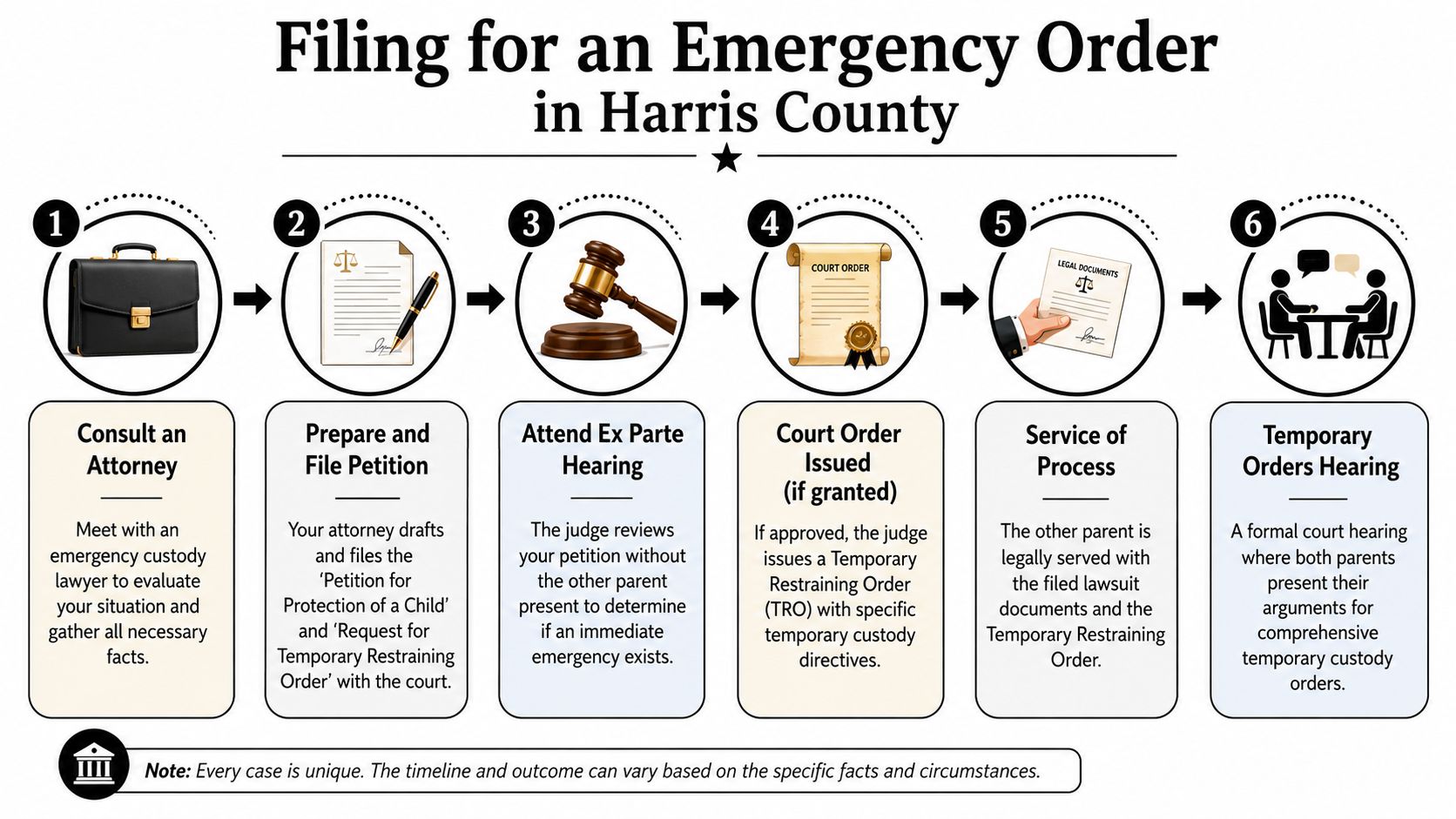
For Texas parents, an emergency custody request is typically pursued through a Temporary Restraining Order with extraordinary relief. The sequence matters. You file the underlying custody petition first, then present sworn evidence showing the child faces immediate danger so a judge can act without notifying the other parent at the outset, as explained in this discussion of Texas emergency custody TRO procedure.
Where Atascocita families usually file
If you live in Atascocita, your emergency family-law matter is generally handled in Harris County. That means dealing with a major court system serving the Houston area, not a small neighborhood office.
If you want a broader orientation to the local system, Harris County Family Courts: A Atascocita Resident's Guide gives a factual overview of how family law cases proceed in the Harris County courts serving Atascocita.
You should also review this page on an emergency child custody hearing in Atascocita, Texas because the hearing that follows the initial filing is where many parents lose momentum.
What gets filed
A proper emergency filing usually includes a few core pieces working together.
- Underlying custody petition: This opens the actual case.
- TRO request: This asks for immediate emergency relief.
- Sworn affidavit or declaration: This is your factual story under oath.
- Supporting evidence: Screenshots, reports, records, and other proof that backs up the affidavit.
The affidavit matters more than most parents realize. It should be clear, direct, dated, and specific. Judges don't want a novel. They want facts they can rely on.
What ex parte means in plain English
An ex parte request means the judge may review your emergency request without the other parent being present at that first stage. That's allowed because the issue is immediate risk. If the court had to wait for full notice in every case, some children would remain in danger while paperwork crawled forward.
But don't misunderstand that. Ex parte relief is narrow. If your filing sounds inflated or unsupported, the court can refuse to act.
Ask for exactly what the facts support. Overreaching is one of the fastest ways to lose credibility.
The practical filing mindset
Think like a judge reading fast in a crowded docket.
Use this checklist before filing:
| Filing question | What your evidence should answer |
|---|---|
| What happened? | A specific event or pattern tied to danger |
| When did it happen? | Exact or approximate dates and times |
| Why is it urgent? | Current risk, not stale history |
| How do you know? | First-hand facts, records, witnesses |
| What do you want the judge to do now? | Temporary relief tied to the danger |
That's how an emergency custody lawyer near Atascocita, Texas should frame your case. Not with drama. With precision.
What to Expect at Your Temporary Orders Hearing
The first emergency order, if granted, is not the end of the fight. It's the beginning of a more formal stage where both parents can be heard.
For Atascocita residents, these matters are generally handled in Harris County at the Harris County Civil Courthouse in Downtown Houston. At the follow-up hearing, the court focuses on the child's best interest, not on a parent's gender. Courts weigh stability, compliance with orders, and child-centered evidence, as discussed in this local overview of family-law practice for Atascocita residents.
What the courtroom feels like
You'll likely be in a busy courthouse with a crowded family docket. People are waiting on divorce issues, support disputes, modifications, and custody matters. Your case matters greatly to you, but to the court it's one of many. That's why preparation matters so much.
A parent who arrives organized has an advantage. A parent who arrives angry and unfocused usually wastes it.
What the judge is deciding
At this hearing, the judge is looking at whether temporary protections should stay in place while the larger case moves forward. The court is not deciding every final custody issue. The judge is deciding what arrangement best protects the child and preserves stability for now.
That means your presentation should stay centered on the child.
- Bring proof of involvement: School communication, medical coordination, counseling records, and caregiving history matter.
- Show compliance: If there are existing orders, follow them unless a true emergency made immediate protective action necessary.
- Stay factual: The courtroom is not the place for a personal revenge speech.
- Be realistic: Ask for temporary relief the court can reasonably enforce.
Calm testimony beats theatrical testimony. Judges hear conflict every day. They pay attention to the parent who stays grounded.
How to present yourself
Here's the version I want every parent to remember. Dress neatly. Arrive early. Turn off your phone. Listen carefully. Answer the question asked. If you don't know, say you don't know. If you made a mistake, don't dodge it.
The judge will notice whether you sound focused on safety and routine or focused on punishing the other parent. Only one of those helps.
A father can have a strong case. A mother can lose a weak one. The legal standard is the child's best interest. If you've been the parent handling school pickups, doctor visits, routines, and the child's daily stability, that evidence belongs in front of the court.
Why a Local Atascocita Lawyer is Critical for Your Case
Emergency custody is one of the worst times to try to teach yourself litigation from scratch. The paperwork has to be right. The evidence has to be organized. The request has to match the law. And the hearing moves quickly.
A local lawyer matters because Atascocita parents usually end up in the larger Harris County system, where deadlines, filing sequence, and courtroom presentation all matter. This isn't just about getting a hearing. It's about putting the right facts in the right form before the judge sees them.
The case usually gets bigger fast
Many parents start with one goal. Protect my child right now. That's the correct goal. But emergency custody disputes often turn into broader temporary orders covering possession, visitation, and child support. In Texas, child-support guidelines often start at 20% of a noncustodial parent's monthly net resources for one child under Texas child-support guidance discussed for Atascocita families. When emergency relief expands into support and possession issues, mistakes get expensive.
That's why experienced legal guidance at the start is not optional if the facts are serious.
What a lawyer actually does for you
A good emergency custody lawyer near Atascocita, Texas should help you do several specific things well:
- Separate fear from proof: Not every bad fact belongs in the emergency filing.
- Draft a usable affidavit: Clear, sworn, detailed, and focused on immediate danger.
- Prepare for the hearing: Evidence tabs, witness planning, and realistic requests.
- Protect against self-inflicted damage: Bad texts, order violations, and overstatements can wreck a strong case.
- Address connected issues: Possession, visitation, and support often move alongside custody.
If you're comparing options, one local resource is the Child Custody Lawyer in Atascocita, TX page for the Law Office of Bryan Fagan – Atascocita TX Lawyers, which describes custody representation for families in this area.
My advice is simple. Don't hire based on the loudest promise. Hire based on whether the lawyer can quickly evaluate urgency, tighten your evidence, and move in Harris County without wasting a day.
FAQ Quick Answers for Atascocita Parents
How quickly can I get an emergency order
It depends on how fast your petition and sworn evidence are prepared and whether the facts show immediate danger. Emergency relief can move faster than an ordinary custody matter when safety is at issue, but speed follows preparation. If your proof is disorganized, your case slows down.
Can I get emergency custody just because the other parent is irresponsible
Usually not. Courts look for urgent risk to the child, not general frustration with the other parent. Irresponsible behavior becomes legally important when you can tie it to abuse, neglect, abandonment, dangerous impairment, or another immediate threat.
What if the other parent hides the child
Treat that seriously. Preserve all communications, contact law enforcement when appropriate, and get legal help fast. Timing matters in these cases because delays can make recovery harder and can complicate where and how the case proceeds.
Will the judge hear from my child
That depends on the child's age, the facts, and the court's procedures. Don't coach your child. Don't script a statement. Let your lawyer decide the safest and most credible way to present the child-related evidence.
Can an emergency order become permanent
Not by itself. Emergency orders are temporary tools. A later hearing and the broader custody case determine longer-term arrangements.
Should I keep texting the other parent for explanations
Only if it helps create a clear record and you can stay calm. One short, factual message is better than a long emotional thread. Never threaten, insult, or argue in text if you expect a judge to read it later.
Do I need a lawyer if I already have the evidence
Yes, if the case is serious enough to seek emergency relief. Evidence alone doesn't file itself, frame itself, or argue itself in court.
If your child may be in danger, act now. Law Office of Bryan Fagan – Atascocita TX Lawyers works with families in Atascocita, Humble, and northeast Harris County on custody, support, divorce, criminal defense, estate planning, and civil matters. Schedule a free consultation at the Atascocita office to review the facts, protect your child, and decide the next step quickly.