A late-night knock at your Atascocita home, a traffic stop on FM 1960, or a search of a rental can turn an ordinary evening into a controlled-substance case before you've had time to understand what officers say they found. If you're facing possession of a controlled substance in Atascocita, TX, the first decisions matter. What you say, what you preserve, and whether you understand your bond conditions can affect the defense from the beginning.
Texas law doesn't treat every drug case alike. The exact substance, penalty group, aggregate weight, and circumstances of the search can move the case from a misdemeanor-level offense to a felony carrying substantial prison exposure. Harris County residents need a clear plan, not a generic penalty chart.
What Just Happened and What Comes Next
If officers have arrested you in Atascocita, the next hours can shape the case before anyone has reviewed the evidence. Do not explain the case to police after your arrest. Provide identifying information when required, stay calm, and clearly request a lawyer. This guide explains what are your Miranda rights. Invoke those rights clearly, then stop talking.
Texas treats possession of a controlled substance as a penalty-group offense under Chapter 481 of the Health and Safety Code. The charge can change sharply based on the substance, its penalty group, and the aggregate weight. Atascocita cases follow Texas's statewide grading system rather than a separate city punishment chart. The applicable thresholds are summarized in UT Health San Antonio's overview of Texas controlled-substance penalties.
What can happen within hours
After an arrest, officers may prepare paperwork describing the substance, where they say they found it, the search, and statements they attribute to you. A magistrate then addresses release and conditions. Those conditions may determine whether you can return home, keep working, travel, submit to testing, or avoid specific people and places.
The immediate issues include:
- Bond conditions: Personal recognizance or surety release can include requirements you must understand and follow.
- Employment concerns: Tell an employer only what is necessary. Do not discuss case facts that could later be used against you.
- Treatment or detox issues: If substance use is part of the situation, handle medical and treatment decisions carefully, and preserve related records.
- Negotiating position: Statements, consent to another search, deleted messages, or contact with other suspects can make the defense harder.
Practical rule: Protect your silence first, document the encounter while your memory is fresh, and contact a Harris County criminal-defense lawyer before your first magistrate appearance.
Write down where officers stopped or searched you, who was present, what each person said, and what property officers seized. Keep the account accurate. Preserve messages, receipts, prescription records, and photographs. Do not post about the arrest online.
Your next step is a confidential consultation with a local attorney. Counsel can review the probable-cause affidavit and bond paperwork, identify early problems with the search or statements, and help you avoid another damaging conversation.
How Texas Defines Possession of a Controlled Substance
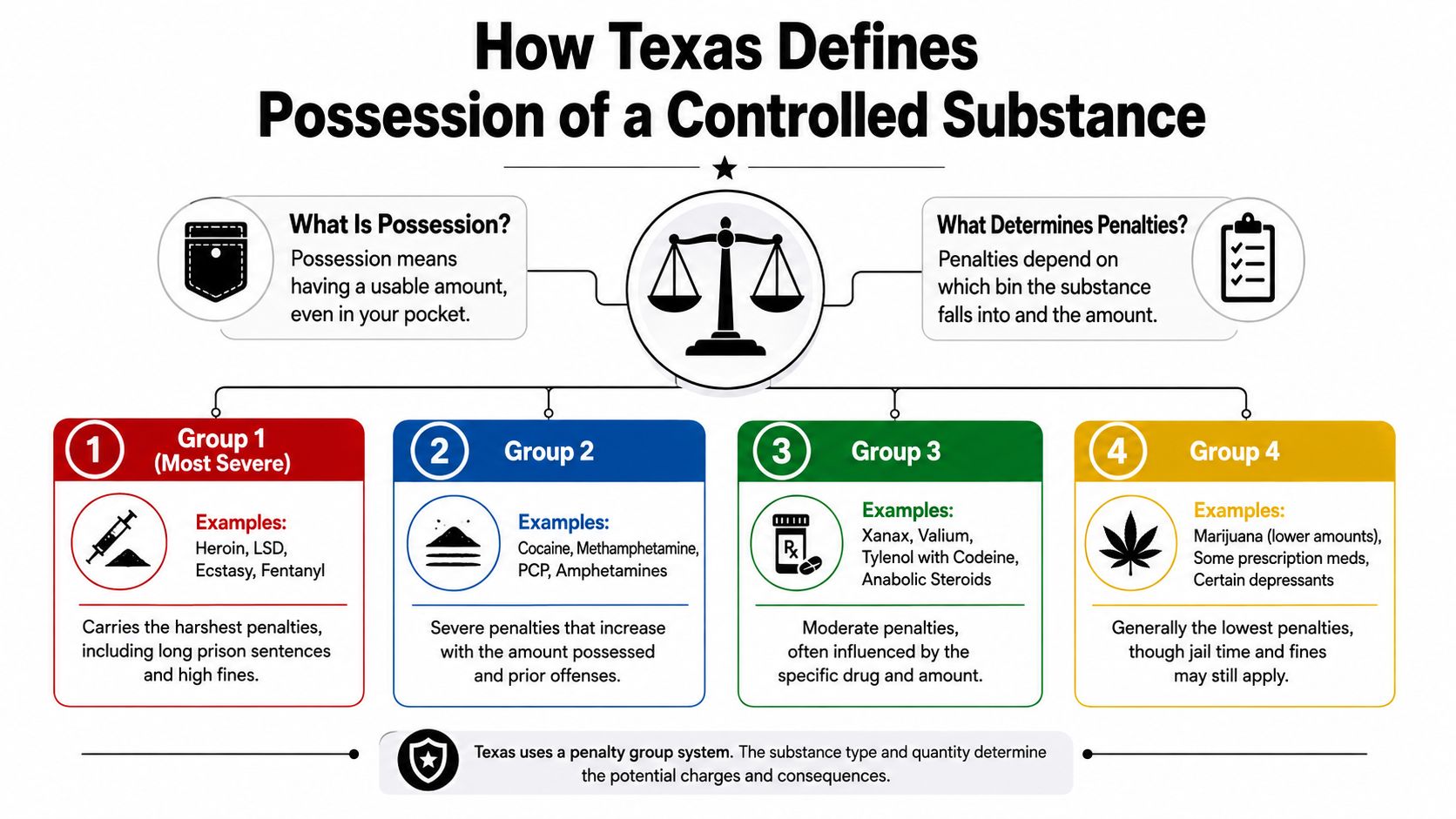
Texas Health and Safety Code Chapter 481 organizes controlled substances into penalty groups. Think of those groups as color-coded risk bins. The bin matters, but the amount inside the bin often determines whether prosecutors file a misdemeanor, state jail felony, or higher felony.
The State must connect a person, a substance, and a particular moment. It must prove that the substance was a controlled substance, that you possessed it, and that you acted knowingly. An arrest label isn't a verdict. A Harris County jury must find every required element beyond a reasonable doubt.
Actual and constructive possession
Actual possession usually means the State claims the substance was physically on you, such as in a pocket, hand, or personal bag. Constructive possession is different. Prosecutors claim you knew the substance was there and exercised care, custody, control, or management over the place where officers found it.
A passenger isn't automatically guilty because officers find a substance in a vehicle. The State still needs evidence linking that passenger to the substance and showing knowledge and control. The same principle matters in a shared apartment or bedroom. A roommate's presence near a substance doesn't automatically establish possession.
The surrounding facts can include ownership or control of the property, fingerprints, statements, proximity, access, personal belongings, and conduct during the search. None of those facts replaces the State's burden, and a defense lawyer should test whether the evidence shows actual knowledge or merely association.
Why residue and small amounts still matter
A prosecutor may rely on residue, fractional amounts, or a casual-use quantity if laboratory testing identifies a controlled substance and the evidence satisfies the legal requirements. The issue isn't whether the amount looked significant to you. It's whether the State can prove the substance, the weight classification, and knowing possession under the charged statute.
Drug terminology can also confuse families. A plain-language resource on downer drugs explained for families may help relatives understand broad categories, but it can't determine how Texas prosecutors will classify a specific substance. That requires the charging document, laboratory evidence, and applicable penalty group.
Penalty Groups and the Weight Thresholds That Drive Felony Levels
A small bag found during an Atascocita stop can become a felony allegation once the laboratory identifies the substance and calculates the charged weight. Texas punishment depends on two questions: what substance was allegedly possessed, and how much did the State count? The answer may turn on aggregate material, including adulterants or dilutants, instead of only the active ingredient. The lab report, testing method, and chain of custody therefore deserve close review from the start.
For Penalty Group 1, the statutory structure is steep. Less than one gram is a state jail felony. One to less than four grams is a third-degree felony. Four to less than 200 grams is a second-degree felony. From 200 to less than 400 grams, the offense is a first-degree felony. At 400 grams or more, the punishment can be 10 to 99 years or life in prison and up to a $100,000 fine. The ranges appear in Texas Health and Safety Code Section 481.115.
Other penalty groups use the same basic weight-driven approach, but their thresholds and measurement rules differ. Penalty Group 3 and Penalty Group 4 carry separate structures. Possession of less than 28 grams in PG3 is generally a Class A misdemeanor, while less than 28 grams in PG4 is generally a Class B misdemeanor. The exact statute, substance, and prescription status still control.
A working chart, not a prediction
| Substance | Penalty Group | State Jail Felony example weight | Third-Degree Felony | Second-Degree Felony | First-Degree Felony example weight |
|---|---|---|---|---|---|
| Cocaine | Usually PG1 | Less than 1 gram | 1 to less than 4 grams | 4 to less than 200 grams | 200 to less than 400 grams |
| Methamphetamine | Usually PG1 | Less than 1 gram | 1 to less than 4 grams | 4 to less than 200 grams | 200 to less than 400 grams |
| Fentanyl | Commonly addressed through PG1 provisions | Less than 1 gram | 1 to less than 4 grams | 4 to less than 200 grams | 200 to less than 400 grams |
| Ecstasy | Classification depends on the charged substance and form | Must be verified from the charging statute | Must be verified | Must be verified | Must be verified |
| Hydrocodone | Often analyzed under prescription-drug penalty provisions | Depends on the applicable group | Depends on the applicable group | Depends on the applicable group | Depends on the applicable group |
| Xanax | Commonly analyzed under PG3 when unlawfully possessed | Usually not the same PG1 structure | Depends on weight and statute | Depends on the applicable group | Depends on the applicable group |
| Hemp-derived THC | Governed by the applicable hemp framework when the product meets the delta-9 THC limit | Not classified under this chart solely because it contains THC | Must be evaluated under the applicable law | Must be evaluated under the applicable law | Must be evaluated under the applicable law |
| Marijuana under Chapter 481 | Separate from qualifying hemp-derived THC products | Must be verified from the charging statute | Must be verified | Must be verified | Must be verified |
| Synthetic cannabinoids | Classification depends on the specific substance | Must be verified from the charging statute | Must be verified | Must be verified | Must be verified |
The hemp and marijuana distinction matters. Hemp-derived THC and marijuana are not interchangeable legal categories. A product that falls within the applicable delta-9 THC limit under the 2019 and 2024 hemp framework requires a different analysis from marijuana charged under Chapter 481. The charging instrument and laboratory evidence must identify what product the State claims it seized.
The chart is a starting point, not an outcome forecast. The Texas District and County Attorneys Association drug-punishment chart explains that some substances, including Penalty Group 1-A and 2-A substances, use dosage units or pound-based thresholds instead of ordinary gram measurements.
Factors that can change the case
Prior felony convictions, drug-free-zone allegations, packaging, multiple containers, alleged intent to deliver, and federal involvement can change the defense strategy. Packaging or quantity may prompt prosecutors to investigate delivery, while federal agency involvement can create separate federal exposure.
Fines, supervision conditions, license consequences, and employment effects require their own review. A low quantity does not make the case harmless, and a serious charge does not establish guilt. The immediate task is to verify the statute, penalty group, net weight, mixture composition, laboratory method, and evidence supporting knowing possession. Those details should be checked before anyone decides whether to seek dismissal, negotiate, pursue diversion, or prepare for trial.
The Arrest and Court Process in Harris County
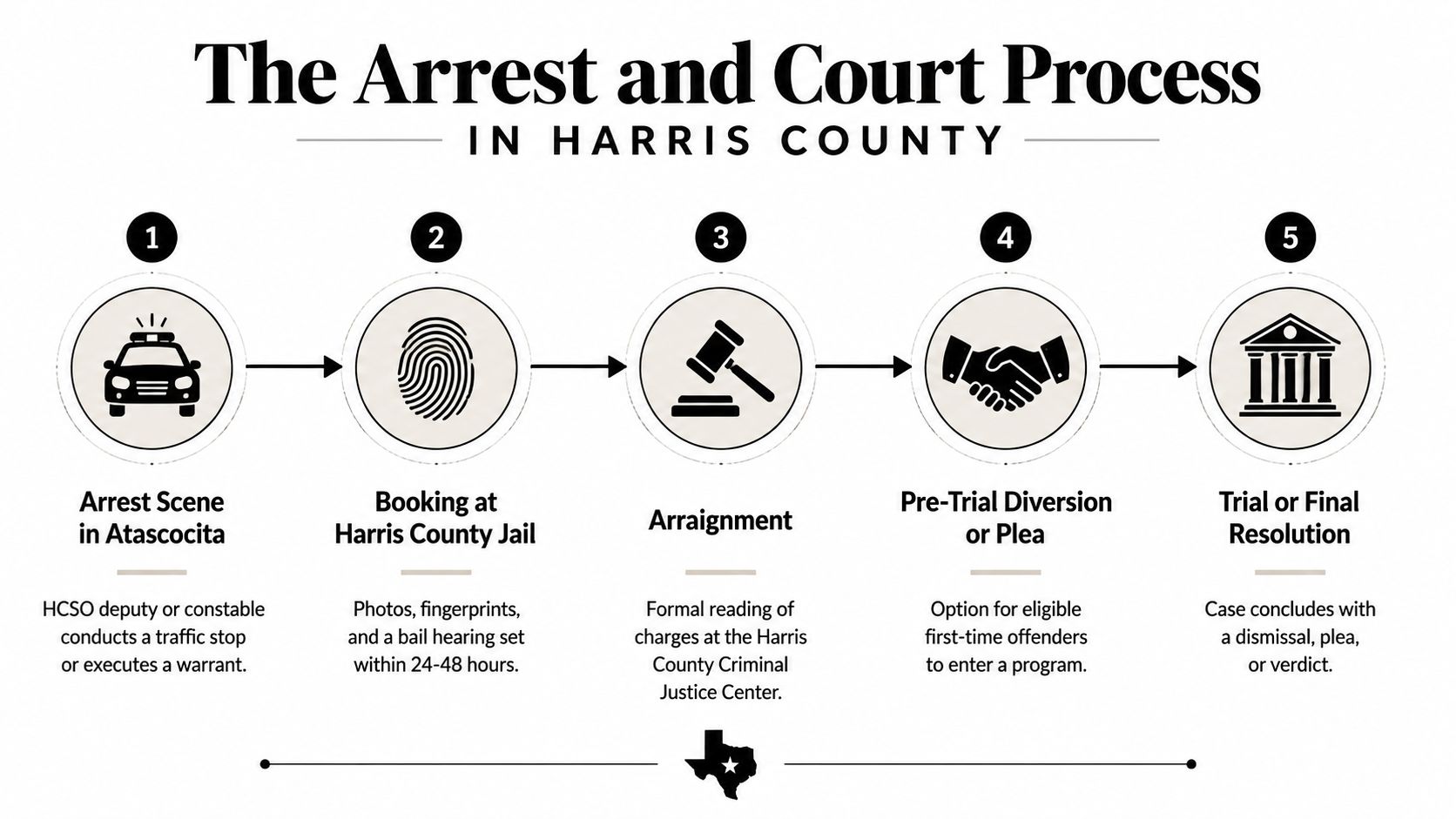
An Atascocita arrest may involve the Harris County Sheriff's Office, a constable, or the Texas Department of Public Safety. The initial scene matters because the legality of the stop, detention, consent request, search, and seizure can shape every later stage.
After arrest, the person is processed through the Harris County system, which can include booking, photographs, fingerprints, and a probable-cause review. Magistration generally addresses release and conditions within the early detention period, commonly within 48 hours. The judge may consider a personal recognizance release or a surety bond, along with conditions such as drug testing, travel limits, or geographic restrictions.
From booking to a charging decision
The Harris County District Attorney's Office reviews the case for filing. A felony matter may go through the grand-jury process before indictment. A misdemeanor follows a different route, but the defense still needs to track settings, evidence, and release obligations from the start.
Most Atascocita felony defendants will encounter the Harris County Criminal Justice Center and one of the felony district courts, potentially including the 184th District Court. The assigned court depends on the filing and docket. A lawyer should confirm the court rather than assume that every case follows the same calendar.
For a practical explanation of the first formal court setting, review what happens at an arraignment hearing. The important point is that an arraignment isn't the moment to improvise. Counsel should already understand the allegations, bond conditions, and immediate evidence issues.
What happens before resolution
Pretrial hearings may address discovery, suppression motions, laboratory records, witness issues, and negotiations. The defense may ask prosecutors to dismiss, reduce, or resolve the case through an alternative pathway. The prosecutor may evaluate the evidence, criminal history, alleged weight, search circumstances, and any aggravating allegations.
A plea is only one possible ending. Other outcomes can include dismissal, deferred adjudication, treatment-oriented programs, or trial. Trial preparation involves jury selection, opening statements, witness testimony, cross-examination, exhibits, closing arguments, and the State's burden to prove guilt beyond a reasonable doubt.
Family-law proceedings are separate from criminal prosecution. For context on how family cases proceed in the courts serving Atascocita, see Harris County Family Courts: A Atascocita Resident's Guide.
Defenses and Diversion Options Worth Exploring
A strong defense starts with the evidence, not the charge's title. A lawyer should obtain and review the offense report, probable-cause affidavit, body-camera footage, dispatch records, search documentation, laboratory material, and chain-of-custody records.
Search and seizure questions
The traffic stop may be challenged if officers lacked a lawful basis to detain you or extended the stop without proper justification. Consent can be disputed when officers claim permission but the circumstances show pressure, confusion, or an unclear scope. Plain-view claims, inventory searches, vehicle searches, and canine procedures also deserve close review.
If a judge suppresses critical evidence, the State may lose the proof needed to establish possession or the substance's identity. That's why the exact sequence matters. Tell your lawyer what happened before the search, not only what officers found afterward.
Possession and laboratory challenges
Constructive-possession cases often turn on whether you knew about the substance and controlled the location. A defense may focus on shared occupancy, multiple passengers, lack of ownership, lack of access, momentary handling, or the absence of connecting evidence.
The laboratory side is equally important. Counsel should examine whether the tested material came from the alleged substance, whether the sample was properly sealed and tracked, and whether the reported weight crosses a felony threshold. A small measurement dispute can have major charging consequences.
| Defense or Pathway | What It Challenges or Offers | Typical Eligibility Factor |
|---|---|---|
| Suppression motion | Challenges an unlawful stop, detention, consent search, or seizure | Facts showing a constitutional or procedural defect |
| Possession defense | Challenges knowledge, control, ownership, or connection to the substance | Weak or ambiguous links between the person and the item |
| Laboratory review | Tests identity, mixture, aggregate weight, and chain of custody | Records or measurements requiring independent scrutiny |
| Prescription defense | Addresses lawful possession of medication or authorized use | Valid prescription or applicable legal authorization |
| Pretrial intervention | Seeks a program-based resolution without a conventional conviction path | Prosecutor requirements, history, facts, and program compliance |
| Treatment court | Combines court supervision with substance-use treatment | Qualification under the program's screening rules |
| Deferred adjudication | Provides a supervision-based resolution with potential later discharge | Court, prosecutor, offense, history, and compliance factors |
Texas law can recognize lawful possession based on a prescription or other authorization, but the documents must match the substance and circumstances. The Texas Compassionate Use Act and licensed-physician exceptions require specific analysis, not assumptions based on a medication bottle.
Diversion isn't automatic. Eligibility may depend on criminal history, offense facts, substance type, weight, prior supervision, admission requirements, and willingness to complete treatment or testing. Read about the differences in deferred adjudication versus pretrial diversion in Atascocita, TX before agreeing to a proposed resolution.
Separate family matters may arise while a criminal case is pending. For a different Harris County issue, Grandparents' Rights in Atascocita addresses custody and visitation rights for grandparents.
First 48 Hours After a Charge
The first two days call for discipline, not panic. Your job is to protect the defense, secure lawful release, and preserve information before memories and records become harder to obtain.
Ask for a lawyer before answering questions. Don't try to talk your way out of the arrest. After requesting counsel, avoid discussing the facts with officers, cellmates, friends, or anyone who might later become a witness.
Follow every bond condition. Read the order carefully. Testing, no-contact requirements, geographic limits, and reporting obligations are not suggestions. A violation can create a new problem and damage your credibility with the court.
Preserve documents and evidence. Gather prescriptions, medical records, treatment history, employment proof, school enrollment records, and evidence of community ties. Write a factual timeline of the stop or search, and preserve relevant texts, receipts, photographs, and location information.
Handle communication carefully. Tell family and work only what they need to know. Don't post on social media, contact alleged co-defendants, or ask someone else to delete messages. If property was seized, make a list and give it to counsel rather than trying to recover items informally.
Prepare for the first appearance. Identify potential sureties, collect release information, and make sure your lawyer knows about medications, medical needs, employment, housing, and treatment history.
Families trying to understand why fast intake matters can review Attorney Assistant intake case insights. The useful lesson is practical: early, organized information gives counsel more to investigate before the case moves forward.
Schedule a consultation before the first court appearance whenever possible. Your lawyer should have time to review the arrest paperwork, identify immediate motions, and advise you about statements, release, and contact with other people involved.
How the Law Office of Bryan Fagan Can Help
Working with a local defense lawyer should begin with a focused intake, not a sales pitch. An Atascocita resident can start by arranging a same-day or next-morning consultation at the Kingwood or Houston office, then bringing the bond paperwork, charging documents, prescription records, medical information, employment details, and any photographs or messages tied to the arrest.
The legal team reviews the arrest report and probable-cause affidavit, then identifies what needs to be obtained. That can include body-camera footage, dispatch records, search documentation, laboratory reports, and chain-of-custody material. The review should also address whether the alleged weight crosses a statutory threshold and whether the evidence establishes knowing possession.
Possible strategies include a motion to suppress evidence, a challenge to laboratory identification or aggregate weight, an argument that the State can't prove knowledge or control, and pursuit of a qualifying pretrial diversion or treatment option. The appropriate path depends on the facts, criminal history, court requirements, and prosecutor's position. No responsible lawyer can promise a dismissal or specific sentence before reviewing the file.
The Law Office of Bryan Fagan – Atascocita TX Lawyers handles criminal-defense matters alongside family, civil, and estate-planning work for residents of Atascocita, Humble, and Harris County. For a controlled-substance case, the next step is to organize the documents, protect your silence, and schedule a consultation so the defense can begin before avoidable mistakes narrow your choices.
The Law Office of Bryan Fagan – Atascocita TX Lawyers offers local legal guidance for controlled-substance charges, including evidence review, search challenges, and evaluation of available case resolutions. Visit the firm's website to schedule a free consultation and discuss your Atascocita or Harris County case with an attorney.