You're leaving a restaurant near FM 1960 in Atascocita when a broken taillight brings a traffic stop. A handgun is found during a search of the vehicle. You believed Texas allowed permitless carry, so the handcuffs feel impossible to understand. Within minutes, you're headed toward Harris County processing, trying to remember whether anyone explained what you're accused of doing.
That situation can become more complicated near the Atascocita High School area, along Beltway 8, or during contact with law enforcement serving the Humble area. Officers may focus on where the firearm was found, who controlled the vehicle, whether alcohol or another allegation is involved, and whether you're legally eligible to carry. Even a person who holds a license can face arrest if the location or circumstances create a separate prohibition.
The phrase unlawful carry Atascocita TX covers more than a permit question. Texas law includes exceptions, disqualifiers, vehicle rules, and location-based felony exposure that many ordinary gun owners never investigate until after an arrest.
A Night That Changed Everything in Atascocita
The driver had finished dinner off FM 1960 and was heading home toward the Atascocita High School area. The stop began with a broken taillight, not a weapons complaint. During a consensual search, the officer saw a handgun beneath the driver's seat and asked who it belonged to.
The driver answered truthfully. He believed the firearm could legally remain in his vehicle. The officer's tone changed, the questions became more pointed, and the driver was placed in handcuffs. There wasn't a warning that made the situation feel understandable. There wasn't time to sort through the legal details before the trip toward a Harris County processing location serving the Humble and northeast Harris County area.
That story is plausible because the legality of carrying depends on more than whether Texas generally permits a person to carry without an LTC. Officers may examine the firearm's location, the person's eligibility, the reason for the stop, any allegation of criminal activity, possible intoxication, and the destination where the firearm was found.
Practical rule: Don't explain the entire history of a firearm during a roadside investigation. Provide required identifying information, state that you want to remain silent, and ask for a lawyer.
A routine traffic stop doesn't automatically prove unlawful carry. The State still has to establish the elements of an offense, and a defense lawyer must examine whether the search was lawful, whether the firearm was possessed, and whether an exception applies. A person's proximity to a handgun isn't always the same as legal possession.
The rest of the legal situation turns on those details. Texas Penal Code provisions can treat ordinary carry as a misdemeanor in one setting and expose a person to felony prosecution in another. That's why a stop on the way home from dinner, a drive along Beltway 8, or a night out in the Atascocita and Kingwood area can require immediate legal attention.
What Texas Law Means by Unlawful Carry
A permitless-carry rule does not make every handgun carry lawful. Under Texas Penal Code Section 46.02, the State generally must prove that a person intentionally, knowingly, or recklessly carried a handgun on or about the person while no lawful exception applied. Read the statute with current Texas guidance, because eligibility, conduct, and location still control the charge. Texas Penal Code Section 46.02
A defense lawyer should test several points:
- Weapon type: Was the object legally treated as a handgun?
- Carrying conduct: Was it on or about the person, rather than merely nearby?
- Eligibility: Could the person legally possess and carry the firearm?
- Mental state: Can the State prove intentional, knowing, or reckless conduct?
- Location and circumstances: Did the carry occur in a vehicle, on private property, or in a prohibited place?
A handgun can generally be carried in a private vehicle without an LTC if the person is otherwise legally permitted to possess a firearm. DPS explains that vehicle carry still has conditions, and broader restrictions continue to apply. License holders also face vehicle-related requirements involving concealment or a holster. DPS guidance on laws related to carrying a handgun
Carrying Is Different From Carrying in a Prohibited Place
Section 46.02 is separate from the offense involving a prohibited location. Texas law identifies restricted places that include schools, college campuses, polling places, courts and court offices, correctional facilities, hospitals and nursing facilities, secured airport areas, and premises licensed to sell alcohol for on-site consumption. Texas Penal Code Section 46.03 summary
That distinction creates risks an ordinary Atascocita resident may miss. A person may satisfy the general carry rule and still face a separate allegation after entering a courthouse, hospital, school-related event, or alcohol establishment. The setting, signage, licensing status, and the person's conduct all deserve review before anyone assumes the case is minor.
Harris County family-law proceedings follow their own court process, outlined in Harris County Family Courts: A Atascocita Resident's Guide. A firearm can create a separate legal problem at a courthouse, even when the person entered for a routine hearing.
The charge must be identified accurately first. Intoxication, prior felony status, protective orders, gang-member status, and the exact location can change the analysis substantially. Get the arrest report, search details, and location records reviewed before discussing the facts with anyone other than your lawyer.
Penalties That Can Turn a Misdemeanor Into a Felony
A routine stop in Atascocita can become a serious criminal case after one detail changes. Under the general unlawful-carry rule, the offense is usually a Class A misdemeanor, carrying up to 1 year in county jail and a fine up to $4,000. Texas Penal Code Section 46.02
The charge can rise to a felony when the firearm is carried on premises licensed or permitted for on-site alcohol sales. The stated range is 2 to 10 years in state prison and a fine up to $10,000.
| Offense Scenario | Charge Level | Maximum Confinement | Maximum Fine |
|---|---|---|---|
| General unlawful carry under Section 46.02 | Class A misdemeanor | Up to 1 year in county jail | Up to $4,000 |
| Carry on premises licensed or permitted for on-site alcohol sales | Third-degree felony | 2 to 10 years in state prison | Up to $10,000 |
The business name alone does not settle the issue. A restaurant, bar, sports venue, or other Atascocita business may have alcohol licensing details that affect the charge. Your lawyer should verify the premises' license, the area where the firearm was found, posted notices, and whether the State can prove the required facts.
Why the setting changes the defense
A firearm in a private vehicle presents a different question from a firearm carried into a Kingwood-area sports bar. School property and other prohibited places create separate location concerns, and the State may pursue a charge different from ordinary unlawful carry. The Texas State Law Library's Texas gun-law guidance identifies public-carry restrictions involving federal firearm disabilities, prior felony convictions, unexpired protective orders, criminal street gang membership, and intoxication outside statutory exceptions.
Those carve-outs can alter the case. A prior felony, protective order, alleged gang-member status, or intoxication allegation may create added exposure even when the person believed permitless carry applied. The location can then push the case from misdemeanor territory into felony territory.
The prosecutor will review more than the weapon. The file may include body-camera footage, search consent, photographs, business records, witness accounts, and statements from the stop. A defense lawyer should test how each item was obtained and whether it proves the charge. Do not treat the arrest report as the final word.
The Hidden Triggers That Catch Atascocita Residents
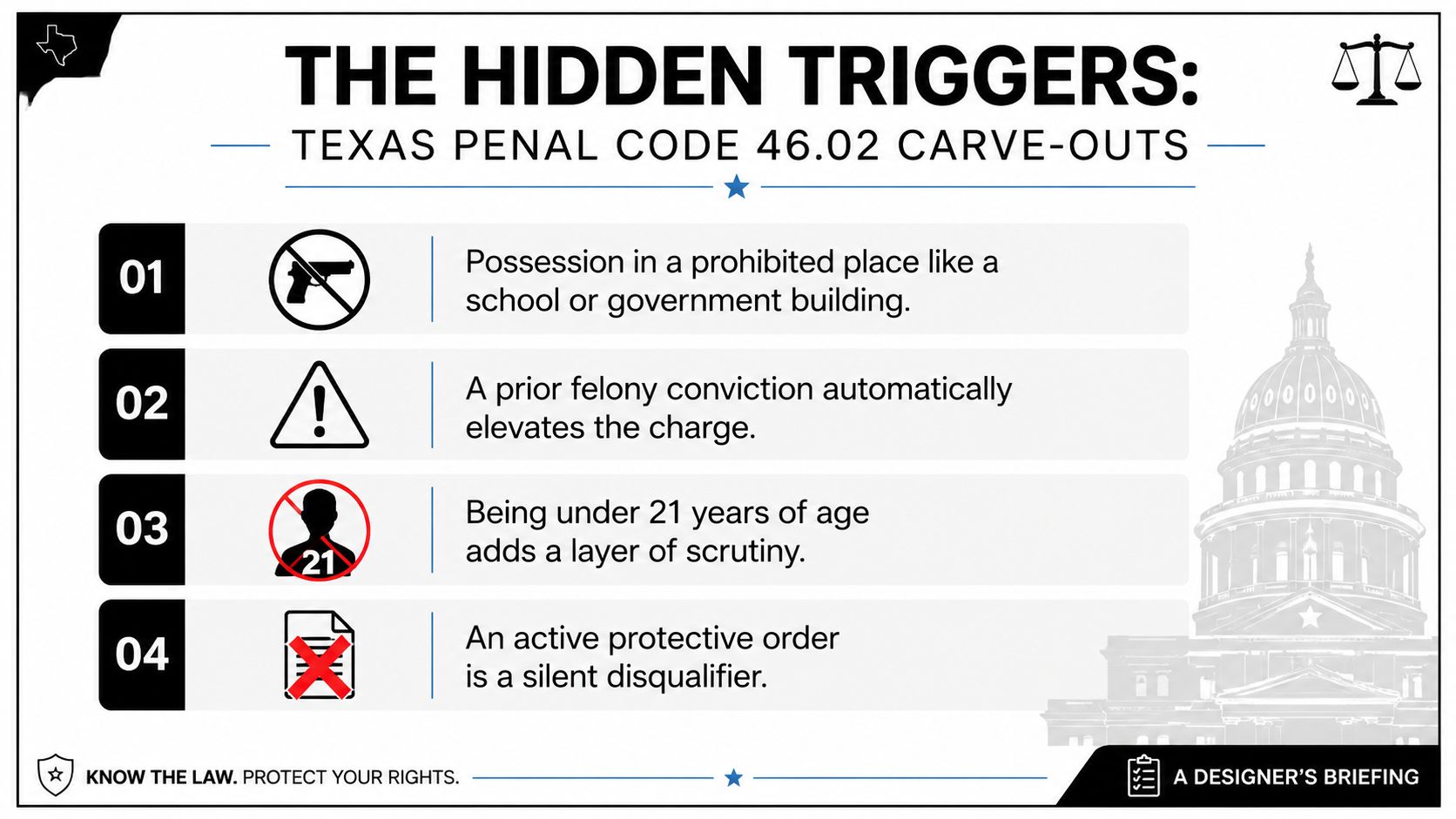
Permitless carry does not erase the restrictions that apply to certain people or situations. Texas still limits public carry for people prohibited from possessing firearms under federal law, people with prior felony convictions, people subject to an unexpired protective order, criminal street gang members, and people who are intoxicated outside narrow statutory exceptions. Review those exceptions carefully before assuming a firearm is lawful.
An ordinary Atascocita encounter can raise several of these issues:
- Alcohol and intoxication: A drink at happy hour may matter if the State alleges intoxication and connects it to unlawful carry or a prohibited location. A firearm inside a vehicle does not automatically resolve the question.
- An old criminal case: A deferred-adjudication matter from years ago still requires a careful review. The label you remember may not answer whether a firearm disability remains.
- A protective order: A workplace or family-related protective order can affect firearm possession while it is effective. Read the actual order and verify its current status.
- Alleged criminal activity: Carrying while engaged in criminal activity can create another route to an unlawful-carry allegation. An argument that becomes an assault investigation may change how officers interpret the firearm.
- Gang-member status: Documented criminal street gang status can create a serious eligibility issue. A denial alone does not resolve the evidence supporting that allegation.
Location and possession details matter during a traffic stop. A firearm beneath a driver's seat, a handgun in a rideshare passenger's bag, and a weapon found after an argument present different questions about control, knowledge, and intent. The DPS legislation and handgun-licensing information confirms that these exceptions remain important after Texas expanded carry laws.
A firearm allegation may appear with another accusation, including a controlled-substance case. Counsel should examine the entire encounter, including the search, statements, and probable cause. The firm's guidance on possession of controlled substance charges in Atascocita addresses a separate offense, but one stop can create multiple legal issues.
Family consequences may follow even when the criminal charge does not decide family-law rights. Grandparents' Rights in Atascocita addresses custody and visitation rights for grandparents in Harris County, while a weapon arrest can affect family relationships and court strategy.
How Unlawful Carry Cases Move Through Harris County
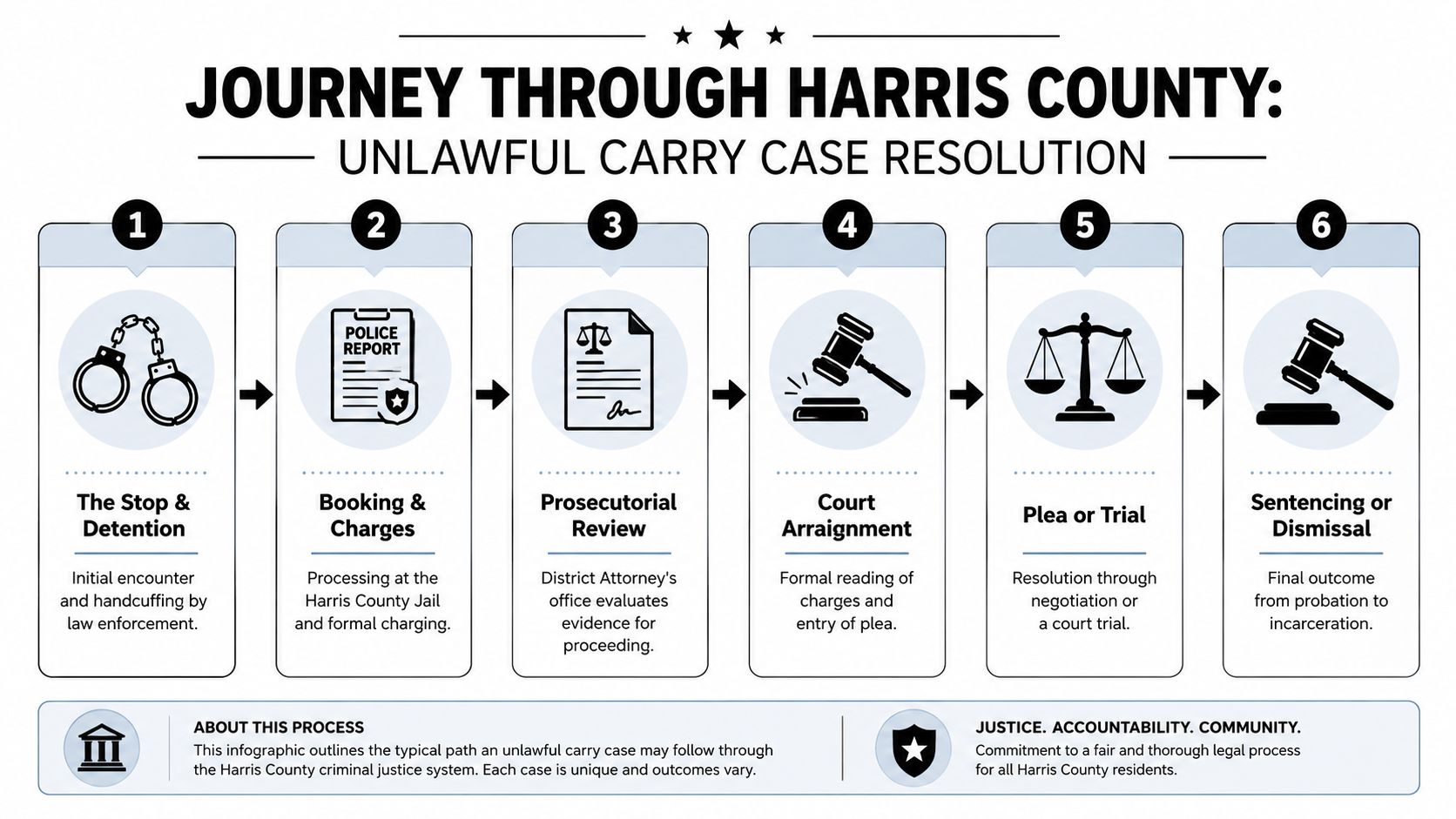
The first hours matter, but the case also follows a process. An Atascocita resident may move from arrest and Harris County Sheriff's Office intake to booking at the joint processing center, then to magistration before a justice of the peace. At magistration, the court addresses the accusation, probable cause, and warnings required under Article 15.17.
What to document at each stage
- Stop and detention: Write down where the stop occurred, why the officer gave for stopping you, whether you consented to a search, and who was present. Don't rely on memory after several stressful court settings.
- Booking and bond: Keep every document from processing. Bond conditions can include restrictions such as GPS monitoring or no-contact orders, and violating a condition can create a new problem.
- Charging review: A misdemeanor Section 46.02 case generally proceeds in a county-level court. A felony enhancement is handled in district court, where the stakes and procedures differ.
- Pretrial work: Counsel may seek records, review body-camera footage, evaluate diversion screening, and identify whether a grand jury presentation is involved.
- Resolution: The case may move through plea-bargain discussions or trial settings. Don't accept a plea before understanding collateral consequences involving employment, firearms, family matters, and immigration status when applicable.
Texas's speedy-trial framework includes the 180-day clock under Article 32A.02, but calculating the period requires attention to exclusions and procedural events. Treat it as a legal issue for counsel, not a countdown you should calculate from the arrest date alone.
The Harris County arraignment process can help explain what happens at an arraignment hearing, but your lawyer still needs to review your specific charge and court paperwork. A family member should preserve the booking records, bond paperwork, court notices, and any property receipts.
The same discipline helps when a criminal case overlaps with family litigation. Enforcement of Court Orders in Atascocita addresses enforcing divorce decree and custody order provisions in Harris County. That process is separate from an unlawful-carry prosecution, but records from one proceeding can affect decisions in another.
Defense Strategies That Hold Up in Texas Courtrooms
The strongest defense depends on the evidence, not the label on the arrest report. A lawyer should first identify whether officers had a lawful reason to stop, extend, search, or seize. If the handgun was discovered during an unlawful vehicle search, a Fourth Amendment suppression motion may keep important evidence away from the jury.
An inventory search deserves separate scrutiny. Police must follow lawful procedures, and the report, policy, body-camera video, and sequence of events can matter. A frisk can also escalate beyond what the circumstances justify. The “plain feel” doctrine doesn't give officers unlimited authority to search every pocket, bag, or vehicle compartment.
Match the defense to the proof
| Defense Strategy | Best For | Typical Outcome |
|---|---|---|
| Suppression motion | Unlawful stop, consent dispute, or improper vehicle search | Evidence may be excluded, weakening or ending the case |
| Lack of possession | Firearm found near several occupants or in a shared vehicle | Charge may be reduced, dismissed, or contested at trial |
| Lawful-carry exception | Eligible person carrying under a vehicle or other statutory exception | Defense may defeat an essential element |
| Signage or mistake-of-fact issue | Unclear location notice or disputed premises facts | May support negotiation or a trial defense |
| Diversion or deferred disposition | Eligible first-time misdemeanor defendant | May create a path short of a contested conviction |
Mere proximity isn't automatically possession. The State may argue constructive possession based on access, control, statements, fingerprints, ownership, or the firearm's placement. The defense should demand proof rather than accept an assumption that the driver owned everything in the vehicle.
An LTC, vehicle location, or private-property exception may also matter, but none should be asserted without checking eligibility and the precise facts. Prosecutors may respond with evidence of intoxication, criminal activity, prohibited status, or a restricted location. A complete defense record includes photographs, receipts, license records, search footage, witness names, and every version of the police report.
For firms building public education around these cases, SEO for criminal defense firms provides separate marketing context. For an accused person, the immediate priority is legal analysis, not online discussion. A focused criminal defense strategy in Atascocita should address suppression, possession, eligibility, charging level, and the resolution path.
Your Next Step With the Law Office of Bryan Fagan
If you've been arrested or cited, act within the first forty-eight hours. Don't contact the officer to “clear things up.” Don't post about the stop. Don't ask friends to call witnesses on your behalf. Tell your lawyer what happened, preserve the evidence, and let counsel decide which communications are appropriate.
Start with a simple evidence file:
- Preserve the firearm records: Keep purchase documents, transfer paperwork, storage information, license records, and photographs. Don't alter, sell, move, or discard the firearm because the case is pending.
- Write the timeline: Record the stop location, route, passengers, restaurant or venue, alcohol consumed, statements made, searches, and the point when officers took control.
- Save digital evidence: Screenshot text messages, ride records, location information, receipts, and communications that may show where you were and what happened.
- Collect court paperwork: Keep the bond order, booking documents, citation, property receipt, and every notice of hearing.
- Stop direct police contact: If law enforcement calls again, remain respectful and ask to speak through counsel.
Early representation can affect bond conditions, diversion requests, charging discussions, and motions challenging an illegal search. It can also prevent avoidable statements from becoming part of the prosecution's theory. The lawyer needs time to obtain video, identify witnesses, inspect the location, and compare the report with the physical evidence.
The Law Office of Bryan Fagan, Atascocita TX Lawyers is one local option for residents of Atascocita, Humble, and northeast Harris County seeking help with criminal defense and related family or civil concerns. A first meeting should cover the paperwork, your rights, the alleged offense, possible defenses, and a candid assessment of what needs to happen before the next court date.
Don't wait for the case to become more serious before getting advice. Bring every document you have, tell the complete story even where facts are uncomfortable, and ask direct questions about misdemeanor versus felony exposure, firearm consequences, bond, and the next court setting.
The Law Office of Bryan Fagan – Atascocita TX Lawyers can review an Atascocita unlawful-carry case, examine the search and charging documents, and help protect your rights in Harris County court. Schedule a free consultation before your next court date so you can understand your options and take the next step with a clear plan.