A detective calls your Atascocita home. Your phone has been taken, or investigators have asked questions about messages sent through a social-media platform. Maybe the accusation reached your spouse, employer, or child before you had any chance to understand what was happening. Fear and confusion are normal reactions, but the first important point is this: an accusation is not the same as a conviction.
For residents of Atascocita, Humble, and northeast Harris County, an online solicitation investigation can move quickly. Harris County law enforcement has used undercover internet and social-media operations to pursue these allegations, and prosecutors may rely on private chats, account information, meeting discussions, and the surrounding circumstances. The charge can also change substantially depending on the minor's actual age or the age the accused believed the person to be.
This guide explains Texas Penal Code § 33.021 in plain English. It separates chat-only allegations from cases involving an arranged meeting, explains how age affects felony exposure, describes the difference between adult and juvenile proceedings, and identifies evidence questions that can matter after an arrest. If investigators have contacted you, avoid trying to solve the problem through more messages or an improvised explanation. A confidential conversation with a defense attorney can help protect your rights while the facts are still being gathered.
Introduction When a Message Becomes a Felony Investigation in Atascocita
A person in Atascocita may think a conversation is private until a law-enforcement officer arrives with questions about an account, a phone, or a planned meeting. The person may not know whether the account belonged to a real minor, an undercover officer, or someone whose age was misrepresented. By that point, investigators may already have preserved messages and formed a theory about what the conversation meant.
That moment creates two separate problems. The first is legal: what did the messages communicate, and what does Texas law require the state to prove? The second is practical: what should the accused do now, before speaking with detectives, deleting anything, or responding to family members who have heard only one side?
Harris County enforcement history shows why these cases deserve immediate attention. In September 2016, the Texas Attorney General announced that a three-day sting in southeast Harris County led to 25 child predators being jailed, involving adults who used the internet and social media to solicit minors. An earlier three-day joint operation in Harris County reported 8 arrests, with 7 men charged with online solicitation of a minor, as reported by Fox 26 Houston's coverage of the Harris County operation. Harris County media also reported a new undercover-chat arrest in August 2026, showing that this remains an active felony prosecution tool in the region.
A practical rule: Don't delete messages, don't contact the alleged minor, and don't give investigators a statement before speaking with counsel.
Local context matters because an Atascocita case may move through Harris County intake, magistration, bond procedures, and criminal court settings serving northeast Harris County. The right response isn't panic or silence without a plan. It's preserving information, limiting unnecessary communication, and obtaining advice from a lawyer who understands both the statute and the local process.
What Online Solicitation of a Minor Means Under Texas Law
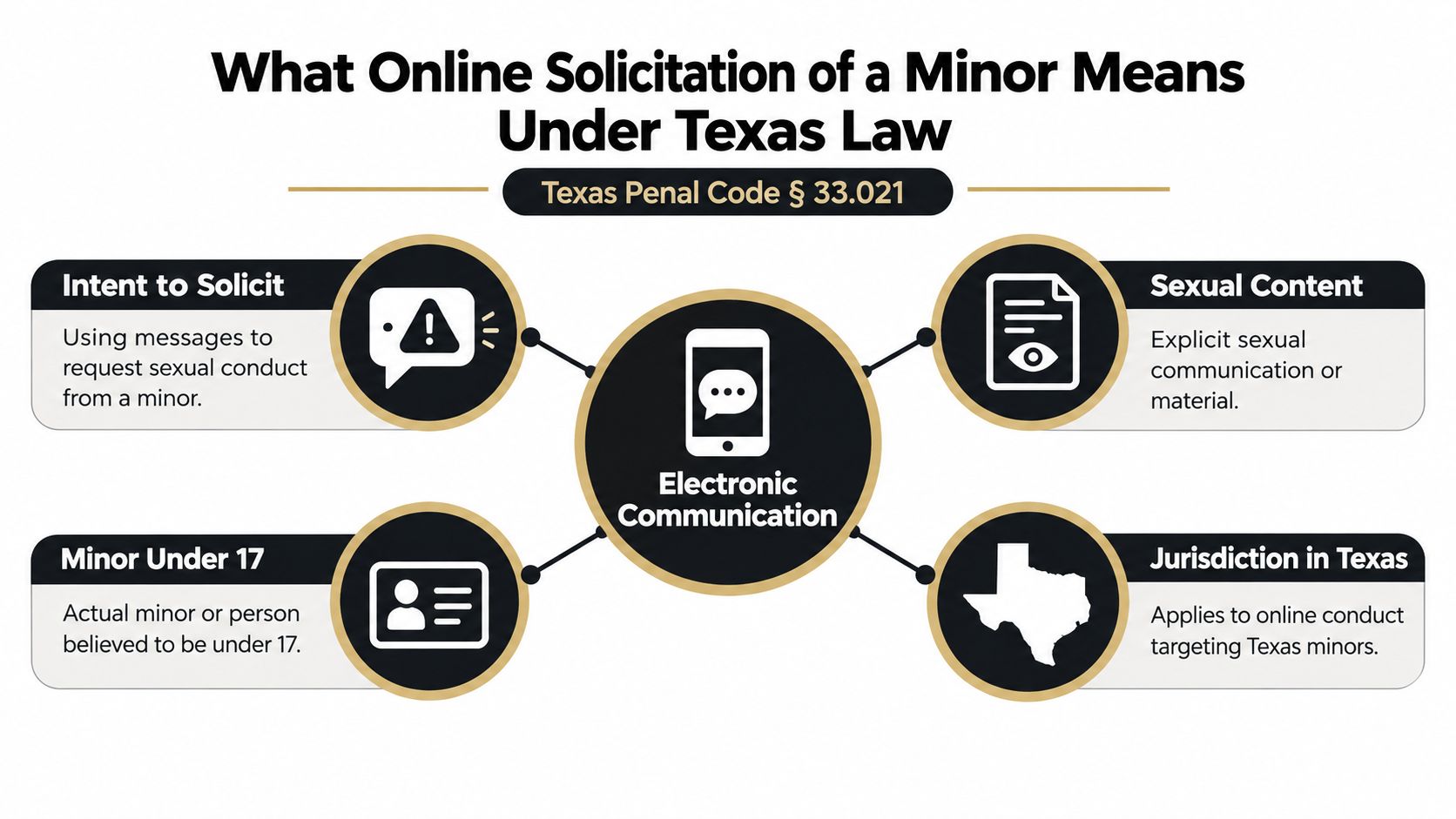
Texas Penal Code § 33.021 addresses certain electronic communications involving a minor. The current statute is available through the Texas Penal Code § 33.021 text, and the exact subsection alleged matters. In simple terms, prosecutors may claim that an adult used electronic communication with the intent to solicit a minor for sexual conduct or to persuade the minor to engage in that conduct.
Think of the allegation as a chain with several links:
- Electronic communication: The state may focus on messages, chats, texts, social-media communications, or another electronic exchange.
- A person believed to be a minor: The case can involve an actual minor or an undercover officer whom the accused believed was underage.
- Sexual solicitation or persuasion: The meaning of the words, images, requests, and conversation matters.
- The required intent: Prosecutors must connect the communications to the intent required by the charged subsection, rather than relying on an isolated phrase without context.
The current framework is particularly important for meeting allegations. Under subsection (c), soliciting a minor over the internet to meet for sexual contact, intercourse, or deviate sexual intercourse can support prosecution. A physical meeting doesn't have to occur for the state to file a charge based on the alleged electronic conduct. That doesn't mean every awkward, suggestive, or misunderstood message proves the offense. It means the complete conversation and the legal elements require careful review.
Why older online explanations can mislead
The statute has a significant constitutional history. On October 30, 2013, the Texas Court of Criminal Appeals unanimously struck down subsection (b) in Ex parte Lo as facially overbroad under the First Amendment. The Legislature later amended the statute, with the narrower version becoming effective September 1, 2015, as reflected in the statutory history and current text.
That history matters because an older article may describe language that no longer applies or may treat every kind of online sexual discussion as identical. A lawyer must compare the alleged conduct with the version of the statute in force and the particular subsection charged. The statute also carries a three-year limitations period, a procedural issue that can matter to both the defense and the prosecution.
People managing a large volume of case records may use a resource such as live tracking for legal files to organize documents and deadlines, but technology doesn't replace legal analysis. Atascocita residents looking for a separate explanation of how family-law matters proceed in the Harris County courts can consult Harris County Family Courts: An Atascocita Resident's Guide. A criminal solicitation case follows a different court path.
Penalties and How Age Changes the Charge in Texas
The alleged age of the minor can change the felony level and the possible prison range. Under the charging framework described by Texas Penal Code § 33.021 penalty information, online solicitation is generally a third-degree felony, but it can be raised to a second-degree felony when the minor is younger than 14 or the accused believed the minor was younger than 14.
That age issue can become contested. Investigators may examine profile information, messages about age, statements made during the conversation, and what the accused appeared to believe. A person may not avoid the enhanced classification merely by arguing later that the person was older if the evidence supports the required belief described by the statute.

Comparing the baseline ranges
The following table summarizes the baseline punishment ranges reported for these charges. It doesn't predict a sentence, plea outcome, probation decision, or registration consequence in any particular case.
| Charge Level | Age Factor | Prison Range | Maximum Fine |
|---|---|---|---|
| Third-degree felony | Minor is generally 14 or older | 2 to 10 years | Up to $10,000 |
| Second-degree felony | Minor is younger than 14, or accused believed minor was younger than 14 | 2 to 20 years | Up to $10,000 |
The third-degree range is 2 to 10 years in prison, and the second-degree range is 2 to 20 years, with a fine of up to $10,000 for either level, according to Texas online solicitation punishment ranges. The enhanced range can create a much more serious negotiation and trial risk for an Atascocita defendant.
A felony charge also affects more than the number attached to a sentencing range. The accusation may affect employment, family relationships, housing, travel, and a person's ability to respond calmly to a CPS inquiry or custody dispute. Anyone researching deferred adjudication in Texas should understand that eligibility and consequences depend on the offense, record, court decision, and precise case outcome. It should never be treated as an automatic solution.
Juvenile Versus Adult Cases and How Sting Operations Work in Harris County
A juvenile accused of conduct under Penal Code § 33.021 doesn't face the same process as an adult. Juvenile matters involve different procedures, decision-makers, confidentiality rules, and potential outcomes. The result depends on the child's age, the alleged conduct, the evidence, and the way authorities classify and refer the matter. Parents should obtain advice promptly rather than assuming an adult criminal-defense strategy will fit a juvenile case.
An adult case may arise from communication with a real minor, or from an undercover operation in which an officer presents as a minor. Those scenarios share some evidence questions, but they aren't identical. In a real-minor case, investigators may examine the account holder, the child's statements, device data, and the sequence of communications. In a sting case, the defense may need to evaluate the officer's profile, recorded chats, prompts, meeting discussions, and the point at which the alleged intent developed.

What the Harris County operations show
The Harris County operations described earlier demonstrate that online solicitation investigations can involve coordinated arrests after conversations occur through internet and social-media platforms. A planned meeting may make the state's theory easier to explain to a jury, but a meeting itself isn't the only possible source of evidence. Messages may be central even when no physical contact occurred.
Private messaging creates technical questions. Investigators may need to establish who controlled an account, whether messages are complete, whether screenshots accurately reflect the exchange, and whether the conversation includes deleted or missing portions. An Atascocita defense lawyer should also examine how officers preserved and authenticated digital evidence.
Families may face parallel concerns. A parent dealing with an investigation may need separate advice regarding a CPS inquiry, and a resource describing CPS Defense Attorney in Atascocita addresses defense against CPS investigations for Atascocita families. CPS proceedings and criminal cases are different matters, so statements made in one setting can have consequences in the other.
Common Defenses and Evidence Issues That Matter After an Arrest
Many people assume that a chat transcript speaks for itself. It doesn't. A prosecutor may present selected messages, but the defense has the right to examine the complete evidentiary picture, including who sent each message, how the account was accessed, what came before and after the quoted language, and whether the state can prove the required intent.

The central questions
A careful review may ask:
- What exactly did the messages request? Sexual contact, intercourse, deviate sexual intercourse, general conversation, sarcasm, and ambiguous language aren't interchangeable legal categories.
- What did the accused believe about age? Age statements, profile details, and the surrounding exchange may matter, particularly where the enhanced age classification is alleged.
- Was there a meeting discussion? A chat-only allegation and a meeting-based allegation can involve different charging theories and different evidence, even though both may rely heavily on electronic communications.
- Did law enforcement follow required procedures? The defense may review warrants, consent, device searches, account seizures, recorded conversations, and the circumstances of detention and arrest.
- Is the digital record complete and reliable? Missing context, altered screenshots, impersonation, shared devices, and account-access issues can affect what a message proves.
The statute's constitutional history also deserves attention. Because subsection (b) was struck down as facially overbroad in Ex parte Lo before the Legislature amended the statute, a defense lawyer must identify the version and subsection being used rather than relying on a generic description of “online solicitation.” That isn't a promise that a constitutional challenge will succeed. It is a reminder that the legal analysis must be precise.
Entrapment may arise in a sting case, but it isn't established just because an officer used a false identity. The issue requires a fact-specific analysis of inducement and predisposition under the applicable law. Similarly, mistaken-age arguments turn on the evidence and the statutory language. A defendant shouldn't try to test these theories by contacting the officer or alleged minor. Preserve the original device and communications, then let counsel analyze them.
Immediate Steps to Take If You Are Investigated or Charged in Atascocita
The first hours after contact with law enforcement can affect the case. Keep your response simple and deliberate.
Don't volunteer an interview. You can remain respectful while declining to answer substantive questions until you've spoken with a lawyer. Casual explanations often create additional statements that prosecutors may later interpret as admissions or inconsistencies.
Don't delete or alter anything. Keep the phone, computer, applications, account information, images, and messages in their existing condition. Deleting material can destroy context and may create a separate problem, even if you believe the content helps you.
Don't contact the alleged minor or undercover account. A new message can be portrayed as intimidation, continued contact, or consciousness of wrongdoing. Let your attorney determine whether any communication is legally and strategically appropriate.
Write down the sequence privately. Record when investigators contacted you, what they requested, whether they searched anything, and who was present. Don't post about the case or discuss details in group chats.
Call a criminal-defense attorney. Give counsel the charging paperwork, bond documents, court information, and any notice received from investigators. A structured criminal defense intake checklist can help you gather essential information for an initial conversation.
What may happen next
Harris County cases can involve intake, magistration, bond conditions, charging decisions, and later court settings. The exact order and timing depend on whether an arrest has occurred, whether a warrant exists, and what the prosecutor alleges. Bond conditions may restrict contact with certain people or platforms, so read every condition carefully and ask counsel before assuming a restriction is informal.
Families often need to manage work, school, housing, and public attention while the case develops. Speak with one trusted person if you need practical help, but avoid asking relatives to investigate, message witnesses, or collect information in a way that could complicate the evidence. If a CPS issue is also pending, separate advice may be appropriate, including information about a CPS defense lawyer in Atascocita, Texas.
How an Atascocita Defense Attorney Helps and What to Expect in Harris County Court
A defense attorney's work begins before a courtroom argument. Counsel can determine what the state has charged, identify the applicable subsection, review the limitations issue, preserve digital evidence, and assess whether the arrest and searches followed legal requirements. The lawyer can also explain bond conditions and help you avoid communications that may increase exposure.
In Harris County court, the case may develop through evidence exchanges, negotiations, hearings, and trial preparation. A sound strategy depends on the actual messages, the alleged age or believed age, the source of the account, the presence or absence of a proposed meeting, and the state's ability to prove every required element. No attorney can promise a dismissal or particular result, but a client should receive clear communication about options, risks, and next decisions.
The Law Office of Bryan Fagan – Atascocita TX Lawyers serves individuals and families in Atascocita, Humble, and northeast Harris County. Its broader Harris County criminal defense attorney resource provides related information for people facing misdemeanor and felony allegations. In a sensitive online-solicitation matter, local access and careful communication can help a family make informed decisions without losing sight of the presumption of innocence.
If investigators have contacted you or you're facing an online solicitation charge, schedule a confidential, free consultation with Law Office of Bryan Fagan – Atascocita TX Lawyers. The firm can review the alleged communications, explain the Harris County process, and help you take informed steps to protect your rights.