After a busy Saturday near FM 1960 and Will Clayton Parkway, a simple shopping trip can turn into an injury claim. A wet floor, broken stair rail, uneven sidewalk, or unmarked pothole may leave an Atascocita neighbor facing medical care, missed work, and uncertainty about who should be held responsible.
Texas premises liability law can be difficult because the answer depends on more than where you fell. It may turn on why you were on the property, whether the owner knew about the condition, how long the hazard existed, and whether your own conduct contributed to the injury. This guide explains the rules in plain English for residents of Atascocita, Humble, and northeast Harris County.
A Slip Near the Atascocita Wal-Mart
A shopper leaves the Atascocita Wal-Mart on FM 1960 East after picking up groceries for a family barbecue. She passes the traffic light near Will Clayton Parkway, crosses the sloped parking lot, and remembers thinking about getting home before the ice melted in the trunk.
Inside, a clerk has just mopped part of the floor. There isn't a cone or warning sign. The shopper steps onto the wet area, her foot slides forward, and she lands hard on her hip. For a moment, she feels more embarrassed than hurt. People walk around her while a manager takes a photograph, but no one offers meaningful assistance or explains what will happen next.
By the time she reaches an emergency room in Humble, the pain has intensified. She worries about the medical bills, the groceries left in the car, and whether she can work her next shift. Even ordinary household concerns, such as checking resources for FullScope Pest Control Atascocita rodents, suddenly feel harder to manage while recovering.
Practical point: A property owner's response after an injury can matter, but the condition itself and the evidence surrounding it usually matter more.
The first question is whether the store had a legal duty to address the wet floor and failed to do so. Texas premises liability law focuses on the visitor's status and the owner's duty to inspect, warn, or make safe dangerous conditions. A paying shopper is generally treated as an invitee, which receives the highest level of protection under Texas law. That usually means the owner must use ordinary care, inspect for hazards, and warn about or correct dangerous conditions the owner knew or reasonably should have known about. Texas premises liability guidance explains this framework and the importance of evidence such as inspection logs, maintenance records, incident reports, and witness statements.
A shopper dealing with a similar injury should also understand that a property claim is separate from other legal matters. For example, an injury involving a minor raises different questions than an adult slip and fall, and families may need to review injury to a child guidance for Atascocita residents.
Who pays when a familiar local store leaves a hazard unmarked? The answer depends on proof, visitor status, notice, causation, and Texas filing deadlines. Those questions apply just as readily to an apartment complex, HOA facility, restaurant, or rental home around Atascocita and Humble.
Who Counts as an Invitee, a Licensee, or a Trespasser
A Kroger shopper on Atascocita Drive enters for the store's business. A neighbor's guest enters with permission for a social visit. Someone crossing private property without permission presents a different legal question. Texas places these visitors into three categories: invitee, licensee, and trespasser.
The category helps determine the property owner's duty to inspect, warn, or address dangerous conditions. In a suburban shopping center near FM 1960, a customer may have greater protection than a visitor at a private home because the customer's presence benefits the business.
| Status | Typical Atascocita Example | Duty Owed by Owner |
|---|---|---|
| Invitee | Paying customer at a Kroger on Atascocita Drive | Highest duty. The owner generally must inspect for hazards and warn about or make safe concealed, unreasonably dangerous conditions the owner knows or reasonably should know about. |
| Licensee | Social guest or Boy Scout selling popcorn door-to-door | Narrower duty. The owner generally must warn about or make safe known hidden dangers. |
| Trespasser | Person entering private property without permission | Highly limited protection. The owner generally must not injure the person willfully, wantonly, or through gross negligence. |
The label depends on why the person entered and whether the owner gave permission, not on physical presence alone. A customer shopping at an Atascocita Town Center business is usually an invitee. A friend visiting an apartment or HOA amenity with permission is commonly a licensee. A person entering a fenced yard or private area without permission is generally a trespasser.
Purpose can also create confusion. A contractor entering a home or shopping center to perform work may be lawfully present, but lawful presence alone does not automatically make that person an invitee. The facts surrounding the visit, including its purpose and the owner's permission, help determine the status.
Why the label changes the case
An invitee may argue that the owner should have found a hazard through reasonable inspections. For example, a customer injured near a busy store entrance may focus on whether staff should have discovered a dangerous condition. A licensee generally must show that the owner knew about a concealed danger and failed to warn or make it safe. A trespasser faces a much narrower path and is generally protected only from conduct that is willful, wanton, or grossly negligent.
Texas legal authorities describe this status-based approach as central to premises liability claims. Texas visitor-status guidance explains that the first technical question is often whether the injured person was an invitee, licensee, or trespasser.
Before assessing an injury at an Atascocita shopping center, apartment property, HOA facility, or private home, identify the visitor's purpose and permission. That classification frames the owner's duty and the evidence needed to evaluate the claim.
The Four Building Blocks of a Texas Claim
A premises liability claim generally needs four connected pieces. If one piece is missing, the case may become difficult even when the injury is real and the property condition was frustrating.
Ownership or control
First, identify who owned, occupied, or controlled the location. Suppose a stair railing pulls away from a duplex near Will Clayton Parkway. The responsible party might be the property owner, landlord, management company, maintenance contractor, or another person with control over repairs. Ownership alone doesn't automatically establish liability, but control helps identify who had the ability and responsibility to address the condition.
A dangerous condition
Next, there must be a condition that created an unreasonable risk of harm. A soft drink spills in the H-E-B produce aisle, for example, and remains on the floor while customers pass through. A broken step, loose handrail, uncovered hole, defective walkway, or unsafe pool deck can also qualify depending on the facts.
The condition must be evaluated in context. A small defect in a quiet area may present a different risk than a wet surface in a heavily traveled grocery aisle. Photos, measurements, lighting conditions, and the presence or absence of warning signs can help show what made the location unsafe.
Actual or constructive knowledge
The owner must generally have known about the condition or should have discovered it through reasonable care. Actual knowledge can come from a prior complaint, employee observation, maintenance request, or incident report. Constructive knowledge requires evidence that the condition existed long enough for a reasonable owner to find and correct it.
For example, an apartment complex's maintenance log may show three earlier complaints about the same lobby tile. That record could help establish notice, particularly if management had time to respond but left the defect in place.
The fact that someone fell doesn't, by itself, prove that the owner had legally sufficient notice of the hazard.
Texas slip-and-fall cases often require a timeline. Recent Texas constructive-notice analysis describes the importance of surveillance video, inspection logs, cleaning records, and witness timing when a claimant relies on constructive notice.
Causation and damages
Finally, the condition must have caused the injury and measurable losses. Emergency-room records, follow-up physical therapy, diagnostic findings, prescriptions, and a consistent description of symptoms can connect the event to the medical condition. Missed shifts at a Humble warehouse may support a lost-wage claim when documented through employer records or pay information.
All four parts must fit together: someone had control, a dangerous condition existed, the responsible party had the required knowledge, and the condition caused actual harm. A strong investigation tests every link instead of relying only on the fact that the fall happened.
Where Injuries Happen Around Atascocita
Atascocita residents encounter different property risks depending on where they live, shop, work, or exercise. The owner's reasonable safety measures should match the location and the foreseeable hazards.
Apartment communities
Along FM 1960 and Will Clayton Parkway, apartment residents may encounter cracked sidewalks, loose stair railings, damaged steps, or poorly lit breezeways. A property manager should inspect common areas, respond to maintenance complaints, repair known defects, and warn residents when a temporary danger can't be fixed immediately.
A tenant who reports a loose railing and later falls when it pulls away has a different evidence picture from a visitor who encounters the problem without any prior warning. Save maintenance requests, emails, photographs, and messages with management.
Stores and shopping corridors
The Walmart, Kroger, and H-E-B areas create familiar retail hazards. Spilled liquids, unsecured entrance mats, loose merchandise, and produce debris can cause a sudden slip. Employees should monitor busy walking areas, clean spills, secure mats, and use visible warnings while a condition is being corrected.
The key issue isn't whether every store must eliminate every momentary risk. It is whether the business used reasonable care under the circumstances and whether it had actual or constructive knowledge of the danger.
HOA and recreational spaces
HOA pools, playgrounds, and fitness centers need regular inspection and maintenance. Wet pool decks may require warnings or barriers. Broken playground equipment should be removed or isolated until repaired. Fitness centers should address damaged flooring, unsecured equipment, and other conditions that create foreseeable risks.
The HOA's governing documents may help identify maintenance responsibilities, but they don't replace the legal analysis. Determine who controlled the area, who received notice, and what action was reasonably available.
Restaurants, parking lots, and rental homes
Restaurants near Atascocita Town Center may face risks from wet entrances, crowded walkways, spills, and poorly maintained restrooms. Parking lots can contain hidden potholes or uneven surfaces, especially where lighting makes defects harder to see. Rental homes may present problems involving porches, decks, stairs, or handrails.
A jury may examine whether the owner or manager conducted reasonable inspections, kept records, responded to complaints, and posted warnings. A claimant's photographs should show the entire setting, not only the spot where the injury occurred.
When Your Own Choices Reduce the Award
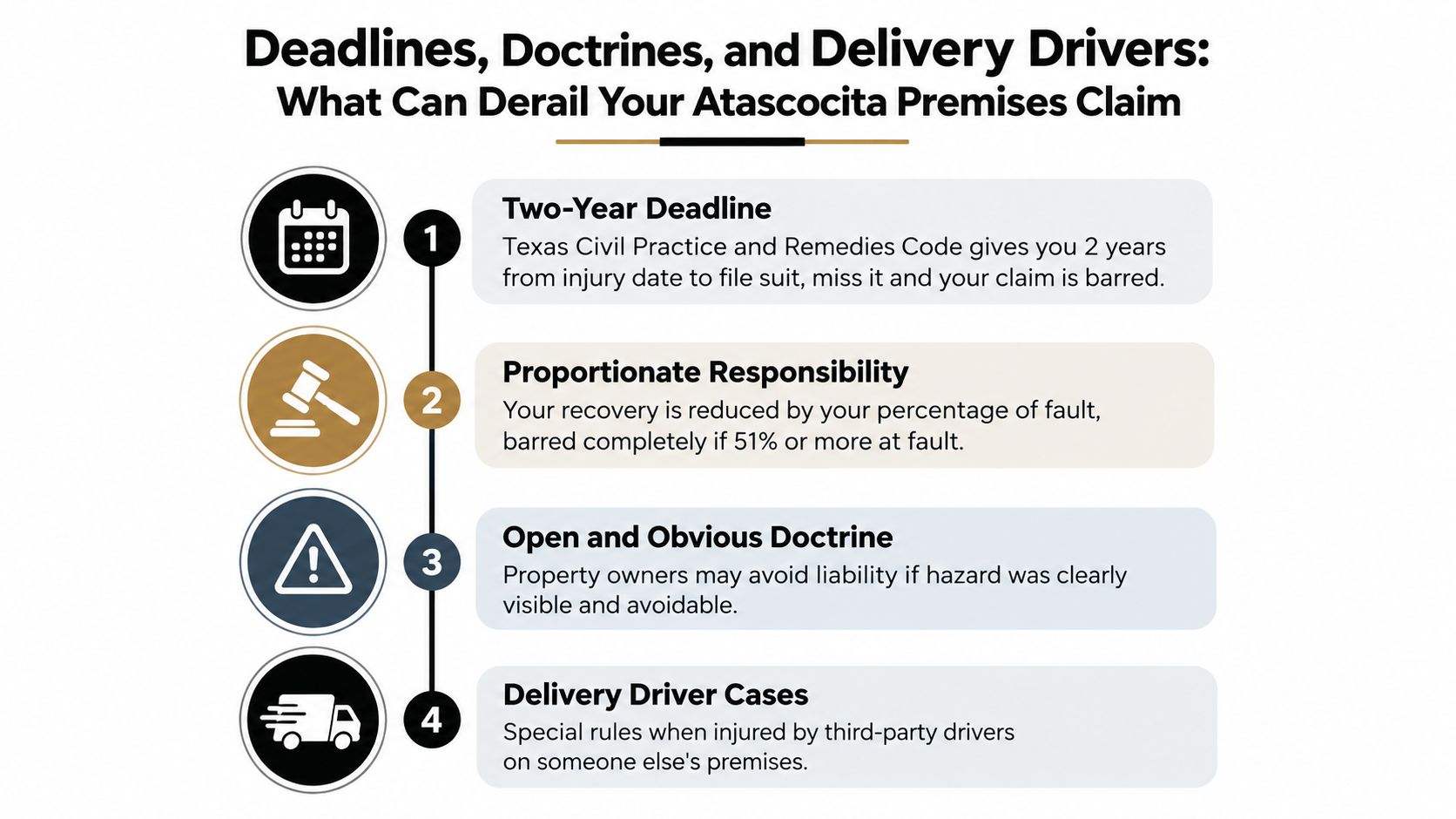
Texas uses modified comparative responsibility in civil injury cases. If the injured person is found more than 50% responsible, recovery is barred. If the person is found 50% or less responsible, the damages are reduced by that percentage. Texas comparative responsibility materials describe this 51% bar and the reduction mechanism.
That rule doesn't mean a distracted person automatically loses. It means the evidence must address everyone's conduct, including the property owner's failure to inspect, warn, or repair and the visitor's decisions at the time of the event.
| Scenario | Your Fault | Original Damages | Your Recovery |
|---|---|---|---|
| Shopper glances at a phone while stepping over a clearly wet floor | 30% | $10,000 | 70%, or $7,000 |
| Runner ignores a bright yellow caution sign and ducks under a barrier into a construction area | 60% | $10,000 | Nothing, because the fault finding exceeds the 51% bar |
These examples illustrate the rule, not a prediction about any individual claim. A court or jury may evaluate lighting, warnings, visibility, the person's purpose, the property owner's conduct, and the timing of the hazard.
How blame enters the conversation
Insurance adjusters may argue that the visitor wasn't watching where they were going, used a prohibited route, wore unsuitable footwear, or ignored a warning. Some of those facts may matter. They don't erase the owner's responsibility if the owner created or failed to address a dangerous condition.
Early documentation helps answer those arguments. Photograph the floor, barrier, sign, lighting, route, and surrounding area. Ask witnesses what they saw before anyone cleans, repairs, or rearranges the scene.
A careful account should be accurate rather than exaggerated. Don't guess about how long a spill existed. Instead, identify what you personally observed and preserve evidence that may establish the timeline.
Deadlines, Doctrines, and Delivery Drivers
Some premises claims fail because the injured person focuses on the accident but misses a deadline or misclassifies the legal theory. Three issues deserve early attention: the filing period, open and obvious conditions, and the status of a worker who was injured while making a delivery or performing a service.
The filing deadline
Texas generally gives an injured person two years from the date of injury to file a premises liability lawsuit. Texas premises-liability deadline guidance explains why residents should preserve evidence and obtain legal advice well before the deadline.
The limitations period isn't a reason to wait. Surveillance systems may overwrite footage, employees may leave, and a repaired hazard may no longer look like it did on the day of the incident. Minors and other special circumstances can involve different rules, so a person should not assume the ordinary deadline answers every case.
Open and obvious conditions
Texas Supreme Court precedent generally does not require a landowner to warn an invitee about a condition that is open and obvious or already known to that invitee. The doctrine has limited exceptions, including the necessary-use exception and the criminal-activity exception. Texas Supreme Court precedent on open and obvious conditions addresses this principle and its exceptions.
Visibility alone doesn't resolve every dispute. A condition may be visible from one angle but obscured by lighting, traffic, merchandise, weather, or the route a person reasonably had to use. Take photographs from the injured person's viewpoint and preserve information about what made the hazard difficult to avoid.
Delivery drivers and independent contractors
Consider a delivery driver who slips near an apartment leasing office. If the driver is an employee injured while performing work, workers compensation may control the relationship with the employer. A claim against the property owner requires a separate premises analysis, and the driver's work status can affect the available legal theory.
Amazon, UPS, and FedEx drivers may be treated differently when they operate as independent contractors or through separate delivery businesses. Texas decisions discussed in recent coverage of open-and-obvious dangers involving independent contractors emphasize that property owners generally have no duty to protect independent contractors from open and obvious hazards, particularly when the worker is expected to recognize and manage them.
For broader issues involving commercial drivers, an injured person can review Atascocita truck accident legal information, then obtain advice based on the exact employment and property facts.
Don't delay a preservation request. A written letter should identify the incident, location, date, requested materials, and the need to preserve surveillance video, incident reports, inspection records, cleaning records, and communications.
Your Evidence Checklist and Next Steps
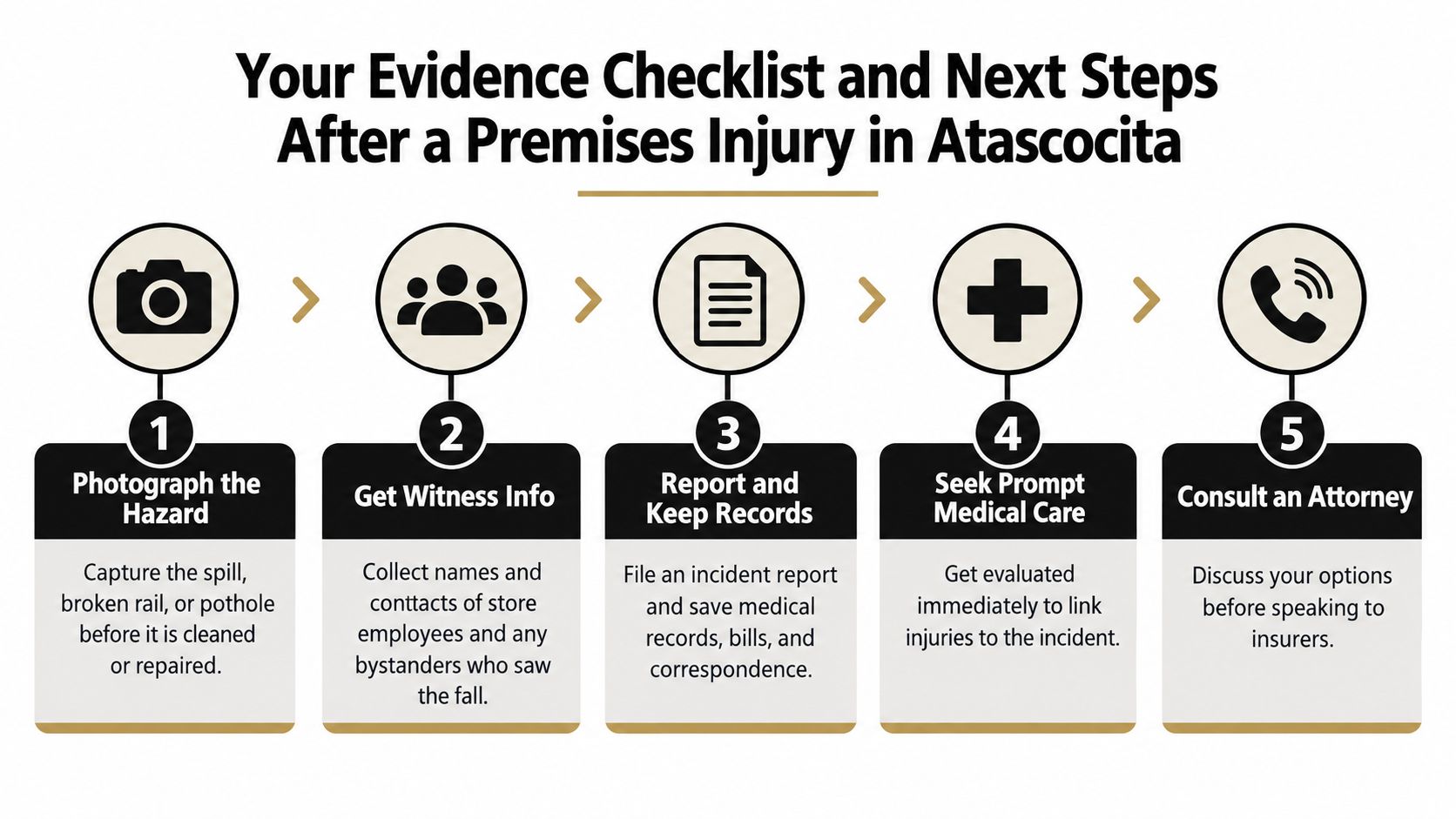
A fall near FM 1960, inside an Atascocita shopping center, or beside an HOA pool can change quickly. Before a spill is cleaned or a broken rail is repaired, photograph it if you can do so safely. Take wide images showing the area and close images showing the defect. Record lighting, weather, warning signs, barriers, and the path you used.
Get names and contact information from employees and witnesses. A worker may know who mopped the floor, while a bystander may remember how long the hazard was present. Ask for an incident report, but keep your own notes because that report may not include every detail. Save the receipt from Atascocita Walmart, Kroger, or another Lake Houston-area business to help show why you were there and when.
Build a medical record
Seek prompt evaluation at Memorial Hermann Northeast or HCA Houston Healthcare Kingwood when your symptoms warrant care. Tell the provider how the injury occurred and which body parts hurt. Follow the treatment plan, and keep records, bills, prescriptions, referrals, and physical therapy notes.
A symptom journal fills in the days between appointments. Record pain in ordinary terms, sleep problems, mobility limits, missed activities, and work restrictions. Do not minimize symptoms because they seemed manageable on the first day, and do not report problems that do not match your experience.
Gather the paper trail
Store these materials in a folder, cloud drive, or spreadsheet:
- Scene evidence: Photographs, videos, receipts, incident reports, and witness information.
- Property communications: Emails, maintenance requests, HOA notices, texts, and prior complaints.
- Medical documents: Records, bills, medication information, referrals, and treatment instructions.
- Income records: Pay stubs, missed-shift information, employer communications, and work restrictions.
- Damage information: Repair estimates for damaged property and a running list of reasonable expenses.
An adjuster may request a recorded statement before you understand the claim. Be truthful, but avoid guessing about timing, fault, or medical conclusions. Preserve texts and emails. Do not post photographs or commentary about the incident on social media.
If the injury occurred in or near traffic, such as a parking-lot fall involving a vehicle, review Atascocita car accident guidance to see how overlapping claims may work. A custodial parent whose injury affects a scheduled exchange may also need advice about that immediate family problem, separate from the premises claim.
Your immediate job is simple: preserve what can disappear, follow medical advice, track the costs, and get legal guidance before the filing deadline approaches.
If you were hurt on property in Atascocita, Humble, or northeast Harris County, organize the evidence and contact a premises liability attorney promptly. A consultation can help identify the property controller, assess notice, evaluate your visitor status, and determine whether another system, such as workers compensation, may apply.
The Law Office of Bryan Fagan – Atascocita TX Lawyers can review the facts and evidence surrounding a premises injury, explain potential civil claims, and discuss practical next steps. Visit Law Office of Bryan Fagan – Atascocita TX Lawyers to schedule a free consultation at the Atascocita office and discuss your situation with a local attorney.