Under Texas Penal Code § 21.08, indecent exposure is typically a Class B misdemeanor carrying up to 180 days in county jail and a fine of up to $2,000. A prior conviction, or civil commitment as a sexually violent predator, can escalate the offense into felony territory.
You may be reading this from an Atascocita kitchen table after a patrol car left your driveway, or after an officer contacted you about an incident near a store, apartment complex, trail, or parking lot. Your spouse may be worried about custody, your employer may be asking questions, and you may not know whether this is a misunderstanding, an arrest warrant, or a charge already filed in Harris County.
The most important point is simple: an accusation is not a conviction, but you should treat it as a serious criminal matter from the first contact with law enforcement. Don't explain the incident on the phone, by text, or at the front door without speaking with a lawyer first. The early record, including officer notes, surveillance footage, witness statements, and your own messages, can shape what happens next.
What Indecent Exposure Really Means in Atascocita
A Humble ISD dad leaves a Target parking lot after a confusing confrontation. Someone reports that he exposed himself. An officer writes a report, identifies him, and begins the process that may lead to an arrest or warrant. He may believe the incident was accidental, brief, or badly misunderstood. The report may tell a much simpler story.
That gap matters. Under Texas Penal Code § 21.08, indecent exposure involves exposing the anus or any part of the genitals with intent to arouse or gratify sexual desire, while acting recklessly about whether another person is present and offended or alarmed. In plain English, the State must prove more than embarrassing conduct or nudity. It must connect the exposure to the required sexual intent and the required awareness of another person's possible reaction.
The charge isn't interchangeable with other offenses
Indecent exposure is different from public lewdness, disorderly conduct, and indecency with a child. Those offenses have different statutory elements and can involve different allegations, witnesses, and sentencing consequences. A report that uses casual language such as “lewd behavior” doesn't answer the legal question. The charging instrument and the evidence do.
“Public” also doesn't necessarily mean a crowded street. A backyard visible from a neighborhood trail, a vehicle seen through a window, or conduct observable from a public vantage point can create difficult questions about location and visibility. The facts around an Atascocita Shores Drive property, a Lake Houston trail, or a Humble apartment complex may matter as much as the accusation itself.
Practical rule: Don't try to solve the case by persuading the reporting officer. Preserve the evidence and protect your right to remain silent.
Most cases begin with a patrol officer's report, not a formal indictment. The officer may respond to a call, interview the complainant, review available video, and submit information for further action. From there, the matter can move through Harris County's criminal courts, where the State must prove every required element beyond a reasonable doubt. Your defense should focus on what the evidence proves, not merely on how upsetting the allegation sounds.
The Core Elements Texas Prosecutors Must Prove
A knock at your Atascocita door can turn into a Harris County criminal case before you have seen a charging document. The officer's report, a complainant's account, messages, photographs, or video may shape what prosecutors pursue. None of those materials removes the State's burden. Prosecutors must prove each statutory element beyond a reasonable doubt, and the defense should test each one separately.
Four questions decide the proof
Was a body part covered by the statute exposed? The allegation must concern the anus or part of the genitals. Remaining fully clothed, adjusting clothing without revealing the relevant area, or experiencing an accidental medical episode can create a factual dispute. The State should be able to identify what was exposed, how long it was visible, and what evidence supports that description.
Was the act intended to arouse or gratify sexual desire? This is often the central issue. Intent is rarely established by a direct admission, so prosecutors may point to the conduct, words, timing, sequence, location, and witness description. A witness's conclusion that conduct seemed sexual does not prove intent by itself. Defense counsel should compare the surrounding facts with explanations such as accident, confusion, illness, playfulness, or another nonsexual reason.
Did the conduct occur in a public setting? A store, parking lot, public trail, or vehicle visible to passersby may support the State's position. A private home raises different questions when someone outside could see inside. The analysis turns on visibility, access, the observer's location, and the circumstances of the observation. Atascocita Shores Drive properties, a Lake Houston trail, and a Humble apartment complex may present very different evidence issues.
Was another person present who could be offended or alarmed? The State must connect the alleged exposure to a person who was present and capable of experiencing the reaction required by the statute. Identify who allegedly saw the conduct, where that person stood, what was visible, and how long the observation lasted. An empty room or an unconfirmed observer can leave a serious gap in the prosecution's proof.
| Element | Plain-English Meaning | Typical Prosecution Evidence |
|---|---|---|
| Exposure | The anus or part of the genitals was allegedly revealed | Eyewitness description, surveillance video, officer observations |
| Sexual intent | The conduct was allegedly meant to arouse or gratify sexual desire | Words, behavior, sequence, context, witness account |
| Public setting | The act occurred where another person could encounter or observe it | Location photographs, video, witness testimony, officer report |
| Presence and possible reaction | Another person was present and could be offended or alarmed | Complainant statement, bystander testimony, video, call records |
The two recurring pressure points are intent disputes and presence disputes. A witness may describe an exposure accurately while still being unable to establish why it happened or whether the required person was present. Those questions deserve investigation before you answer police questions, make statements to a complainant, or accept a rushed resolution.
Keep messages, photographs, surveillance footage, clothing, medical records, and location information that may clarify what happened. Do not edit or delete material, and do not try to persuade the reporting officer at the door. Protect your right to remain silent and have counsel address the evidence.
For background on family cases in the Harris County courts serving Atascocita, residents can review Harris County Family Courts: A Atascocita Resident's Guide. That family-court process is separate from the criminal case, but the two can affect one another when custody or visitation is already contested.
How the Charge Escalates From Misdemeanor to Felony
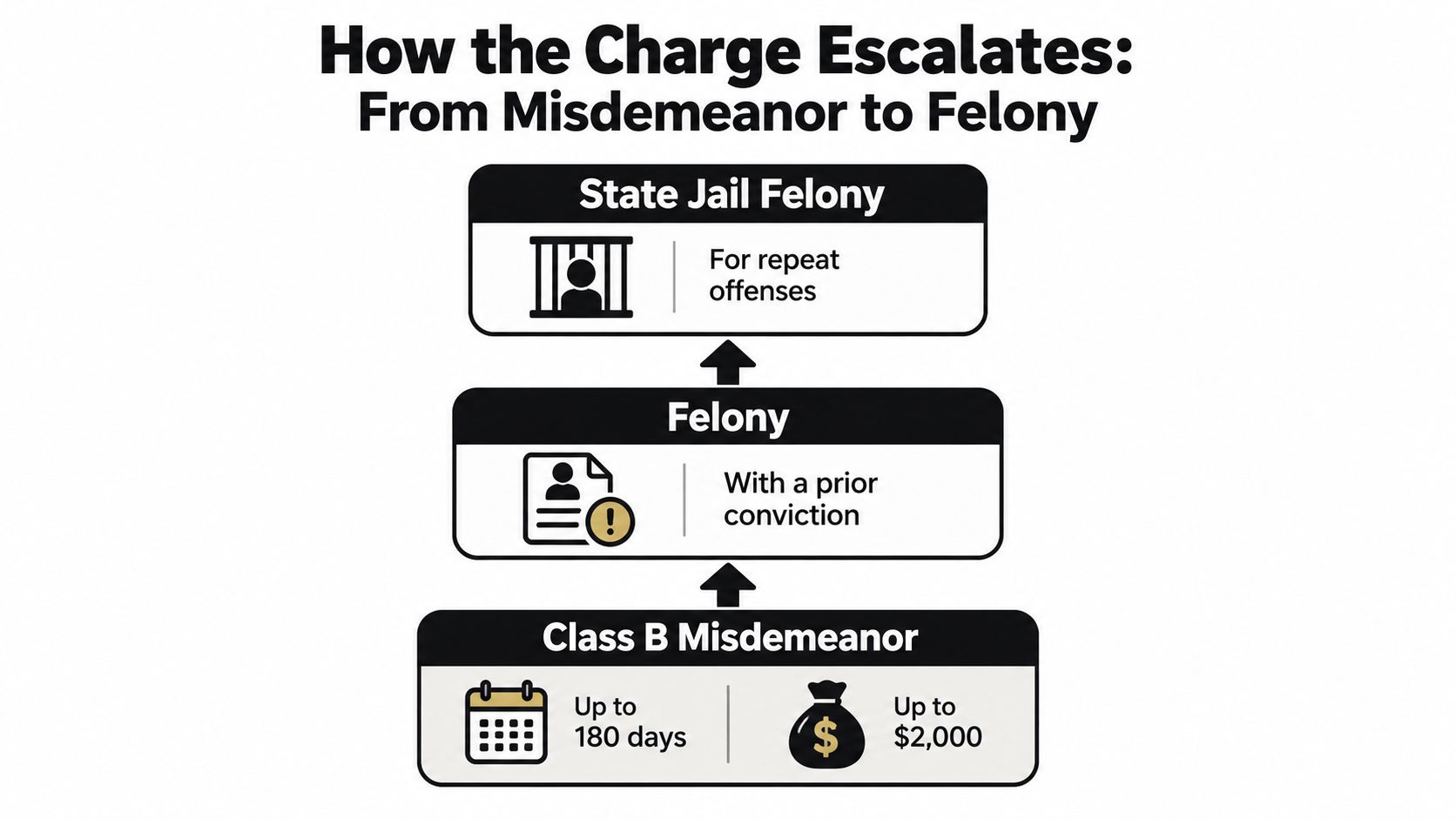
If police knock on your door in Atascocita or Humble, do not treat an indecent-exposure allegation like a warning. A first charge under § 21.08 is generally a Class B misdemeanor, carrying exposure to up to 180 days in county jail and a fine of up to $2,000. The statutory framework appears in Texas Penal Code § 21.08. The filing starts a criminal case and can affect the way prosecutors evaluate your history and negotiate the case.
One prior conviction can raise the offense to a Class A misdemeanor. Texas law generally permits up to one year in jail for that classification, although the applicable statute and case facts control the punishment. That change affects bond decisions, negotiations, and the court's view of the allegation. Your lawyer should review the charging instrument and prior judgments before recommending any plea.
Repeat history can produce more serious enhancements. The statute provides for state jail felony treatment after two or more prior convictions. It also allows a third-degree felony if the actor is civilly committed as a sexually violent predator. A repeat allegation does not automatically establish either result. The State must identify the qualifying convictions and prove the statutory condition it relies on. Counsel should obtain the judgment records and compare them with the current charging language.
Local filings show why history matters
A published Harris County snapshot reported 197 indecent exposure cases in 2020 and 248 in 2021, an increase of 51 cases, or about 25.9% year over year. The figures appear in Harris County indecent-exposure reporting. They show that these filings occur in the Houston area and should not be dismissed as an unusual one-time problem.
For Atascocita and Humble residents, early legal review matters. Prior convictions can change the classification, bond strategy, negotiation posture, and long-term exposure. Have a lawyer examine the filing and criminal history before treating the case as a routine misdemeanor.
Consequences Beyond the Courtroom
A conviction is only one part of the problem. An indecent-exposure case can affect a person's registry status, family relationships, employment, housing, and reputation. Those effects may begin before trial if the allegation appears in a custody dispute, workplace investigation, or local conversation.
| Category | What You Face | Duration |
|---|---|---|
| Registry and reporting | Possible sex-offender registration, address and verification duties, travel reporting, and internet-identifier disclosures | Depends on the offense, conviction, and applicable registration rules |
| Family and community | Custody arguments, supervised-visitation requests, school volunteer concerns, housing complications, and public-record exposure | Can continue through the family case and beyond |
| Employment and professional life | Background-check issues, licensing questions, workplace restrictions, and reputational harm | May continue as long as records remain accessible or licensing rules apply |
Registry questions require an exact legal review
Atascocita residents often ask whether an indecent-exposure case leads to registration on the Texas sex-offender registry. The answer turns on the offense classification, conviction, registration law, and case-specific facts. A dismissal, deferred outcome, misdemeanor, and felony do not necessarily receive identical treatment, so do not rely on a general internet statement.
If registration applies, duties may include reporting an address, verifying identifying information, following travel requirements, and disclosing internet identifiers. Public registry information can create problems near FM 1960, Humble ISD campuses, apartment searches, and neighborhood relationships. Have a lawyer review those consequences before accepting a plea. After judgment, your options may be narrower.
Family consequences can become a second courtroom
A spouse or opposing parent may raise the allegation in a custody case. Under the Texas Family Code's best-interest framework, a judge may consider conduct related to a child's safety and welfare. An accusation does not decide custody by itself, but it can support requests for supervised visitation, temporary orders, or other restrictions.
Professional consequences also require early attention. Teaching, nursing, commercial, and other licenses may involve criminal-history review. Noncitizens should consult immigration counsel before entering a plea because the immigration effect depends on the person's circumstances and the disposition.
Even an unproven allegation can damage trust in a close community. Do not discuss the facts publicly or post an emotional response online. Preserve relevant messages, notices, and records, then let counsel address the allegation through the Harris County process.
Common Defenses That Can Work
The strongest defenses begin with the statute and target specific elements the prosecution must prove. In an Atascocita or Humble case, that means testing the evidence before accepting the State's version of what happened.
Challenge the alleged exposure
The State may lack reliable proof that the anus or genitals were exposed. Clothing can shift without revealing the required body part. A medical episode, fall, or accidental movement may explain a witness's observation.
Video can settle details that memory often cannot. It may show the distance, viewing angle, duration, lighting, and whether the witness could identify the body part described. Preserve surveillance footage quickly, especially when the allegation involves a store, apartment complex, parking lot, or another location where recordings may be overwritten.
Separate embarrassment from sexual intent
Outdoor urination, streaking at a private party, or foolish behavior does not by itself establish an intent to arouse or gratify sexual desire. Those circumstances create an intent dispute that the defense should develop with messages, witness accounts, medical information, location evidence, and video.
The question is whether the State can prove the intent required by § 21.08.
Context matters. A rushed police report may describe conduct in the most damaging terms, while messages and witness accounts may show a different explanation. Give counsel the full timeline, including what happened before and after the allegation.
Test presence, identification, and police conduct
If nobody observed the conduct, the presence element may fail. That issue can arise in isolated areas near Lake Houston, along back trails, or in wooded lots off Atascocita Shores Drive. Counsel should identify who contacted police, who claims to have seen the exposure, and whether that person had an unobstructed view.
Mistaken identification also deserves close examination. Poor parking-lot lighting, distance, hurried observations, and cross-racial identification concerns can weaken confidence. Witness memory may change after conversations, social-media posts, or repeated contact with investigators. Compare the first description with later accounts before treating the latest version as reliable.
Police conduct may support a constitutional challenge. An unlawful stop, warrantless search of a vehicle or phone, or questionable undercover operation can support a motion to suppress evidence. Review those facts with counsel and a focused criminal defense strategy. Each challenge should connect to the State's burden, whether by excluding evidence, creating reasonable doubt, or improving plea negotiations.
Walking Through the Harris County Court Process
A knock at your Humble home, a call from an investigator, or a report from a store can start the case before you ever see a courtroom. The sequence may involve several agencies and settings, so knowing what comes next helps you avoid statements and decisions that create new problems.
From first contact to a court setting
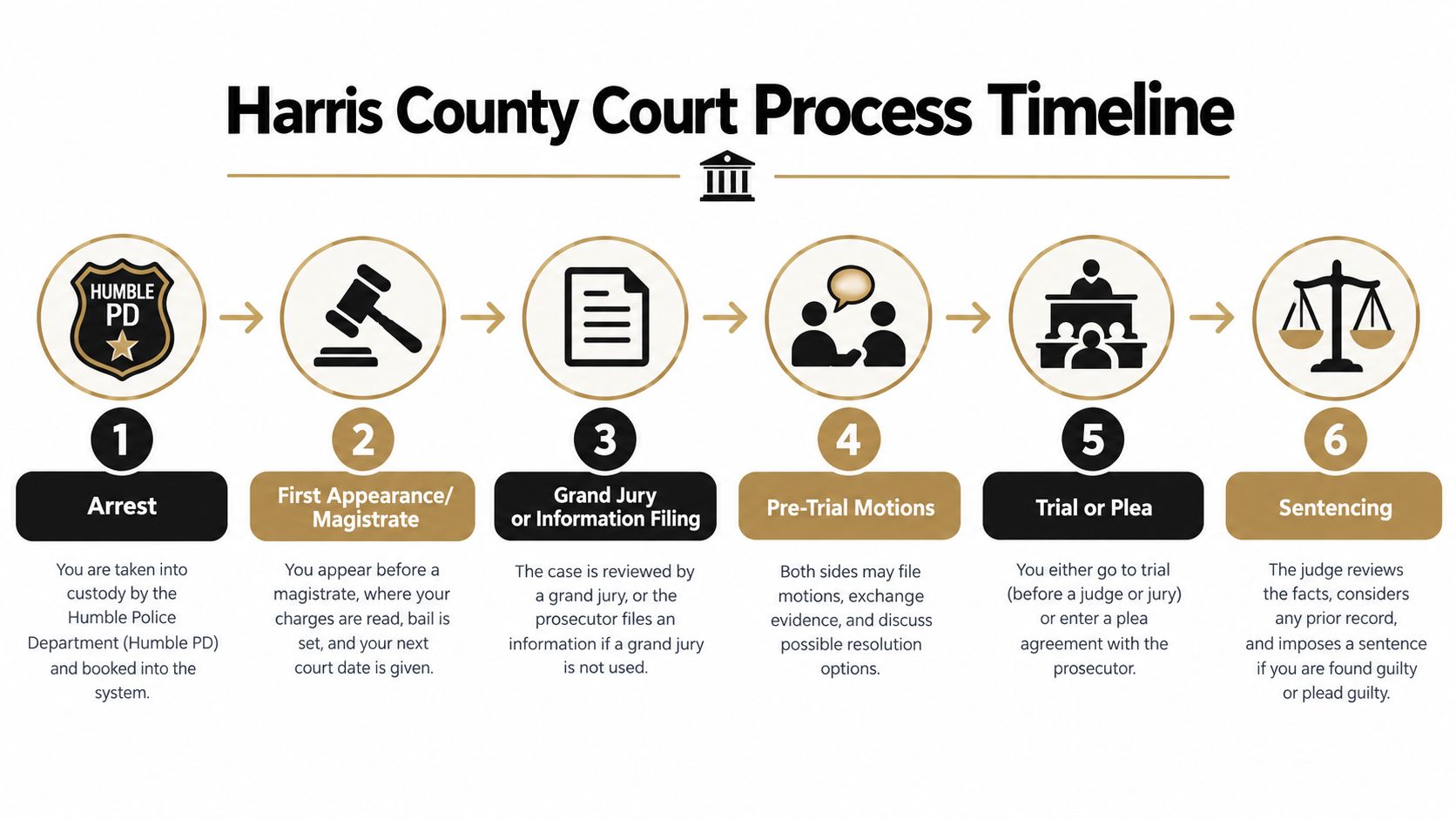
Arrest or investigation: A Humble ISD police officer, Harris County Precinct 4 constable, or Harris County Sheriff's Office deputy may respond to a report from Walmart, H-E-B, an apartment complex, or another public location. You could be arrested immediately, contacted later, or notified that a warrant exists. Do not answer substantive questions because an officer sounds calm or promises the matter can be resolved quickly. Give required identifying information, then ask for counsel.
Magistration: After an arrest, you generally appear for an initial judicial review within the legally required period. In Harris County, this commonly occurs through the Joint Processing Center, where bond and release conditions are addressed. Bond depends on the case and your circumstances. Follow every condition from the moment you are released, including restrictions on contact.
Charging and arraignment: A misdemeanor may proceed in a Harris County Criminal Court at Law. At arraignment, you enter a formal plea and receive information about the accusation. Review what happens at an arraignment hearing before attending, then let your lawyer address questions about the case.
Discovery, negotiations, and trial
After filing, the defense requests discovery. The materials may include body-camera footage, store surveillance, witness statements, dispatch records, photographs, and other evidence. Counsel should compare each item with the statutory elements, identify gaps or inconsistencies, and preserve material that supports your account.
The Harris County District Attorney's Office may discuss a negotiated resolution or diversion when legally available and appropriate. Eligibility is not automatic. Before accepting any program, understand whether it affects dismissal, your record, supervision, or registration. If negotiations fail, the case can proceed through motions, jury selection, testimony, and a verdict.
The waiting can bring embarrassment, anger, or exhaustion. Keep communications limited, obey bond conditions exactly, and let counsel communicate with prosecutors and witnesses. A careful review of the file, rather than a rushed explanation, should guide the next decision.
Your First Steps and When to Call a Local Attorney
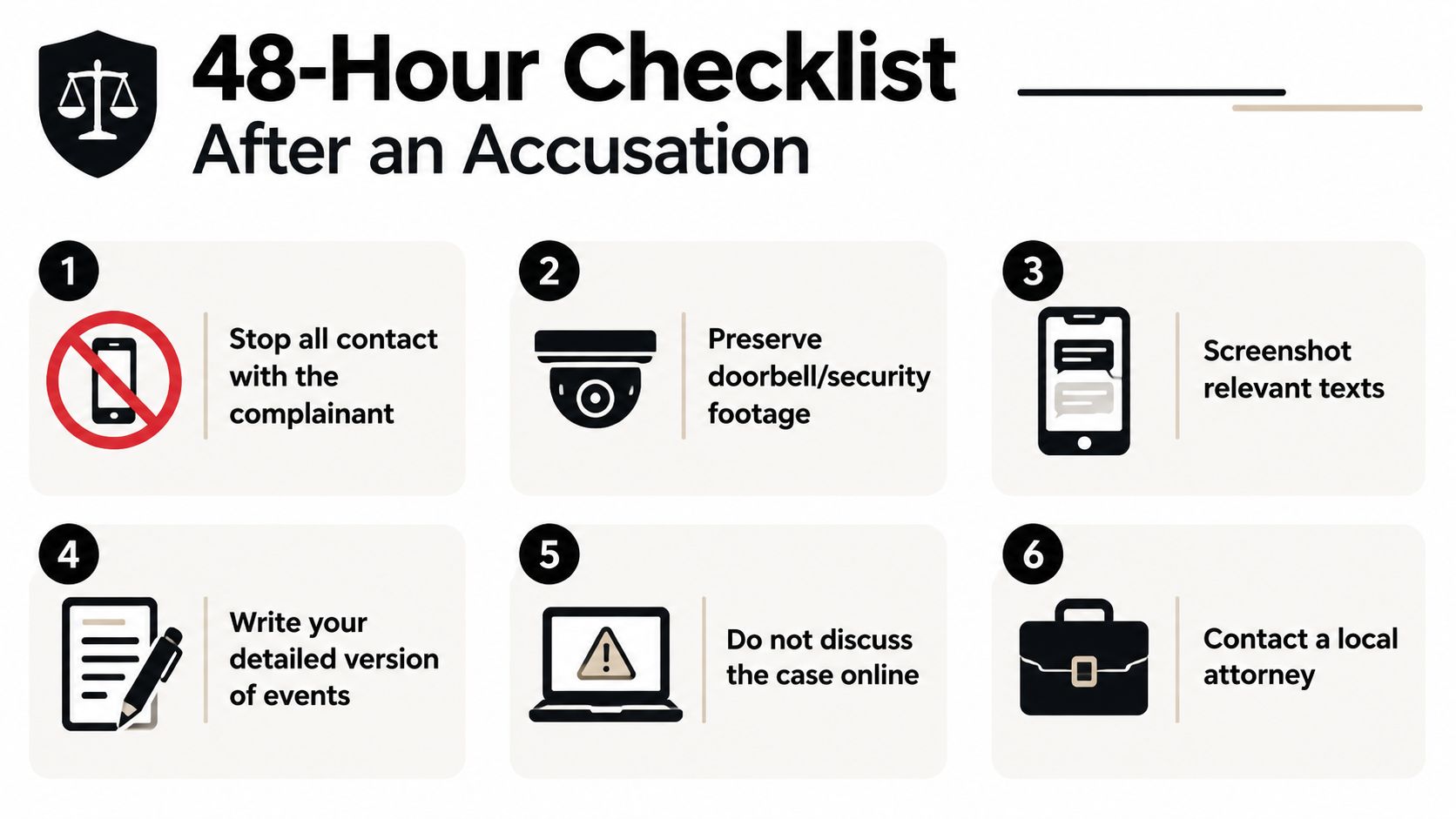
The first 48 hours are about preserving options, not proving your innocence to everyone who asks. Start with these actions:
- Stop contact with the complainant. Don't call, visit, apologize, argue, or send a message through a friend. Even an innocent attempt to explain can become evidence or create a bond violation.
- Preserve electronic evidence. Save doorbell footage, security video, location records, photographs, and relevant texts. Screenshot messages and keep the originals in their existing form.
- Write your account privately. Record where you were, who was present, what happened before and after, what you wore, and what each person said. Memory fades, and details can become difficult to reconstruct.
- Don't speak with investigators without counsel. You can politely provide identifying information when required, then say you want a lawyer before answering questions.
- Stay off social media. Don't post about the accusation, the alleged complainant, the police, or your feelings about the case.
Preservation matters: Don't delete texts, videos, photographs, location data, or social-media messages. Tell your lawyer what exists before deciding what should be preserved or produced.
Bring the warrant, charging instrument, bond paperwork, written notice from the District Attorney's Office, and your written timeline to the consultation. Include names of witnesses, store or apartment information, possible cameras, and any contact you received from police. If a juvenile's parent is involved, or if a college student at Lone Star College-Kingwood learns about an investigation, call before waiting for a summons.
The Law Office of Bryan Fagan – Atascocita TX Lawyers can evaluate the criminal case alongside related custody or family concerns, attend relevant Harris County proceedings, and discuss whether a pretrial resolution under the applicable law is available. Administrative support can also matter when gathering records and organizing communications, and Legal assistants may be a useful resource for non-legal case administration.
Use this decision tree:
- Police want an interview, a warrant exists, or you've been arrested: Call a defense attorney immediately.
- You received court paperwork or a summons: Schedule a consultation before the first setting.
- You only heard an informal rumor: Preserve evidence, avoid contact, and monitor for official notice while arranging legal advice.
- A custody case is active: Tell your family lawyer about the allegation and coordinate strategy with criminal counsel.
If you're weighing private representation against appointed counsel, review public defender versus private attorney and ask direct questions about communication, investigation, court coverage, and the scope of representation.
The Law Office of Bryan Fagan – Atascocita TX Lawyers helps Atascocita, Humble, and northeast Harris County residents evaluate indecent-exposure allegations, protect their rights, and address related custody concerns. Schedule a free consultation so an attorney can review your paperwork, preserve the right evidence, and build an action plan before the case gains momentum.