 Skip to content
Facing the possibility of losing your parental rights is, without question, one of the most frightening and stressful experiences a parent can go through. Here in Texas, the termination of parental rights isn't just a custody change; it's a court process that permanently dissolves the legal relationship between you and your child—ending every right and responsibility you have. As a local law firm serving families in Atascocita and the surrounding communities, we know how devastating this process can be. The first, most critical step in protecting your family is to understand exactly what you are facing.
Understanding Parental Rights Termination in Texas

For families in communities like Atascocita and Humble, the idea of having your parental rights terminated can feel abstract and overwhelming. At its core, it’s a court order that completely and permanently severs the legal ties between a parent and child. Once it’s done, you are, in the eyes of the law, strangers.
This is not a step any Harris County judge takes lightly. The law treats the parent-child bond as sacred, and the bar for breaking it is set incredibly high. You can think of it as the legal system's "nuclear option"—it’s only used when all other avenues have failed and it’s proven to be absolutely essential for the child's welfare.
Two Paths to Termination
For most parents, this situation unfolds in one of two ways. It’s crucial to know the difference because it fundamentally changes the legal battle you’re about to face.
-
Voluntary Termination: This is when a parent willingly consents to give up their rights. We often see this in adoption cases, like when a stepparent in Humble wants to adopt their stepchild and the other biological parent agrees to it.
-
Involuntary Termination: This is a serious, contested legal fight. It’s usually started by Child Protective Services (CPS) or another concerned party based on allegations that the child's health, safety, or well-being is in jeopardy.
In every single case, the court's decision boils down to one guiding principle: the "best interest of the child." Before a judge will even consider termination, they must be persuaded by clear and convincing evidence that ending your relationship with your child is truly what's best for their future.
Why This Matters for Atascocita Families
While these cases are rare compared to the overall number of families, the termination of parental rights has permanent, life-altering consequences for thousands of Texas families every year. Statewide data on Texas child welfare cases shows over 5,500 parental rights terminations in one recent year alone. For families in Harris County, these aren't just statistics; they represent a local reality where our courts are tasked with these complex and emotionally charged cases every day.
This guide is here to cut through the confusion and give you the clarity you need. We'll walk through your rights, the legal process, and the steps you can take to fight for your family’s future with the support of a law firm that understands our community.
Voluntary vs. Involuntary Termination of Rights
In Texas, terminating parental rights isn't a one-size-fits-all process. It follows one of two very different paths, and knowing which one applies to you is the first step in understanding what lies ahead. This isn't just a minor legal distinction; it fundamentally changes the emotional journey, the court process, and the stakes for everyone involved.
Think of it this way: one path is chosen, often with a heavy heart but with a clear goal in mind for the child's future. The other path is a fight, a contested battle where a parent's right to their child is on the line.
Voluntary Termination: A Path of Agreement
Voluntary termination is exactly what it sounds like—a parent consciously decides to give up their legal rights to a child. This is never a casual decision. It involves signing a formal legal document, usually an affidavit of relinquishment, that clearly states your intent to permanently end the parent-child relationship.
However, a parent's signature isn't the final word. A Harris County judge must still review the entire situation and be convinced that terminating your rights is truly in the child’s best interest.
This scenario is most often seen in adoption cases. For example, let's say a family in Humble has a child from the mother's previous relationship. Her new husband has been the primary father figure for years and wants to adopt the child. The child's biological father might agree that this stable, two-parent home is what's best. By voluntarily signing away his rights, he clears the way for the stepparent to legally become the child’s parent, formalizing a bond that already exists.
While this process is still serious and requires a judge's approval, it's rooted in cooperation, not conflict. The goal is to provide legal stability for a child within a new family structure.
Involuntary Termination: A Contested Battle
Involuntary termination is a whole different world. This is a lawsuit brought against a parent, demanding that the court sever their rights against their will. Most often, these cases are filed by the Texas Department of Family and Protective Services (DFPS)—what most people call CPS—but other relatives or interested parties can sometimes initiate them as well.
This is a full-blown legal fight where the stakes are incredibly high. The party trying to terminate your rights has a heavy burden. They must prove two separate things to the court by clear and convincing evidence, which is a very tough legal standard to meet:
- First, they have to prove that the parent committed an act that falls under one of the specific grounds for termination listed in the Texas Family Code (like endangerment, neglect, or abandonment).
- Second, they must also convince the judge that ending the parent-child relationship is definitively in the child’s best interest.
For a parent in Atascocita facing an involuntary termination suit, this means you are going up against the state's full resources. The process is adversarial, deeply stressful, and runs on strict court deadlines. It's a fight to keep your family together, and the law requires the other side to prove their case, not for you to prove you're a good parent.
To put it simply, these two legal actions could not be more different. This table breaks down the core distinctions at a glance.
Voluntary vs. Involuntary Termination of Parental Rights
| Aspect | Voluntary Termination | Involuntary Termination |
|---|---|---|
| Parent's Role | The parent willingly agrees and signs an affidavit to give up their rights. | The parent opposes the termination and fights the lawsuit in court. |
| Who Initiates | Often the parent themselves, in coordination with an adoption plan. | Typically initiated by CPS or another party against the parent's will. |
| Court Standard | The judge must still find that termination is in the child's best interest. | The petitioner must prove a legal ground and best interest by "clear and convincing evidence." |
| Common Scenario | A stepparent in Humble wants to adopt their stepchild, and the other parent agrees. | CPS intervenes due to concerns of neglect, abuse, or endangerment. |
Whether you are considering relinquishing your rights as part of an adoption plan or are being forced to defend them, understanding your legal position is critical. For compassionate guidance on your specific circumstances, you can learn more about our Atascocita child custody services.
What Does It Take to Lose Your Parental Rights Involuntarily?
A Texas court can’t just decide to terminate your parental rights on a whim. This is one of the most serious actions a judge can take, often called the "civil death penalty" for a family relationship. Because the stakes are so high, the law sets a very high bar.
The person or agency asking the court to end your rights—whether it's the other parent or Child Protective Services (CPS)—has a tough job. They have to prove their case with clear and convincing evidence. This isn't a "he said, she said" situation. It's a much stricter standard of proof than in most civil cases, meaning the judge must have a "firm belief or conviction" that the claims against you are true.
This whole process is deliberately difficult. The court has to make two separate findings before it can even consider issuing a termination order.
The Two-Hurdle Test for Termination
Think of it like a two-part test. The party trying to terminate your rights must clear both hurdles. If they stumble on either one, their case fails.
- They Must Prove a Legal Reason: First, they have to prove that your actions (or inaction) meet at least one of the specific grounds for termination laid out in the Texas Family Code. We'll dig into what those are in a moment.
- They Must Prove It's in the Child's Best Interest: Second, they must also prove that permanently severing the bond between you and your child is truly what’s best for that child's future.
This is a critical distinction. A judge could theoretically find that a parent’s conduct meets a technical legal ground but still conclude that termination is not in the child’s best interest. Both pieces of the puzzle must be firmly in place.
Common Reasons a Court Might Terminate Parental Rights
The Texas Family Code lists nearly 20 different legal grounds for involuntary termination. While the statute book is full of legalese, these grounds boil down to real-world situations that threaten a child's safety and well-being. Here are some of the most common ones we see in Harris County courtrooms.
- Endangerment: This is a big one. It means you knowingly put your child in a situation or environment that endangers their physical or emotional health. This could be anything from exposing them to drug use or domestic violence to engaging in criminal activity yourself, even if the child wasn't directly there to see it.
- Abandonment: This can play out in a couple of ways. The classic example is voluntarily leaving a child with someone else, not providing any support, and staying away for a specific length of time.
- Failure to Support (Neglect): This ground kicks in if you have the ability to support your child but fail to do so for a year, within the six months leading up to the case being filed. It’s about a consistent pattern of not providing for your child's basic needs.
- Not Following a Court-Ordered Plan: When CPS gets involved, a judge often creates a "service plan" with steps you must take to get your child back, like attending parenting classes or counseling. If you fail to follow through with the judge’s requirements, that failure can become its own reason for termination.
It's so important to understand that a single mistake or a bad day usually isn't enough. The court is looking for a consistent pattern of behavior that shows you are unable or unwilling to give your child a safe, stable home.
Knowing what you're up against is the first step toward defending your rights. If you're facing these kinds of accusations, your job is to show the court that you're actively fixing the problems and that your child needs you in their life. You can get a head start by reading our guide on how to prepare for a custody hearing in Texas.
Navigating the Termination Process in Harris County
For any parent in Atascocita, getting tangled up in the court system can feel like being dropped into a maze blindfolded. It's confusing and, frankly, terrifying. When Child Protective Services (CPS) gets involved and an involuntary termination case kicks off, you're suddenly facing a world of legal deadlines, court appearances, and words you’ve never heard before. Our goal is to give you a clear, step-by-step roadmap of what a typical termination case looks like in Harris County, taking the mystery out of the process so you can focus on what matters most: fighting for your family.
The whole thing usually starts long before anyone files a lawsuit. It often begins with a CPS investigation, which is triggered when someone reports suspected abuse or neglect. If the investigators believe a child is in immediate danger, they have the power to remove that child from the home and file a formal petition with the court. That petition is what officially starts the legal clock ticking.
The Initial Stages and Your Service Plan
Once a case is filed, the timeline gets tight. A judge will almost always hold an initial hearing within 14 days. At this first hearing, the court will make some quick decisions and issue temporary orders—things like where your child will live for the time being and who is allowed to have contact with them. If you can't afford an attorney, the court will appoint one for you at this stage.
This is also where a critical document comes into play: the Family Plan of Service. Think of it as a personalized checklist or a roadmap back to getting your child home. It’s a court-ordered list of tasks you have to complete to prove you can provide a safe and stable home.
A typical plan might require you to complete:
- Parenting Classes: These are meant to help you build new skills for handling stress and managing your child's behavior.
- Counseling or Therapy: This could be for anything from anger management and past trauma to other mental health concerns.
- Substance Abuse Treatment: This is almost always included if drug or alcohol use was a factor in the investigation.
- Maintaining Stable Housing and Employment: The court needs to see that you can provide a secure, consistent environment.
Completing this service plan isn't just about checking off boxes. It’s your single best opportunity to show the judge that you are serious about making whatever changes are necessary for your child's well-being.
Key Players and Court Milestones
Throughout this journey, you'll be dealing with several key people. Of course, there’s your attorney and the attorney for CPS. But the court will also appoint a lawyer just for your child, known as an Attorney Ad Litem. This lawyer has one job: to represent what they believe are your child’s best interests. Their opinion and recommendations carry a lot of weight with the judge.
As your case moves forward, you'll attend periodic status hearings and reviews. These are check-ins where the judge looks at your progress on the service plan. Before you ever get to a final trial, the court might also order mediation. This is a confidential meeting where everyone sits down with a neutral third party to try and work out an agreement. While it doesn't solve every case, it's a valuable chance to find some common ground. If mediation fails, the case gets set for a final trial, where a judge or jury will make the ultimate decision.
This whole process boils down to a two-part legal test that the court has to apply before it can do something as permanent as terminating parental rights.
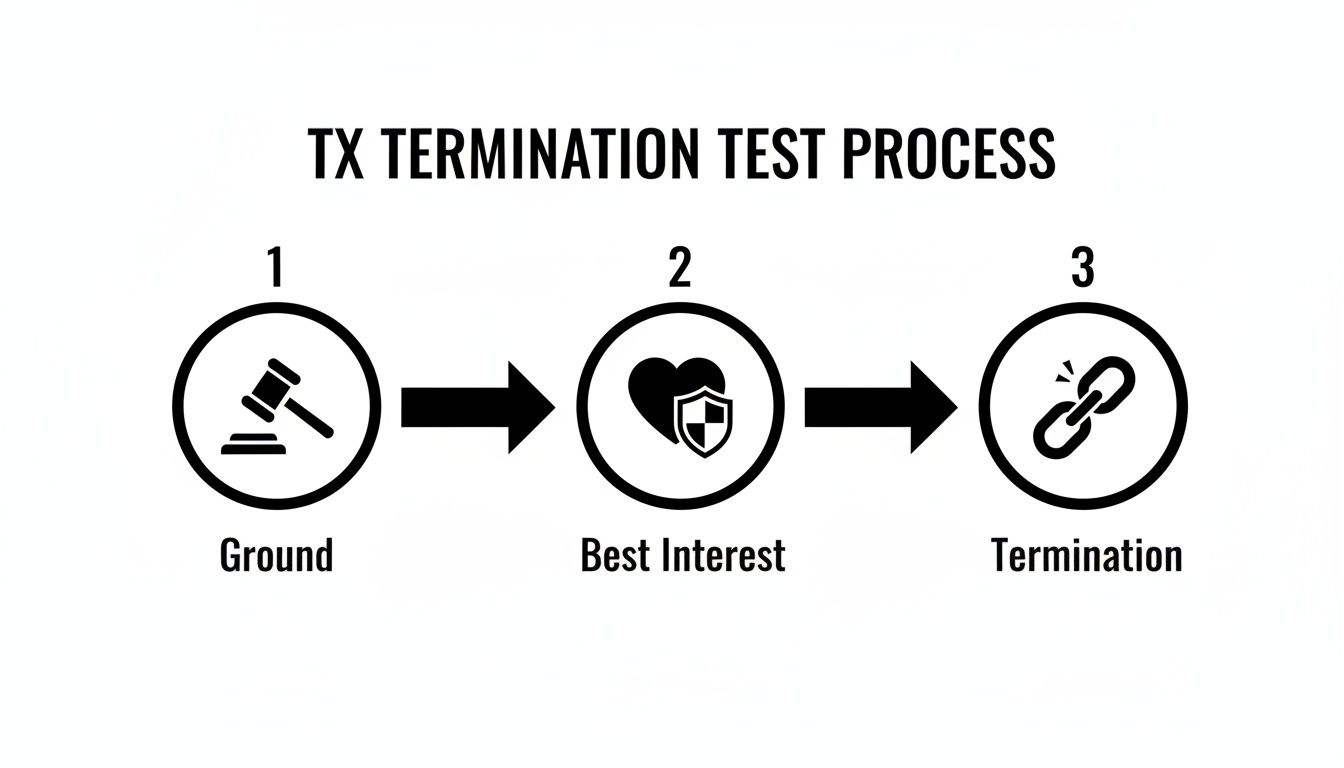
As you can see, the court must find that at least one statutory ground for termination exists and that termination is in the child's best interest. It’s a high bar, but one that gets met every day in Texas courts.
The timelines in these cases are incredibly strict. Local statistics show that termination of parental rights cases made up 27.6% of all child-protection cases filed in one major Texas county. These aren't the long, drawn-out legal dramas you see on TV. About 27.2% of family cases were resolved within 6–12 months, and only 10% lasted longer than 18 months. For families in Atascocita and Humble, these numbers underscore just how quickly these cases move through the Harris County court system.
The court process is demanding, and the stakes couldn’t be higher. While it has some things in common with other family law cases, the rules and speed are unique. For a better sense of how our local courts operate, you might find our guide on filing a divorce in Harris County to be a helpful resource.
Trying to face this journey alone is a risk you simply don't have to take. If you're involved in a CPS case in the Atascocita, Humble, or Kingwood area, contact The Law Office of Bryan Fagan today for a free consultation. We’re here to help you understand your rights and build the strongest defense possible for your family.
How to Build a Defense for Your Parental Rights
Getting a notice that someone wants to terminate your parental rights feels like the ground has dropped out from under you. It’s an overwhelming, terrifying moment. But this is not the time to give up; it’s the time to build a smart, strategic defense.
To convince a Harris County judge to rule in your favor, your defense needs to accomplish two critical things. First, you have to prove you’ve taken real, concrete steps to fix the problems that brought Child Protective Services (CPS) to your door. Second, you must show that keeping your family together is what’s genuinely best for your child.

This isn’t about pretending to be perfect overnight. It’s about showing progress, commitment, and the deep love you have for your child. The road map for this defense is your court-ordered service plan.
Proving Your Commitment Through Action
Think of your service plan as more than just a to-do list—it's your most powerful piece of evidence. Every class you complete, every appointment you keep, and every goal you meet sends a powerful message to the court: you are willing and able to give your child a safe, stable home.
Your legal strategy will revolve around showing your progress in very specific ways:
- Challenging the Evidence: The state has to prove its case. Your attorney will dig into the allegations, question the testimony of CPS caseworkers, and find evidence that tells your side of the story.
- Demonstrating Substantial Change: You need to show the judge that the person you are today is not the same person you were when this case began. This means providing tangible proof—certificates from parenting classes, clean drug tests, letters from counselors, and proof of steady employment and a safe place to live.
- Highlighting the Parent-Child Bond: We can bring in testimony from teachers, family, or therapists who have seen your relationship with your child. Their stories can illustrate the strong, positive bond you share and make a compelling argument that breaking that bond would do more harm than good.
The heart of a strong defense is changing the story. Instead of letting the case be about past mistakes, we present the judge with a clear picture of a dedicated parent who has done everything possible to build a safe and loving future for their child.
Imagine a parent from Atascocita struggling with substance abuse. They didn't just go to the required treatment program. They went further, joining a local support group, finding a sponsor, and getting a stable job near Lake Houston. By showing the judge that comprehensive, ongoing commitment to sobriety, they proved the original risk to their child was gone. That’s the kind of proactive effort that gets a judge’s attention.
Navigating the System with Urgency
The landscape of Texas child welfare is changing. Statewide reforms have led to a massive 55% decrease in child removals and a 47% drop in the number of children in foster care between 2018 and 2024. This is good news, showing a trend toward keeping families together.
However, there’s a catch. Federal reviews show that once a case does get filed, Texas courts tend to move toward termination very quickly. For families in Atascocita and Humble, this means you can't afford to wait. You have to start building your defense from day one.
Putting together a convincing case means being prepared and knowing what to expect in the courtroom. You can learn more by reading our guide on how to prepare for a custody hearing. The principles discussed there are a great starting point for presenting your case effectively.
Your story and your efforts are what matter most. With the right legal strategy, you can present a powerful argument that shows a judge that the best and safest place for your child is right there with you.
Life After a Final Termination Order
Knowing the legal grounds and the court process is one thing, but truly understanding what happens after a judge terminates your parental rights is something else entirely. For a parent in Atascocita or Humble, this isn't just a legal document; it's a permanent and life-altering event that legally redefines your family forever.
The goal here isn't to scare you. It's to be completely clear about the stakes and drive home why getting an experienced attorney involved immediately is absolutely essential.
A final order terminating parental rights is exactly what it sounds like: final and permanent. Once that order is signed by a Harris County judge, the legal bond between you and your child is completely and irreversibly broken.
The Permanent Changes to Your Family
Think of a final termination order as legally erasing your role as a parent. The practical effects are immediate, sweeping, and absolute.
- No More Parental Rights: You lose all legal rights to see or spend time with your child. Your ability to make decisions about their school, their doctor, or their religious upbringing is gone.
- Inheritance Rights Are Gone: Your child can no longer legally inherit from you if you die without a will, and you lose the right to inherit from them.
- A New Legal Family: Most importantly, terminating your rights opens the door for your child to be legally adopted by someone else, whether that's their foster parents or other family members who have been caring for them.
This permanence is precisely why Texas law makes termination so difficult. The courts see it as the ultimate, last-resort solution to ensure a child's safety and stability.
We often get asked if a termination order can ever be reversed. The hard truth is that in nearly every single case, the answer is no. This is why it's so critical to put up the strongest possible defense before a final order is ever signed.
What Happens to Child Support
It's a common question: "If my rights are terminated, do I still have to pay child support?" The answer is a bit of a mix. A termination order does stop your obligation to pay any future child support from that day forward.
However, it does not get rid of any past-due child support you already owe. That debt, known as "arrearages," is still on the books. You are legally required to pay it in full, and you can expect the Office of the Attorney General to continue collection efforts until it's paid off.
The finality of a termination order is one of the most sobering realities in Texas family law. While the chances of undoing a final order are incredibly slim, it's worth understanding how to appeal a family court decision to see just how limited the options are after the fact. This only reinforces the most important truth: the real fight for your family has to happen before the judge's gavel falls for the last time.
Frequently Asked Questions About Termination Cases
When you’re staring down a situation this serious, it’s completely normal to have a flood of urgent questions. Let's walk through some of the most common ones we hear from families in Atascocita, Humble, and the surrounding areas.
Can I Get My Parental Rights Back After Termination in Texas?
This is usually the first, and most heart-wrenching, question we get. The honest, tough answer is that a Texas court order terminating parental rights is final and permanent. Once that gavel falls and the judge signs the order, the legal relationship between you and your child is severed forever.
There are a few, very narrow exceptions for an immediate appeal right after the trial. But there is no legal path to "reinstate" or "get your rights back" down the road. This finality is exactly why it's so critical to get an experienced attorney involved and start building a strong defense the second you're contacted by CPS. Acting immediately is your best—and frankly, your only—shot at preventing a permanent loss.
How Long Does a CPS Termination Case Take in Harris County?
Every family's situation is different, but these cases move surprisingly fast on a court-mandated schedule. For families here in Harris County, you can expect a CPS case that involves termination to wrap up within 6 to 18 months.
The Texas Family Code is very clear on this; it sets strict deadlines to prevent children from languishing in foster care. This sped-up timeline puts immense pressure on parents. You don't have years to turn things around; you have a matter of months. That’s why you have to jump in with both feet, engaging with the court and your service plan from day one.
Does Termination of Parental Rights Stop My Child Support?
This is a bit of a "yes and no" answer. The termination order does stop your legal duty to pay any future child support from the day the order is signed.
However—and this is a big one—it does not wipe out any past-due child support, which is legally called "arrearages." Any amount you owed before your rights were terminated is still a debt you legally have to pay. The Office of the Attorney General will keep pursuing collection until that old balance is paid off. The debt doesn't just vanish with the termination order.
The legal system can feel like a maze, and in a termination case, the stakes are as high as they get. You don't have to navigate this fight by yourself. The dedicated attorneys at The Law Office of Bryan Fagan – Atascocita TX Lawyers are here to stand up for your rights and walk with you through this incredibly tough time. We are a part of your community and are committed to helping our neighbors in Atascocita, Humble, and northeast Harris County protect their families. Schedule your free, confidential consultation at our Atascocita office today by visiting us at The Law Office of Bryan Fagan's Atascocita website.


