 Skip to content
Divorcing a spouse who is in prison starts with a few key legal actions: you'll need to file an official petition with the court, make sure you meet Texas's residency rules, and then have the divorce papers legally served on your spouse at their correctional facility. The good news is that Texas law allows you to get a divorce even if your spouse does not agree, and their incarceration can actually serve as the specific legal reason for ending the marriage.
Navigating Divorce When Your Spouse Is Incarcerated

Going through a divorce is challenging enough. When your spouse is behind bars, it adds a whole other set of legal and emotional hurdles that can make everything feel confusing and overwhelming. If you live in Atascocita, Humble, or anywhere in northeast Harris County, please know you are not alone in facing this, and there is a clear path forward.
It's hard to overstate the strain that incarceration puts on a marriage. The abrupt financial difficulties, the emotional void, and the sheer physical distance can make it feel impossible to keep the relationship afloat.
The Reality of Incarceration and Marriage
A prison sentence often has a final, devastating impact on a marriage. Research paints a stark picture: the divorce rate for couples where a spouse is imprisoned for a year or more is a staggering 80 percent for men and nearly 100 percent for women. Those numbers are miles apart from the divorce rate in the general population, which just goes to show how intense these situations are.
This isn't just a number on a page; it’s the lived experience of families right here in our community. The person you built a life with is now in a place that has completely upended your own life, your family’s sense of security, and your plans for the future.
Understanding Your Legal Standing in Texas
Before we get into the "how-to," it helps to have a grasp of the basics of Texas divorce law. While you always have the option for a no-fault divorce, Texas law also gives you a specific "fault" ground that fits this exact scenario.
Under the Texas Family Code, you can file for divorce based on a felony conviction if your spouse has been imprisoned for at least one year and has not been pardoned. Using this as your grounds can sometimes be a strategic advantage, especially when it comes time to divide your marital property.
What this means is you have a direct, legally solid reason to end the marriage. At The Law Office of Bryan Fagan – Atascocita TX Lawyers, our goal is to make this process less intimidating. We'll guide you through every stage, from start to finish.
We'll help you with:
- Kicking off the divorce process correctly within the Harris County court system.
- Ensuring divorce papers are properly served to an inmate in a Texas Department of Criminal Justice (TDCJ) facility.
- Working toward a fair resolution on child custody, support, and how your property is divided.
You don't have to figure all this out on your own. Our Atascocita team is right here to offer the local support and legal guidance you need to move on. Give us a call today for a free, confidential consultation.
Kicking Off the Divorce Process in Harris County
The first real step toward ending your marriage is filing what's called an Original Petition for Divorce. This is the official document that gets your case on the court's radar and formally tells a judge you want to dissolve your marriage. For those of us in Atascocita and Humble, this all happens through the Harris County District Clerk.
But before you can even think about filing, you have to clear a critical hurdle: Texas’s residency rules. To file for divorce here in Harris County, you must have lived:
- In Texas for at least the last six months
- In Harris County for at least the last 90 days
These aren't just suggestions; they are firm requirements that establish the court’s authority to handle your case. Once we’ve confirmed you meet these residency requirements, we can get to work drafting your petition.
No-Fault vs. Fault: Choosing Your Legal Grounds
A big part of drafting that initial petition involves deciding on the "grounds" for the divorce. Think of this as the legal reason you’re asking the court to end the marriage. In Texas, you have a couple of options, and your choice here can significantly shape the rest of your case.
The most common route, by far, is a no-fault divorce. You’re essentially telling the court that the marriage has become "insupportable" because of conflict and that there’s no chance of getting back together. It's a straightforward path that avoids pointing fingers or assigning blame.
However, your specific circumstances open up another, potentially more powerful, option: filing on fault grounds.
The Texas Family Code is very clear on this: a felony conviction where your spouse has been imprisoned for at least one year is a specific, recognized reason for a fault-based divorce. This isn’t a minor detail; it’s a strategic tool.
Why does this matter? Pleading fault based on the felony conviction can give you leverage, especially when it comes to dividing property. For instance, if your spouse drained your joint savings account to pay for their criminal defense attorney, a Harris County judge could see that as wasting community assets. By highlighting the felony as the reason for the divorce, you build a stronger case for receiving a larger, or "disproportionate," share of the remaining property to make up for that financial damage.
The Paperwork: What Goes into the Petition
Once we've settled on the grounds and drafted the petition, it's time to make it official. We handle the electronic filing with the Harris County District Clerk, making sure every detail is correct so the process moves along smoothly.
The petition itself lays out the essential facts for the court. It will include:
- The names and basic information for both you and your spouse.
- A clear statement that you meet the state and county residency rules.
- The grounds for the divorce, whether it's insupportability or the felony conviction.
- Information regarding any children you have together.
- A general description of the community property that needs to be divided.
This document doesn't need to list every single spoon you own, but it sets the legal wheels in motion. Filing it is a huge step toward taking back control of your life. For a more granular look at the local procedures, you can get more details on filing a divorce in Harris County from our in-depth guide.
We know the ins and outs of the Harris County court system. Our job is to make sure your petition tells your story accurately and positions you for the best possible outcome, so you can start focusing on what comes next.
Serving Divorce Papers to an Inmate in Texas
Once your divorce petition is filed with the Harris County District Clerk, the next critical step is legally notifying your spouse. This is called service of process, and it’s a part of the process that trips up a lot of people when a spouse is incarcerated. You can't just mail the papers or drop them off yourself. Texas law is very specific about how this has to be done to make it official.
Getting service right isn't just about checking a box. It’s about protecting your divorce from being thrown out later. If your spouse can argue they were never properly notified, it can invalidate the entire proceeding, forcing you to start all over again. It’s absolutely crucial to get this step right from the beginning.
Before you can even think about serving papers, though, you have to lay the groundwork.
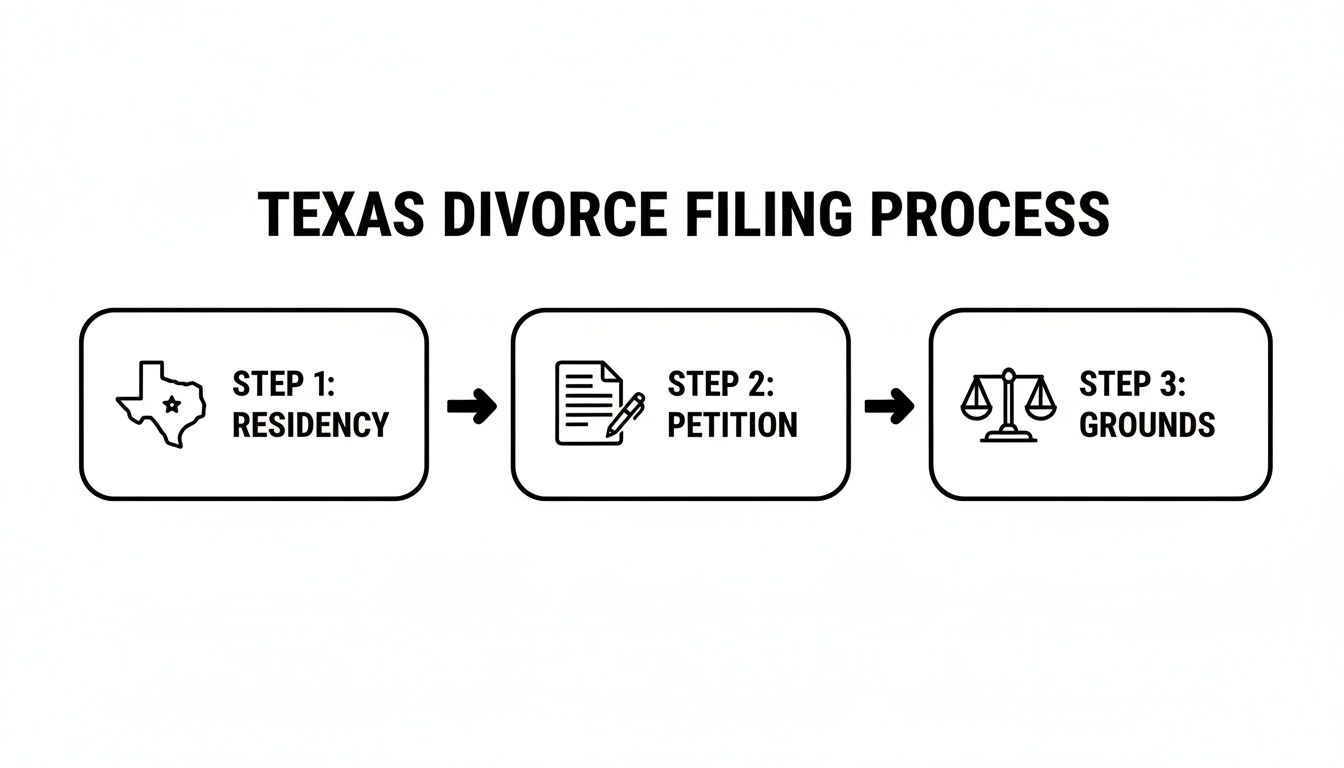
As you can see, confirming your residency, drafting the divorce petition, and establishing the grounds for divorce are the foundational actions you must complete first. Only then can you move on to service.
The Formal Method: Personal Service
The most traditional and bulletproof way to serve an inmate is through personal service. This means having an authorized professional hand-deliver the divorce papers directly to your spouse in the correctional facility. You are not allowed to do this yourself.
You have a couple of options for who can perform this delivery:
- A Sheriff or Constable: You can use a deputy from the county where the prison is located.
- A Private Process Server: These are certified professionals whose entire job is delivering legal documents.
From our experience helping families in Atascocita, using a private process server is often the most efficient route. At The Law Office of Bryan Fagan, we work with process servers who are familiar with the Texas Department of Criminal Justice (TDCJ) system. They know the specific protocols for getting into a facility and serving an inmate, which can be a real headache otherwise. After delivery, they file a formal "Return of Service" with the court, which is the official proof you need to move your case forward.
The Simpler Route: A Waiver of Service
There’s a much faster and more affordable alternative, but it hinges entirely on your spouse’s cooperation. If your spouse agrees to the divorce and is willing to sign a document, you can skip formal service altogether.
A Waiver of Service is a legal form your spouse signs to acknowledge they have received the divorce petition. By signing it, they are "waiving" the right to be formally served by a sheriff or process server.
This isn’t just a simple signature, though. It must be signed in front of a notary public. The good news is that most TDCJ facilities have notaries available for inmates. We can prepare the waiver and send it to your spouse with clear instructions on how to get it signed and notarized.
Once they mail it back, we file it with the Harris County clerk. This becomes the official proof of notification. For a truly uncontested divorce, this is the best-case scenario.
First Things First: You Have to Find Them
No matter which path you take—personal service or a waiver—there’s one step you absolutely cannot skip: you must know exactly where your spouse is incarcerated. Inmates get transferred between units more often than you’d think, and sending a process server to the wrong facility is a frustrating waste of time and money.
Before we do anything, our first action is to use the official TDCJ Inmate Locator tool. This public database confirms their current unit and, just as importantly, provides their unique TDCJ inmate number. Prison officials need this number to locate your spouse, and the process server will need it to complete their job.
This simple check avoids so many potential delays. Our Atascocita team is meticulous about these small details because they make a huge difference in keeping your case on track. For a broader look at the initial steps, you can review our guide on how to file for divorce in Texas.
Handling Child Custody and Property Division
When you're dealing with a divorce and your spouse is in prison, figuring out what happens with your kids and your property can feel overwhelming. It’s not just the emotional strain; it's the very real, practical worries about your children’s stability and your own financial future. For families here in the Atascocita and Humble areas, it’s important to know that Texas law has a clear path forward to help you regain control and find stability.
Frankly, these issues are often the final straw. A spouse's incarceration puts an incredible amount of pressure on a marriage—financially, emotionally, and socially. It's a sad reality, but research confirms that a spouse's imprisonment drastically increases the odds of divorce. In fact, for every extra year they're behind bars, the likelihood of divorce jumps by 32 percent. The reasons are complex, ranging from the sheer economic hardship to the complete erosion of the marital relationship.
Protecting Your Children The Texas Way
In any Harris County divorce involving kids, the judge has one guiding principle: the “best interest of the child.” This is the lens through which every decision is made. When one parent is incarcerated, this standard makes the custody outcome much clearer.
Almost without exception, a parent's imprisonment results in the non-incarcerated parent being named the sole managing conservator. This is a powerful legal designation. It gives you the exclusive authority to make all the critical decisions for your child, including:
- Deciding where your child lives.
- Making all educational and school enrollment choices.
- Consenting to medical, dental, and psychological care.
- Having the final say on psychiatric treatment.
Becoming the sole managing conservator gives you the clear, unambiguous authority you need to parent effectively without having to get approval from someone who simply can't participate. You can learn more about building a strong case for your parental rights in our guide on how to win child custody in Texas.
What About Child Support?
This is a common question we hear from our Atascocita clients: "How can they pay child support from a prison cell?" The short answer is, they can't. But their legal obligation doesn't just vanish. Texas courts are realistic about this.
A judge will almost certainly reduce the child support obligation to $0 or a token amount while the parent is incarcerated and has no income. The crucial thing to understand is that the order itself stays active. Once your ex-spouse is released and starts working again, you can go back to court and have the support amount modified to reflect their new income. The debt isn't wiped clean; it's just paused until they have the ability to pay.
Dividing Your Marital Property
Texas is a community property state. In simple terms, this means nearly everything you and your spouse acquired during the marriage belongs to both of you. This includes the house in Humble, joint bank accounts, cars, and retirement funds. The law requires this property to be divided in a "just and right" manner.
Now, "just and right" doesn't automatically mean a 50/50 split. The court can look at many factors, and this is where using a felony conviction as your ground for divorce can give you a real strategic advantage.
A Strategic Advantage: If you can prove that your spouse's criminal behavior damaged the community estate—your shared marital finances—a judge has the discretion to award you a larger share of the assets. For instance, if thousands from your joint savings account were spent on their legal defense or to pay restitution, that's money that was effectively stolen from your family.
A Harris County judge can make you whole for that loss by awarding you a disproportionate share of what's left. This could mean you get more of the equity in your home or a bigger piece of the retirement accounts. As you work through the division of assets, having a well-drafted settlement release agreement is key to ensuring all financial connections are severed cleanly, which helps prevent problems down the road. We can help you gather the proof of these financial losses and build a compelling case for a property division that is truly just and right for your family.
Finalizing Your Divorce and Starting Your New Life

After all the paperwork, the service of process, and the negotiations, this is it—the final step. This is where a Harris County judge makes your divorce official, finally closing a difficult chapter and allowing you to move forward.
Before we get to that, keep in mind Texas law has a mandatory 60-day waiting period. This clock starts the day we file the Original Petition for Divorce, and no judge can finalize the divorce a single day sooner. This rule applies to every divorce in the state, with no exceptions for cases involving incarceration.
The Uncontested Path: A Simple Prove-Up Hearing
If your spouse has been cooperative—perhaps they signed a Waiver of Service or even the Final Decree of Divorce itself—then we’re on the uncontested path. This is the simplest and quickest way to the finish line. We'll schedule a straightforward "prove-up" hearing at the Harris County Civil Courthouse.
Forget any courtroom drama you've seen on TV. This is a very brief, informal meeting with the judge. You and I will go to court, I’ll ask you a handful of simple, prepared questions under oath, and the judge will review the paperwork. Once they confirm everything is in order, they'll sign the Final Decree of Divorce.
The entire hearing is usually over in just a few minutes. It’s not a trial; it’s simply the last administrative step to make the terms you’ve both agreed upon legally binding. When the judge’s pen hits the paper, you are officially divorced.
For our clients in Atascocita and Humble, this quiet, anticlimactic hearing often brings a profound sense of relief. It’s the formal, legal start to their new life.
The Contested Path: When Your Spouse Fights Back from Prison
But what if your spouse refuses to cooperate? They might disagree with how you want to divide property or the custody plan you've laid out for your children. When a divorce is contested, the process gets more complicated because your spouse has a constitutional right to be heard.
This doesn't mean they get a field trip from a TDCJ facility to a Houston courthouse. A "bench warrant" to transport an inmate for a civil case like divorce is exceptionally rare. It just doesn't happen.
Instead, the court facilitates their participation remotely. Based on our experience, their involvement will almost always be handled in one of two ways:
- By Phone: Your spouse is brought to a specific room in the prison and joins the hearing via a conference call speakerphone.
- By Video: This is becoming much more common. Your spouse appears on a monitor in the courtroom, allowing for a more direct, face-to-face interaction with the judge.
During this remote hearing, the judge will listen to both sides. Your spouse gets their chance to object and make their case. As your attorney, we will be there to present our evidence and advocate for the terms you're seeking. After hearing from everyone, the judge makes the final, binding decisions on every disputed issue.
At The Law Office of Bryan Fagan – Atascocita TX Lawyers, handling these logistical and legal complexities is our job. Whether we’re setting up a simple prove-up or coordinating a contested remote hearing, we manage every detail so you can focus on what's truly important—healing and building a stable, brighter future for you and your family.
Common Questions About Divorcing an Inmate in Texas
Even with a step-by-step guide, it's natural to have lingering questions. This process is unique, and you're likely facing situations you never anticipated. Here are some of the most common questions we field from clients in Atascocita, Humble, and across Harris County, along with the straightforward answers you need.
How Long Will This Actually Take?
Texas law requires a mandatory 60-day waiting period after filing before any divorce can be finalized. But let's be realistic—when your spouse is incarcerated, the process almost always takes longer.
A practical timeline for a prison divorce is usually somewhere between four to six months. This buffer accounts for the extra hurdles involved, like tracking down your spouse within the TDCJ system, coordinating service of process with the facility, and dealing with any administrative delays. If your spouse decides to fight any part of the divorce, that timeline will stretch out as we work through the contested issues.
Can My Spouse Refuse to Get Divorced?
No, they can't. This is a critical point that often brings our clients immense relief. In Texas, you have an absolute right to dissolve your marriage. Your spouse's consent isn't required to grant the divorce itself.
That said, while your spouse can't stop the divorce from happening, they can contest the terms. They have a right to disagree with your proposed division of property, your plan for the kids, or anything else in the Final Decree of Divorce.
If they file an answer with the court challenging the terms, it simply means we'll have to present both sides to a judge, who will then make the final call. It complicates the "how," but it doesn't stop the divorce.
What if I Have No Idea Which Prison They're In?
This is a common hurdle, and it's one we handle all the time. You aren't expected to keep tabs on their location as they move through the state's prison system. One of our first steps is to use the official Texas Department of Criminal Justice (TDCJ) online offender locator tool.
This public database gives us two non-negotiable pieces of information: their current facility and their TDCJ inmate number. We need this for a few key reasons:
- To Serve the Papers: A process server can't hand-deliver the divorce suit without knowing exactly where to go and who to ask for.
- For All Communication: Any official legal notice or correspondence sent to the prison must include these details to have any chance of reaching your spouse.
- For the Court Record: The court requires precise information in all filings.
We track this down right away to prevent any unnecessary delays. It's a standard part of our process, so you can leave that detail to us.
Do I Still Have to Show Up in Court?
Yes, a final court appearance is required to finalize every Texas divorce. But what that "appearance" involves is very different depending on whether the case is contested or uncontested.
If your spouse agrees to the terms and signs the necessary paperwork (an uncontested divorce), your court visit is just a brief, simple "prove-up" hearing. You and I will go before a judge in a Harris County courthouse for just a few minutes, you'll answer a few basic questions under oath, and the judge will sign the final decree. It's more of a formality.
If the divorce is contested, we'll have more involved hearings, but your presence at the final one is still essential to get the divorce finalized. Either way, our team will be right there with you, making sure you're prepared and know exactly what to expect.
Divorce is challenging enough on its own. When you add the complexities of a spouse being incarcerated, it can feel overwhelming. You don't have to navigate this legal maze by yourself. At The Law Office of Bryan Fagan – Atascocita TX Lawyers, we bring compassion and deep experience to these exact situations, helping you find clarity and start your next chapter. If you're in Atascocita, Humble, or the surrounding northeast Harris County area, reach out today for a free, confidential consultation. Let us help you move forward.


