Skip to content

You may be caring for a child, sibling, or adult family member in Atascocita and doing what many families do late at night. You’re thinking past school, past medical appointments, and past next month’s bills. You’re asking the harder question: what happens when I’m not the one handling everything?
That question can feel heavy because the answer isn’t just emotional. It’s legal, financial, and practical all at once. A good plan has to protect your loved one, preserve the support they rely on, and give trusted people clear instructions for the future.
A lot of online advice makes this sound like a stack of forms. It isn’t. Special needs planning is more personal than that. It’s a way to build stability around one person’s life, routines, care, and dignity. If you’re looking for a special needs planning attorney Atascocita families can turn to, it helps to start with the basics and work outward from there.
Securing Your Loved One's Future in Atascocita
A parent in Humble might have a simple estate plan already. Maybe there’s a will, a life insurance policy, and a list of who should step in if something happens. For many families, that feels responsible and complete.
Then one detail changes everything. Their child receives or may someday need SSI or Medicaid. Suddenly, leaving money directly to that child can create problems instead of protection.
That’s where families often get stuck. They know they need to plan, but they don’t know what kind of planning fits. A standard inheritance may not work. A basic trust may not work either. The right answer usually depends on how benefits work, who will manage funds, and what kind of long-term support the person will need in daily life.
Why this area is so specialized
Special needs planning sits at the intersection of estate planning, public benefits, and future caregiving decisions. That’s one reason families shouldn't assume every estate plan solves this problem.
In Texas, there are only 9 active members listed in the Special Needs Alliance directory for Texas attorneys. That small number reflects how specialized this work is. Families in Atascocita, Humble, and northeast Harris County often need advice from someone who understands how Texas planning tools interact with benefits rules that can affect a loved one’s future.
Practical rule: If your loved one receives means-tested benefits or may need them later, don’t assume a regular will or direct beneficiary designation is safe.
What peace of mind really looks like
For most families, peace of mind doesn’t come from having more paperwork. It comes from knowing a few key questions have been answered:
- Who will manage money carefully: Someone needs legal authority and clear instructions.
- How funds can help without causing harm: Support should improve life, not accidentally disrupt benefits.
- What happens if caregivers change: A plan should still work if family roles shift over time.
- How local life fits in: School transitions, adult care, housing, and medical routines all matter in communities like Atascocita and Humble.
Good planning doesn’t erase uncertainty. It gives your family a map. That matters when siblings want guidance, grandparents want to help, or parents want to stop worrying that one well-meant gift could create legal trouble later.
What Is Special Needs Planning A Foundation for Their Future
Special needs planning works best when viewed as building a custom home. Not a bigger house. A better-designed one. The goal is to create a financial structure that supports your loved one for life while keeping the public-benefit foundation underneath it intact.

A traditional estate plan often assumes an heir can receive money outright, manage it alone, and use it however they choose. That’s fine in many families. It can be the wrong fit when a loved one depends on benefits or needs help handling money and decisions.
The three goals most families are balancing
Special needs planning usually tries to do three things at the same time.
- Protect benefit eligibility: The plan should avoid turning support money into a direct asset that creates problems.
- Add comfort and opportunity: Funds can still help with therapies, education, transportation, hobbies, technology, travel, and other extras that improve daily life.
- Put reliable people in charge: Someone needs authority to manage assets, follow the trust terms, and make thoughtful decisions.
That’s why this planning is often called “supplemental” in practice. The assets are there to add to your loved one’s life, not replace everything else or interfere with needed public support.
Why a regular will may not be enough
Many people hear “estate planning” and think the answer is just updating a will. The problem is that a will alone often controls who receives property, not how that property should be held and managed for a person with disabilities.
If a grandparent names a beneficiary directly, or if a parent leaves money outright with good intentions, those assets may create avoidable trouble. The legal tool matters just as much as the gift.
A short video can help make these ideas easier to picture in real life.
What goes into the foundation
A complete plan often includes more than one document and more than one conversation. Families may need to think through:
| Planning area | Why it matters |
|---|---|
| Trust design | Holds and manages assets in a safer way |
| Trustee selection | Decides who will carry out the plan |
| Benefit coordination | Helps avoid conflicts with public programs |
| Decision-making authority | Addresses who can help with medical or financial choices |
| Family instructions | Reduces confusion for siblings and relatives |
A strong plan isn’t just about leaving money. It’s about leaving a workable system.
That’s the heart of special needs planning. You’re not just passing assets on. You’re designing support around one person’s real life.
Core Tools Special Needs Trusts and ABLE Accounts
When families in Atascocita start looking for practical tools, two names come up quickly: Special Needs Trusts and ABLE accounts. They can work together, but they aren’t interchangeable.
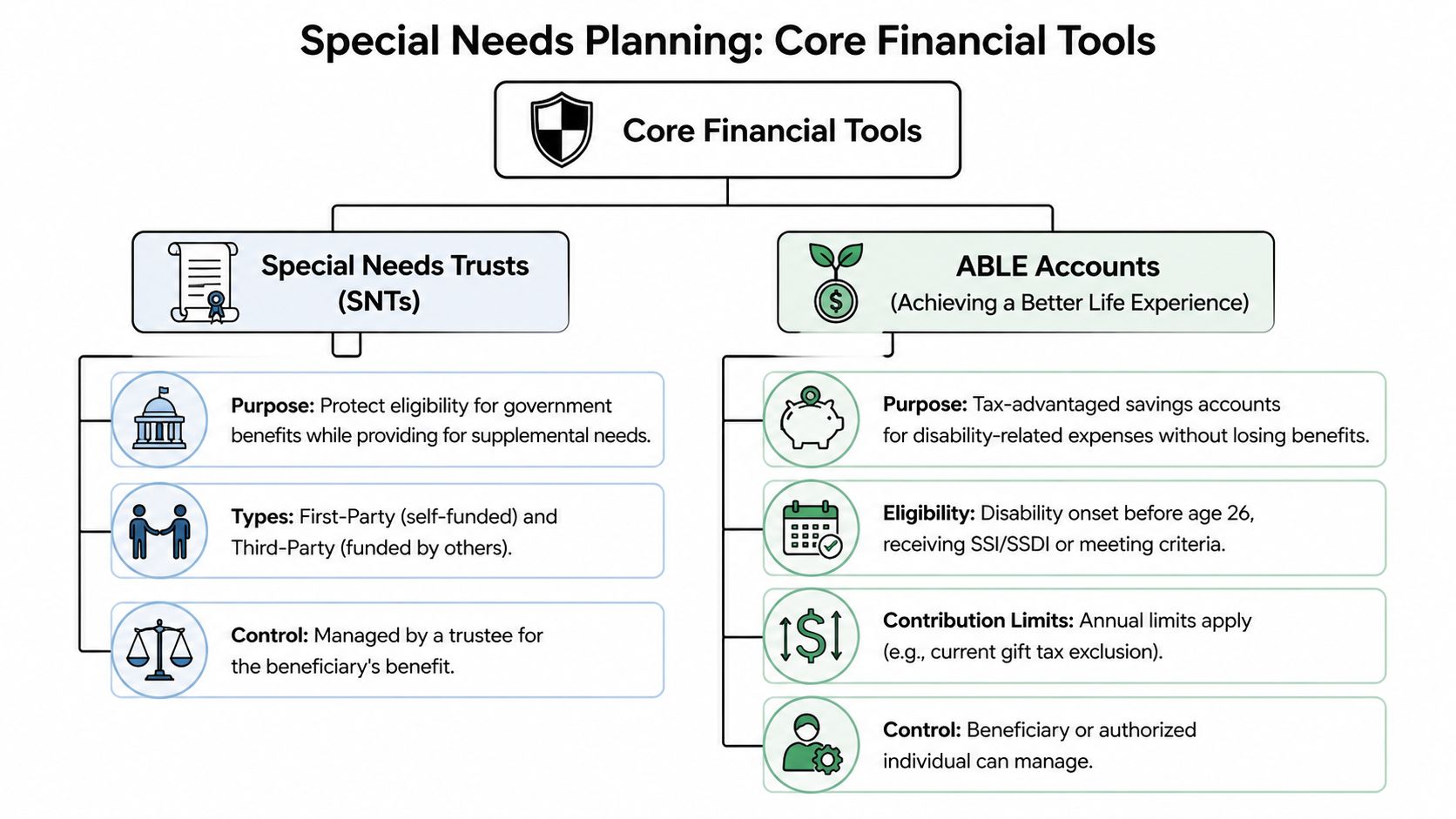
A trust is usually the larger, more structured planning tool. An ABLE account is often the flexible, day-to-day companion tool. Understanding the difference helps families avoid one common mistake: trying to force one tool to do every job.
Special needs trusts in plain English
A Special Needs Trust, often called an SNT, holds assets for the benefit of a person with disabilities while placing a trustee in charge of managing those funds according to the trust terms.
There are two broad categories families usually hear about:
- First-party SNT: This type is funded with the beneficiary’s own money, such as funds already belonging to that person.
- Third-party SNT: This type is funded by someone else, often a parent, grandparent, or other relative as part of a larger estate plan.
For many families, a third-party trust becomes the central long-term planning tool because it gives relatives a designated place to leave support instead of naming the loved one directly. If you want a broader look at trust creation in Texas, this guide on how to create a trust can help you understand the larger framework.
ABLE accounts as a practical companion
An ABLE account is a tax-advantaged savings tool built for certain disability-related situations. Families often like it because it can be more accessible for everyday spending and can allow the beneficiary or an authorized person to manage it more directly.
The infographic below summarizes the basic roles these tools play.
ABLE accounts are often useful when a family wants a place for smaller savings, routine disability-related expenses, or a more hands-on spending tool that complements a trust rather than replacing it.
Key point: A trust is often the long-range structure. An ABLE account is often the flexible spending tool.
Special Needs Trust vs. ABLE Account At a Glance
| Feature | Third-Party Special Needs Trust (SNT) | ABLE Account |
|---|---|---|
| Main purpose | Hold and manage support from parents, grandparents, or others for supplemental needs | Save and spend on qualifying disability-related expenses in a more direct way |
| Who typically funds it | Family members or other third parties | The beneficiary, family members, or others contributing to the account |
| Who manages it | A trustee manages distributions and administration | The beneficiary or an authorized individual may manage it |
| Best use | Long-term planning, inheritances, larger family gifts, coordinated estate planning | Day-to-day or medium-term disability-related spending and savings |
| Control structure | More formal, with legal instructions in the trust document | Simpler account-based structure |
| End-of-life treatment | Depends on trust terms and type of trust | Depends on applicable account rules and circumstances |
How families often use both
A common pattern looks like this:
- Parents create a third-party special needs trust as the main destination for inheritances and larger gifts.
- The loved one uses or has access to an ABLE account for practical disability-related expenses.
- Family members learn where gifts should go so nobody accidentally names the loved one directly on an account or policy.
That combination can give families both structure and flexibility. The trust handles the long view. The ABLE account can help with shorter-term spending needs.
Where confusion usually starts
Many families ask whether they can skip the trust and just use an ABLE account. Sometimes that question comes from wanting a simpler setup. Other times it comes from not realizing how many issues a trust can solve, including trustee oversight, inheritance planning, and long-term management if parents are no longer here to coordinate everything.
The better question is usually not “Which one is better?” It’s “Which jobs need to be covered?” Once you ask it that way, the answer often becomes clearer.
Preserving Essential Government Benefits in Harris County
Families usually come to this issue through a hard lesson. They discover that help from a parent or grandparent can interfere with benefits if the money lands in the wrong place.
That’s because some public programs look at a person’s available resources. If money is transferred directly to the beneficiary, it may be treated as a countable asset. In practical terms, that can create eligibility problems for programs such as SSI or Medicaid.
Why direct inheritances can backfire
A direct gift sounds generous. A direct inheritance sounds responsible. But for a person who depends on means-tested support, those transfers can create legal and financial complications very quickly.
Here’s the simple version:
- Cash in the beneficiary’s name: May be treated as available to them.
- An inherited account paid outright: May affect eligibility analysis.
- A properly drafted trust holding the asset instead: Often works very differently because the asset isn’t being handed over in the same way.
That distinction is one of the main reasons special needs planning exists at all. It’s not about hiding assets. It’s about using the right legal structure so support is available in a way that doesn’t undercut the very programs keeping a loved one stable.
The same money can help or hurt. The difference is usually in how it’s titled, controlled, and distributed.
Moving beyond protection to coordination
Many families stop after they hear “protect SSI and Medicaid.” That’s important, but it’s only part of the picture.
There’s also a planning gap that deserves attention. As noted by McClure, Mueller & Irvin’s discussion of Texas special needs planning, many families focus on protecting benefits but don’t proactively identify and coordinate other available support such as housing assistance, food programs, or vocational rehabilitation. In real life, that means families may secure one piece of the puzzle while leaving other valuable resources untouched.
What a benefits audit can uncover
A more complete approach asks better questions:
- What benefits is your loved one receiving now
- Which programs might they qualify for that nobody has explored
- How should trust distributions be timed and used so they complement existing support
- Who in the family needs instructions so gifts and inheritances go to the right place
This “layering” approach matters in Harris County because support doesn’t come from one source alone. A workable life plan may involve healthcare coverage, public benefits, local services, educational support, transportation help, and structured family funding through a trust.
The practical takeaway for local families
If you live in Atascocita, Humble, or nearby communities, don’t think of planning as only a defensive move. Yes, you want to avoid disqualification problems. But you also want to build the most complete support system available.
That’s where careful legal guidance helps. A well-designed plan can preserve what your loved one already has and organize what they may still be missing.
Guardianship and Its Alternatives Defining Your Role
One of the hardest transitions for families happens when a child becomes an adult in the eyes of the law. Parents may still be scheduling appointments, handling insurance, and helping with every major decision. But once that child reaches adulthood, your legal authority doesn’t automatically continue.
That’s when families start asking about guardianship.
Full guardianship is not the only option
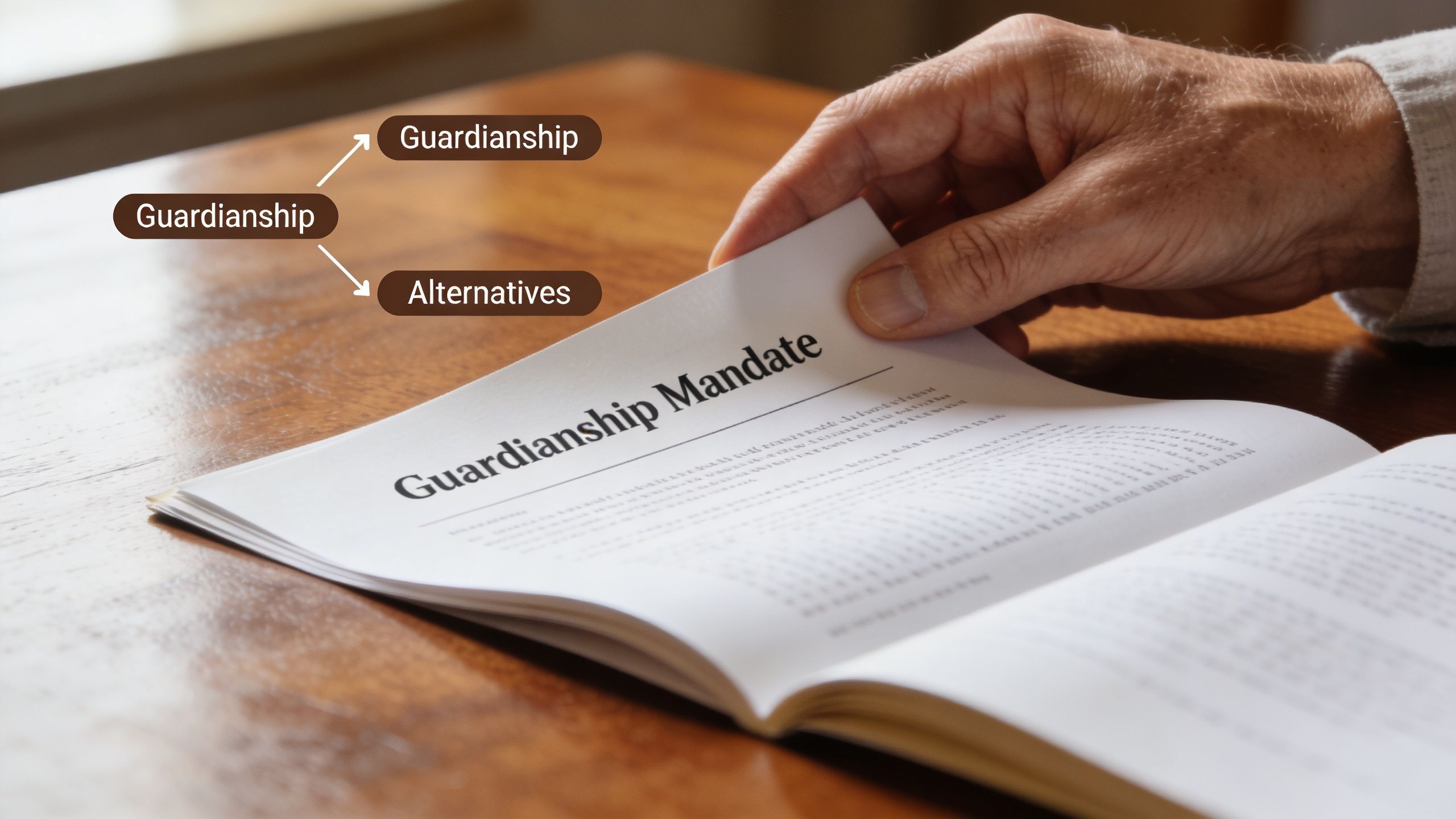
Texas law allows for limited guardianships, which can be adjusted to a person’s specific needs, such as financial management or medical decision-making, without imposing the broader restrictions of a full guardianship. The Texas guardianship overview from J. Leeds Law Firm highlights why this can be an important planning tool for families who want protection without taking away more independence than necessary.
That matters because guardianship should fit the person, not the other way around.
A limited guardianship may be worth discussing when your loved one can make some decisions independently but still needs help in defined areas. A full guardianship may be considered when the person cannot safely manage major personal or financial matters at all.
A spectrum of decision-making support
Families often think the choice is binary. Either total independence or full guardianship. In practice, there’s a spectrum.
Some families may consider:
- Durable Power of Attorney: Gives authority over certain financial matters.
- Medical Power of Attorney: Addresses healthcare decisions if the person can legally sign one.
- Supported decision-making: Allows the individual to keep decision-making authority while receiving help understanding options.
- Limited guardianship: Targets only the areas where legal oversight is needed.
- Full guardianship: Reserved for situations where broader protection is necessary.
If you’re sorting through these choices, this outside guide on navigating adult guardianship decisions offers a helpful family-centered overview of the practical questions that often come up.
How local families often approach the question
In many Atascocita households, the discussion starts with day-to-day realities. Can your loved one understand a medical consent form? Can they manage a bank account? Would they be vulnerable to pressure, scams, or unsafe agreements? The answer may differ from one area of life to another.
That’s why a personalized approach matters. If you want more background on Texas guardianship concepts, this resource on conservatorship in Texas can help clarify how court involvement and protective authority may work.
The goal isn’t to take control for its own sake. The goal is to give your loved one as much independence as possible, with as much protection as necessary.
The Role of a Special Needs Planning Attorney
Families often ask whether they can piece this together on their own. They may download forms, update a will, or rely on general advice from friends. The problem is that special needs planning isn’t one legal issue. It’s several legal issues overlapping.
A special needs planning attorney Atascocita families hire should be helping with more than document drafting. The job usually includes education, strategy, coordination, and long-term review.
What an attorney is really doing behind the scenes
A lawyer in this area often steps into four roles at once:
| Role | What it looks like in practice |
|---|---|
| Educator | Explains trusts, benefits interaction, and decision-making options in plain language |
| Strategist | Designs a plan around your loved one’s needs, family structure, and resources |
| Drafter | Prepares the trust and related documents so the plan is legally usable |
| Ongoing advisor | Helps the family update the plan as circumstances change |
One option local families consider is the estate planning attorney near me resource from the Atascocita office, which addresses wills, trusts, and related planning services in this community.
Why this work often reaches beyond estate planning
Families dealing with disability-related planning are often balancing school services, healthcare needs, adult transition issues, and public benefits questions at the same time. Legal planning may need to coordinate with those realities.
For example, some parents also need outside educational support. A resource on special education advocacy can be useful when a child’s school services and long-term planning concerns are connected. That doesn’t replace legal advice, but it shows how often families need a coordinated approach rather than one isolated document.
Why local knowledge matters
A local attorney can help you think through practical questions that generic online guides usually miss. Who will serve as trustee? Who will communicate with providers? What instructions should siblings have? If guardianship becomes necessary, how should the family prepare for local court procedures?
The Law Office of Bryan Fagan – Atascocita TX Lawyers provides estate planning services that may include trusts, wills, and related planning for families in Atascocita, Humble, and Harris County. For many families, the primary advantage is having one place to talk through how all the moving parts fit together.
Preparing for Your Consultation A Step Toward Peace of Mind
The hardest part is often making the first appointment. Many families worry they won’t know what to say, or that they need to have every answer before meeting with a lawyer. You don’t.
A good consultation is a starting point. You bring the facts you have, the concerns keeping you up at night, and the names of the people involved. The attorney helps organize the rest.

What to gather before you come in
You don’t need a perfect file. A simple folder or notebook is enough. If possible, bring or prepare:
- Basic family information: Names, relationships, and who currently helps with care or decisions.
- Existing estate documents: Any wills, trusts, beneficiary designations, or powers of attorney already in place.
- Benefit information: Recent letters, notices, or summaries showing current public benefits or applications.
- Financial picture: A list of major assets, life insurance, retirement accounts, and property that may eventually pass to your loved one.
- Care team details: Doctors, schools, case managers, therapists, or support providers if they’re relevant to planning.
- Key decision-makers: The people you might name as trustee, guardian, backup guardian, or agent.
Questions worth writing down
Families often leave a consultation feeling relieved when they come in with a short written list. Your list might include questions like:
- Should our family use a third-party special needs trust?
- How should grandparents leave gifts or inheritances?
- Does our child need guardianship later, or would a less restrictive option fit better?
- Who should manage funds if both parents are gone?
- Are there local or government benefit programs we haven’t explored?
Bring your questions in the language you actually use at home. You don’t need legal vocabulary for the meeting to be productive.
How to make the meeting more useful
Try to think in terms of real-life situations, not just legal labels. Instead of saying “we need estate planning,” you might say, “Our daughter may need lifelong support, and we don’t want family gifts to cause problems.” That gives the attorney something concrete to work with.
It also helps to identify your biggest fear and your biggest goal. For one family, the fear is losing benefits. For another, it’s sibling conflict. For someone else, it’s making sure an adult child has a safe decision-maker for healthcare and housing.
If your planning needs connect to broader family concerns, the Atascocita office also provides guidance in related areas such as family law representation and estate planning matters through the firm’s local services.
If you’re ready to talk through your family’s next steps, schedule a free consultation with Law Office of Bryan Fagan – Atascocita TX Lawyers. Our team works with families in Atascocita, Humble, and northeast Harris County who need clear answers about trusts, guardianship, estate planning, and long-term protection for a loved one with special needs. Call the Atascocita office at 281-562-7344 to set up a confidential meeting and start building a plan that fits your family.