Skip to content
When you're standing at an exchange spot in Atascocita and the return time has passed, the first feeling usually isn't legal. It's panic. Then anger. Then the flood of questions. Is my child okay? Is this just traffic, or is the other parent refusing to bring them back? What am I supposed to do right now?
That scene plays out all over northeast Harris County. A parent waits outside a Starbucks on West Lake Houston Parkway, in a grocery store parking lot near FM 1960, or at a familiar fast-food restaurant used for exchanges because it feels public and predictable. The phone stays quiet. Minutes turn into an hour. The order says one thing. Reality says another.
If you're dealing with what to do if other parent keeps child past visitation atascocita texas, you need two things at once. You need a calm plan for the next few hours, and you need a legal strategy that protects your position if this becomes a pattern. The emotional part is real, but so is the legal side. In Harris County, judges want specifics, not guesses, and they want parents to act carefully instead of escalating a bad exchange into a worse one.
A late return can be a simple delay. It can also be a violation that needs to be documented and enforced. The difference often comes down to what you do in the moment.
The Unbearable Wait A Parent's Guide to a Late Visitation Return
The hardest part is the waiting because it strips away your sense of control. Your order gives a pickup or return time. You arranged your day around it. Maybe your child has school the next morning in Humble ISD. Maybe you packed dinner, medicine, or homework because you expected them home on time. Then the clock keeps moving.
Most parents in this situation cycle through the same thoughts. First, they assume there's an innocent reason. Then they start checking traffic, re-reading texts, and refreshing their phone. After that, frustration usually takes over. By the time the other parent is seriously late, many parents are tempted to drive to the other house, call everyone they know, or send the kind of text that feels good for ten seconds and hurts them later in court.
Don't make your next move based on adrenaline.
Keep your focus on two goals. Confirm your child's safety, and protect your ability to enforce the order if needed.
In Atascocita and Humble, local judges see these cases often enough to know the difference between a worried parent and a parent who let emotion take over. If you stay measured, document the facts, and avoid self-help, you put yourself in the stronger position.
There is a legal remedy when the other parent keeps your child past court-ordered visitation. There are also practical first steps that matter before any motion is filed. Start there.
Immediate Actions When Your Child Is Not Returned on Time

The first hour matters. Not because you'll usually solve the legal issue in that hour, but because you'll either create useful evidence or create avoidable problems.
Start with calm contact
Send a short written message. Keep it neutral. Ask where the child is, whether the child is safe, and when the child will be returned. If you call, follow it with a text so there's a written record.
A good message sounds like this:
"It's now past the return time in our order. Please confirm [child's name] is safe and tell me your ETA for return."
That works better than threats, insults, or legal lectures. A judge reading your messages later should see a parent trying to solve the problem, not inflame it.
What not to do in the moment
Avoid these common mistakes:
- Don't go to the other parent's home unannounced. That can trigger a confrontation, especially if emotions are already high.
- Don't withhold future time on your own as payback. Self-help often creates a second legal problem.
- Don't flood the phone with angry texts. One clear message every reasonable interval is enough.
- Don't involve the child in the conflict. If the child answers, focus on reassurance, not interrogation.
If there are facts suggesting immediate danger, that's different. In that situation, urgency comes first.
When to call local law enforcement
If you're in Atascocita, a practical question comes up fast. Should you call Harris County Constable Precinct 4 or the Harris County Sheriff's Office?
If this appears to be a routine visitation violation without signs of immediate danger, a call to local law enforcement can still help create a record and request a welfare check. In the Atascocita area, parents often start with Harris County Constable Precinct 4 for local response issues and Harris County Sheriff's Office if that's the agency covering your location or the other parent's location. Tell dispatch you have a court order, the child wasn't returned on time, you want the child's welfare checked, and you understand officers may not be able to force an exchange without further court action.
That last part matters. Officers often cannot override a possession dispute on the spot. But a call log, incident number, or report may become useful later.
If there are genuine safety concerns, ask about an emergency remedy. This guide on an emergency child custody hearing in Atascocita is a helpful starting point when the issue goes beyond lateness and into risk.
A short video can also help if you're trying to steady yourself and think through next steps before acting.
Keep a simple timeline that night
Open your notes app and log events in order:
- Return time in the order
- Where the exchange was supposed to happen
- Each call or text attempt
- Any response received
- Any police or constable contact
- Actual return time, if the child is returned
That timeline becomes the seed of your enforcement case if this happens again.
Building Your Case How to Document the Violation for Harris County Courts

Harris County courts don't reward vague frustration. They reward precision. If you end up filing an enforcement action, the strength of your case often comes down to whether your records show the exact date, time, place, and manner of the violation. TexasLawHelp explains that this level of detail is required in enforcement proceedings under Chapter 157, that isolated incidents rarely succeed, and that in severe cases courts may award make-up time, attorney's fees, or even custody modification, while 70% of motions are dismissed for vagueness according to the cited practitioner benchmarks in that guidance on enforcing a visitation order in Texas.
Build a violation log like a judge will read it
A useful log is not a diary. It's a clean record of facts.
Write each incident like this:
- Date and order provision: "Friday, April 15. Order required return at 6:00 p.m."
- Exchange location: "Chick-fil-A in Atascocita parking lot, agreed exchange site."
- What happened: "Other parent did not arrive by 6:00 p.m."
- Contact attempts: "Called at 6:05 p.m., 6:12 p.m. Texted at 6:08 p.m."
- Response: "Text received at 6:20 p.m. saying 'running late.'"
- Actual outcome: "Child returned at 8:15 p.m."
That format gives a Harris County judge something concrete to evaluate. "He always does this" doesn't help much. "Child not returned at 6:00 p.m. on April 15 at the designated exchange point, despite three contact attempts" does.
Save the evidence behind the log
Your notes matter, but backup matters more. Keep:
- Screenshots of texts and call logs
- Emails
- Receipts from exchange locations
- Photos showing you were present
- Names and contact information for witnesses
- Incident numbers from law enforcement or constable calls
If you're gathering screenshots, it's worth understanding the basics of using text messages as legal evidence so you preserve them in a way that's easier to present later.
A good record answers the judge's unspoken questions before they're asked. Where were you? What did the order require? What exactly did the other parent do?
Patterns matter more than isolated complaints
Courts are more likely to treat repeated noncompliance seriously when you can show a pattern instead of one rough weekend. The practical reality in Harris County is that parents who keep organized records have an advantage, while parents who rely on memory usually don't.
TexasLawHelp's guidance also stresses prior written communication and specific proof. That matches what local courts want to see. If you tried to resolve the problem calmly before filing, that usually helps your credibility.
Here are the records parents often forget to keep:
| Record | Why it helps |
|---|---|
| Calendar screenshots | Shows the court-ordered date and time |
| Fuel or food receipt near exchange site | Helps prove you were physically there |
| School or daycare notice | Shows impact on the child when returns run late |
| Witness contact info | Supports your account if the other parent disputes it |
If you expect a custody hearing or enforcement hearing soon, this guide on how to prepare for a custody hearing can help you organize your evidence in a way the court can use.
What works and what doesn't
What works is boring. Clean notes. Saved texts. Chronological records. Neutral language.
What doesn't work is dramatic. Long emotional messages. Guessing motives. Telling the court what you "know" without showing how you know it.
A parent who documents carefully often looks more reliable than a parent who is obviously angrier, even if both are upset. That's one of the hard truths in family court.
Understanding Your Legal Rights Under Texas Law
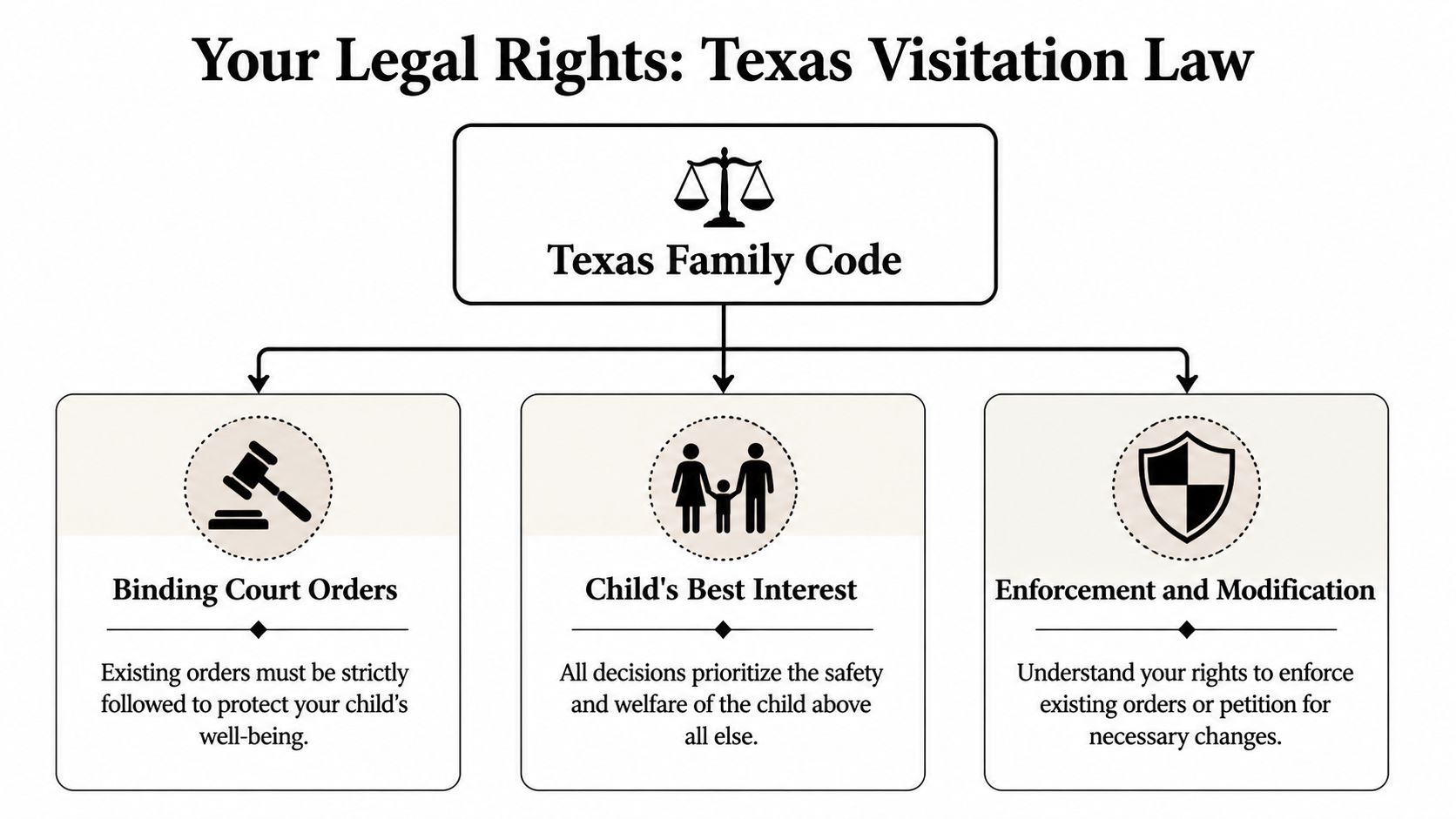
A possession order is not a parenting suggestion. It's a court command. In Texas, including Atascocita in Harris County, keeping a child past the court-ordered end of visitation is a violation of court-ordered possession under Texas Family Code §157.001, and Texas law also emphasizes the child's right to frequent and continuing contact with both parents under §153.001. The same source notes that under Texas Penal Code §25.03, failing to return a child after visitation can rise to a state jail felony, punishable by up to 2 years in jail and fines up to $10,000, as explained in this discussion of Texas visitation rights and legal remedies.
What that means in plain English
If your order says the child must be returned at a specific time and place, the other parent doesn't get to rewrite that schedule because it's inconvenient, because the child wants to stay longer, or because they think they're making a better decision in the moment.
Texas law is built around stability for the child. That includes predictable exchanges and ongoing contact with both parents when a court has already entered orders. Judges take interference seriously because repeated interference doesn't just frustrate a parent. It disrupts the child's routine and the child's relationship with the other side of the family.
The child is not the messenger, not the decision-maker, and not the excuse for ignoring a court order.
One late return versus a pattern
Not every violation leads to the same response. A single late return with a believable explanation may still be a violation, but courts often react differently when they see repeated disregard for the schedule.
That difference matters in real life:
- One-time issue often leads to documentation, written notice, and close monitoring.
- Repeated denials or late returns can justify enforcement, contempt requests, make-up time, and in severe cases a deeper look at whether the current arrangement still protects the child's best interests.
- Safety-related conduct may support emergency action instead of ordinary enforcement.
Rights come with discipline
Parents often feel relieved when they learn the law is on their side. They should. But legal rights only help if you use them carefully.
That means following your own order, showing up at the right place and time, staying sober and composed during exchanges, and avoiding retaliation. In family court, a strong legal position can be weakened by poor behavior. The court isn't just reviewing what the other parent did. The court is also evaluating whether you handled the problem in a child-focused way.
Taking Formal Legal Action Filing a Motion for Enforcement

When late returns become a pattern, the main court tool is a Motion for Enforcement of Possession or Access. You file it in the court that issued your order. The motion tells the judge exactly what order exists, exactly how it was violated, and exactly what relief you're asking for.
At this stage, many cases become stronger or weaker on paper before anyone enters a courtroom.
What the motion must do
An enforcement motion has to be specific enough for the court to identify each violation. General complaints won't carry the case. The judge needs to see the terms of the order and a list of incidents tied to those terms.
In practical terms, the motion usually needs:
- The exact language of the possession order
- Each alleged violation listed separately
- Dates, times, places, and manner of noncompliance
- The remedies requested
- Proper notice to the other parent
A parent can file without counsel, but drafting matters. The Atascocita child custody enforcement lawyer page gives a useful overview of enforcement-focused representation when you need help turning your records into a court-ready filing.
What judges can do
Texas courts have real enforcement power. According to the cited Bryan Fagan discussion on visitation violations in Harris County, civil contempt can jail a violator until the child is returned, while criminal contempt can punish past violations with up to 180 days in jail per incident. The same source says success rates for enforcement motions jump over 50% when a parent presents logs of 3 or more violations with witness or receipt evidence, while 72% of cases are dismissed for poor documentation and motions with fewer than 3 incidents prevail about 20% of the time in Harris County courts, as described in that article on what happens when a custodial parent violates a visitation order.
Possible remedies may include make-up visitation, attorney's fees, contempt findings, and other relief appropriate for the pattern shown in court.
Filing an enforcement case isn't about punishing every disagreement. It's about showing the court that the order has to mean something.
Police versus court action
The confusion many parents feel is understandable. Law enforcement and family court do different jobs.
| Situation | Best First Action: Call Police/Constable | Best Long-Term Action: File Court Motion |
|---|---|---|
| Child is late, no sign of danger | Ask for a welfare check or incident record | Yes, if it becomes a repeated pattern |
| Child not returned and communication stops | Contact local law enforcement to document and check safety | Yes, enforcement is usually the legal remedy |
| Immediate risk to child safety | Call law enforcement right away | Likely yes, plus consider emergency relief |
| Repeated late returns over several exchanges | Law enforcement may create a report, but won't usually fix the pattern | Yes, this is what enforcement motions are for |
The trade-offs parents need to understand
Court action can help, but it isn't instant. Hearings take preparation. Notice has to be handled correctly. Your evidence has to be organized. The other parent gets a chance to respond. If your proof is sloppy, the court may deny relief even if you know the problem is real.
On the other hand, doing nothing sends a message too. It tells the other parent the schedule is flexible and tells the court, later, that the violations may not have seemed urgent when they were happening.
A balanced approach usually works best. Document. Try concise written communication. Then file when the facts support it.
What often persuades a Harris County judge
Local judges tend to respond well to parents who look steady, prepared, and child-focused. They want to see:
- A clear order
- A clean timeline
- Proof you appeared for exchanges
- Written communication without threats
- A pattern, not just resentment
If your file shows repeated missed or late returns, exact details, and a parent who kept showing up anyway, your position is much stronger than if you walk in with only a general sense of unfairness.
One practical option for handling this process is retaining counsel familiar with northeast Harris County practice, including firms that handle visitation enforcement matters such as the Law Office of Bryan Fagan – Atascocita TX Lawyers.
Partnering with an Atascocita Attorney to Protect Your Family
A visitation violation hits two parts of your life at once. It affects your child, and it drags you into a system that expects precision when you're already stressed. That's why many parents struggle even when they're legally right. They know the schedule was violated, but they don't know how to present it in the form a Harris County court needs.
A local family law attorney helps in several ways. First, your lawyer can tell the difference between a frustrating incident and a case that's ready for enforcement. Second, your lawyer can shape your documentation into a motion that tracks the order line by line. Third, your lawyer can take over direct conflict so you're not trying to negotiate with the other parent while also preparing for court.
The value of local judgment
Atascocita, Humble, and the surrounding Harris County area have their own practical rhythms. Exchange locations, school schedules, sheriff and constable response patterns, and courthouse expectations all affect how these cases unfold. A lawyer who regularly handles custody disputes in this region can help you avoid mistakes that aren't obvious when you're reading the order at your kitchen table.
That includes knowing when to push for enforcement, when to seek emergency relief, and when a demand letter or narrowly focused filing may work better than a broad emotional complaint.
Many parents don't need more outrage. They need a plan that a judge will actually sign.
You don't have to carry this alone
If the other parent keeps your child past visitation, your fear is valid. Your frustration is valid. But the most useful response is disciplined, not reactive.
Keep the focus where it belongs. Your child's safety. Your child's routine. Your child's right to a stable relationship with both parents under the order already in place.
If you want practical guidance specific to your exact order, exchange history, and court, speak with a lawyer before the pattern gets harder to unwind.
If you're dealing with a missed return, repeated late exchanges, or a co-parent who keeps ignoring a possession order, schedule a free consultation with Law Office of Bryan Fagan – Atascocita TX Lawyers. We help parents in Atascocita, Humble, and across northeast Harris County understand their options, document violations properly, and take the right legal steps to protect their time with their children.