Skip to content
You pull into the exchange spot in Atascocita a few minutes early. Your child is buckled in, backpack packed, and already asking whether the other parent is almost there. The time in your order comes and goes. Then your phone lights up with a text saying plans have changed, or worse, nothing comes at all.
For many parents in Humble and northeast Harris County, that moment is when a custody problem stops feeling like paperwork and starts feeling personal. You’re not just dealing with inconvenience. You’re dealing with broken routines, a disappointed child, and the fear that if this keeps happening, the order you fought for won’t mean much.
If you searched for ex refuses to follow custody order atascocita tx solutions, you probably need more than a general warning that “you can file something in court.” You need a practical path. In Harris County, the right response usually isn’t the loudest one. It’s the one that creates an advantage, protects your child, and puts you in the strongest legal position if the problem continues.
That Sinking Feeling When Your Ex Breaks the Custody Order
A lot of custody violations start in ordinary places. A school pickup in Humble. A handoff at a coffee shop in Atascocita. A Sunday evening return that never happens. The facts may look small from the outside, but they hit hard when you’re the parent left waiting.
The emotional part matters because it affects what people do next. Some parents send angry texts. Some threaten to keep the child next time. Some give up and hope the situation improves on its own. Usually, none of those responses helps.
The parent who stays calm, documents carefully, and acts with purpose usually has the stronger case.
Texas judges see these cases through the child’s routine and stability. A missed exchange isn’t just an annoyance. It can disrupt school nights, activities, sleep, and the child’s sense of predictability. In Atascocita and the wider Harris County area, that practical impact often matters more than who feels more offended.
What this looks like in real life
One parent says, “I thought we agreed to switch weekends.”
The other says, “We never agreed to that.”
Or a parent starts making “temporary” changes that somehow keep happening. Late returns. Denied visits. Interference with calls. Excuses that shift from week to week.
Those patterns are often more important than one isolated bad weekend. Courts tend to look closely at repeated conduct, especially when it shows a parent is putting conflict ahead of the child’s stability.
What usually doesn’t work
When your ex breaks the order, these moves often backfire:
- Retaliation: Keeping the child next time because your ex did it first can create a second problem instead of solving the first.
- Loose verbal deals: If you keep making off-the-record changes, it becomes harder to prove what happened.
- Threats without follow-through: Repeated warnings with no action can teach the other parent that the order has no teeth.
If this is happening to you, you’re not powerless. But your next steps need to be deliberate.
Your First Moves When a Custody Order is Violated
Friday pickup was set for 6:00 p.m. You arrive at the exchange spot in Atascocita, wait, send a polite text, and get either silence or a last-minute excuse. In that moment, the urge to argue, threaten, or even keep the child the next time is strong. Those reactions are common. They also tend to make a fix harder and a court case more expensive.

The better approach is strategic and escalating. Start with steps that can solve the problem without court if the other parent is still capable of cooperating. At the same time, build your file as if a Harris County judge may need to read it later. That balance saves some families money. It also puts you in a stronger position if informal efforts fail.
Start with the order itself
Pull out the signed court order and read the exact wording. Focus on pickup times, return times, exchange locations, holiday terms, phone or video access, and any special provisions that apply to your situation.
Details matter here. Parents often remember the general arrangement but miss the specific language a judge will enforce. If the order says the child must be returned at 8:00 p.m. at a named location, compare that line to what happened. If calls were blocked, check whether the order gives specific communication rights and times.
Build a record a judge can follow
Good documentation is simple, dated, and boring. That is a compliment.
Judges do not want a long rant. They want a clean timeline with proof attached. Use one system and keep it current:
- Screenshots: Save texts with dates and times visible.
- Email folder: Keep co-parenting messages in one place.
- Calendar log: Record each missed exchange, denied visit, late return, or blocked call.
- Short notes: Write down what happened, where it happened, and who saw it.
- Photos when appropriate: A time-stamped photo at the exchange location can help confirm you were there.
If the immediate issue is a late return or a parent refusing to bring the child back, this guide on what to do if the other parent keeps your child past visitation in Atascocita walks through practical next steps.
Use formal notice as a tool before you file
Many parents assume they have only two options. Put up with it, or rush to court. In practice, there is often an important middle step.
A well-written formal notice can sometimes stop the behavior without the cost of filing an enforcement case. It also shows the court that you addressed the issue in a measured, child-focused way. That matters in Harris County, where judges often pay attention to which parent acted reasonably before asking for relief.
A good notice should do three things:
- Quote or identify the exact part of the order that was violated.
- List the dates and conduct clearly and briefly.
- Demand compliance in a professional tone.
Practical rule: Write every message as if it may end up in an exhibit notebook.
A weak notice says, “You always do this and I’m sick of your games.”
A stronger notice states that the current order required return of the child at a specific time and place, that the exchange did not occur as ordered, and that you expect compliance going forward, along with makeup time if appropriate under the circumstances.
That kind of notice is not about sounding tough. It is about creating a clean paper trail while giving the other parent one fair chance to correct course.
Here’s a helpful video overview before deciding whether to push for compliance or file:
Know when to stop negotiating
Some violations justify a short attempt to resolve things informally. Others do not.
If the other parent missed one exchange, admits it, and quickly offers a realistic makeup plan, a formal notice may be enough. If you are seeing repeated denials, shifting excuses, interference with school or medical decisions, or a parent who ignores every written request, continued back-and-forth often just burns time and increases frustration. At that point, the notice has done its job. It documented the problem and marked the point where stronger action became reasonable.
This is the trade-off many parents miss. Filing too early can increase conflict and legal fees. Waiting too long can make a bad pattern look tolerated.
What to avoid in the first week
Early mistakes can weaken a solid case and create new problems.
- Do not violate the order yourself: Keep complying unless your attorney gives you a specific legal reason not to.
- Do not use the child as a messenger: Keep adult conflict away from the child.
- Do not send angry message after angry message: A few clear written communications are better than twenty emotional ones.
- Do not rely on verbal side deals: If any temporary change is agreed to, confirm it in writing right away.
The goal is steady pressure, not chaos. In many custody disputes, the parent who stays organized and acts with discipline is the one the court trusts most.
Understanding Your Legal Rights Under Texas Law
Texas law gives you more than one way to respond when a custody order is ignored. The right tool depends on what happened, how often it has happened, and whether the problem is a one-time breakdown or a pattern that is starting to affect your child’s routine.

In practice, that distinction matters. In Harris County, judges usually see the difference between a parent who made a genuine mistake and corrected it, and a parent who keeps testing the limits of the order. One may call for a warning or makeup time. The other can justify enforcement, contempt, fee shifting, or even a request to change the order itself.
The common violations courts enforce
Courts regularly deal with a short list of repeat problems in possession and access cases. These commonly include denial of visitation, failure to return a child on time, unauthorized schedule changes, and interference with parent-child communication, as described in this article on what Texas parents can do when an ex refuses to follow the custody schedule.
Those categories sound simple on paper. Real cases are usually messier. A parent may call a denied weekend a “misunderstanding,” or treat repeated late returns as no big deal. Courts look past the label and focus on the order’s exact language, the facts of each incident, and whether the conduct appears intentional.
That is why specificity matters so much under Texas law.
Civil contempt and criminal contempt
Texas courts can enforce custody orders through contempt, but the type of contempt affects both the goal and the risk.
Civil contempt is aimed at getting compliance. A judge may order makeup parenting time, attorney’s fees, or other remedies designed to push the parent back into following the order.
Criminal contempt punishes disobedience that already happened. Under Texas Family Code §157.001, a parent who violates an enforceable order can face civil or criminal contempt, and Bryan Fagan’s discussion of custody order enforcement in Texas notes that criminal consequences under Texas Penal Code §25.03 can include jail time up to two years and fines up to $10,000.
Judges do not hand out the harshest penalties in every case. Repeated violations, clear proof, and conduct that shows open disregard for the order usually matter a great deal. That is the trade-off for parents in Atascocita deciding whether to keep trying informal fixes. A short paper trail and a formal notice may solve a minor problem cheaply. A parent who keeps refusing to comply can force the case into a much more expensive stage.
Why repeated interference changes the case
A pattern of interference can change how the court sees the entire family dynamic. What starts as missed exchanges can begin to look like deliberate obstruction, poor co-parenting judgment, or an effort to weaken the child’s relationship with the other parent.
That shift matters because the court is no longer looking only at whether a rule was broken. The court may start asking whether the current arrangement is still workable. If the interference includes manipulation, pressure on the child, or efforts to damage the parent-child bond, this discussion of how to prove parental alienation can help you spot the kinds of evidence that often matter.
The child’s best interest is still the center of the case
Texas courts come back to the same question over and over. What outcome best serves the child?
That usually includes:
- Routine and stability
- Emotional health
- Reliable access to each parent when ordered
- Lower conflict around exchanges and communication
Parents sometimes want the judge to focus on how disrespectful or infuriating the other parent has been. That reaction is understandable. But the stronger legal position is usually the calmer one. Show how the violations disrupted school, sleep, activities, medical care, or the child’s sense of stability, and you are speaking in the terms courts use every day.
How to File a Motion for Enforcement in Harris County
When the reminders, polite requests, and formal notice have not changed anything, enforcement is the point where the court gets involved. In Harris County, that process rewards precision and punishes vague complaints.
A Motion for Enforcement asks the judge to compare the written order to specific conduct. The court is not deciding whether your co-parent has been difficult in general. The court is deciding whether a clear order was violated, on identifiable dates, and what remedy fits the violation.
What the motion must do
A strong enforcement motion ties each complaint to the exact language of the current order. It lists the date, time, place, and what should have happened under the order. It also states what you want the judge to do, whether that is makeup time, attorney's fees, contempt, or another enforcement remedy allowed by Texas law.
In practice, that means general statements usually fall flat. A judge can work with, “On June 14, the order required pickup at 6:00 p.m. at the designated exchange location, and the child was not produced.” A judge has much less to work with if the filing only says visitation was blocked repeatedly.
Texas courts also expect proper notice and proper service. If the other parent is not served the right way, or the motion is too vague about the alleged violations, the hearing can be delayed or the request can fail even when the underlying facts are strong.
The basic Harris County path
Most enforcement cases are filed in the same court that signed the custody order. For Atascocita parents, the process usually looks like this:
Read the current order line by line
Enforcement starts with the wording already on paper. If the order is too vague, that creates a real problem because judges enforce specific commands, not assumptions.Build a violation timeline
Put each incident in date order. Match it to the exact paragraph of the order. Save the texts, emails, screenshots, photos, and call records that support each entry.Draft the motion carefully
Each alleged violation should be separately stated and tied to the order. Many self-filed cases become weak due to this drafting issue. The facts may be real, but the motion does not present them in an enforceable format.File with the Harris County clerk
Filing opens the case, but it does not put the other parent under the court's power for that hearing by itself.Serve the other parent correctly
Service matters. A lot. If contempt is being requested, courts are especially strict about notice and procedure.Prepare for the hearing with organized exhibits
Judges appreciate a clean set of evidence, labeled and chronological. Ten useful exhibits beat a phone full of scattered screenshots every time.
If you want a local lawyer to review whether your order is specific enough to enforce and whether contempt is realistically on the table, speak with an Atascocita custody enforcement lawyer.
Evidence checklist for your enforcement motion
| Evidence Type | What to Collect | Why It's Important |
|---|---|---|
| Text messages | Screenshots showing dates, times, and the full message thread when possible | Shows what was said, when it was said, and whether the violation appears intentional |
| Emails | Complete email chains about exchanges, denials, or schedule changes | Preserves context and can show a pattern over time |
| Calendar log | A dated record of missed visits, late returns, denied calls, and no-shows | Gives the court a usable timeline |
| Order copy | The signed custody order and any later modification orders | Lets the judge compare the conduct to the actual order language |
| Photos | Time-stamped photos at exchange locations when relevant | Can support that you appeared ready to comply |
| Call logs | Records of blocked or unanswered calls if communication is part of the order | Helps prove interference with ordered contact |
| Witness details | Names and contact information for people who saw missed exchanges or heard statements | Independent witnesses can strengthen credibility |
| Notes | A contemporaneous journal with dates, times, location, and what happened | Helps you testify clearly and consistently |
What happens at the hearing
An enforcement hearing usually moves faster than parents expect. The judge will often focus on a short set of practical questions.
- What exactly did the order require?
- Which provision was violated?
- On what dates did that happen?
- Was the violation willful?
- What remedy is supported by the evidence?
That is why calm preparation matters more than outrage. In court, a clean timeline and clear exhibits carry more weight than a long account of every disagreement since the divorce.
I often tell parents to prepare the hearing the way they would prepare a work presentation for a skeptical audience. Lead with the document. Then the date. Then the proof. That approach is cheaper, stronger, and easier for the court to follow.
Bring a clean timeline. Judges make better decisions when they do not have to assemble the chronology themselves.
What the court can do
If the evidence supports enforcement, the court may order:
- Makeup possession time
- Attorney's fees reimbursement
- Fines or penalties for repeated violations
- Contempt findings
- Additional orders aimed at getting compliance
There is a practical trade-off here. Enforcement can be effective, but it costs time, filing fees, service fees, preparation time, and often attorney's fees. That is why I usually look at these cases in stages. Start with a serious written demand when that still has a chance of working. If the violations continue, file an enforcement case that is organized, specific, and ready for a judge to act on.
When Enforcement Isn't Enough The Path to Modification
Some parents get an enforcement order and the behavior improves. Others get temporary compliance, then the same problems return. When violations become chronic, enforcement may no longer be the best long-term answer.
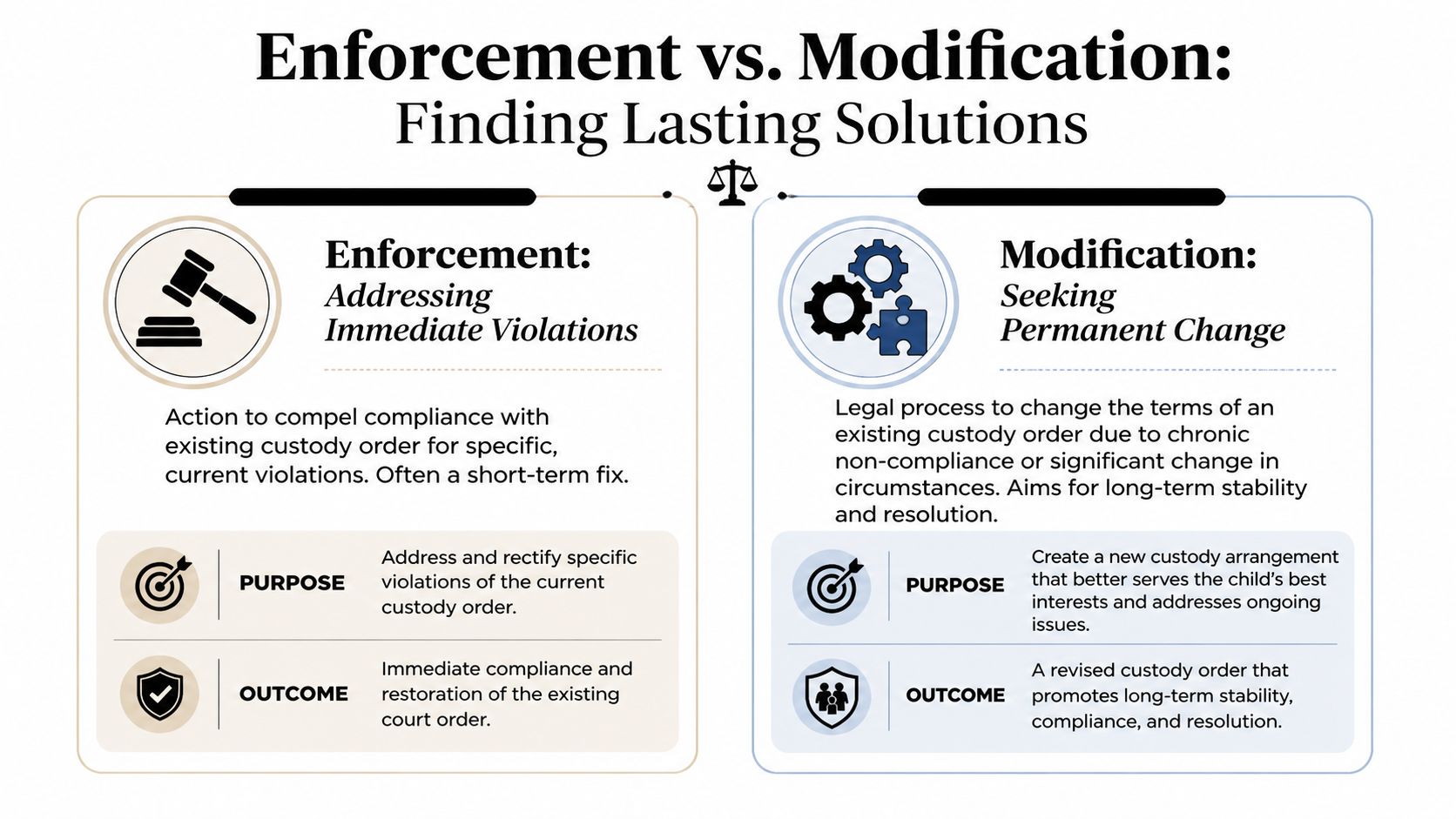
Enforcement fixes the past. Modification reshapes the future.
That’s the practical distinction many parents miss.
An enforcement case asks, “What happened, and what should the court do about it?”
A modification case asks, “Is this order still workable, or does it need to change because the situation has materially shifted?”
For ongoing, systematic violations, Texas Family Code §156.101 allows a custody modification based on a material and substantial change, and that path is often the better long-term solution when repeated enforcement isn’t stopping the problem, as discussed in this Texas custody modification overview.
When modification starts making more sense
A modification may be worth serious consideration when you see a pattern like this:
- The other parent keeps violating after warnings or prior enforcement
- Exchanges are so conflict-heavy that the child is suffering
- Communication interference keeps happening
- The current structure leaves too much room for manipulation
- The child’s routine is repeatedly disrupted
In those situations, filing the same kind of enforcement action again and again can feel like patching the same leak instead of repairing the pipe.
What a modified order can change
A modification can do more than punish misconduct. It can redesign the arrangement to reduce the chance of future conflict.
Possible changes may include:
- More detailed exchange terms
- Specific pickup and drop-off locations
- Adjusted possession schedules
- Supervised visitation in appropriate cases
- Changes to decision-making authority
- A shift in primary custody if the facts support it
If one parent consistently undermines the order, the court may eventually ask whether that parent should keep the same level of authority.
That question often becomes more serious when the pattern shows the parent is placing personal conflict above the child’s needs.
A side-by-side view
| Issue | Enforcement | Modification |
|---|---|---|
| Main focus | Specific violations that already happened | Restructuring the order for long-term stability |
| Typical result | Makeup time, fees, contempt, compliance orders | New custody or possession terms |
| Best use | Isolated or recent violations | Chronic, repeated non-compliance |
| Core proof | Clear breach of a current order | Material and substantial change plus child’s best interest |
A lot of Atascocita parents start by asking for immediate consequences. That’s understandable. But if the same parent keeps refusing to follow the order, the stronger strategy may be one that changes the framework itself.
Let an Atascocita Attorney Protect Your Family and Your Peace of Mind
Custody conflict wears people down. Even when you know you’re in the right, the day-to-day stress can affect your sleep, work, patience, and ability to stay steady for your child. That’s one reason legal strategy matters so much. A good plan protects more than your rights. It protects your bandwidth.

Protect your child while the case is unfolding
Children usually know when something is wrong, even if they don’t know the legal details. They do better when one parent stays calm and predictable.
A few practical habits help:
- Keep adult issues away from the child: Don’t ask the child to explain the other parent’s behavior.
- Use written communication tools when possible: Co-parenting apps can create a cleaner record and reduce misunderstandings.
- Stick to routines: School, bedtime, meals, and activities become even more important during custody conflict.
- Avoid courtroom talk at home: Your child doesn’t need to carry the emotional weight of the litigation.
Know when to stop handling it alone
Some problems can be solved with a direct letter and better boundaries. Some can’t. If the violations are repeated, intentional, or affecting your child’s stability, delay usually helps the non-compliant parent more than it helps you.
The strongest cases often come from parents who did three things well:
- They documented carefully.
- They avoided retaliation.
- They got legal help before the facts became messy.
You don’t need to turn every violation into a war. But you also don’t need to normalize conduct that keeps disrupting your child’s life.
Calm action is not weakness. In custody cases, it is often the most effective form of strength.
If you live in Atascocita, Humble, or another part of northeast Harris County, local guidance matters. Court procedure, filing choices, and the quality of your documentation can change the outcome in a very real way.
If your ex refuses to follow a custody order and you need practical Atascocita TX solutions, schedule a free consultation with Law Office of Bryan Fagan – Atascocita TX Lawyers. The firm helps parents in Atascocita, Humble, and across Harris County understand their options, document violations effectively, and pursue the right strategy, whether that means a formal notice, enforcement action, or custody modification.