Skip to content

You may be reading this while sitting in a parking lot in Atascocita, outside a school, or near a familiar exchange spot in Humble, staring at your phone and waiting for a message that should have come already. The return time has passed. Your calls may be going to voicemail. Your texts may show “delivered” with no response. In those moments, fear and anger hit fast.
When a child isn't returned after visitation, parents often swing between two instincts. One is panic. The other is hoping it will sort itself out if they just wait a little longer. Neither response gives you much protection. A calm, deliberate response does.
Understanding what to do if child is not returned after visitation in Texas Atascocita depends on two immediate questions. Is your child in immediate danger, and is this a simple delay or a deliberate refusal? Texas law gives parents tools for both situations, but choosing the right tool matters.
Your First Moments of Panic When a Child Is Not Returned
A missed exchange in Atascocita rarely feels minor. Maybe you were supposed to meet near a neighborhood shopping center, a school pickup lane, or another routine handoff point you've used before. You arrive on time with the court order in your car, your phone in your hand, and a growing sense that something is wrong.

That reaction is normal. Parents in northeast Harris County often tell me the hardest part of these cases is the first hour, when they don't know whether they're dealing with traffic, defiance, or a genuine safety problem. The uncertainty is what makes people freeze.
Start with control, not confrontation
Your first job is to slow yourself down enough to act clearly. Don't send threats. Don't start a social media argument. Don't drive to every place you think the other parent might be. Those choices can create new problems and can make a judge focus on your conduct instead of the other parent's violation.
Use the court order like a checklist. Confirm the exact return time, exchange location, and any language about transportation, notice, or exceptions. Many parents remember the general schedule but not the exact wording, and in enforcement work, exact wording matters.
Practical rule: The parent who stays calm, follows the order, and creates a clean record usually walks into court with the stronger position.
Separate urgency from emotion
Not every late return becomes a legal emergency. Some do. The key is identifying which situation you're in without minimizing the risk.
Ask yourself:
- Was there any prior message about a delay? If so, preserve it.
- Has this happened before? A repeated pattern calls for a stronger response.
- Is there any reason to believe your child is unsafe right now? If yes, safety becomes the first issue.
- Is the other parent refusing to answer at all, or are they answering and making excuses? That difference affects what comes next.
For parents in Atascocita, Humble, and surrounding Harris County communities, these cases usually move on two tracks at the same time. One track is immediate safety. The other is formal legal enforcement. You don't have to choose one and ignore the other. You do need to keep them distinct.
If your child is in danger, treat it as a danger case. If your child is being unlawfully kept in violation of a court order, treat it as an enforcement case. The worst mistake is blending those categories out of frustration and using the wrong remedy at the wrong time.
Your Immediate Actions and When to Call the Police
When the return time passes, act in a sequence. Don't wait indefinitely, and don't assume officers or judges will fill in missing details later. The first few actions often shape the entire case.
The first calls and messages
Try to contact the other parent in a way that creates a record. A short text is usually better than a heated phone call because it preserves your words and the time stamp. Keep it factual. State that you are at the exchange location, the child was due back under the court order, and you need confirmation of the return immediately.
Then call. If there's no answer, leave a calm voicemail. If there's another adult involved in exchanges, such as a grandparent, use care and stay neutral. Don't start making accusations you can't prove yet.
A practical checklist looks like this:
- Confirm the order terms so you know the exact violation.
- Send a clear written message asking for immediate return.
- Call and leave a voicemail if there's no response.
- Stay at the exchange location long enough to document your presence.
- Save everything including screenshots, call logs, and any reply.
When police involvement makes sense
Texas treats this more seriously than many parents realize. A Texas family-law explanation notes that under Texas Penal Code Section 25.03, retaining a child in violation of a court-ordered visitation arrangement can qualify as parental abduction and may be prosecuted as a felony, depending on the facts, and Texas Access provides the Access and Visitation Hotline at 1-866-292-4636 for guidance on possession and access disputes, as discussed in this explanation of what happens if a non-custodial parent refuses to return a child.
That doesn't mean every officer will immediately retrieve the child at the scene. It does mean you should take the violation seriously and create a law enforcement record when appropriate. If the situation feels immediate in Atascocita or Humble, contact local law enforcement and be ready to provide the court order, the child's identifying information, the exchange details, and the other parent's last known location.
If you're unsure how local officers typically handle these calls, this overview of whether police can enforce a custody order in Atascocita, Texas helps explain the practical limits and why court-backed remedies are often still necessary.
Call 911 if the danger is immediate. If you suspect abuse or neglect, Texas guidance treats that as a separate safety issue, not just a visitation problem.
What helps and what hurts
What helps is precision. Tell officers you have a court order, the child was due at a specific time and place, the child has not been returned, and you want an incident report. What hurts is showing up angry, speculating wildly, or speaking as if the order says more than it does.
Some parents also want a simple way to keep family location-sharing and safety communication organized during tense custody situations. A resource some families review for that purpose is Safety that runs along. No noise, no control, just Safe.. It doesn't replace legal action, but it can fit into a broader safety plan when co-parenting is unstable.
Building Your Case with Meticulous Documentation
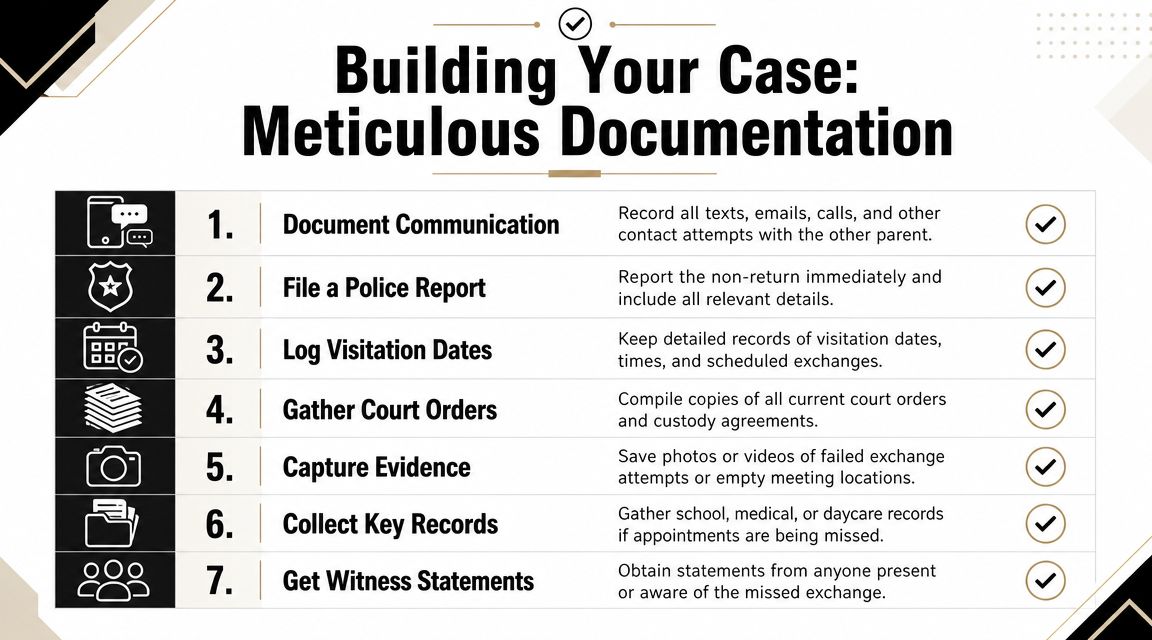
Family court doesn't run on outrage. It runs on proof. If you want a judge in Harris County to enforce a possession order, you need more than “they ignored me” or “I know what happened.” You need a record that's specific, orderly, and credible.
Texas Law Help notes that the strongest enforcement path is often to show a pattern of noncompliance and file a Motion to Enforce that states the exact order language, the date, place, and time of each missed exchange, and the relief requested under Texas Family Code 157.002. It also notes that texts or emails by themselves are not enough unless you can prove you were physically present at the exchange location at the ordered time, which is why a contemporaneous log, witness names, and proof of arrival carry real weight in court, as explained in this Texas Law Help guide on enforcing a visitation order.
What to collect right now
You don't need fancy software. You do need consistency.
- Court papers including your current order, any later modification, and any exchange instructions
- Communication records such as texts, emails, missed calls, and voicemails
- Proof of your presence at the exchange site, which may include photos, location history, receipts, or a witness
- A written log made as events happen, not days later
- Third-party records if the child misses school, daycare, therapy, or an appointment during the withholding
A parent who can hand over a clear timeline gives an attorney something usable. A parent who brings a phone full of scattered screenshots and half-remembered dates creates avoidable delay.
Why sloppy evidence backfires
Judges see plenty of cases where both parents claim the other is lying. The parent with the better paper trail usually has the advantage. That becomes even more important if the other parent later says there was confusion about the schedule, the exchange location changed, or you never showed up.
If you need a practical system for gathering records before meeting with counsel, a simple guide to family document organization can help you sort orders, school records, medical papers, and communication history into one usable file.
Social media can also damage a good case. If you've posted about the dispute, or the other parent has, this discussion of how judges view social media in custody cases in Texas Atascocita is worth reading before you post anything else.
Keep your log like someone else will read it in court, because they may.
Using Emergency Legal Actions to Secure Your Child's Return
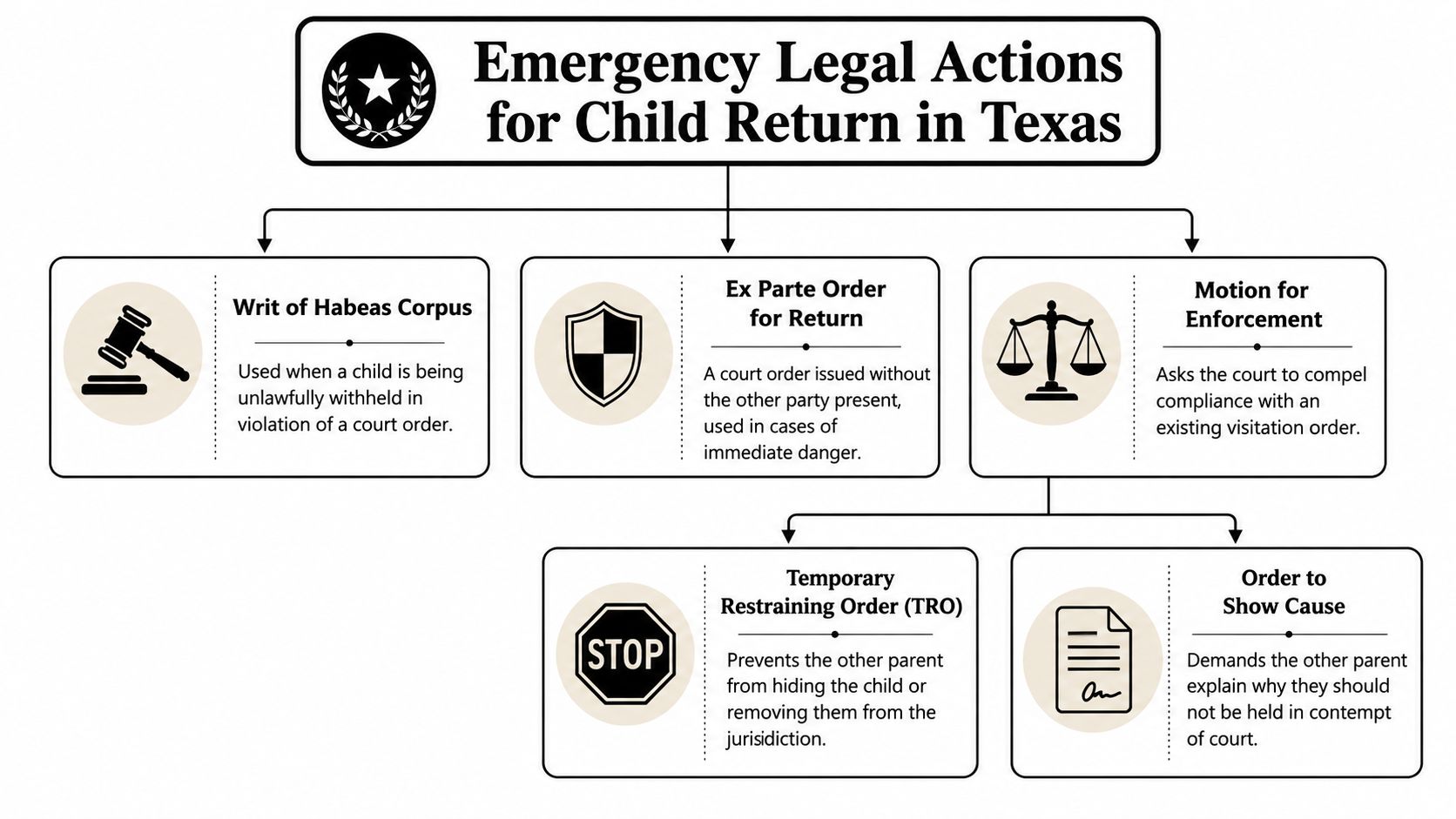
When a child is being unlawfully withheld, the legal question isn't just whether the other parent violated the order. The question is which tool gets results fastest without creating unnecessary delay. In these cases, the remedy matters as much as the underlying facts.
The three remedies parents confuse most often
The first common tool is a Motion to Enforce. That remedy is usually about a violation of an existing order and asking the court to compel compliance. It can be effective when there is a pattern, when the child is likely to be returned before the hearing, or when the dispute is part of a broader ongoing noncompliance problem.
The second is a Petition for Writ of Habeas Corpus. In Texas, this is often the most direct remedy when a parent refuses to return a child after court-ordered visitation. TexasLawHelp explains that if a judge finds you have a superior right to possession, the child is being illegally kept, you did not give up possession for the prior six months, and there is no serious immediate welfare issue, the judge must order the child's return. If there is a risk the child may be moved or hidden, the court can also sign a Writ of Attachment, directing a sheriff or constable to immediately deliver the child. Texas guidance also advises calling 911 in an emergency and contacting Child Protective Services at 1-800-252-5400 if abuse or neglect is suspected, as outlined in Texas Law Help's explanation of what to do when a parent refuses to return a child.
Here's a plain-English comparison:
| Remedy | Best fit | Main purpose |
|---|---|---|
| Motion to Enforce | Repeated violations or a pattern of missed exchanges | Ask the court to enforce an existing order |
| Writ of Habeas Corpus | Child is being unlawfully kept right now | Compel the other parent to appear with the child |
| Writ of Attachment | Risk the child may be hidden or moved | Authorize immediate delivery of the child by law enforcement |
Strategy depends on timing
The mistake many parents make is treating every case like a contempt case. Sometimes contempt is too slow. If the other parent is actively withholding the child and time matters, a writ-based approach may be the stronger move.
That's especially true in Harris County when there are signs the other parent may relocate, disappear, or keep dodging service. A lawyer can evaluate whether the immediate goal is getting the child back first, punishing the violation later, or both.
For a practical overview of urgent court action, this page on an emergency child custody hearing in Atascocita, Texas gives helpful local context.
A short video can also help you understand how emergency custody disputes move through the court process:
What actually works
The strongest emergency filings are disciplined. They attach the order. They identify the missed exchange clearly. They avoid emotional overstatement. They explain why ordinary waiting is risky.
A fast filing with clean facts usually beats a long filing full of anger.
For parents dealing with what to do if child is not returned after visitation in Texas Atascocita, the right emergency action often turns on one practical issue. Is the child likely to come back on their own soon, or do you need the court to force the issue now?
Navigating Claims of Danger or Emergency from the Other Parent
Many custody disputes get more complicated the moment the withholding parent says, “I had to keep the child because of an emergency,” or “I'm protecting the child from you.” Those claims can be real. They can also be tactical.
A lot of generic articles miss that distinction. They treat every refusal to return a child as ordinary disobedience. Texas practice is more nuanced. Texas Access notes that if danger is immediate, calling law enforcement may be appropriate. If the danger is not immediate, a protective order and then a request to modify visitation may be the better path. Texas guidance also distinguishes between a motion for enforcement and a habeas action based on whether the child is likely to be returned before court action and whether there is a serious immediate welfare question, as explained in the Texas Access FAQ on possession and access issues.
Not every accusation freezes your rights
A parent doesn't get to suspend a court order just by using the word “danger.” Judges want facts. What happened. When it happened. Who saw it. Whether a doctor, school, counselor, officer, or investigator was contacted. Whether the concern is immediate or speculative.
If the other parent makes a true emergency claim, the legal path may shift away from ordinary visitation enforcement and toward protection-focused remedies. If the claim is weak, inconsistent, or unsupported, the court may view it as a pretext for withholding.
That distinction matters in Harris County because the wrong response can damage your position. If you charge ahead as if no safety concern exists when there is one, you can look reckless. If you back down completely every time the other parent makes an accusation, you can lose control of the case.
How to respond without making it worse
Use a measured approach:
- Ask for specifics in writing. What is the emergency, and when did it occur?
- Don't argue by text about every accusation.
- Preserve the message exactly as sent.
- Avoid retaliatory withholding on your side.
- Talk with counsel quickly about whether the issue belongs in enforcement court, protective-order court, or a modification request.
The court is less interested in which parent sounds more offended. The court wants to know which parent acted reasonably once the allegation was made.
False allegations often collapse under documentation. Real emergencies usually leave footprints. Either way, your response should look steady, child-focused, and grounded in evidence.
Partnering with an Atascocita Attorney for a Long-Term Solution
Getting your child returned is the immediate problem. Keeping this from happening again is the larger one.
In Harris County, parents often learn that a missed return is only the surface issue. The deeper problem may be a possession order with vague exchange terms, a pattern of last-minute excuses, repeated claims of “emergency” with no follow-through, or a co-parent who has decided the order is optional. A long-term legal plan addresses that pattern, not just the latest incident.
An attorney handling these cases in Atascocita should do far more than prepare a filing. The job includes reviewing the current order for weak points, organizing your texts, call logs, and timelines into usable evidence, preparing you for how a Harris County judge is likely to view the facts, and deciding whether enforcement alone is enough. Sometimes it is not. Sometimes the better answer is a modification with tighter pickup terms, school-based exchanges, supervised visitation, geographic restrictions, or clear language about what happens if one parent claims the child cannot be returned.
Why local representation matters
Local practice affects outcomes. Filing procedures, court settings, constable involvement, and judicial expectations in Harris County can shape what relief is realistic and how quickly you can pursue it. In an active withholding case, delay and guesswork cost time you do not have.
That is why many parents look for counsel who regularly handles custody, possession, and enforcement disputes in this area. Law Office of Bryan Fagan – Atascocita TX Lawyers handles family law matters in Atascocita, Humble, and Harris County, including cases involving withheld children, possession disputes, and requests to enforce or modify existing orders.

The long-term fix is usually broader than one hearing
Parents usually call about one missed return. By the time the case reaches court, the facts often show a larger breakdown in co-parenting and compliance.
A sound legal strategy should cover three separate goals:
- Immediate relief to address the current withholding problem
- A clean evidentiary record so the court can see the full pattern over time
- Stronger orders for the future through enforcement, modification, or safety-based relief when the facts support it
That last point matters in Atascocita cases more than many parents expect. If the other parent keeps invoking an undefined “emergency” every time possession is supposed to switch, your order may need more precise language about notice, medical documentation, who can keep the child from school or daycare, and when law enforcement contact is appropriate. A better order reduces room for manipulation and gives the court a clearer basis to act if this happens again.
If you are dealing with what to do if child is not returned after visitation in Texas Atascocita, do not wait to see whether the other parent decides to cooperate. Early legal advice can protect your position, sharpen the record, and help you pursue a remedy that fits what is happening in your case.