 Skip to content
You pull up to a neighborhood in Atascocita or Humble for your scheduled pickup. Your child is supposed to come out with a backpack and maybe a stuffed animal. Instead, the door stays shut, a text comes through, or the other parent steps outside and says you’re not taking the child today.
That moment feels chaotic fast. Most parents want the same answer right away: can police enforce custody order Atascocita Texas, or are you stuck standing there with a court order that nobody will help enforce?
The short answer is that law enforcement in Atascocita can sometimes help, but not in the way many parents expect. Because Atascocita is in unincorporated Harris County, these calls usually go to the Harris County Sheriff’s Office, not a city police department. Deputies often treat these disputes as family court matters first, public safety matters second, and criminal matters only when the facts clearly cross that line.
That distinction matters. If you expect deputies to read your order and immediately force a handoff, you may leave frustrated. If you understand what they can do, what they usually won’t do, and how Harris County family courts handle violations, you can protect yourself and build a stronger case for real enforcement.
A Frustrating Moment on an Atascocita Doorstep
A denied exchange usually doesn't start with a dramatic scene. It starts with ordinary plans. You leave work early, drive down West Lake Houston Parkway, maybe stop for a snack your child likes, and show up exactly when the order says you should.
Then everything changes in a minute. The other parent says the child doesn't want to go. Or says you're late, even when you aren't. Or claims you'll have to work it out later. Meanwhile, your child may be inside hearing every word.

Why parents call for help
In that moment, calling law enforcement feels logical. You have a signed order. You followed it. The other parent didn't. Many parents assume that means a deputy can readily step in and make the exchange happen.
Sometimes a deputy will come out, review the situation, and encourage compliance. Sometimes the deputy will document the incident and leave without forcing a transfer. That outcome can feel like the system failed you, even though it often reflects how custody enforcement works in Texas.
Practical rule: A custody order isn't the same thing as an arrest warrant. It gives you rights, but those rights are often enforced through family court, not a patrol response.
What northeast Harris County parents need to know
For families in Atascocita, Humble, and nearby parts of northeast Harris County, the key issue isn't just Texas law in the abstract. It's how local deputies respond on scene, what language appears in your order, and whether the facts point to a civil violation or a crime.
That means the best next step depends on what happened:
- Simple denial of pickup: Often handled as a civil violation that belongs in family court.
- Threats, violence, or immediate danger: More likely to trigger a stronger law enforcement response.
- A parent hiding or removing a child in violation of the order: May raise criminal issues, depending on the facts.
- An order with weak wording: Harder to enforce on the spot, even when you're in the right.
When parents understand those trade-offs early, they make fewer mistakes. They stop arguing with the deputy, start preserving evidence, and focus on the remedy that works.
Understanding Police Limits in Atascocita Custody Disputes
In Atascocita, these calls usually land with the Harris County Sheriff’s Office. Deputies aren't family court judges, and they aren't there to rewrite unclear orders in real time. Their job is public safety first.
That local reality explains why so many parents get an answer they don't expect. Under Harris County Sheriff’s Office protocols for Atascocita custody disputes, deputies require certified copies of orders with explicit enforcement language. Without that, they typically document the dispute and refer the parties back to family court. A 2025 Harris County family court data summary reported that only 12% of 1,847 custody-related calls resulted in immediate enforcement, while 78% were referred to court, as described in this Harris County custody dispute discussion.
Civil violation versus criminal violation
Most denied visitations are treated as civil enforcement problems. That means the order may have been violated, but the solution usually comes from a judge through a motion to enforce, not from a deputy making a physical handoff.
A criminal issue is different. Deputies can act more directly when the facts suggest a separate offense, a danger to the child, or another immediate threat. But they usually won't make that leap just because one parent says the other is wrong.
Here's the practical distinction:
| Situation | How deputies usually see it |
|---|---|
| Parent says the child isn't going today | Civil dispute |
| Order wording is vague or incomplete | Interpretation problem for court |
| Parent presents a certified order with clear terms | Easier for deputy to review |
| Threats, violence, or abduction concerns | Potential law enforcement action |
The notice in Texas custody orders
Texas final conservatorship orders must include this notice:
"NOTICE TO ANY PEACE OFFICER OF THE STATE OF TEXAS: YOU MAY USE REASONABLE EFFORTS TO ENFORCE THE TERMS OF CHILD CUSTODY SPECIFIED IN THIS ORDER."
That language matters, but parents often read too much into it. The phrase reasonable efforts doesn't require a deputy to physically remove a child from one parent and hand the child to the other during every exchange dispute. In practice, reasonable efforts often mean reading the order, speaking with both parents, urging compliance, and documenting what happened.
Why deputies hesitate
Deputies are trained to avoid escalating a scene involving a child unless the law clearly supports intervention. If your order is vague, missing, unsigned, or not certified, the deputy may decide that forcing compliance creates more risk than benefit.
That isn't the deputy taking sides. It's the deputy recognizing limits.
A few examples show why:
- Unclear exchange terms: If the order says "weekend visitation" but doesn't spell out the exact pickup time or location, the deputy may refuse to guess.
- Competing claims: If one parent says there was an agreement to switch weekends and the other denies it, the deputy usually won't try to resolve that factual dispute on the curb.
- Child distress: If the child is upset, deputies often focus on de-escalation instead of creating a larger confrontation.
Deputies in Atascocita generally work to keep the peace. They don't usually act as on-scene interpreters of disputed family court language.
What this means for your case
If you're asking can police enforce custody order Atascocita Texas, the practical answer is this: sometimes, but only within narrow limits. Police can support safety, verify documents, and sometimes pressure compliance. They usually can't fix a chronic co-parenting problem on the spot.
That is why the quality of your order matters so much, and why court enforcement remains the main tool when the other parent keeps violating possession terms.
When Harris County Police Can and Will Intervene
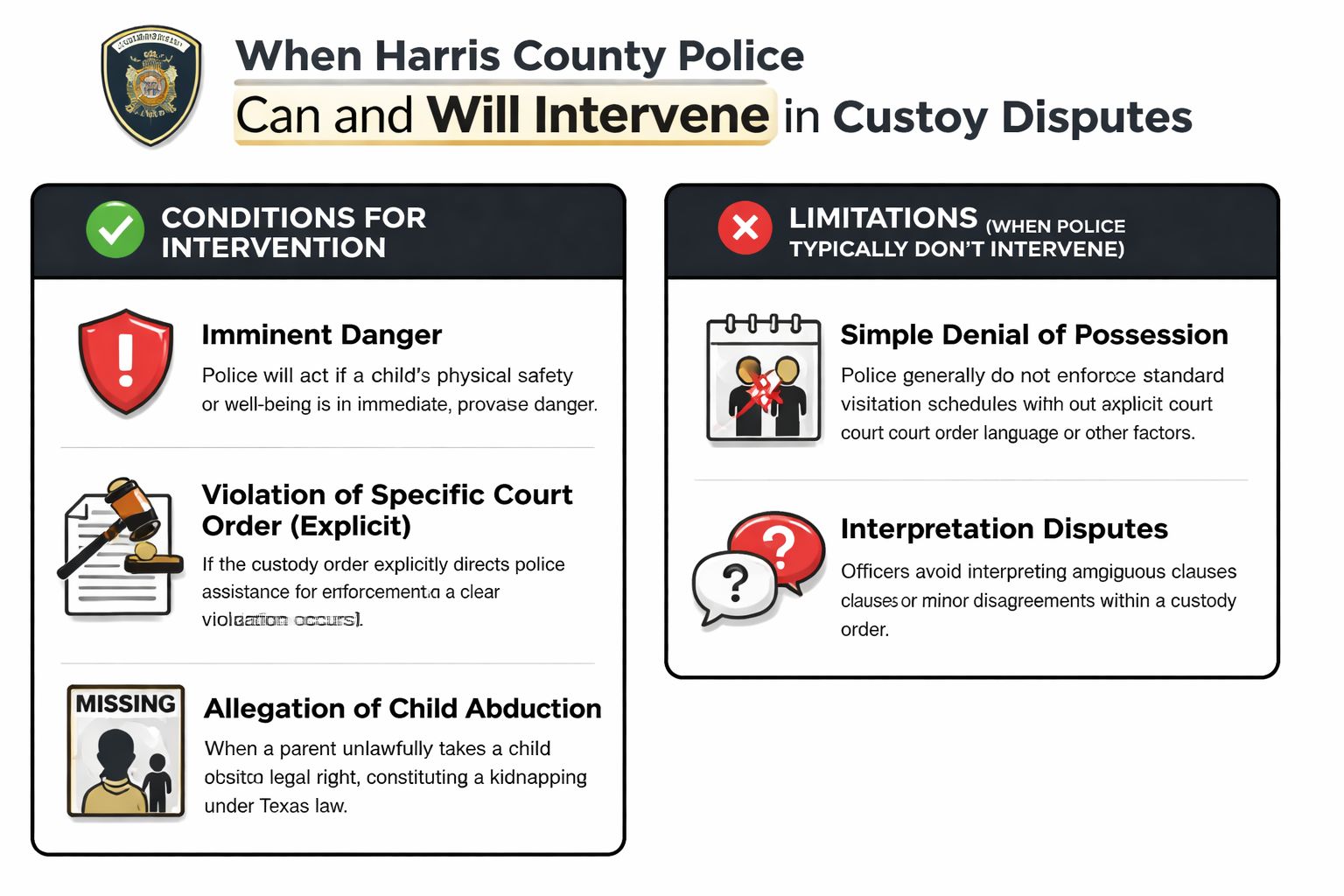
There are situations where deputies move from observer to actor. The line usually appears when the facts point to immediate danger, a clear criminal violation, or a specific court directive that leaves less room for interpretation.
In other words, law enforcement response gets stronger when the issue stops being only about a missed exchange and starts looking like a child safety or criminal matter.
Immediate danger changes the response
If a deputy believes a child faces immediate harm, the analysis changes fast. At that point, the deputy isn't just reviewing a possession dispute. The deputy is addressing a safety problem.
That can include allegations involving violence, credible threats, intoxication around the child, or facts that suggest abuse or neglect. If domestic violence is part of the picture, parents often need support beyond the custody issue itself. The Blooming Lilies LLC blog on domestic violence is a useful starting point for understanding warning signs and safety planning.
Interference with Child Custody
Texas law also draws a line between a civil violation and a crime. Police in Atascocita prioritize immediate danger assessments, and if a custody violation meets the criteria for criminal Interference with Child Custody under Texas Penal Code §25.03, the probability of arrest rises to 60%. That offense is a state jail felony carrying penalties of 180 days to 2 years in jail and a $10,000 fine, as discussed in this analysis of Texas custody order enforcement.
That doesn't mean every late return or denied weekend becomes a felony. It means some conduct moves beyond contempt and into criminal territory when a parent knowingly keeps or takes a child in violation of the order.
Examples that may raise the stakes include:
- Refusing to return a child for an extended period when the order clearly requires return
- Taking the child and concealing the child’s location
- Crossing jurisdictional lines to defeat the order
- Ignoring direct police instruction after review of a clear court order, when other facts support criminal intent
Court orders that trigger stronger enforcement
Some court orders are built for regular possession schedules. Others are built for active recovery of a child. If a judge signs a more specific directive, law enforcement may have a clearer role.
Those situations can involve orders such as:
| Type of court directive | Why it matters |
|---|---|
| Writ of Habeas Corpus | Commands that the child be brought before the court |
| Writ of Attachment | Can direct law enforcement to take possession of the child under court authority |
| Emergency protective or temporary orders | Can change the urgency and scope of enforcement |
A parent dealing with repeated retention issues may also want to review what to do if the other parent keeps a child past visitation in Atascocita because the best response often depends on whether the problem is isolated, repeated, or escalating.
The stronger and more specific the court directive, the less room there is for on-scene hesitation.
What usually does not trigger active intervention
Even with a valid order, deputies often won't take decisive action when the dispute is routine, fact-heavy, or unclear.
That often includes:
- A standard denial of pickup with no immediate safety issue
- A disagreement over who was late
- Conflicting claims about a verbal schedule change
- Ambiguous order language that needs judicial interpretation
That's the hard truth behind this topic. Police can be essential in the right case, but they aren't the primary engine of custody enforcement in ordinary possession disputes.
The Power of a Clear and Enforceable Custody Order
The strongest custody enforcement tool often isn't a squad car. It's a well-drafted order.
Texas requires every final conservatorship order to include the notice to peace officers that they may use reasonable efforts to enforce child custody terms. But that notice only helps if the order itself tells everyone exactly what those terms are. Texas Law Help notes that every final Texas conservatorship order must contain that notice, yet in 2024 only 12% of custody enforcement motions filed in Harris County resulted in immediate police involvement, often because the order terms were too vague, according to Texas Law Help’s explanation of law enforcement, child safety, and visitation disagreements.
Vague orders create avoidable fights
An order that says "reasonable visitation" invites argument. An order that says "pickup at 6:00 p.m. Friday at the Starbucks on West Lake Houston Parkway" leaves less room for conflict.
Judges, deputies, and lawyers all work better with specifics. So do parents.
Compare the difference:
| Weak wording | Strong wording |
|---|---|
| "Weekend possession as agreed" | "First, third, and fifth Fridays at 6:00 p.m. until Sunday at 6:00 p.m." |
| "Pickup at a mutually agreed place" | "Pickup at Humble Police Department safe exchange area" |
| "Summer possession by notice" | "Notice by stated deadline, with exact start and end date" |
What a strong order should spell out
A custody order should answer practical questions before they become arguments. In northeast Harris County, good orders often address common friction points around traffic, school calendars, and exchange locations.
A more enforceable order usually includes:
- Exact dates and times so nobody has to guess when possession starts and ends
- Clear exchange location such as a school, safe exchange zone, or specific public place
- Holiday language that overrides the regular schedule in plain terms
- Transportation responsibility identifying who picks up and who drops off
- Communication rules if confirmation through text or an app is expected
Local insight: If the order forces a deputy to interpret "what the parents meant," enforcement gets weaker. If the order reads like a checklist, enforcement gets easier.
Fixing an order that no longer works
Many parents don't realize their problem isn't only the other parent's behavior. It's the wording in the existing decree. Orders drafted years ago may not fit current school schedules, work obligations, or the practical reality of exchanges in Atascocita and Humble.
If your order creates repeat confusion, modification may be the most effective long-term fix. This overview of the Texas standard possession order is a good place to start if you want to compare your current language against more structured possession terms.
Clear language doesn't eliminate conflict by itself. But it gives the court something solid to enforce, and it gives the other parent fewer places to hide.
Your Guide to Court-Ordered Enforcement in Harris County
When deputies won't force the handoff, your next move is usually family court. In Harris County, that means filing an enforcement action under the Family Code and asking a judge to impose consequences.
Through enforcement actions, many parents find their position strengthened. In Harris County, enforcement motions succeeded in 88% of hearings, or 3,912 of 4,438, with fines of $100 to $2,000 imposed in 45% of cases, custody modifications in 22%, and a median of 72 hours of makeup visitation, according to this Harris County enforcement overview.
What an enforcement case asks the judge to do
A motion for enforcement tells the court three basic things: there is a valid order, the order was violated, and the judge should impose a remedy.
That remedy might be as simple as makeup possession. In stronger cases, it can include fines, attorney’s fees, or contempt findings. Repeated violations can also support requests to change custody terms.
What to gather before you file
Strong enforcement cases are built on organized proof, not frustration. Start collecting records the same day the violation happens.
Useful evidence often includes:
- A certified copy of the custody order
- Screenshots of texts or app messages showing denial, delay, or refusal
- Call logs and incident numbers from law enforcement contacts
- Photos, videos, or timestamped location records showing you appeared for the exchange
- Notes made the same day recording who was present and what was said
Where the case goes
Enforcement usually has to be filed in the court with continuing jurisdiction over your SAPCR or divorce case. For many Atascocita families, that means a Harris County family district court.
If you're unsure where your case is pending, your order will usually identify the court and cause number. Those details matter because filing in the wrong place causes delay.
What happens at the hearing
At the hearing, the judge isn't deciding whether the situation feels unfair in a general sense. The judge is asking whether the order was clear, whether the other parent knew what it required, and whether the violation is proven.
That means details matter:
- Show the order
- Identify the exact paragraph violated
- Match the violation to evidence
- Ask for a specific remedy
Parents often hurt their own cases by speaking in broad conclusions. "She always does this" is less useful than "On Friday at 6:00 p.m., I appeared at the exchange location identified in Paragraph 7, and the child was not produced."
Remedies the court can order
Family court has tools that patrol officers don't. Judges can create consequences that change behavior over time.
Here is a practical summary.
| Remedy | Description |
|---|---|
| Makeup possession | Additional time awarded to replace the time you lost |
| Fines | Monetary penalties for violating the order |
| Attorney’s fees | The court may order the violating parent to pay fees |
| Contempt | A judge can punish willful violations of court orders |
| Custody modification | Repeated violations can support changing conservatorship or possession terms |
Bring the judge a clean timeline, a marked-up copy of the order, and organized exhibits. Courts respond to proof, sequence, and specificity.
Why court works when police don't
Police often avoid making legal judgments in a parking lot or on a front porch. Judges do the opposite. Their job is to interpret the order, hear evidence, and issue consequences.
That difference is why court enforcement is often the most effective solution when a parent keeps violating visitation in Atascocita, Humble, or elsewhere in Harris County. A deputy may create a record. A judge creates an enforceable remedy.
What to Do When Police in Atascocita Decline to Act
When a deputy says they can't make the exchange happen, most parents feel angry, embarrassed, and stuck. This is the point where a bad night can either become a damaging argument or strong evidence for court.
Choose the second path.
What to do at the scene
Stay calm with the deputy and with the other parent. If you argue, raise your voice, or try to force contact with the child, you may damage your own case and create a safety issue.
Use this checklist instead:
- Ask for identifying details including the deputy's name, badge number, and any incident or event number
- Keep your order available and show the relevant possession language without arguing over interpretation
- Leave if told to leave because refusing can escalate a civil problem into something worse
- Avoid discussing child support or old grievances because that muddies the issue
Start documenting immediately
Once you leave, begin building your record. The goal is to preserve facts while they're still fresh.
Write down:
- Date and exact time you arrived and left
- Location of the exchange
- Who was present
- What the other parent said
- What the deputy said
- How the child exchange failed
Save every relevant message. Screenshot texts. Preserve app communications. Keep voicemails. If you have lawful video or photo evidence, store it somewhere secure.
A short explanation of the legal process can help orient you before you act further:
Turn the refusal into evidence
A police refusal doesn't mean the violation didn't happen. It often means only that the deputy wouldn't enforce it on scene.
That distinction matters. In court, the fact that you appeared, remained calm, presented the order, and sought lawful help can strengthen your position. The deputy's incident number may also support your timeline.
If the problem repeats, don't wait too long to get legal help. A parent dealing with denied possession can learn more about working with an Atascocita custody enforcement lawyer when informal efforts have stopped working.
Leave with records, not rage. Courts can use records.
Your Next Steps with The Law Office of Bryan Fagan
By the time most parents search can police enforce custody order Atascocita Texas, they aren't looking for theory. They need a plan that works in real life.
The practical takeaway is straightforward. Police are mainly there for safety and peacekeeping. Family courts are where custody orders are enforced. If your order is clear and your evidence is organized, you have options even after a denied exchange.
A few local resources may help you take the next step:
- Harris County District Clerk for court records, filings, and cause number information
- Harris County Precinct 4 Constable’s Office for local public safety information and community resources
- Your existing court order and certified copies because those documents drive everything that follows
If you're dealing with repeated violations in Atascocita, Humble, or elsewhere in northeast Harris County, don't sit in uncertainty. A free consultation can help you understand whether your case calls for an enforcement action, a modification, or an emergency request based on the specific facts.
Frequently Asked Questions About Custody Order Enforcement
Can police force the other parent to hand over my child during normal visitation
Usually, not during an ordinary visitation dispute. Deputies may review the order, encourage compliance, and create a report, but routine enforcement usually happens in family court unless the facts suggest danger, criminal interference, or a more specific judicial directive.
What if the other parent says I can't see the child because I'm behind on child support
That's not a lawful self-help remedy. Possession and child support are different legal obligations. A parent generally can't withhold court-ordered access because support is disputed or unpaid, and the proper response is still through court.
Does it matter that I live in Atascocita instead of inside Houston city limits
Yes, from a practical standpoint. Atascocita is largely unincorporated, so the responding agency is often the Harris County Sheriff’s Office. Local protocol, document review, and on-scene practices may differ from what people assume when they think of a city police department.
What if the other parent is only late, not refusing outright
Lateness can still matter, especially if it becomes a pattern. But isolated delay is less likely to trigger active law enforcement involvement than a direct refusal, concealment, or safety concern. Document it carefully so a pattern can be shown if the problem keeps happening.
Can I record the exchange
That depends on the circumstances and how the recording is made. Many parents use screenshots, contemporaneous notes, and location records because those are often enough to support the timeline. If you're considering audio or video recording, get advice based on your specific facts before relying on it.
What if my order is from another Texas county
A valid Texas order can still be enforced, but the practical issue is whether the responding deputy can quickly confirm what the order says and whether it is specific enough for on-scene review. For repeated violations, the court with jurisdiction over the case remains central.
Should I call 911 or a non-emergency number
If there is immediate danger, call 911. If the issue is a routine denied exchange without a safety threat, a non-emergency call may be more appropriate. The key is to describe the facts accurately and avoid overstating the situation.
What if my child doesn't want to come with me
That doesn't automatically excuse the other parent from following the order. Much depends on the child’s age, the circumstances, and what the order requires. A parent can't usually defeat possession merely by saying the child refused. These situations are often fact-intensive and should be documented carefully.
If you're dealing with denied visitation, repeated custody violations, or an order that isn't working in real life, the Law Office of Bryan Fagan – Atascocita TX Lawyers can help you understand your options. Our team works with parents in Atascocita, Humble, and across Harris County to enforce custody orders, seek modifications, and protect parent-child relationships through clear, practical legal action. Schedule a free consultation to talk through your situation and build a plan that fits your family.


