You've received the Lakeshore home in your divorce, but the HOA statement still arrives in both names. Your former spouse says the decree finished the transfer, while the mortgage statement and tax account tell a different story. After an already demanding process, it's understandable to want the paperwork behind you.
A Lakeshore Atascocita HOA transfer after a divorce works best when you treat the court award, county title records, and association account as separate jobs. Start by identifying what each office needs, then keep proof that each change was completed. That approach helps protect your home without turning an administrative delay into another dispute.
The Transfer Checklist at a Glance
| Track | Document | Where it goes | Who acts |
|---|---|---|---|
| Court award | Final divorce decree with the property clause | Issuing family court for a certified copy | Receiving spouse or attorney |
| Title | Special warranty or other deed as ordered | Harris County Clerk, Real Property records | Both spouses coordinate required signatures and notarization |
| HOA records | Recorded deed, decree, settlement statement if applicable, and ownership update form | Lakeshore HOA or management company | Receiving spouse |
| HOA account | Resale certificate or account statement | Lakeshore HOA management company | Owner requesting the statement |
| Homestead tax | Ownership documentation and homestead application | Harris County Appraisal District | New owner |
| Tax billing | Notice after HCAD processes the change | Harris County Tax Office | New owner |
Use this as a completion checklist, not just a document list. A recorded deed is the proof; a signed deed sitting in your closing folder is only a draft of that proof. The same standard applies at the association: your update request counts when management confirms it changed the owner and billing records, so ask for that confirmation in writing.
The distinction matters because each record does a different job. The decree settles rights and obligations between the spouses. The county deed makes the ownership change public, and the HOA account controls who management treats as the member and where statements and notices go. Those records update on separate schedules, so any of them can lag behind the others.
For statewide disclosure requirements, Texas Property Code Chapter 207 requires resale information to address transfer restrictions, assessments, unpaid property-related amounts, and transfer fees. That makes the account review useful even when no buyer is purchasing the home. Ask management whether your divorce transfer requires a resale certificate or a simpler ownership-update packet.
Put the paperwork in working order
Begin with the decree and existing title. Have the required conveyance document prepared and recorded, then handle the HOA and tax updates in parallel. One office's receipt of a document tells you nothing about what any other agency received.
Create a folder with separate tabs for the court, county clerk, association, lender, insurance company, and tax agencies, and drop every delivery confirmation and reply into the matching tab. Keep the dated log of requests, responses and confirmations described under Resolving Disputes and Timing the Transfer; that log becomes your evidence if an office stalls or disputes what it received.
Practical rule: Mark a task complete only when you have evidence of the result, not merely evidence that you submitted a request.
Start wherever the gap is widest. If the county record still shows two owners, record the deed first. If title is clean but statements still arrive in both names, go straight to the association and its ownership-update packet. Work one office at a time, confirm each result, then move to the next row of the checklist.
Confirm the Decree and Choose the Deed
Start with the property award, not the association's form. Management can update its records, but it can't resolve an unclear award or choose the right conveyance document for the spouses.
- Identify the property precisely. Compare the decree's legal description with the purchase deed. A street address helps identify the home, but it shouldn't substitute for checking the lot, block, subdivision, and other recorded description.
- Read what the court ordered. Is the Lakeshore residence awarded to you, ordered sold, or awarded subject to a payment to your former spouse? An equalization payment means one spouse owes money to balance the property division.
- Separate ownership from loan responsibility. Review who must pay the mortgage and whether the decree requires refinancing, an assumption, or efforts to obtain a release. Check who pays taxes, insurance, and HOA charges while those arrangements remain unfinished.
- Find the cooperation requirements. Identify the deed-signing deadline, required documents, and any obligation to provide information or attend a closing.
- Check the property classification. Don't assume the names on the purchase deed settle whether the home is community or separate property.
Texas generally treats property acquired during marriage as community property and presumes property possessed at divorce is community property; the marital estate is divided on a just-and-right basis, not automatically 50/50, under the Texas Family Code's marital-property provisions. For Atascocita and Humble homeowners, purchase records, mortgage history, closing documents, and payment records help counsel evaluate that classification.
A written marital-property agreement may also affect the result. The Texas Family Code's partition and conversion provisions explain why changing names on title alone doesn't establish a valid conversion of separate property into community property. Align the decree, any applicable agreement, and the proposed deed before signing.
Match the deed to the award
| Deed type | Typical use after divorce | Title promise | Lender check |
|---|---|---|---|
| Special warranty deed | Decree orders one spouse to convey the home | Covers title claims arising through the grantor during the grantor's ownership | Confirm with lender |
| General warranty deed | Broader title assurance is required, including when earlier title history needs examination | Broader warranty covering earlier title claims, subject to stated exceptions | Confirm with lender |
| Quitclaim deed | Grantor releases whatever interest they hold | No title warranty | Confirm lender and title company accept it |
The grantor transfers an interest; the grantee receives it. A broader warranty isn't a substitute for a title examination, and a convenient online quitclaim form may create acceptance problems later.
Texas homestead rules also require attention to spousal participation in a conveyance or encumbrance under the Texas Family Code's homestead provisions. If the departing spouse must receive compensation secured by the home, counsel should evaluate an owelty lien, a lien securing a partition-related payment, alongside the deed and financing arrangement.
Our guide to property division in divorce provides related context. Before negotiating the transfer, gather the purchase deed, closing file, mortgage statements, payment history, and HOA ledger so the agreement addresses actual obligations rather than assumptions.
Record the Deed and Notify the Lakeshore HOA
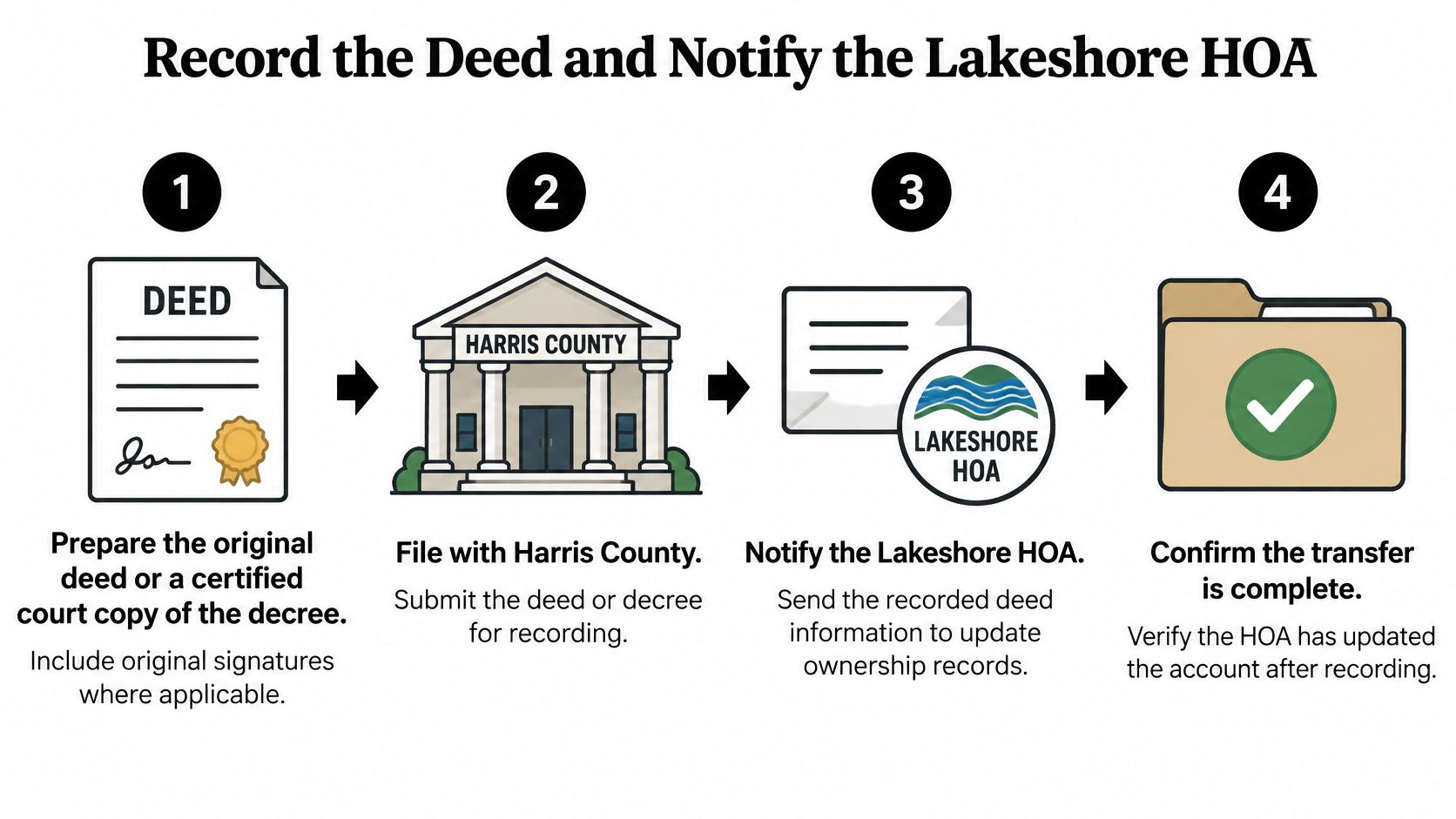
The decree, the deed, and the HOA account are three separate records, and none of them updates the others. Recording the deed fixes the county's title history. The HOA keeps billing whoever its ledger names until someone submits its paperwork. Treat the county filing and the association submission as two distinct tasks so you can pinpoint exactly where a delay sits.
Use this process illustration to organize the handoff.
Complete the county filing first
- Prepare a recordable document. The Harris County Clerk's Real Property Department identifies requirements including an original document or certified court copy, original signatures where applicable, deed notarization, a legal description, the grantee's address, printed signer names and capacities, and a return address. Have counsel confirm whether the decree itself should be recorded or whether the award requires a separate deed.
- Submit the conveyance for recording. File with the county clerk's Real Property records and retain the receipt. Obtain the recorded copy showing the recording information, rather than circulating only the unrecorded signed version.
- Build the HOA packet. Assemble the recorded deed, relevant decree documentation, and management's ownership-update form. Include a settlement statement only if the closing file has one and management's form asks for it.
Both spouses should coordinate the signing process, but the deed preparer determines who must sign each instrument. Adding or omitting a signature because a generic checklist says so is how otherwise valid deeds get rejected at the counter.
Finish the association handoff
- Send the decree in the form management accepts. Before sending sensitive court materials, ask whether a certified extract or the relevant pages will satisfy its requirements. Identification, account forms, and portal registration typically travel with the same packet.
- Verify the actual changes. Request written confirmation naming you as owner of record, then check the billing address, email address, portal access, and delivery preferences for notices. Confirm that the next statement reflects the correction.
- Contact the mortgage servicer and insurance carrier separately. Ask each what documentation it needs and whether any additional transaction or policy change remains outstanding.
Confirmation is the step most often skipped. Confirmation means a written statement from management naming you as owner of record, not an automated email acknowledging an attachment.
For accompanying divorce guidance, the following video may be helpful.
A rejected county filing generally calls for a document correction or clarification of recording requirements. An HOA rejection may instead concern missing account information or an association-specific form. Request the specific defect in writing, identify who can correct it, and resubmit a complete packet with a short cover note explaining the correction.
Clear HOA Fees, Assessments and Liens Before Transfer
A divorce-related ownership change isn't necessarily a conventional sale. Before paying a charge labeled “transfer fee,” find out whether management means a resale certificate, an administrative account update, document copies, or an unpaid assessment.
Under Texas Property Code Chapter 207's resale-certificate rules, the preparation charge for specified resale information is capped at $375, and an update to an existing certificate is capped at $75. Those are statutory maximums for those services, not verified Lakeshore charges. The statute generally places the certificate fee on the purchaser unless the parties agree otherwise and prohibits that fee when the association fails to deliver the certificate within the required period.
Separate the fee categories
| Charge | Cap or amount | Who usually pays | Request in writing |
|---|---|---|---|
| Resale certificate preparation | Statutory preparation maximum described above | Purchaser, unless the parties agree otherwise | Itemized statement with recipient and legal basis |
| Resale certificate update | Statutory update maximum described above | Confirm allocation under the parties' agreement and applicable requirements | Identification of the certificate being updated |
| Administrative ownership change | Amount supported by applicable governing documents or management authority | Person responsible under the decree and applicable documents | Basis in the declaration or management contract |
| Delinquent assessments | Amount shown on the account statement | Property account remains outstanding until resolved; decree allocates responsibility between spouses | Payoff letter with due dates |
| Document copy charges | Itemized amount with applicable authority | Requesting owner, subject to the decree or agreement | Itemized charge sheet |
Ask whether management is processing a title transfer or merely changing member contact information. That answer helps you evaluate whether the requested service matches the charge.
A decree assigning an expense to your former spouse doesn't make the association's ledger disappear. If the account remains unpaid, address the property account and the obligation between spouses as separate issues. Don't assume removing a name from billing resolves an existing lien.
Make a written balance request
Ask management for:
- The current ledger. Include unpaid assessments, approved special assessments, and any pending account adjustments.
- An itemized fee list. Request each charge's description, recipient, amount, and supporting authority.
- A dated payoff or balance letter. Specify the intended transfer date and ask how later payments or charges will affect the balance.
- Lien information. If a lien has been asserted or recorded, ask what payment and release documentation management requires.
Keep the replies with your decree and payment receipts. If an amount is disputed, ask counsel to review the charge before signing a broad acknowledgment that you owe it.
Nearby communities may present similar allocation questions but use different governing documents. Our discussion of Balmoral HOA amenity assessments in divorce illustrates why homeowners should examine the actual obligation rather than borrow another neighborhood's fee assumptions.
Track Homestead and Tax Records With HCAD
The decree awards you the house, the deed puts it in your name, and the HOA account shows you as the owner. None of those filings touches your property-tax record. HCAD keeps its own ownership and exemption ledger, and it updates only when you submit the right paperwork.
The HCAD ownership-change and exemption guidance treats divorce-related transfers as ownership changes and sets April 30 as the ordinary homestead application deadline. It also explains that an owner acquiring property after January 1 may qualify for the applicable portion of that tax year if the prior owner didn't receive the same exemption, provided the application is filed before the first anniversary of the acquisition date. Eligibility still requires the applicable ownership and principal-residence conditions.
Submit and verify the tax changes
- Send ownership evidence to HCAD. Provide the recorded deed and final decree through the appraisal district's applicable process. Keep a copy of everything submitted.
- File or update Form 11.13 as appropriate, with identification showing the Lakeshore address and the requested proof that you own and occupy the home as your principal residence.
- Confirm that your former spouse no longer claims the property as a principal residence. If the ownership or occupancy circumstances are unusual, explain them accurately rather than guessing on the application.
- Follow up with the Harris County Tax Office after HCAD processes the change. Confirm the tax billing name and mailing address.
- Complete the association's separate document request, including any applicable settlement statement, resale paperwork, or account forms.
| Item | Deadline | Who acts |
|---|---|---|
| Ordinary homestead application | April 30 | New owner |
| Property acquired after January 1 | Before the first anniversary of the acquisition date, subject to eligibility | New owner |
| Harris County Tax Office notice | After HCAD processes the change | New owner |
An old exemption still showing on your account screen doesn't confirm that your post-divorce application obligations are complete.
Check the processed account, not just your submission receipt. If HCAD requests supporting material, respond with the exact document requested and retain the acknowledgment. If the district denies the homestead application or an exemption stays in your former spouse's name after you have filed correctly, take the paperwork to counsel, since the fix may depend on language in the decree rather than anything the appraisal district can correct on its own.
Tax corrections also don't address unpaid HOA assessments or outstanding architectural obligations. Ask management about unresolved notices, particularly if your former spouse previously received the association's correspondence.
Resolving Disputes and Timing the Transfer
A former spouse's refusal to sign doesn't necessarily mean you must renegotiate the property award. It may mean you need to enforce the order you already have.
The Texas State Law Library's after-divorce guide explains that a party affected by a property-division decree can seek enforcement in the court that issued it. Save the written request for signature, the proposed document, the decree's cooperation language, and any refusal. Your attorney can assess whether an enforcement motion or another corrective step fits the problem.
Identify who is blocking which task
A signature dispute belongs with counsel and, when necessary, the issuing court. Don't ask HOA management to decide whether your former spouse has complied with the decree. Management's acceptance of your name on an account won't cure an unfinished conveyance.
An HOA packet rejection calls for a different response. Request the precise reason, ask management to identify the governing-document provision or written submission requirement, correct the defect, and resubmit. If the request changes after each submission, preserve the earlier instructions so counsel can address the inconsistency.
Our guide to Summerwood HOA deed restrictions in an Atascocita divorce offers related context on separating a divorce award from subdivision obligations. Lakeshore homeowners still need to use Lakeshore's own documents.
Be careful before the divorce is final
Transferring the home early isn't a reliable shortcut. Under the Texas Family Code's pending-divorce transfer provisions, certain transfers or debts intended to injure the other spouse's rights can be challenged; relief against an outside party involves proof that the party had notice of that intent. The rule doesn't make every pending-case transfer automatically void, but it makes secrecy a poor strategy.
Disclose the home, mortgage, HOA balance, assessments, and intended deed transaction. Obtain clear temporary orders or final decree language before changing title or adding secured debt.
Keep a dated log: Record what you sent, who received it, what they requested next, and whether you met the decree's deadline.
Request account documents early, and have management confirm its applicable delivery period in writing. Use the decree's signing deadline to organize document preparation, lender review, and recording rather than waiting until the deadline to begin. A clear chronology helps your attorney distinguish an administrative delay from a refusal that needs court action.
Schedule a Free Consultation Before You Sign
A legal review pays off most when the three records point in different directions: the decree awards you the home, the county deed still names both spouses, and the HOA account shows a balance neither of you has paid. It is also worth the time when the property clause is unclear, your former spouse will not cooperate, or an HOA packet keeps coming back rejected. An owelty obligation, an unresolved refinancing requirement, or a proposed transfer during a pending case each deserve attention before you sign anything.
The divorce attorneys at the firm have local experience with the courts, judges, and legal framework of Atascocita and surrounding counties. They handle the paperwork and negotiations involved in reaching finalization, with attention to what the property documents require.
Bring the documents that show the gap
A consultation moves faster when the attorney can see exactly where the records disagree. Prepare a folder containing:
- The signature deadline from your decree, so timing advice accounts for what is due and when.
- The HOA rejection notice or resubmission request, if management sent one, along with a copy of the packet you filed.
- Any refinancing or assumption correspondence showing where the lender review stalled.
- Your dated log of what you sent, who received it, and what was requested next.
Readers weighing representation can review our Divorce Lawyer in Atascocita, TX page for information about divorce representation for clients in Atascocita and Harris County.
The initial consultation with an Atascocita attorney is free. You can contact the firm online or visit the Atascocita office to arrange a consultation and discuss which record remains unfinished.
Law Office of Bryan Fagan – Atascocita TX Lawyers can review the decree, the deed, and the HOA account together and tell you which gap to close first, so schedule your free consultation before the deadline decides for you.