
You've found a waterfront home in Atascocita, or you're finally ready to replace the aging dock behind your house. Then someone asks for a City shoreline lease, and the paperwork you thought was settled suddenly feels uncertain. The seller has a permit, the neighbor says everyone uses the shoreline, and your deed appears to reach the water.
Before you sign a construction contract or pay for dock access, pause over a more important question: What right do you have? For an Atascocita homeowner evaluating a City of Houston Lake Houston shoreline lease, the safest starting point is separating ownership from permission, then matching the proposed use to the correct approval.
Which Permission Your Shoreline Project Needs
Which permission applies to your shoreline situation
| Your situation | Likely path | First document to pull |
|---|---|---|
| Deed reaches the water and you plan a pier | City pier construction permit plus annual pier license | Deed, plat and surveyor-prepared site plan |
| You want to moor a sanitary vessel at the shoreline | City shoreline license, issued for one calendar year | Existing shoreline license record and vessel details |
| You plan to rent out dockage commercially | Commercial shoreline license, with dockage count and total rentable square footage in the commercial pier application | Pier permit history and dockage plan |
| Shoreline sits on state-owned submerged land | State lease from the Texas General Land Office; large projects may need School Land Board approval | Survey showing the submerged boundary |
| Shoreline or dock sits on city land or park facilities | Review whether a lease under the city parks authority applies, with a set term and conditions | Current lease and its approval requirements |
| You bought a waterfront home or inherited a dock | Confirm which permits and licenses are current and whether they transfer | Title exceptions and pier permit records |
A City pier permit or shoreline license gives permission for a regulated activity, not proof that you own the lake bed. A deed alone also doesn't prove authority over submerged land.
The distinctions matter because several approvals can apply to the same project. A dock rental arrangement, for example, may require a valid agreement granting access, appropriate commercial licensing, and a properly permitted pier. Calling the arrangement a shoreline lease doesn't resolve those separate questions.
Why Lake Houston waterfront is different
The City of Houston continues to own and operate Lake Houston for municipal water supply, irrigation, and recreation, according to the Lake Houston overview. That public-water role makes shoreline use different from an ordinary private lakefront subdivision.
For residents of Atascocita, Kingwood, Humble, Huffman, and Crosby, the practical lesson is straightforward: a waterfront address isn't an approval category. A listing describing lake view or lake access doesn't establish who controls the land beneath a proposed dock or what use is authorized.
Municipal boundaries also deserve attention. Our explanation of Houston's extraterritorial jurisdiction and what it means for Atascocita legal filings helps distinguish location questions from assumptions based on a mailing address.
Start with the land, not the project name: Ask who controls the proposed work area before asking which application to submit.
Your first action is to pull the deed, plat, survey, and any shoreline agreement. Compare those documents with the situation table before choosing a permitting or leasing path.
Records to Pull and Rights to Confirm Before You Sign
A permit in the seller's folder doesn't establish that the seller owns everything beneath the dock. It also doesn't answer whether you can rent the dock, enlarge it, exclude another user, or keep using it after a transfer.
The Houston Permitting Center's Lake Houston guidance requires attention to three separate layers: ownership or authority over the shoreline, City licensing and construction requirements, and private deed restrictions. Have a Texas-licensed surveyor identify the relevant control line and map the proposed work rather than treating the visible water's edge as a legal boundary.
Records to pull and the rights each one answers
| Record | What it answers |
|---|---|
| Recorded deed | Whether you hold title to the upland and any stated water-access rights |
| Survey and plat | Where the ordinary high-water or relevant control line and property lines sit |
| Title exceptions | Recorded easements or reservations that may limit dock or shoreline use |
| Shoreline license records | Whether sanitary-vessel mooring or commercial shoreline use is licensed |
| Pier permit history | Whether construction was permitted and what approved plans show; obtain current licensing records and a separate condition inspection |
| Lease or shoreline agreement | Who may use the dock, who pays repairs and renewals, and what the agreement says about a sale |
| Subdivision restrictions | Private limits on docks or improvements, checked separately from City rules |
These records answer different questions. A lease may grant defined use rights, while simple permission to maintain a bulkhead may authorize only that activity. Neither should be interpreted more broadly than its actual language, and a City license doesn't guarantee a continuing private lease.
Check the parcel and the promised rights
For flood-plain regulation, Houston's flood-plain code defines the Lake Houston area using the Lake Houston Dam to the south, West Lake Houston Parkway Bridge to the northwest, and a generally east-west line intersecting the confluence of Luce Bayou and the East Fork to the northeast. Compare the parcel and activity with those boundaries rather than relying on a listing description.
Private restrictions require their own review. Our discussion of Atascocita deed restrictions and land-use controls explains why public approval doesn't settle every neighborhood restriction.
Ask direct questions before closing or committing money:
- Ask the seller: What document grants shoreline access, and does it allow assignment, rental, improvements, or shared use?
- Ask the City: Which approvals cover the existing structure, are they current, and what changes are required for your proposed use?
- Ask about future events: What happens after a sale, foreclosure, inheritance, or boundary dispute, and which document supports that answer?
- Ask about competing users: Does a neighbor have recorded access, contractual permission, or merely an informal arrangement?
How to Apply for a Shoreline Lease Step by Step
There isn't a single application that turns every Lake Houston waterfront lot into privately controlled shoreline. Your application package should follow the ownership, location, and use you've established, not the label a seller or contractor uses.
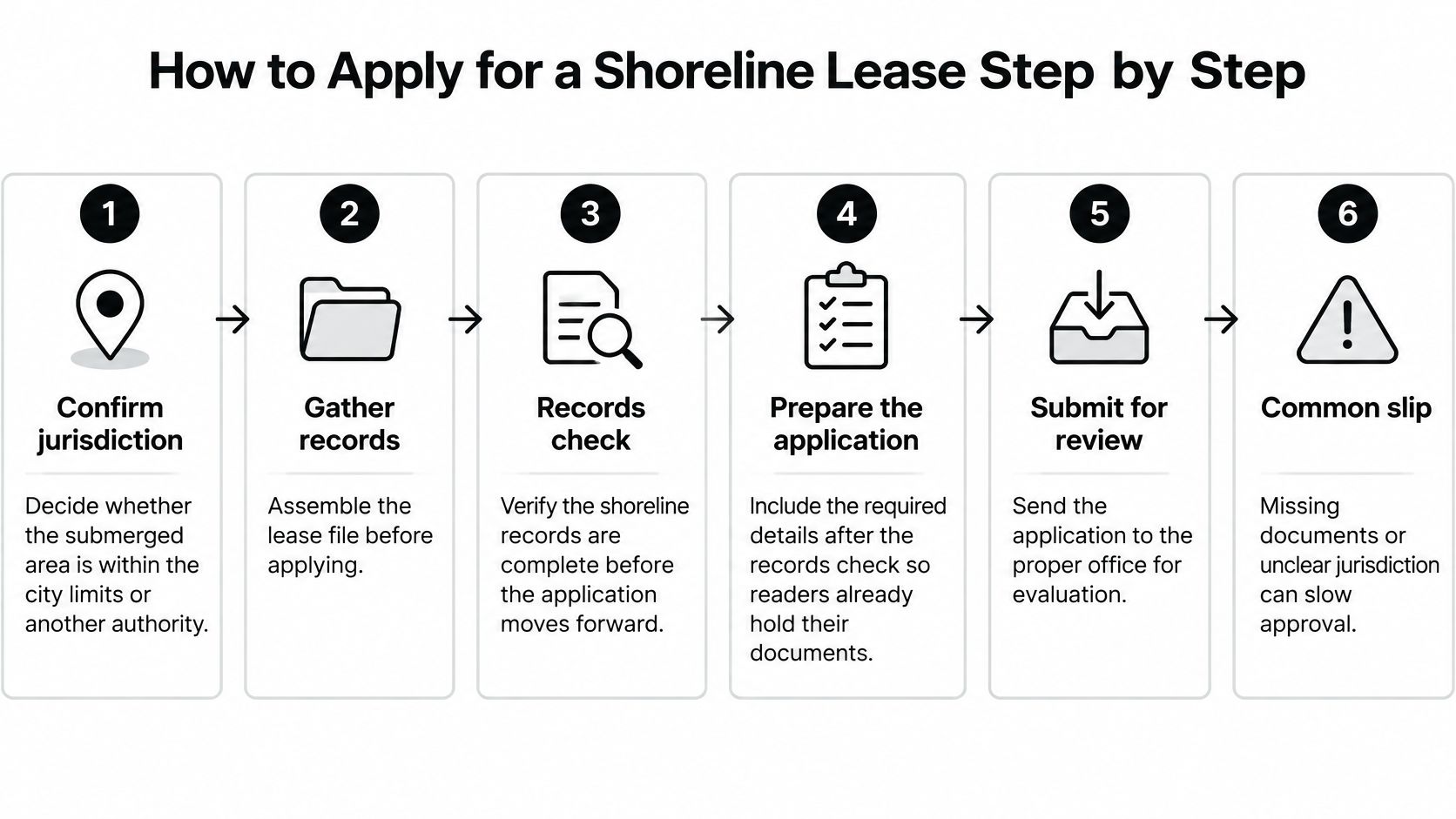
Prepare the application around the actual project
Confirm jurisdiction. Determine whether the submerged area is City-controlled, navigation-district property, state-owned, or under another authority. Don't assume a City license replaces a state lease, or that proximity to public water automatically establishes state ownership.
Locate the relevant boundary. Use the deed, plat, survey, and shoreline agreement to identify the ordinary high-water or other applicable control line. The common slip is substituting the current water level for the legally relevant boundary.
Commission a usable site plan. Have a Texas-licensed surveyor map property lines, shoreline, water depths, proposed pier limits, and docking locations; the City may require a surveyor- or engineer-prepared plat. A sketch copied from a tax map isn't a substitute for establishing where the proposed work will sit.
Assemble the supporting package. Include plans, applicable fees, insurance or financial assurance when required, relevant state or federal authorizations, and any necessary Parks or City Council approvals. Keep a submission checklist so an overlooked authorization doesn't leave an otherwise complete application waiting.
Describe commercial use accurately. Identify the proposed rental layout rather than submitting a plan that makes a commercial operation look residential. Houston's Lake Houston construction and pier provisions require commercial pier applicants to identify dockage spaces and total rentable square footage, limit residential lots to one pier, and require calendar-year pier licensing with a legible tag at the outermost extremity.
Wait for written authorization. Obtain the applicable construction approval before building, altering, or making major pier repairs, and address separate bulkhead or dredging requirements before that work starts. A neighbor's ongoing construction doesn't establish that your project is approved.
Complete the operating requirements. After construction, obtain the required pier license and display the tag in the required location. The avoidable mistake is treating a completed structure as ready for use while licensing remains unfinished.
Know what a completed file looks like
Keep the issued construction permit, approved plans, inspection correspondence, current license documentation, and any executed state or parks lease together. Save the application as submitted, including attachments, so you can show exactly what officials reviewed.
For an Atascocita Shores homeowner, that file should also match the physical dock. If the approved drawing shows a different footprint or docking arrangement, resolve the discrepancy before advertising access or promising a buyer that everything is authorized.
Construction approval, operating permission, and a right to occupy land should each have their own supporting document.
Before paying the final contractor invoice, compare the completed work with the approved plans and clarify who will handle renewals. Put that responsibility in writing if a tenant, co-owner, or property manager will use the dock.
Fees, Timelines and Renewal Dates to Plan Around
A contractor may be ready to start in spring, but a required state lease can affect the schedule. Separate work approvals from recurring licenses, then plan backward from the date you hope to build.
| Approval | Term or timing | What triggers it |
|---|---|---|
| Pier construction permit | Obtain before construction, alteration, or major repair | A new or materially altered pier |
| Annual pier license | One calendar year; renew each calendar year | A pier that is used, owned, rented, or leased |
| Shoreline license | One calendar year | A sanitary vessel moored at the shoreline |
| Commercial shoreline license | One calendar year; required before commercial use | Commercial use, rental, or lease of the shoreline |
| Bulkhead or dredging permit | Obtain before work begins | Bulkhead or dredging work |
| State submerged-land lease through the General Land Office | About three months after complete information is received | State-owned submerged land; projects over 500 linear feet or 200 square feet of fill may need School Land Board approval |
| Application fees | Request the current fee schedule from the issuing office before filing | The applications required for your project |
The Texas General Land Office living shorelines permitting guide describes typical state-lease execution as about three months after complete information is received. It also identifies projects over 500 linear feet or 200 square feet of fill as potentially requiring School Land Board approval. These are planning points, not guaranteed dates or proof of a right to use the lake bed.
Build the calendar backward
If you hope to build in spring and need a state lease, begin preparing the file in winter. Missing information, unresolved ownership, or additional authorizations can extend the schedule, so avoid committing to a construction date based only on the typical lease timeline.
Keep construction approvals and annual licenses on separate calendar entries. A construction permit concerns the work; calendar-year licenses need renewal attention even after the contractor has finished.
Set reminders early enough to gather records, replace an illegible tag, and confirm who handles each renewal. If someone else rents or manages the dock, put that responsibility in writing.
Budget for the whole file
Request the current fee schedule from the issuing office before filing, and identify which applications apply to your project. Ask separately whether survey preparation, engineering, insurance, financial assurance, or other supporting work is required. The application fee may not be the only cost to plan for.
A useful planning file includes:
- A document owner: Assign someone to obtain each missing approval or attachment.
- A written status record: Save submission confirmations and requests for additional information.
- A construction condition: Make mobilization depend on receiving the required written approvals.
- A renewal assignment: Identify who receives notices and pays recurring charges.
Enforcement, Appeals and Problems That Stall a Lease
A signed dock agreement can cover a private arrangement without making every shoreline use lawful. If the underlying permission is missing, expired, or narrower than the promised use, the contract does not establish ownership of the lake bed or replace the City's approval.
If you receive an enforcement notice, preserve it and pause any work that could add to the problem. Photograph the dock and license tag, save the envelope or electronic delivery record, and identify exactly what the City says is wrong.
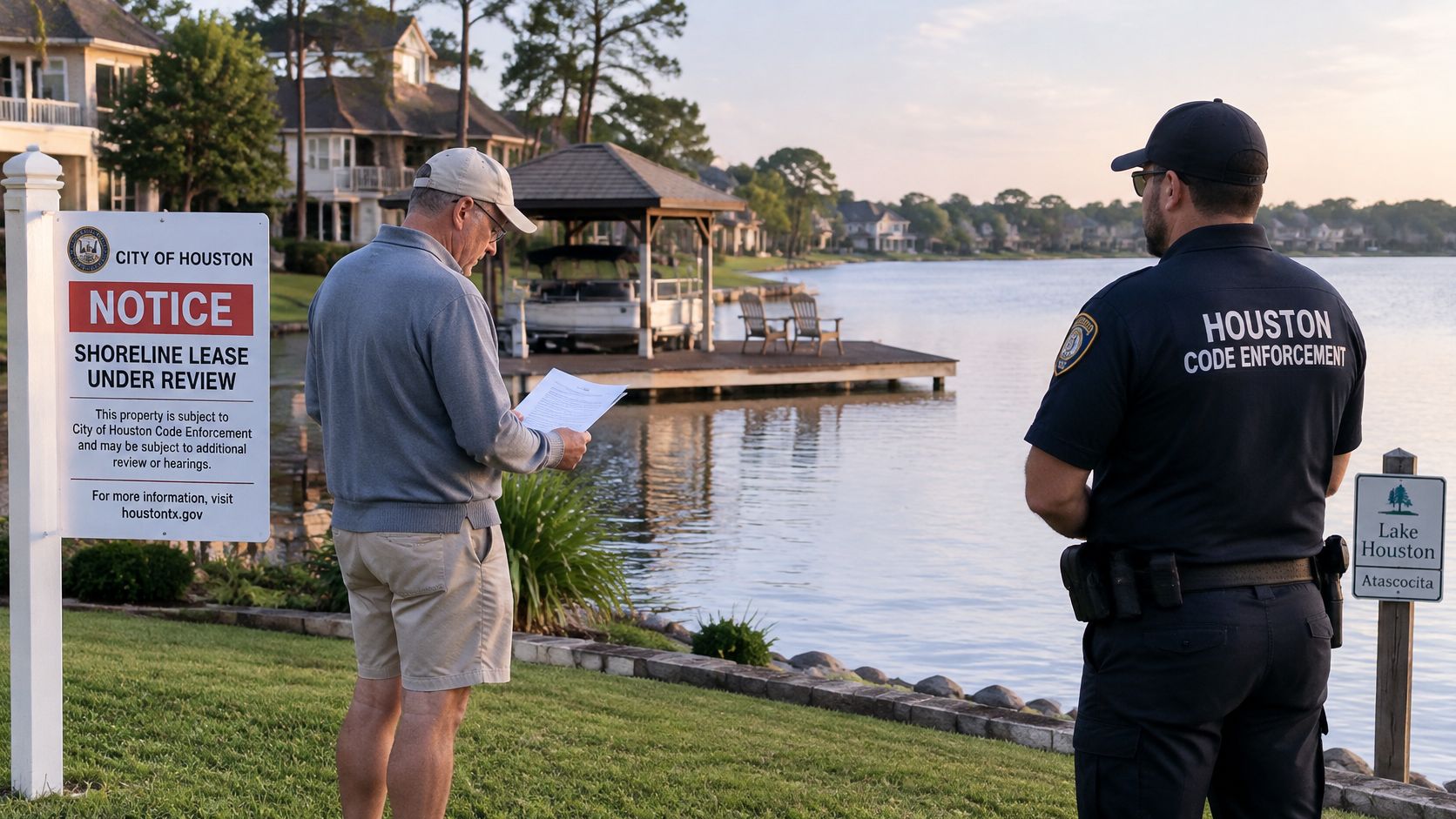
Respond to the stated violation
Under Houston's shoreline-license ordinance, revocation grounds include an unsanitary shoreline, ordinance violations, and failure to maintain permanent contact information. After revocation, the City may remove the license tag within 48 hours. Keep your contact information current and respond to the specific grounds in the notice.
The right response depends on the problem. For a maintenance dispute, gather the agreement, maintenance requests, photographs, and payment records. For alleged unpermitted construction, compare the approved plans with the work completed.
A shared-pier disagreement raises a different question: what rights do recorded documents and written agreements actually grant? Long-standing neighbor use alone may not establish the extent of those rights. Review the records before blocking access, changing locks, or removing someone else's property.
Read public-land agreements narrowly
The Houston parks-authority document authorizes leasing land and improvements for park purposes for a term of years, subject to acceptable conditions. It does not give every waterfront homeowner authority to lease public shoreline.
Read each agreement clause by clause. Check the term, permitted use, maintenance duties, insurance, environmental obligations, approval requirements, and termination provisions. Permission for access, for example, may not authorize commercial dockage or new structures.
Protect your position: Keep the notice, agreement, and your response together. A phone conversation does not replace a written record.
A complete appeal procedure depends on the specific ordinance and issuing office. Ask in writing what review options are available, which deadlines apply, and whether a request for reconsideration affects enforcement. Do not assume it pauses action.
- Request the decision in writing: Ask which provision and factual condition support it.
- Record deadlines: Keep every notice and response with its delivery date.
- Ask about review: Request written instructions from the issuing office before any stated deadline expires.
- Separate the disputes: A private contract or access disagreement differs from a municipal enforcement matter. The Texas civil litigation process explains how civil disputes proceed in Texas courts.
An ordinance notice is not automatically a criminal charge. If you receive a citation or charging document, have counsel identify the proceeding and its response requirements rather than treating it as ordinary lease correspondence.
Get a Free Consultation Before You Sign
A dock dispute can feel much larger than a paperwork problem when it affects your home, retirement plans, or family inheritance. You don't have to resolve unclear submerged-land ownership or an unfamiliar public-land agreement by guessing.
Stop handling the matter alone when the seller can't produce the promised agreement, a neighbor claims shared access, or the City questions your use. A General Land Office lease, enforcement notice, foreclosure, or transfer after a death also deserves a focused legal review before you commit money or surrender access.
Bring a file that supports clear answers
Bring the records checklist, correspondence, photographs of license tags, approved plans, and your proposed site plan. Include advertisements or seller statements that influenced your decision, along with any contractor proposal or dock-rental agreement.
Our Atascocita team includes Byron Shaw and Teresa J. Glascoe. We serve residents of Atascocita, Humble, Harris County, and surrounding communities, and our listed office is 7702 FM 1960 Rd E, Suite 212, Humble, TX 77346.
Waterfront rights can also affect family decisions. In a Texas divorce, identifying and dividing a property interest is different from securing whatever City approval its use requires; a custody arrangement likewise shouldn't be treated as a shoreline authorization.
For estate planning or an inherited dock, take a practical sequence:
- Identify the interest: Determine whether the family holds ownership, a lease, access rights, or a license.
- Check transfer language: Look for assignment, death, termination, and consent provisions.
- Coordinate the estate documents: Have the will, trust, and administration plan address the actual transferable interest.
- Confirm ongoing obligations: Identify who will maintain the dock and handle required approvals during the transition.
Our Texas wills and trusts services can help families coordinate waterfront interests with their estate plans.
Make the next decision with support
The initial consultation is free. Call 281-519-3083 or complete the firm's online contact form to schedule a consultation at the Atascocita office.
Bring your questions even if your file is incomplete. The aim is a dock that stays legal and a family that understands and protects its rights.
Law Office of Bryan Fagan – Atascocita TX Lawyers offers guidance on civil disputes, family property concerns, and estate planning that can affect Lake Houston waterfront interests. Visit Law Office of Bryan Fagan – Atascocita TX Lawyers to schedule your free consultation and discuss your shoreline documents before you sign, build, or transfer dock access.