You're looking at the workshop behind your Atascocita home, wondering whether you'll have to sell the property or pay your spouse for a building you helped construct. Your spouse points to the construction receipts. You pull up the county appraisal. Neither number seems to reflect what someone would pay for the place.
An Atascocita detached workshop or barn valuation in a divorce starts with ownership, then moves to market value and debt. A barn can contribute far less than it cost to build. Understanding those separate questions can help you protect your financial position without turning every disagreement about the property into a personal battle.
Marital or Separate Property Comes First
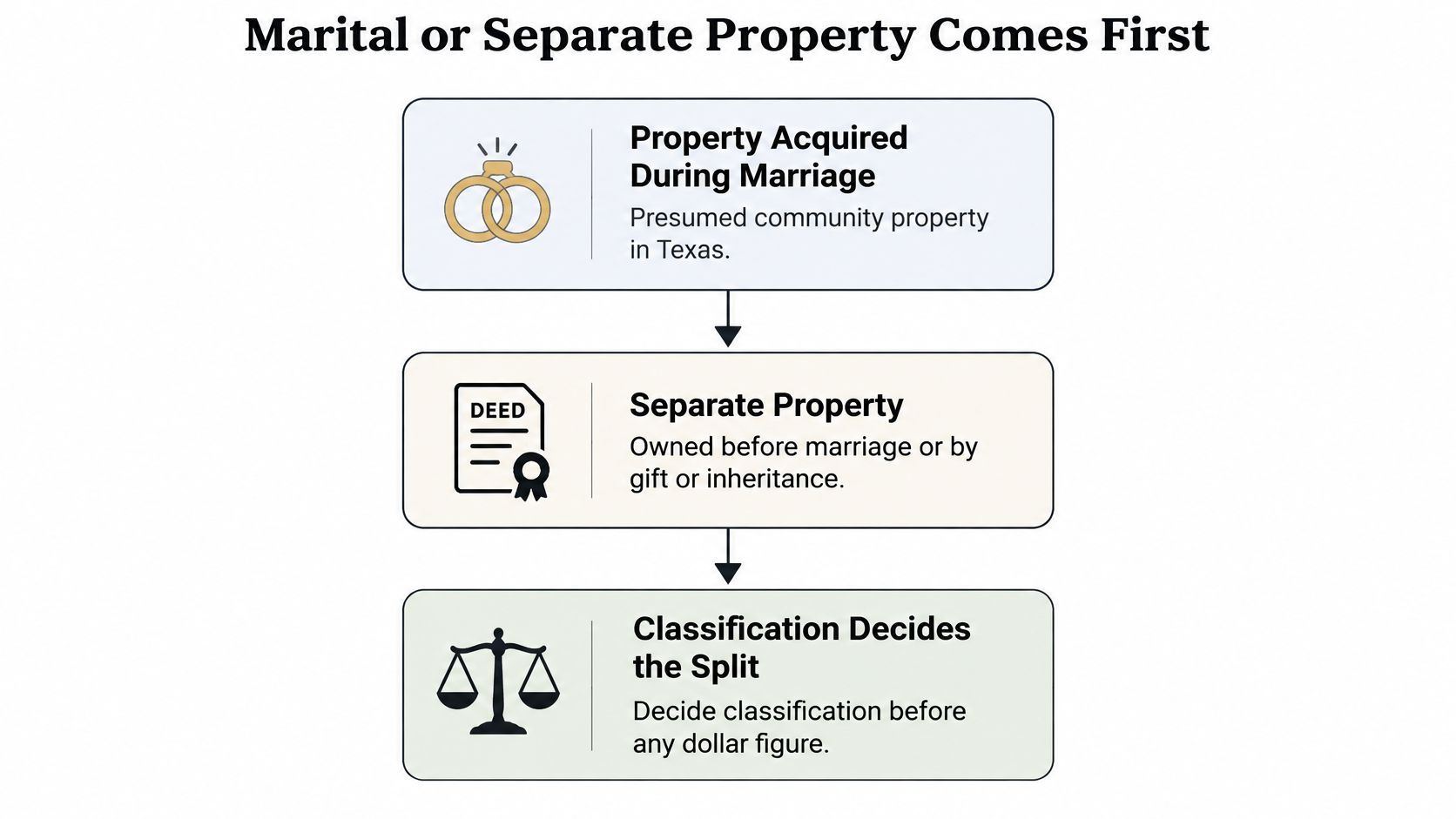
Texas starts with a presumption of community property. Under Texas Family Code §§3.002 and 3.003, property acquired during marriage generally is community property, and property possessed by either spouse during marriage or at dissolution is presumed community; a spouse claiming separate ownership must prove it by clear and convincing evidence.
Separate property can include property owned before marriage or received by gift or inheritance, as explained in the Texas Family Code's separate-property provisions. The name on a deed is a starting point, not a substitute for tracing acquisition and funding.
A detached barn is usually analyzed as part of the property. That means identifying its contribution separately for appraisal purposes doesn't necessarily make it a separately owned asset.
Classification scenarios and what they mean for valuation
The shorthand descriptions below identify issues to investigate, not automatic rulings about a structure's ownership.
| Scenario | Likely Classification | What Decides It | Valuation Consequence |
|---|---|---|---|
| Land and barn both owned before marriage | Separate property | Deed, closing statement, and evidence of any later marital expenditures | Usually not divided; marital expenditures may require reimbursement analysis |
| Land owned before marriage, barn built during marriage from earnings | Land separate; community-funded barn raises reimbursement issues, not automatic community ownership | Permits, invoices, bank records, and the improvement's legal relationship to the land | Enhancement or reimbursement analysis for the improvement |
| Land and barn acquired during marriage | Community property unless separate character is established | Acquisition records and the community-property presumption | Net equity included in the just and right division |
| Barn built with separate funds on community land | Land community; separate contribution must be traced rather than assuming the barn is separately owned | Tracing of construction funds and treatment of the attached improvement | Reimbursement claim may apply; tracing required |
| Mixed funding and incomplete records | Community presumption remains unless separate character is established | Tracing schedule prepared with an accountant and reviewed by counsel | Appraise the tract and improvement contribution; identify supported reimbursement claims separately |
Put the ownership history in writing
Start with a simple document sequence:
- Pull the deed and closing statement.
- Collect construction contracts and permits.
- Trace the money that paid for construction.
- Have counsel determine whether the land, improvement, and funding create different characterization or reimbursement issues.
- Ask the appraiser to report land, residence, and barn contributions separately without double counting.
Our explanation of property division in divorce provides context for fitting the property into the larger marital estate. Keep the ownership timeline and supporting records together: the court's just and right division concerns the estate as a whole, and a clean record makes a proposed buyout or offset easier to evaluate.
How a Texas Court Puts a Number on a Workshop or Barn
Consider a hypothetical property on a two-acre lot off FM 1960: a 1,200-square-foot metal barn was built during the marriage for $48,000. One spouse treats the construction bill as proof of value. A buyer would not. The buyer compares this parcel to other acreage sales and decides what the barn adds to the whole property in its actual condition and permitted use.
That gap between cost and market reaction is what the appraisal exists to measure. The court needs evidence of the property's total value and divisible equity, with no separate price attached to each building. As the Texas Family Code's property provisions explain, characterization and reimbursement questions must be resolved before the financial result can be determined.
Valuation methods and what each one measures
| Method | What It Measures | Strongest When | Main Weakness |
|---|---|---|---|
| Paired sales comparison | Market price difference between properties with and without a comparable barn | Recent sales of similar acreage and structures exist | Few true comparables in some Atascocita subdivisions |
| Market extraction | Improvement value isolated through analysis of land and residence sales | Enough sales show different building features | Needs a substantial, clean sales data set |
| Cost approach | Replacement cost, minus depreciation, plus land value | Construction is recent, documented, and permitted | Can overstate value of atypical or unpermitted structures |
| Income approach | Rental income the barn can generate under a lawful lease | The barn is leased or has a lawful commercial use | Rarely fits a purely residential workshop; business profits aren't automatically property income |
| HCAD tax appraisal | January 1 market value for tax purposes, as described in HCAD's property-tax guide | Historical reference point for the account | Date and scope can differ from the divorce appraisal |
Read the reasoning, not just the conclusion
Community assets ordinarily are valued near the divorce date, although counsel should confirm the effective date appropriate to the case. The appraisal must address that date, even if the inspection happens later.
Look for a sales grid with adjustments, a cost table, and an explanation of depreciation when those methods appear. An appraiser needn't use every approach. The report should explain why each chosen method fits this barn and why the rejected ones do not.
A useful appraisal explains how the appraiser reached the number and what evidence could change it.
A report resting only on invoices or the tax account leaves the central question unanswered: what would a buyer pay for this outbuilding on this tract? Ask whether the appraiser tested buyer demand for this particular kind of structure, because a barn that cost plenty to build can still add little to the sale price.
Why the Tax Value and Receipts Fall Short
The county appraisal notice and the construction invoice folder are often the first documents spouses reach for. They're useful, but they answer different questions from a market-based divorce appraisal.
The county record concerns property taxation. The invoices show expenditures. Neither document, standing alone, establishes how much the barn increased the property's market value.
Check what the county actually recorded
Harris County's appraisal information describes the county's tax-appraisal framework, including exemptions, appraisal caps, special valuation provisions, and property-record matters. Those features make it important to distinguish the account's market-value information from taxable amounts and special treatment.
Review the account carefully:
- Listed or omitted: Is the detached workshop or barn shown at all?
- Measurements: Does the recorded building size match the structure?
- Description: Does the account identify the actual building type and use?
- Special treatment: Is agricultural or another special valuation affecting the record?
- Property boundaries: Does the account describe the entire tract being considered in the divorce?
A missing barn doesn't prove it has no market value. A listed improvement amount doesn't prove that a buyer would pay that amount above the value of the home and land.
Enhancement isn't the same as spending
In Baker v. Baker, the court described enhancement value as the difference between market value before and after improvements, rather than their construction cost. That distinction matters when marital funds improved separately owned real estate.
For a hypothetical example, suppose a barn has $48,000 in invoices but adds only $19,000 to the market value of a two-acre property. A roof needing replacement, missing permit documentation, or dimensions that don't suit likely buyers could explain the gap. Those figures illustrate the distinction, not an Atascocita pricing estimate.
Keep the receipts: They can help establish timing, funding, materials, and construction history, even when they don't prove enhancement value.
Also avoid treating an insurance replacement limit as the likely sale contribution. Rebuilding a structure and selling a property with that structure are different transactions.
For an Atascocita or Humble homeowner, the practical response is to preserve both sets of records and obtain a market-based analysis. Don't discard an invoice because it doesn't establish value, and don't accept a tax figure merely because it appears on an official notice.
How an Appraiser Values a Detached Barn or Workshop
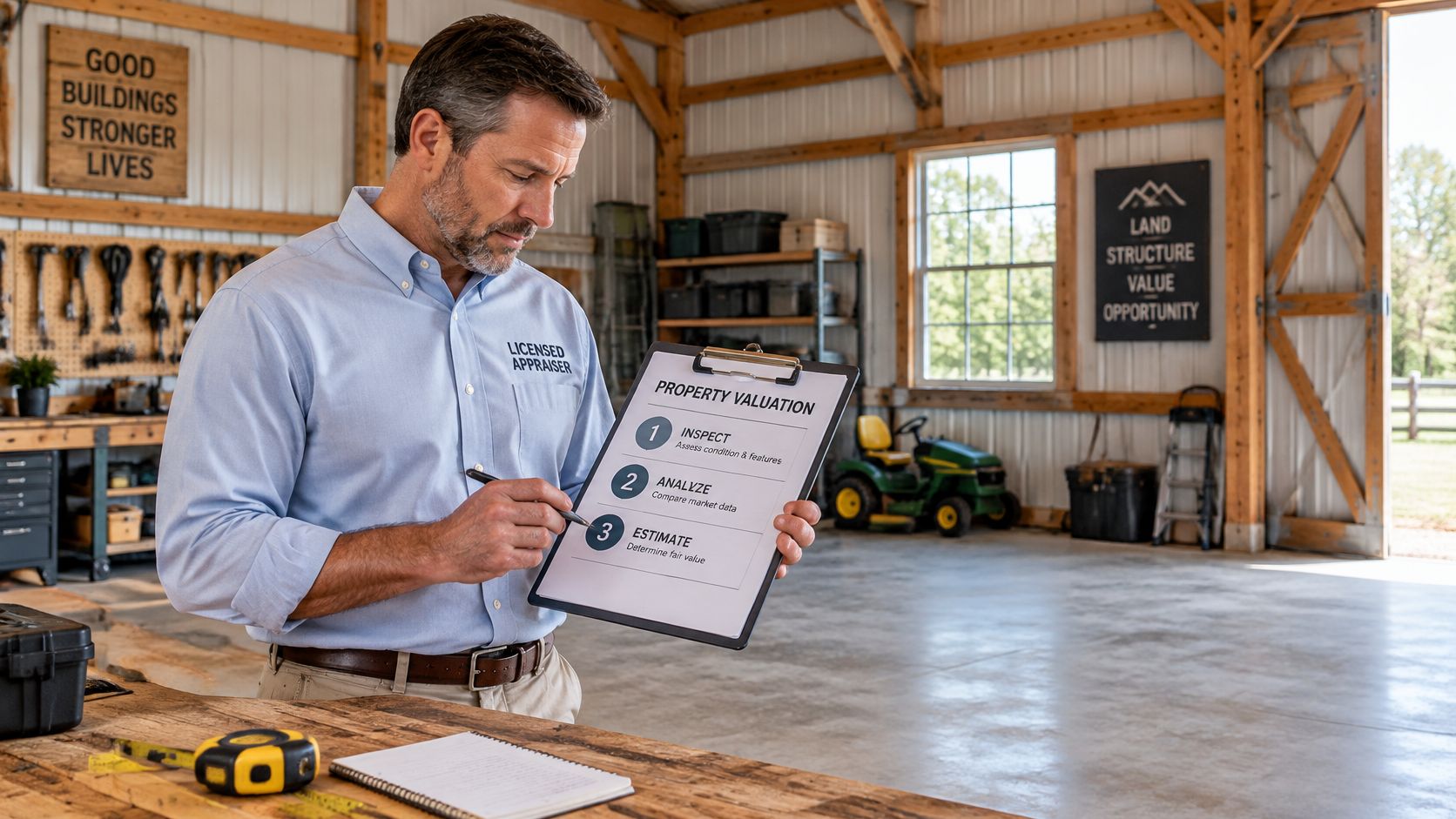
A credible appraiser tests the property's usefulness to buyers instead of assuming every construction dollar remains recoverable. The inspection should connect the barn's physical features with its legal use, condition, access, and place within the overall tract.
Start with cost, then account for lost usefulness
The Colorado Division of Real Estate's appraiser practice guidance describes cost analysis that considers replacement or reproduction cost and accrued depreciation. This is appraisal guidance, not a rule governing Texas property ownership.
The basic sequence is:
- Estimate the barn's current replacement cost.
- Add the relevant land value, while accounting consistently for other improvements in the overall property appraisal.
- Subtract accrued depreciation for physical deterioration, functional obsolescence, and external influences.
Physical deterioration includes problems such as corrosion, roof leaks, damaged siding, or foundation movement. Functional obsolescence concerns usefulness: a building may be sound yet have awkward bays, inadequate clearance, poor ventilation, or inconvenient vehicle access.
External influences concern circumstances beyond the building itself. The appraiser should explain any claimed effect rather than applying an unsupported reduction.
Specialized features can also be expensive without being valuable to the typical purchaser. Oversized electrical service may suit the owner's equipment, while a residential buyer may prefer ordinary storage and usable yard space.
Test the result against comparable sales
The appraiser should compare similar acreage, utility capacity, restrictions, condition, building functionality, and site layout. Adjustments should explain meaningful differences instead of treating every outbuilding as interchangeable.
Fannie Mae's appraisal guidance on improvements distinguishes minimal, atypical, and significant outbuildings; an atypical structure may receive little or no contributory value, while substantial barns or farm facilities can raise residential-versus-agricultural property questions. These lending-appraisal distinctions help explain why a well-built barn doesn't automatically command a matching premium.
If comparable Atascocita sales aren't available, the appraiser should disclose that limitation. Broader-area sales may be useful, but the report should explain their relevance and the adjustments made for location and property differences.
Prepare the property information before inspection
You can make the analysis more reliable without trying to influence the conclusion:
- Obtain records: Gather permit documentation and the tax improvement description.
- Verify recognition and use: Ask the appropriate authority about approvals and identify relevant deed restrictions.
- Document maintenance: Photograph roof damage, unfinished work, drainage concerns, and other defects.
- Confirm the effective date: Request a retrospective opinion when counsel needs a value for a date before the inspection.
A permit is evidence of approval for the work it covers, not a blanket assurance that every current use is lawful. Give the appraiser the underlying documents rather than a verbal assurance that everything was approved.
The finished report should distinguish replacement cost from market value, explain limited buyer demand, and identify the effect of incomplete construction or nonconforming use. It should also show how the barn's contribution fits within the total property value.
Evidence to Gather and Who to Hire
The strongest evidence is the evidence you can still reach. Keep original electronic files, download bank statements, and save dated photographs before repairs, equipment removal, or other changes make the barn's earlier condition harder to establish. A picture taken this month can settle a dispute about a leaking roof that a picture taken next spring cannot.
Pull the records below while you still have easy access to them, and note the date, the account holder's name, and the amount on each one. Those three details are usually where ownership and funding questions get answered.
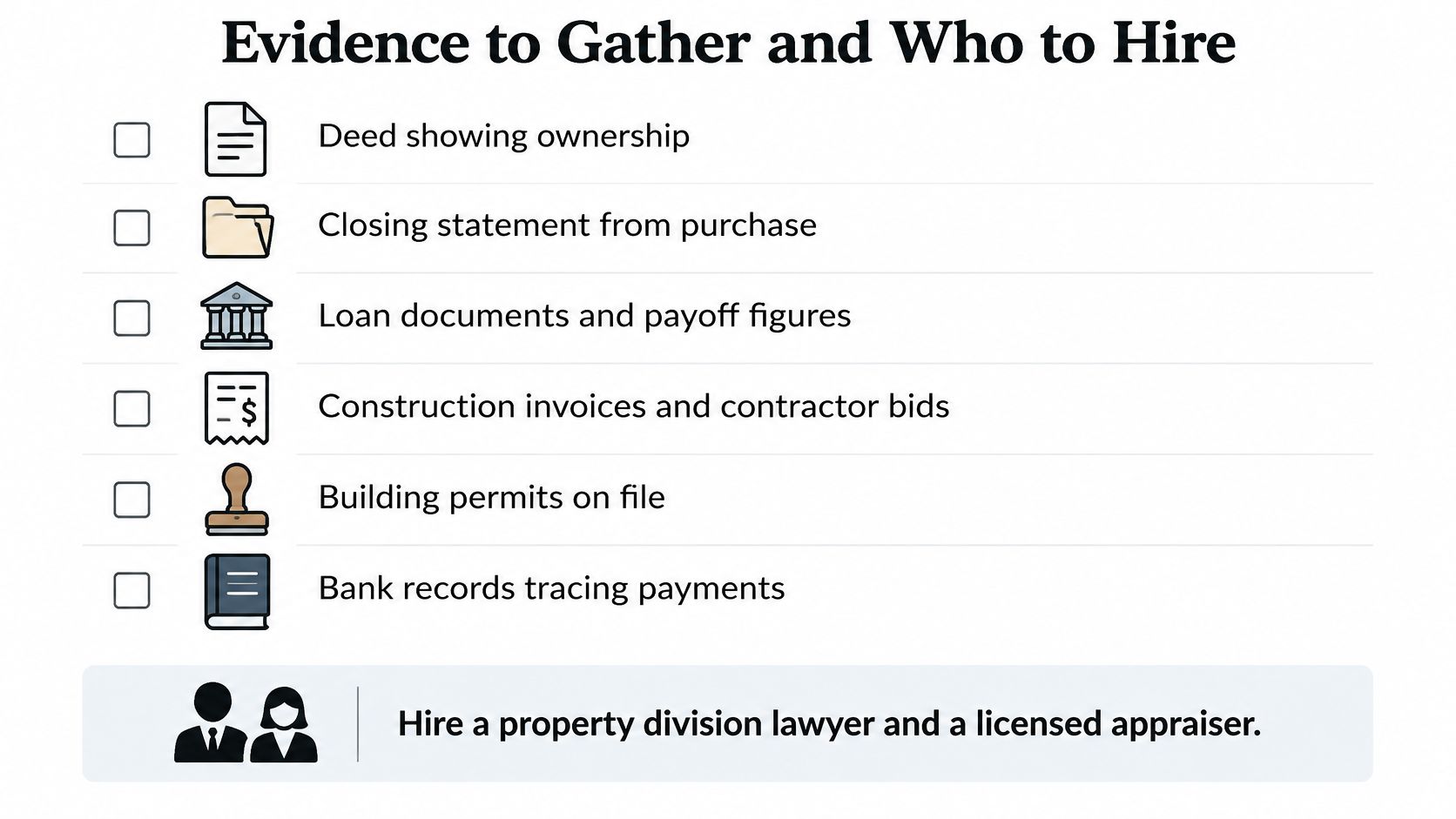
Evidence to gather and what each document proves
| Document | What It Proves |
|---|---|
| Deed and closing statement | Acquisition timing and ownership information supporting classification |
| Loan documents | Debt secured against the property and financing history |
| Construction invoices and bids | When and how the barn was built or proposed |
| Building permits | Evidence of approval and legal recognition for the work covered |
| Bank records | Which funds paid for construction |
| HCAD notices and protest file | Tax value, recorded characteristics, and disputed account information |
| Prior appraisal | Earlier valuation and property description to compare against |
A deed may fix the acquisition date while bank records show which funds paid for construction. No single record answers the whole ownership question on its own, so gather all of them even when one seems decisive.
When a spouse disputes ownership or funding, discovery is the formal process attorneys use to request relevant asset and financial information. Our attorneys write discovery requests and responses for that purpose, and they have negotiated, mediated, and litigated a wide range of family law and estate planning cases.
Choose expertise that fits the property
A Property Division Lawyer in Atascocita addresses division of community property and complex assets. The appraiser supplies a different kind of expertise: a supported valuation opinion. Before you hire one, ask:
- Local property experience: Have you valued acreage and outbuildings in northeast Harris County?
- Reporting detail: Can you identify land, residence, and barn contributions without double counting?
- Effective date: Can you provide a retrospective opinion if needed?
- Methodology: Will the report explain the approaches used and rejected?
Owners with animal facilities or additional acreage may also find our discussion of acreage and livestock in a divorce useful when organizing related assets.
Plan the fee and delivery schedule
Appraisal scope becomes more involved with additional acreage, multiple structures, and more detailed reporting requirements, so a basic residential appraisal quote may not cover litigation needs.
- Request the fee estimate and delivery date in writing before engagement.
- Schedule inspection access early.
- Allow additional preparation time for a retrospective opinion.
- Coordinate delivery with discovery and mediation deadlines.
Clarify whether the engagement includes revisions, attorney conferences, or testimony. Ask for a report that is ready for settlement discussions, not just a completed inspection.
How the Number Shapes Your Buyout, Offset or Sale
Once the ownership questions and appraisal are addressed, the next decision is practical: who keeps the property, and how does the settlement account for its equity? The barn's contribution affects that decision, but it usually isn't a separate pile of money to divide.
Consider a hypothetical settlement involving a home and two acres with $300,000 in net equity, including $19,000 attributable to the barn's enhancement. The enhancement is already inside the total equity. Adding it again would overstate the property's value.
Apply the value without counting it twice
In that example, an assumed equal allocation would assign $150,000 of equity to each spouse before considering other assets, reimbursement claims, or negotiated adjustments. That arithmetic is an illustration, not a prediction of what a Texas judge would order.
A supported reimbursement claim can affect the overall settlement analysis. Counsel should identify which marital estate made the contribution, which estate benefited, and how the claim will be handled rather than subtracting construction receipts from one spouse's share.

Settlement routes for a valued barn
| Route | How It Works | Role of the Appraisal |
|---|---|---|
| Buyout | One spouse keeps the property and pays the other's allocated share of equity | Supplies the value used to calculate payment alongside debt and settlement terms |
| Offset | The keeping spouse gives up other marital assets of agreed equivalent value | Must be detailed enough to support matching the assets offset |
| Sale | Property is sold and net proceeds are divided after debt and costs | Serves as a reference for pricing and valuation disputes |
A buyout may preserve a home base or workspace, but the spouse keeping it needs a workable payment and financing plan. An appraisal doesn't establish that a lender will approve financing or release either borrower from an existing obligation.
An offset may reduce the cash needed immediately. However, retirement funds, vehicles, and real estate don't necessarily have equivalent liquidity, tax treatment, or ongoing expenses, even when their stated values match.
A sale converts the property into proceeds but introduces decisions about preparation, repairs, access, pricing, and carrying expenses. The agreement should identify who handles those tasks and how disagreements will be resolved.
Settlement safeguard: Write down whether the barn's contribution is included in the overall value and how any reimbursement claim is resolved.
Make the agreement usable after mediation
A mediated agreement should identify the accepted property value, valuation date, debt figures, allocation method, payment terms, and treatment of disputed claims. Clear terms reduce the risk that spouses leave mediation with different understandings.
Our firm guides clients through mediation, facilitates discussions about asset division and child custody, and helps them reach mutually agreeable solutions. Related valuation issues can arise with other specialized property, including an Atascocita Shores waterfront lot in a divorce.
For complex assets, prepare a written list of the properties, debts, and disputed contributions before contacting our office. That gives the conversation a concrete starting point.
Schedule a Free Consultation Before You Value the Barn
The initial consultation with an Atascocita attorney is free. Bring the records you already have and ask how the workshop, barn, and underlying land should be evaluated before gaps are filled by guesswork. One question drives everything: what number would a buyer pay for the property as it sits, separate from what the barn cost to build or what the tax notice shows?
Our Atascocita office welcomes in-person consultations, and we serve residents of Atascocita, Humble, and throughout Harris County. You can contact the firm online or visit the office to arrange a time.
Bring the questions that affect your next decision
The document inventory is covered in Evidence to Gather and Who to Hire. For this meeting, focus on the choices and dates only you can supply:
- Your immediate concern: whether you hope to keep the home, need a buyout, or are considering a sale.
- Your deadline pressure: any pending mediation, proposed agreement, inspection, listing, or sale date.
- Your tolerance for dispute: whether classification, reimbursement, or the appraisal scope is likely to be challenged.
Ask which valuation date applies, whether tracing is necessary, and what scope of appraisal would help resolve the dispute. An initial assessment frames the questions to investigate and shows which records or appraisal work still have to be completed.
Before signing a property agreement or authorizing a sale, have counsel clarify classification, valuation, and any existing court restrictions. Preserve every document and photograph in the meantime, and avoid making irreversible decisions based on an unsupported estimate.
Pull the deed or latest closing statement first. It anchors ownership, legal description, and the timing questions that decide whether the barn is marital, separate, or mixed.
Law Office of Bryan Fagan – Atascocita TX Lawyers helps homeowners address property classification, appraisal questions, and settlement options involving detached workshops and barns. Visit Law Office of Bryan Fagan – Atascocita TX Lawyers to arrange your free initial consultation at the Atascocita office, and bring the deed first so the discussion can start with classification and dates.