Skip to content

You may have bought your Atascocita Shores waterfront lot with plans to build, retire near the water, or keep it for your children. Now you're facing divorce, and your spouse's proposed value looks nothing like yours. An online estimate, a tax assessment, and a neighbor's asking price may only make the disagreement harder.
Atascocita Shores waterfront lot valuation in a divorce starts with the land's supported market value, but the settlement turns on its divisible equity. Getting there takes more than attaching a price to a lake view. You need reliable sales, verified waterfront rights, current debt records, and a clear understanding of which ownership interests belong in the marital estate.
What a Texas Court Actually Divides on a Waterfront Lot
Does the lot have to be split fifty-fifty? No. Texas Family Code §7.001 and the community-property provisions require a “just and right” division rather than an automatic 50/50 split, and property acquired during marriage is generally presumed community property unless its separate character is proven.
Separate-property tracing is a document exercise, not a statement that one spouse supplied the money. The acquisition date, closing documents, source of the down payment, and records of later contributions help counsel determine what belongs in the divisible estate.
Start with equity, not the asking price
The working calculation is fair market value minus mortgage debt and other applicable encumbrances. Selling expenses require separate treatment because an actual sale and a spouse-to-spouse buyout aren't the same transaction.
Worked equity example for an Atascocita Shores lot
| Line item | Amount |
|---|---|
| Fair market value at valuation date | $400,000 |
| Less outstanding mortgage or liens | ($150,000) |
| Gross equity before selling costs | $250,000 |
| Less selling costs | Attorney-reviewed closing estimate if a sale is planned |
| Divisible equity after selling costs | Gross equity minus approved selling expenses, subject to ownership characterization |
This illustration assumes the equity belongs to the community estate. A separate-property interest or reimbursement claim needs its own legal analysis; it isn't automatically resolved by subtracting a receipt from the appraised value.
Community assets are generally valued at or near divorce, with judicial discretion when the valuation and division dates differ. Don't assume an appraisal prepared when you separated will remain suitable through trial.
For property division in divorce, assemble these records this week:
- Ownership documents: The deed and purchase closing statement.
- Debt evidence: A current mortgage payoff and lien records.
- Contribution records: Improvement receipts and statements tracing separate funds.
How to Value an Atascocita Shores Lot Step by Step
Give the appraiser a written assignment that matches the legal question. A mortgage appraisal, a sales presentation, and a report prepared for divorce may address different interests, assumptions, and dates.
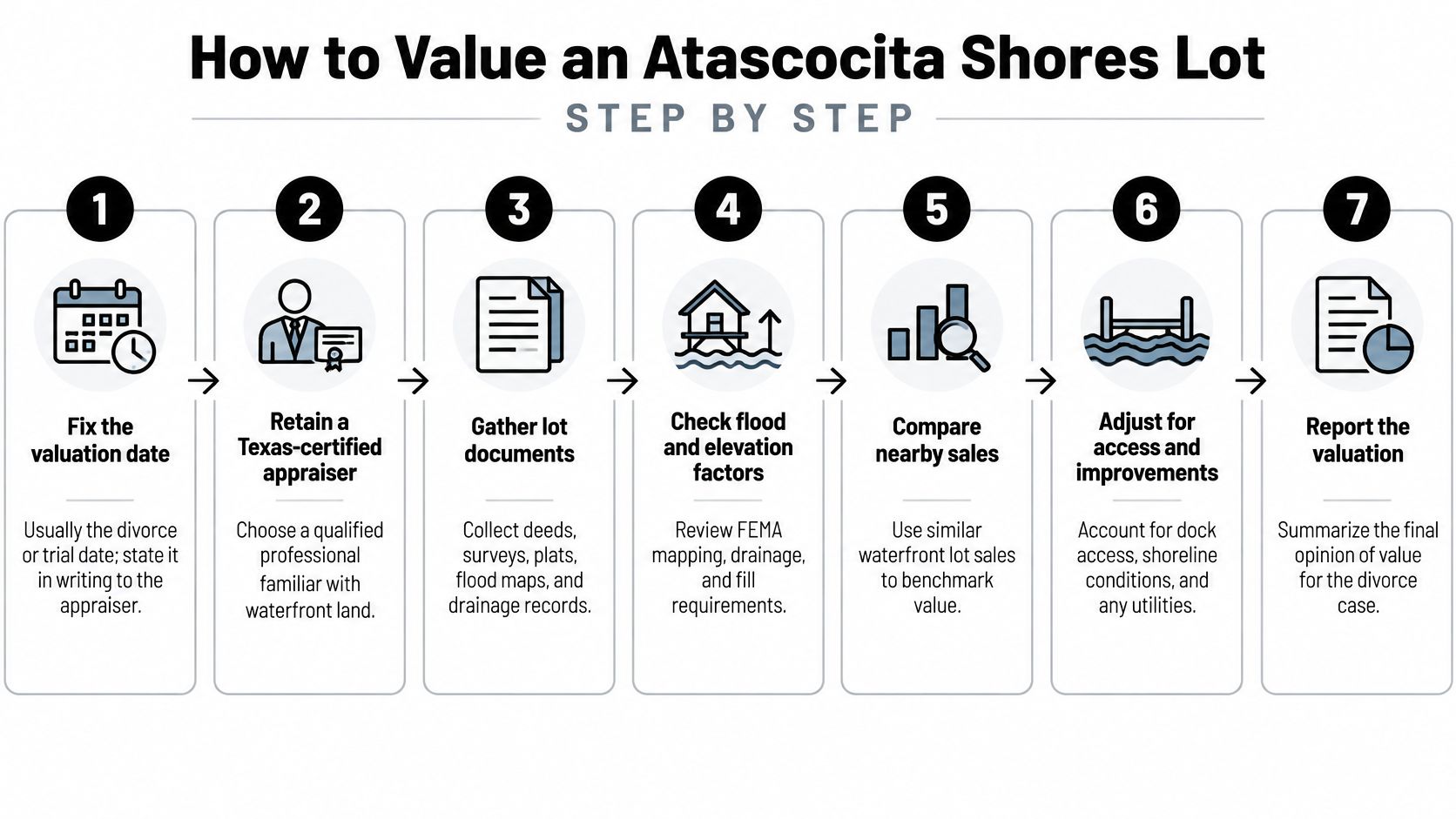
Use this process to organize the assignment and its supporting documents.
Define the assignment before ordering the report
Fix the valuation date. Counsel should identify the appropriate divorce or trial-related date and communicate it in writing. Ordering a report without that direction risks receiving a sound opinion for the wrong point in time.
Choose a Texas-certified appraiser with waterfront land experience. Ask about vacant-land assignments, shoreline adjustments, and the ability to explain the report under questioning. Familiarity with nearby houses isn't a substitute for understanding waterfront land.
Define the interest being valued. Identify fee-simple ownership, claimed separate interests, liens, easements, and marital improvements for review. The appraiser measures value; the attorney addresses legal characterization, so don't ask the appraisal to decide ownership rights by itself.
Inspect and verify the lot. Review dimensions, shoreline access, utilities, flood status, wetlands, restrictions, dock or bulkhead rights, and buildability. A drive-by inspection can miss a drainage easement or development constraint that changes what a buyer can do.
Build the opinion from comparable transactions
Select comparable vacant-lot sales. Start with transactions that offer similar waterfront utility, then explain any expansion into Humble or other nearby communities. Choosing nearby improved homes because vacant sales are scarce introduces house value into a land assignment.
Adjust the sales with market support. Address frontage, open-water versus canal exposure, lot size, view, elevation, access, improvements, and transaction timing. An unexplained percentage adjustment is harder to defend than a calculation tied to observable buyer behavior.
Reconcile the evidence into a supported value. Preserve the plat, MLS sheets, deeds, photographs, mapping, and adjustment calculations with the final report. The narrative should explain which transactions deserve the most weight, rather than merely averaging the adjusted prices.
The Texas appraisal practice materials preserved by the University of North Texas describe a general 24-month comparable-sale window in property-tax practice, with exceptions when too few sales exist to form a representative sample. That's a useful documentation benchmark, not an automatic evidentiary rule for every divorce appraisal.
A retrospective opinion needs a clear paper trail. Ask the appraiser to identify the historical market evidence used, explain any timing adjustment, and distinguish facts known on the effective date from later developments.
Report test: If the appraiser can't explain why each comparable is truly waterfront and offers similar usable rights, the report needs more work.
Flood, Dock and Access Factors That Move the Number
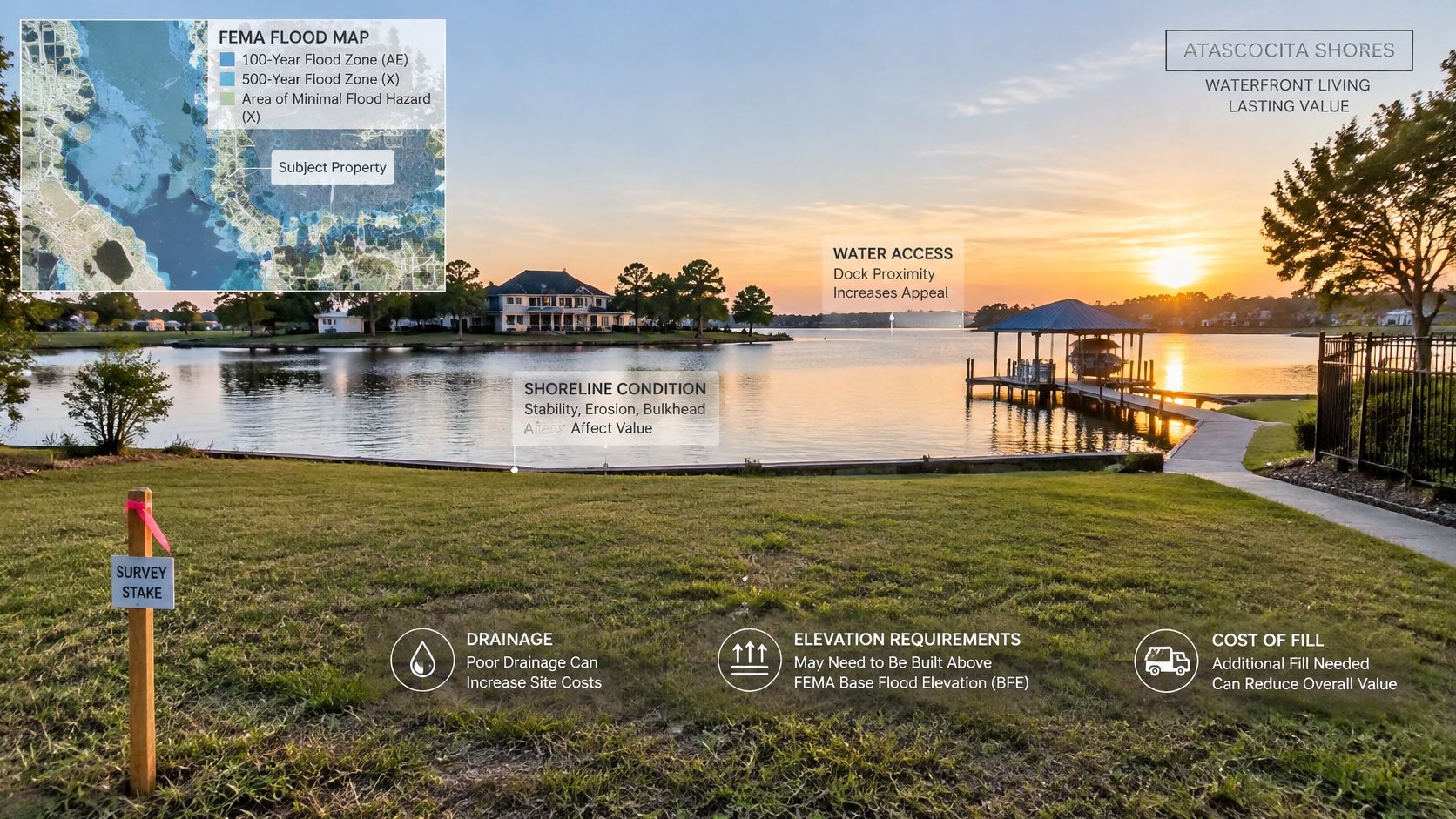
A waterfront view doesn't establish that a buyer can build, launch a boat, or replace a deteriorating dock. Check the physical conditions and legal permissions separately before assigning a premium.
The shoreline deserves the same scrutiny as the lot boundaries.
Match each constraint to evidence
Begin with FEMA flood mapping, drainage records, and available height information. If development requires fill, engineered drainage, or raised construction, obtain a written feasibility assessment and site-work estimate rather than assuming the land is ready to build.
Then review shoreline permissions, setbacks, deed restrictions, and easements. Have counsel verify claimed riparian rights, whether dock permission and shoreline access transfer with ownership, and whether association rules limit the proposed use.
- Physical condition: Photographs and contractor inspections establish bulkhead deterioration, erosion, clearing needs, and dock condition.
- Legal use: Recorded instruments and permit records establish what may be built or accessed.
- Financial feasibility: Written estimates help test whether a proposed improvement makes economic sense.
Separate present value from a proposed build-out
Consider a lot with a permitted dock and clear title compared with a canal lot that needs bulkhead repairs. The appraiser shouldn't apply the same waterfront adjustment to both merely because each touches water.
Ask for as-is value and, when supported, a separately identified opinion based on specified completed work. Don't deduct repair costs again if the comparable-sale adjustments already account for the same condition.
This video provides additional context for reviewing the property before negotiations.
The Texas Comptroller's property-valuation guidance explains that property-tax market value generally uses January 1 and recognizes highest and best use, so the Harris County Appraisal District figure isn't automatically the divorce value. A broker price opinion may help with listing strategy, but it doesn't replace a specialized appraisal addressing disputed waterfront assumptions.
Potential development value deserves scrutiny. A proposed subdivision or expensive build-out shouldn't be treated as achievable merely because someone drew a plan.
Every material constraint needs a documentary source, a supported cost estimate, or an explanation of why no adjustment is warranted.
Comparable Sales and Waterfront Adjustments That Hold Up
Adjustments for waterfront features in comparable sales
| Waterfront feature | Why it moves value | Evidence to collect | Adjustment direction |
|---|---|---|---|
| Direct lake frontage | Dock rights and open views | Plat, survey and shoreline photos | Upward against non-waterfront sales when supported |
| Protected cove frontage | Calmer water and mooring options | Exposure notes and shoreline mapping | Upward against less usable frontage when market evidence supports it |
| Canal frontage | Access limits and bulkhead maintenance | Canal permits and bulkhead condition | Downward unless comparables are canal lots, subject to market support |
| Water access only | Shared or easement-based use | Recorded easement and HOA rules | Downward against comparable direct waterfront ownership |
| Improved home sale versus vacant lot | Home value mixed into land price | MLS sheet and sale type | Separate the sales before adjusting |
Adjustment direction describes how the comparable's price is changed to reflect the subject lot. It isn't a guaranteed premium or discount, and cove frontage isn't automatically superior to open water.
Compare usable waterfront, not just waterfront labels
Use the sales-comparison approach as the primary method for this vacant-land assignment. Paired sales, where sufficiently similar properties differ in a relevant feature, can help support an adjustment; broader market evidence may be necessary when clean pairs aren't available.
For each sale, calculate:
- Adjusted price per front foot: Adjusted sale price divided by verified waterfront frontage.
- Adjusted price per square foot: Adjusted sale price divided by verified land area.
Reconcile those measures only after examining utility. A deep parcel with limited buildable area may look inexpensive per square foot while offering less practical use than a smaller parcel.
Texas appellate valuation disputes illustrate why supported market-value evidence and the timing of that evidence matter; the Thirteenth Court of Appeals decision concerning marital-property valuation is a useful reminder to prepare evidence counsel can defend, rather than a collection of online estimates.
Put listing statistics in their proper place
For market context, Realtor.com's Atascocita market information reported an Atascocita Shores median listing price of $399,900, compared with an Atascocita median listing price of $333,632, an implied neighborhood premium of approximately 19.9%. A separate Redfin snapshot reported 22 waterfront homes for sale in Atascocita and a $330,000 median listing price.
Those are listing snapshots, not closed vacant-lot transactions or appraisals. They don't justify transferring a neighborhood-wide premium directly to your parcel, particularly when the datasets include houses.
When comparable sales are thin, ask for a documented search showing geographic boundaries, property types, and reasons for exclusions. An older, well-matched waterfront transaction with a supported timing adjustment can be more useful than a recent sale with different rights.
Don't average unlike properties to create the appearance of agreement. Require the appraiser to explain which sale most closely reflects what a buyer would actually purchase.
Choosing a Buyout, Sale or Offset Split
Settlement options for a waterfront lot
| Option | Best fit | Who must act | Main risk |
|---|---|---|---|
| Buyout with cash or offset | One spouse wants the lot and can pay the other's share | Keeping spouse refinances or uses other assets | Loan approval and appraisal gap |
| Retain with deferred sale | Couple needs time or wants stable schooling | Both remain obligated on an existing joint mortgage until payoff or lender-approved release | Shared liability for taxes, insurance and upkeep |
| Sell and split net proceeds | Neither spouse wants to keep the lot | Spouses coordinate listing, closing costs and mortgage payoff | Market timing and selling costs |
| Offset against other marital assets | Lot traded for retirement or other property | Counsel and financial professionals value the offset assets | Tax effects and valuation mismatch |
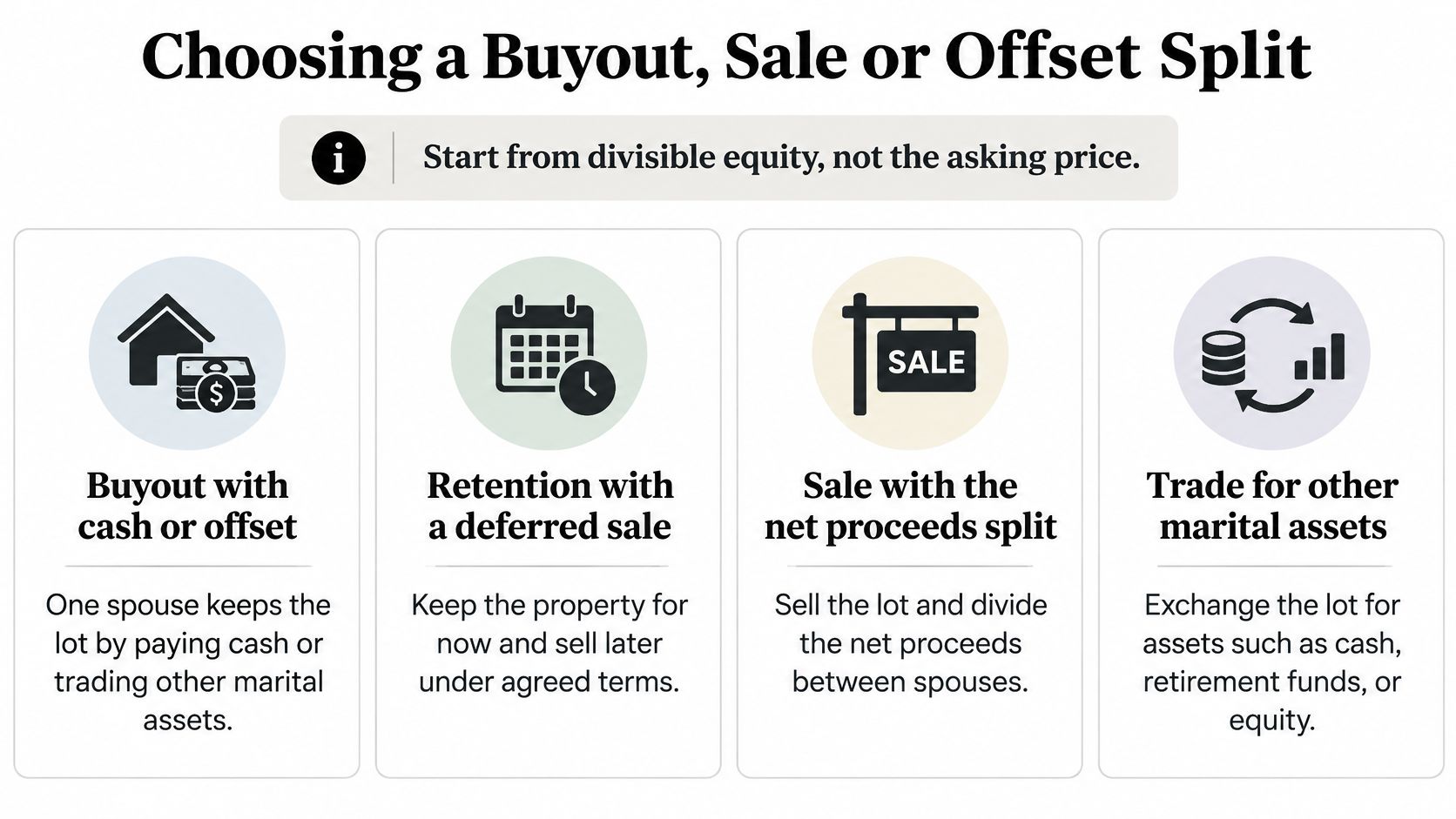
The available structure should fit your finances, not just your preference for keeping the land. Texas Family Code §7.001 allows a just-and-right division of the overall marital estate, which can support awarding the lot to one spouse with other property allocated to the other, or a sale with proceeds divided.
Test the settlement with net-equity math
For illustration only, assume a $400,000 appraisal, $150,000 debt payoff, and hypothetical selling costs of 6 percent, or $24,000. That produces $226,000 in net equity; under a hypothetical 60/40 allocation, the non-keeping spouse's forty-percent share would be $90,400.
Those percentages aren't a forecast of the court's decision or a statement of local selling charges. Replace them with the actual proposed allocation and a transaction-specific closing estimate.
For a buyout, counsel should also address whether hypothetical selling costs belong in the calculation when no sale is planned. Do not import sale expenses into a retention agreement.
Use this comparison to evaluate the practical commitments behind each option.
Choose terms that can actually be performed
A spouse planning a future home near the children's school may prefer retention, but a vacant lot doesn't itself provide housing. Test the combined cost of the buyout, ongoing expenses, and any future construction before sacrificing liquid assets.
A sale may offer a cleaner break when neither spouse wants to develop the property. Deferred sale can provide breathing room, but the agreement should identify who pays carrying costs, approves repairs, chooses the broker, and authorizes price changes.
An offset involving retirement assets needs more analysis than matching account balances against land equity. Consider taxes, accessibility, and the transfer documents before calling the exchange equivalent.
Use divorce mediation in Atascocita to compare complete proposals rather than negotiating the lot's price in isolation. The practical liability test is straightforward: Which option ends unwanted joint debt exposure soonest and leaves each spouse with manageable cash flow?
Experts, Evidence and Recording the Final Order
Start the expert engagement with an assignment letter naming the effective date, the interest being valued, and the relevant transactions to review. Counsel should frame the legal question without directing the appraiser toward a preferred result.
If the opinion is retrospective, require the appraiser to preserve the historical evidence and explain the adjustment method. The attorney should be able to trace the conclusion back to documents, not just to an expert's confidence.
Assign responsibility before the work begins
Resolve the appraisal arrangements before authorizing the assignment:
- Confirm the fee and payment responsibility. Include the potential cost of updates, testimony, and responding to challenges.
- Choose joint or separate experts. A jointly selected appraiser may narrow disagreement, while separate experts may be appropriate when assumptions or interests are disputed.
- Plan for conflicting conclusions. Ask the experts to identify whether the gap comes from different dates, comparables, rights, or conditions before commissioning more work.
Discovery should seek account statements, loan records, improvement receipts, and tracing documents. A receipt proves an expenditure, but it doesn't necessarily prove an equal increase in market value.
For parcels with private utility systems, coordinate the land assignment with septic-system and water-well valuation in an Atascocita divorce. The appraiser should know whether the system is usable, permitted, and already reflected in the comparable adjustments.
Our divorce attorneys have local experience with the courts, judges, and legal system of Atascocita and surrounding counties. That familiarity helps counsel frame the expert's findings clearly for mediation or trial without treating an online estimate as equivalent evidence.
Finish the transfer in the real-property records
Under Texas Family Code §3.412, an order affecting real property isn't constructive notice to a good-faith purchaser for value or a creditor without actual notice unless recorded in the county deed records. Counsel should coordinate recording the relevant certified order and transfer instruments in Harris County.
The title company and lender should address payoff, refinancing, liens, title insurance, and any required special warranty deed. Confirm association obligations and taxes as part of that process.
Recording doesn't remove a spouse from the mortgage. A title transfer and a lender's release are different steps, and the decree should address what happens if refinancing or payoff fails.
Before trial or final settlement, confirm:
- Valuation date fixed: The report answers the correct time-specific question.
- Report defended: Counsel can explain the assumptions and adjustments.
- Recording plan written: Each required document has a responsible person.
Book a Free Consultation Before You Negotiate
Before signing a settlement, take these concrete actions:
- Gather the records: Bring the deed, mortgage statement, improvement receipts, and any documents supporting separate-property contributions.
- Write down the assignment: Confirm the appraiser's valuation date, ownership interest, and scope.
- Compare complete outcomes: Evaluate buyout, temporary retention, and sale proposals against divisible equity and continuing obligations.
You don't need to resolve every disagreement before seeking legal guidance. Bring the competing numbers and identify what each person wants to do with the lot. A consultation can help clarify which missing document or expert opinion needs attention first.
Choose the next step that matches your situation
The Divorce Lawyer in Atascocita, TX page describes divorce representation for clients in Atascocita and Harris County. Couples who already agree can review the Uncontested Divorce Lawyer in Atascocita page for information about handling an agreed divorce.
For an overview of filing and the stages that follow, The Divorce Process in Atascocita: What to Expect provides a step-by-step look at divorce in Atascocita and Harris County.
The initial consultation with an Atascocita attorney is free. You can contact the firm online to schedule or visit the Atascocita office for a consultation. The firm serves residents of Atascocita, Humble, and throughout Harris County.
This is a difficult financial and personal decision. You deserve to understand the land's usable rights, supported value, and remaining obligations before agreeing to a number.
Law Office of Bryan Fagan – Atascocita TX Lawyers offers divorce guidance on property division, including the evidence and settlement terms needed to address a waterfront lot. Visit Law Office of Bryan Fagan – Atascocita TX Lawyers to schedule a free consultation at the Atascocita office, and bring your deed, debt records, and any existing appraisal so you can discuss the next practical step.