Skip to content

Say you and your spouse bought a home on a larger lot near Atascocita or Humble, outside a municipal water line. The taps work. The pressure tank is old, the last lab test is years out of date, and the driller's log is missing. One of you wants to keep the house. The other is holding a pump invoice and a settlement draft that lists the well as one checkbox.
That checkbox hides several pieces. A private well works like a small utility bolted to the lot: the pump and tank, any easement that lets someone reach the well, the water interest tied to the land, and the repair bill that shows up after the decree. Each piece can change the dollars attached to the house.
An Atascocita home on well water disclosure in a property division is how those pieces get named before anyone signs. The old tank is equipment someone will own or replace. A missing log leaves a gap in the paperwork. Depth and yield stay unknown until a document supplies them. A stale water test points to a cost that belongs in the settlement math, next to the invoice already in hand.
Whether a Well Changes Who Gets the House
Texas courts characterize, value, then divide. Characterization decides whether the house, and each interest tied to the well, is community property or separate property. Valuation assigns dollars to what the title and the equipment include. Only then does the court divide the community estate.
Under Texas Family Code §7.001, that division must be one the court considers "just and right," taking account of both spouses and any children. The standard is not an automatic 50/50 cut of every asset.
A private well is a bundle, not a single box on a form. The pieces sit together but move different settlement numbers: the pump, tank, and treatment equipment; an easement that lets someone else reach a line; groundwater rights that were kept, leased, or conveyed; and the repair liability that follows whoever keeps the house. A tested, working system can raise the home's value. A severed water interest or a shared easement can shrink what ownership includes. A failing pump can become debt, an offset, or a reason one spouse takes cash or other property instead of the house.
A home bought during marriage is generally community property, and property either spouse possesses during the marriage or at dissolution is presumed community. A spouse who claims the home, the land, or one of those well interests is separate property must prove it by clear and convincing evidence. Useful proof includes the purchase contract, closing disclosure, title records, construction invoices, well permits, inspection reports, maintenance records, water-quality tests, and repair bills. Thin paperwork usually leaves the community presumption in place.
Does the well change the division? Quick answers
| Question | Short answer | Where it is decided |
|---|---|---|
| Is a home bought during marriage community property? | Usually yes, unless separate property is proven | Characterization under Texas Family Code §3.003 |
| Does a well disclosure decide who owns the home? | No, it is evidence of condition and value | Tracing and documentation of the property |
| Can the well change the home's value? | Yes, if it is working, tested and documented | Valuation and settlement negotiation |
| Can community money spent on pump or treatment work be repaid? | Possibly, if it benefited a separately owned home | Reimbursement claim against the benefited estate |
| Must the home be split 50/50? | No, the court divides the estate in a just and right manner | Court's equitable division |
One spouse can receive the house while the other receives assets of similar value, or community spending on a pump can support a claim against a separate estate. Our overview of property division in divorce shows how courts and spouses balance those pieces across the whole estate. The claim still rises or falls on clear and convincing proof of what is separate, and on documents that show what each piece of the well is worth.
Disclosure Duties in Divorce and Home Sales
Buyers and sellers meet the Seller's Disclosure Notice at closing, which is usually the first time the well is written down. The Texas Seller's Disclosure Notice asks whether water comes from a well and whether the property lies in a groundwater or subsidence district. That box looks small. In a divorce, the date on the form can show what was known, and when.
A separate water-rights disclosure goes further. It covers known wells, who owns and operates them, access agreements, permits or registrations, and groundwater rights that have been severed, sold, or leased. Those details matter in northeast Harris County, where one parcel can include a house, a well, an easement for a neighbor's line, and water interests that do not all belong to the same person.
The notice works like a dated photograph of the property, not a single checkbox labeled "well." Each line is a separate piece of the bundle, and each piece can move the settlement number on its own.
What each setting requires
Texas Property Code §5.069 addresses water availability in certain executory-contract transactions and requires disclosure of whether the property has water service providing potable water. Misleading or deceptive information may create statutory remedies, including cancellation and refund rights in the circumstances that section covers. That statute applies to the transactions it names. The duty still depends on the transaction, property type, and facts, so it is not a blanket rule that every residential seller must provide the same standalone well form.
| Setting | What must be disclosed about the well | Risk if it is wrong |
|---|---|---|
| Residential home sale (Seller's Disclosure Notice) | Whether water comes from a well; whether the property is in a groundwater or subsidence district | Buyer claims and disputes after closing |
| Water-rights disclosure (TREC) | Known wells, ownership and operation, access agreements, permits or registrations, severed or leased groundwater rights | Severed water interests surface after the sale |
| Executory contract (Texas Property Code §5.069) | Whether the property has water service providing potable water | Cancellation and refund rights where information is misleading |
| Divorce inventory and settlement | Well equipment, easements and water interests listed as marital or separate assets | Incomplete sworn information may be challenged after the decree |
An exception is worth checking carefully. A separate water disclosure is not required when the seller is unaware of any well, water rights, or related water features and the home receives water solely from a listed utility. Confirm what the seller knew before relying on that exception. A capped, unused, shared, or off-site well can exist even when the kitchen tap is on city water today.
Why divorce disclosure is a different problem
In a divorce, each spouse lists assets in a sworn inventory and signs a settlement that a court turns into a decree. Leave a shared well, an easement, or a known failed test off that inventory, and the other spouse may later challenge the division or say the bargain rested on incomplete information.
Each missing piece changes the math differently. Omit a failed pump, and the inventory overstates equity by the replacement cost. Omit an access easement, and the home looks unrestricted even though a neighbor may already have a right to cross the lot. Omit a severed or leased groundwater right, and the decree can award the house while the water stays with someone else. A known repair belongs on the same list, because that bill has to be assigned to one spouse or divided between them.
Dated documents sort the timing. A disclosure, inspection report, laboratory result, repair invoice, or notice of inadequate flow may show that a condition existed before or during the marriage. A failed pump, contaminated test, dry well, missing permit, or required connection to a municipal system can mean a lower value or a capital expense the decree should assign.
If a spouse says the well was never mentioned, compare the sale file and the seller's notice side by side. Couples who already agree on the other issues can work with an Atascocita uncontested divorce lawyer to craft a fair, enforceable agreement that still names the well equipment, any easement, and any water interest. Agreement does not fill in a missing well record.
Practical rule: If the answer on a form and the facts on the ground differ, correct the record before anyone signs.
Valuation turns on whether the system works, is documented, produces enough water, and needs replacement soon.
How Ownership and Upkeep Shape the Split
A spouse inherited a semi-rural lot near Humble years before the wedding. The deed may keep that land as separate property. During the marriage, community funds paid to deepen the well and install filtration. A neighbor holds a recorded easement to reach a shared wellhead. Calling all of that "a house with a well" skips the question that moves the settlement: which piece belongs to which estate, and who pays for what is already worn out.
A private well is a bundle of divisible pieces. Assign a value only after you separate those pieces.

The parts inside the bundle
- Land title: Who holds the deed, and when did they acquire it?
- Well casing, pump, pressure tank, and treatment equipment: What's physically installed, how old is it, and who paid for it?
- Water-use agreements: Does a neighbor share the well, or do you share theirs?
- Groundwater ownership or leases: Has anyone severed, sold, or leased the water interest apart from the surface?
- Access easements: Who may enter the lot to service the well, and along what route?
- Repair liabilities: What work is already needed, and who's responsible for paying?
One Atascocita home can hold every item on that list in a different ownership category at the same time. Title answers who owns the dirt. Equipment invoices answer who paid for the pump and the tank. A water-use agreement or a groundwater lease can send the economic benefit of the water to someone who does not hold the deed. An access easement decides who may cross the lot. A repair bill decides which spouse leaves with a future expense. Each document changes a different number on the property spreadsheet.
District rules sit on top of those documents for many local parcels. A Harris-Galveston Subsidence District well permit in a divorce can change what you are dividing when the lot falls inside that district's permit system. The firm's divorce attorneys have local experience with the courts, judges, and legal setting of Atascocita and surrounding counties, which matters when the deed, the permit, and the contractor file sit in different offices.
Upkeep is not the same as a capital improvement
Replacing a filter cartridge or paying a routine service call is ordinary household upkeep. Drilling a new borehole, replacing a submersible pump, or installing a full treatment system changes the property in a lasting way. The account that paid is the fact that matters. Texas law recognizes a reimbursement claim when property from one marital estate benefits another and failure to repay would result in unjust enrichment, under the Texas Family Code provisions on marital property and reimbursement.
Courts do not treat that claim as a running total of every dollar spent. They apply equitable principles and may offset competing claims. Inspection reports and contractor descriptions, dated and tied to a payment source, show whether the work kept the home habitable or was elective.
For every well expense, ask one question. Which part of the bundle is this, who paid, and when?
Documenting and Valuing the Private Well
One spouse agrees to keep the Atascocita house. Months later the pump fails, a neighbor's line crosses the lot, and the closing file never said who owns the tank or who pays to fix the water. A guess about a well tends to favor whoever keeps the house and finds the repair bill later. The well works like a small inventory, not one disclosure box: equipment, any easement, the water interest, and the repair liability. Each piece needs its own paper, and each paper moves a different number in the settlement. Gather the file in this order. Do not price the system until that paper is in hand.
Eight steps to build the well file
- Pull the deed, closing statement, and title policy. Confirm who owned the home and when. These documents anchor the characterization analysis.
- Locate premarital deeds or inheritance papers. If either spouse claims separate property, these records, plus bank tracing, carry the burden of proof.
- Collect the driller log, permits, and district records. Look for groundwater or subsidence district files, and in Harris County check whether the lot falls in the Harris-Galveston Subsidence District area.
- Order a water-quality test and a flow test. Use licensed providers and an accredited laboratory, and keep the signed reports with dates.
- Gather invoices and bank statements for every well expense. Separate ordinary upkeep from capital work, and note which account paid each bill and when.
- Photograph the pump house, pressure tank, treatment equipment, and wellhead. Record where each item sits on the lot, and note any shared lines crossing a boundary.
- Request well documents from your spouse in writing. If records don't come voluntarily, use formal discovery so there's an enforceable deadline.
- Have your attorney write well responsibilities into the decree or sale agreement. Assign testing, repairs, disclosure corrections, sale costs, and indemnity by name.
Texas guidance states that a seller must disclose whether a well exists and its condition, and private-well sale information should address the water and sewer service serving the parcel, as the Texas Groundwater Protection Committee FAQ on buying property with a private water well explains. For valuation, obtain the well record or driller documentation, depth and pump setting, flow or yield test, pressure-tank and pump age, electrical demand, maintenance history, water-quality laboratory results, treatment equipment, and any documented bacterial, nitrate, salinity, iron, or other contaminant findings.
The firm's attorneys handle every divorce step, from jurisdiction and filing through negotiation and finalization, so the well file is built with the rest of the property record rather than after mediation. The guide to septic system and water well valuation in an Atascocita divorce goes further on pairing these two systems, which often serve the same lot.
How each record moves the settlement number
| Evidence | What it shows | Effect on value or settlement |
|---|---|---|
| Well log or driller report | Depth, casing and pump setting | Confirms a documented, functioning system |
| Flow or yield test | Gallons per minute and whether household demand is met | Low yield lowers appraised value |
| Pump and pressure-tank age | Remaining service life and likely replacement timing | Replacement cost is credited or discounted |
| Water-quality lab results | Bacteria, nitrate, iron, salinity and other contaminants | Treatment cost or contamination discount |
| Treatment equipment records | Age, service schedule and operating condition | Asset to inventory and value, or a repair liability |
| Permits and district records | Legal status of the well and the parcel | Missing permits may require correction before sale or award |
| Shared access or easement | Who may use the well and under what terms | Affects marketability and buyer interest |
Read the table as four ledgers. The log, pump age, and treatment records price the equipment. The easement row prices shared use. Permits speak to the legal water interest. Lab results and a weak yield price the repair liability. A failing pump, inadequate yield, contaminated water, or required treatment can reduce marketability and create immediate repair costs. A functioning system with reliable testing supports the appraised value. Those outcomes change buyer due diligence and the net equity credited to each spouse.
Physical condition and legal title to groundwater are separate questions, and each needs its own document.
Get replacement quotes from two licensed contractors. Two independent figures are far more defensible in negotiation than one estimate a spouse obtained from a friend.
Once those quotes sit next to the tests, the decree can name who pays for testing, who completes repairs, who corrects any disclosure, who bears sale costs, and who indemnifies the other if a claim surfaces later. If one spouse keeps the home, that language matches the inventory to a person. If the home will be sold, it tells the listing agent and the buyer which pieces of the system are being conveyed, and in what condition. Language such as "spouse keeps the house as is" leaves the equipment, the easement, the water interest, and the repair bill unpriced, and that is where post-decree disputes start.
Reimbursement Claims and Settlement Options
One spouse will keep the Atascocita house. The other wants cash. The draft lists the private well as a single included item. That shorthand hides four separate pieces, and each piece changes the payment.
Equipment is the pump, tank, and treatment gear. An easement is the right to reach the well, sometimes shared with a neighbor. A water interest is its own legal claim. Repair liability is the bill that follows whoever takes the house. Those four lines work like items on a closing statement. Price each one, then pick a structure that can actually pay the bottom line.
Four ways to settle the well
Buyout with an equalizing payment. One spouse keeps the house and pays the other from savings, other assets, or a refinance. Cash on hand and loan qualification decide whether the deal holds. A lender may also ask how the house gets water. A weak yield or a shaky shared easement can shrink the refinance even when the spouse who stays wants the property.
Sale with a net-proceeds split. The house is sold, and the proceeds are divided after credits for well repairs needed to close. Market timing and selling costs come off the top. Neither spouse keeps an unknown system. A shared easement that worries buyers lowers the price for both people, not only for the spouse who hoped to stay.
Award with a holdback or escrow. One spouse keeps the house while cash is set aside for a known repair, such as a pump near the end of its service life. That money stays parked until the work is finished and the invoice is in the file. The delay is the cost of not guessing at a repair that is already identified.
Offset against other community property. Community money spent on a house one spouse owned before marriage can be credited against retirement accounts, vehicles, or other assets. No new check has to be written on closing day. The offset only survives if tracing shows which account paid and what the payment bought. Thin tracing shrinks the credit, and those other assets stay put.
How two credits cancel
Take a pump replacement paid with community money and mortgage principal paid on that same house. The court can net the two claims rather than awarding both in full. If the mortgage credit is larger, the pump credit reduces it. If the pump credit is larger, the mortgage payments reduce that figure instead. One number, not two stacked awards.
Put the well on the same page before anyone locks an equity figure in mediation. Equipment value is one line. The easement's effect on what a buyer would pay is another. A water interest is its own line. Repair liability is a subtraction from the spouse taking the house. The buyout, the sale split, the escrow holdback, or the retirement offset is only the total of those lines. An appraisal that assumes a sound well will overstate the equalizing payment if a low-yield result is still in a drawer. Correcting that total after a draft is circulated costs goodwill, and often more attorney time, than setting the pump credit against the mortgage credit at the first session.
Schedule a Free Consultation Before You Sign
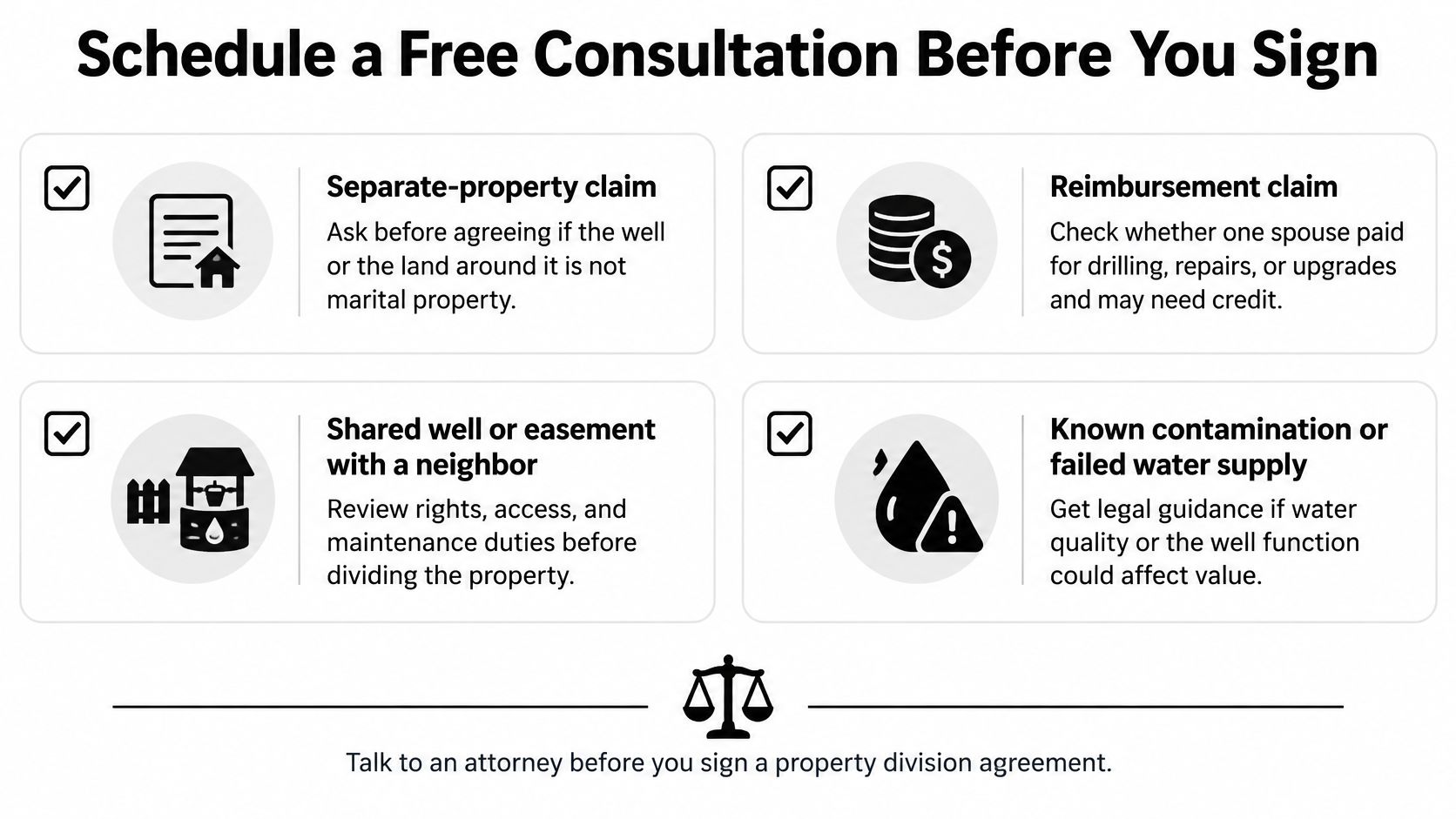
Some well issues you can document on your own with a folder and a few phone calls. Others call for an attorney before you sign anything, because the decree language will be hard to change later. Treat these situations as your checklist.
- Separate-property claim: One spouse says the home, land, or well isn't marital property.
- Reimbursement claim: Community money paid for drilling, a pump, or treatment on a separately owned home.
- Shared well or easement: A neighbor uses the well, or you rely on a well located on someone else's lot.
- Contamination or a failed test: A lab result, dry well, or inadequate flow could change the home's value.
- Pending sale or buyout: A buyer, lender, or appraiser will ask questions your file should already answer.
- Suspected nondisclosure: You believe a well, defect, or water interest was left off an inventory or settlement draft.
The experts who support the legal work
A licensed water well driller or pump contractor can assess physical condition and provide replacement quotes. An accredited laboratory produces water-quality results a buyer or court can rely on. An appraiser with rural or well-property experience understands how yield and documentation affect market value in northeast Harris County. A forensic accountant helps when bank tracing is needed to prove which estate paid for what.
Your attorney coordinates these experts so their reports arrive in time and fit the decree. A lab result without decree language assigning treatment costs solves only half the problem. A contractor quote without a holdback provision leaves the spouse keeping the home to absorb a cost both spouses knew about.
If any item on the checklist fits your situation, we'd welcome a conversation before you sign. The initial consultation with an Atascocita attorney is free. You can reach our Atascocita office at 281-519-3083, and our listed office address is 7702 FM 1960 Rd E, Suite 212, Humble, TX 77346. For more on dividing community property and complex assets for Atascocita divorces, see our Property Division Lawyer in Atascocita page.
If you're dividing an Atascocita or Humble home served by a private well, the Law Office of Bryan Fagan, Atascocita TX Lawyers can help you document the well, value it correctly, and write settlement terms that assign repair and disclosure duties clearly. Visit Law Office of Bryan Fagan – Atascocita TX Lawyers to schedule your free consultation and talk through your property division before you sign.