Skip to content

You're gathering divorce paperwork, and the Walden waterfront lot you once planned to build on has become a point of disagreement. You remember what you paid. Your spouse points to a listing down the street. Neither number tells you what equity belongs in your settlement.
Walden on Lake Houston waterfront lot valuation in a divorce starts with the parcel's actual rights, condition, and market evidence. For homeowners in Atascocita, Humble, and northeast Harris County, the practical task is to turn those facts into a documented number, then decide whether keeping the lot makes financial sense.
Net Equity Schedule for a Waterfront Lot
Say a Walden couple both assume their lot is still worth its purchase price. Once they begin preparing their property inventory, they discover that the useful settlement figure isn't the original cost. It's the supported value of the interest being divided, reconciled with the debt and any appropriate adjustments.
The Best Lawyers discussion of Texas inventories and appraisements illustrates the basic calculation: a $600,000 market value less a $250,000 lien leaves approximately $350,000 in gross equity before transaction costs. That's an example, not a valuation of your Walden parcel.
Build a document-backed calculation
Start with a dated appraisal identifying the lot and its effective valuation date. Keep Harris County appraisal information in the file for comparison, but don't substitute it for the market analysis.
Next, request a lender payoff letter. A monthly statement may show principal without identifying everything required to release the lien. Label the payoff's expiration date so nobody treats an expired figure as current.
Then identify documented repairs or compliance work. The important question is whether the appraiser has already accounted for those conditions. Don't subtract a bulkhead problem twice, once through a lower appraised value and again through a separate repair deduction.
Net equity schedule for a Walden waterfront lot
| Line item | Example amount | Document to keep |
|---|---|---|
| Indicated fair-market value | $600,000 | Dated appraisal tied to the valuation date |
| Less mortgage or lien payoff | -$250,000 | Current payoff letter from the lender |
| Gross equity before repairs | $350,000 | Subtotal from the two lines above |
| Less documented repairs or compliance costs | Subtract supported costs not already reflected in value | Bulkhead bids, permits, engineer letter |
| Less selling costs, sale scenario only | Subtract documented proposed sale expenses | Listing agreement and estimated closing costs |
| Net equity for division | Gross equity less applicable, nonduplicated adjustments | Figure weighed with the parties' other assets |
The table uses the hypothetical amounts in the inventory example, not current local sales evidence. Leave unsupported deductions out of the calculation rather than inserting a guess.
Separate a sale from a retention scenario
If a spouse will keep the lot, prepare a retention calculation. If the proposed settlement requires a sale, prepare a sale calculation with separately identified commissions and closing expenses. Hypothetical selling expenses shouldn't reduce the retention figure.
Practical rule: Every deduction needs both a supporting document and an explanation of why it belongs in that settlement scenario.
The inventory should also identify the address, legal description, mortgage information, and ownership interest. That prevents an accurate calculation from being attached to the wrong parcel or an incomplete interest.
Before negotiating, reconcile the documents. The appraisal and payoff letter won't show the same amount because they measure different things, but the inventory must reproduce each correctly. Resolve mismatched parcel descriptions, outdated balances, and unexplained adjustments before anyone makes a buyout offer.
Prove Which Assets Are Community Property First
An Atascocita couple bought a waterfront lot before marrying, then rebuilt the dock during the marriage. The original ownership interest and the money spent on the dock raise separate questions.
Property possessed by either spouse at divorce is generally presumed to be community property. Property acquired during marriage is generally community property unless it qualifies as separate property under the Texas Family Code's marital-property provisions. A spouse claiming the Walden lot, or an interest in it, is separate property must support that claim with evidence.
Tracing turns on when and how the ownership interest was acquired, and whether the records support that account. A deed is relevant, but it may not show the source of the purchase funds or the character of later contributions.
Follow the money, not just the deed
Marital payments toward taxes, debt, or improvements do not automatically change separate real estate into community property. They may raise a reimbursement issue, which requires a different analysis from ownership. Keep each type of payment distinct.
Gather records that connect the ownership claim to the source of funds:
- Acquisition records: The deed and closing statement showing what was purchased and when.
- Funding records: Bank statements tracing the down payment.
- Debt and carrying records: Loan statements and property-tax records.
- Improvement evidence: Dock, bulkhead, utility, and construction invoices, along with payment records.
- Separate-fund documentation: Gift or inheritance records and account statements connecting those funds to the purchase.
The firm's property division representation in divorce addresses how ownership claims fit into the broader division of property.
If records are missing, request archived statements and closing documents early. An appraisal can establish value, but it cannot prove that funds used to acquire the lot were separate property. A clear tracing file helps distinguish the lot's ownership history from later spending that may require a separate reimbursement analysis.
Pick the Valuation Date the Court Will Use
A lot worth $300,000 when the case began and $375,000 near trial creates a $75,000 gap, or about $37,500 per spouse before debt, property characterization, and other assets. The Texas Family Law Practice Manual discusses this kind of valuation-timing issue in its discussion of valuation timing.

Texas courts generally value community property at divorce or as close to that time as possible, while the trial judge has discretion to select the precise date. Purchase, tax appraisal, and move-out dates cannot stand in for the valuation date. A separation-date appraisal may not reflect the market conditions relevant to mediation or trial.
Give every valuation the same date anchor
Before commissioning or updating an appraisal:
- Discuss the likely date with your attorney. Identify the date the court may use rather than choosing one because it produces a preferred value.
- Put the effective date in the assignment. Specify whether the appraiser should provide a current or retrospective opinion.
- Review older appraisals before mediation. Determine whether intervening sales or changes to the lot warrant an update.
- Use sales relevant to that date. A listing found when the divorce began may not reflect the market at the eventual valuation date.
- Label the inventory consistently. Record the appraisal's effective date alongside the dates of supporting debt and property-condition documents.
The inspection date and effective valuation date can differ. For a retrospective appraisal, the appraiser may need photographs, permits, and repair records to reconstruct the lot's earlier condition.
A value without an effective date is incomplete evidence. Ask the appraiser to explain which market conditions and property facts apply to the selected date. That explanation is more useful in negotiations or court than a current asking price attached to an older inventory.
Pull the Title and Shoreline Records Before Appraising
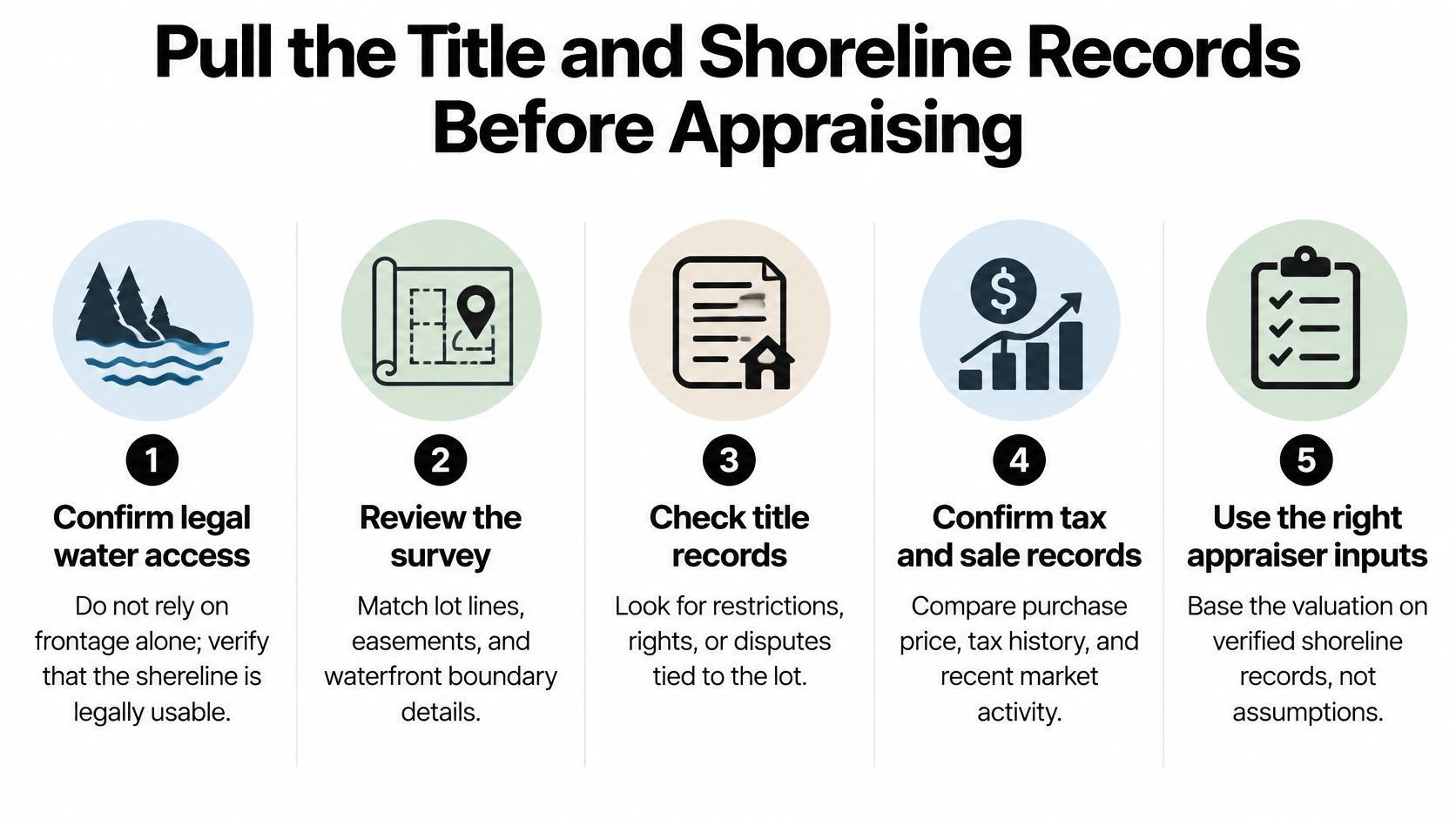
An appraiser can measure waterfront frontage accurately and still start with the wrong assumption about its utility. A shoreline boundary doesn't, by itself, establish permission to build a dock, maintain a retaining wall, or reach navigable water.
The Texas property-tax appraisal provisions recognize generally accepted appraisal methods and adjustments for property differences. For a waterfront assignment, the underlying legal and physical facts need verification before those adjustments mean much.
Verify the parcel and its usable waterfront
- Match the parcel documents. Compare the survey, subdivision plat, and legal description. Resolve inconsistencies before valuing land that may include an adjoining strip or exclude an assumed access area.
- Read the restrictive covenants. Identify building, dock, boathouse, and retaining-wall limitations. Keep the controlling document and give the appraiser the actual restriction, not a neighbor's interpretation.
- Confirm shoreline rights. Review ownership, easements, and permissions affecting boat access. A title exception or access restriction may affect the appraised value rather than create a simple repair deduction.
- Identify lake-level assumptions. Record the conditions reflected in the survey or plat. Ask whether observed water access represents the conditions relevant to the valuation.
- Inspect the bulkhead. Obtain written contractor estimates and engineering advice where warranted. Deferred shoreline work may justify a substantial adjustment, but repair cost and market-value impact aren't automatically identical.
- Check development constraints. Document utilities, buildability, flood exposure, and drainage. Keep provider information, elevation materials, and permit findings with the parcel records.
- Check the comparable's boundaries. Confirm whether each sale involved a single lot or adjacent parcels sold together. Assemblage potential can make an otherwise similar sale misleading.
The checklist below reinforces the distinction between measured frontage and verified rights.
Record the financial consequence
For each finding, note the supporting document, the appraiser's treatment, and any separate cost. If the appraisal already reflects restricted construction potential, don't add an arbitrary compliance deduction afterward.
Our discussion of deed restrictions and property division explains why subdivision documents deserve attention during divorce preparation. Restrictions from another neighborhood aren't a substitute for Walden's parcel-specific records.
A title or shoreline problem changes what a buyer can acquire and use. It can change the number itself, not merely the wording in the appraisal.
Adjust Comparable Sales for the Waterfront Premium
A Walden waterfront lot marketed at $250,000 and 8,398 square feet provides a point of comparison, not a value conclusion. Homes.com's Lake Houston land listings also showed nearby land listings ranging from $84,999 to $300,000. These are asking prices for different properties and do not establish what your lot would sell for.
Compass records a 0.20-acre waterfront lot at 8826 Cross Country Drive listed for $300,000 in 2024. Treat it as a lead for further market research, not as a closed sale at that price.
Compare buyer utility rather than waterfront labels
The strongest comparisons are recent closed sales of land with similar frontage, access, and shoreline condition. The appraiser then explains how differences between each comparable and your lot affect the indicated value.
Adjustment grid for waterfront comparable sales
| Factor | Adjustment direction | How to support the number |
|---|---|---|
| Frontage and usable water depth | Higher usable frontage adds value | Paired sales with similar depth and access |
| Bulkhead or shoreline condition | Needed repairs subtract value | Dated repair estimate from a qualified contractor |
| Flood or drainage exposure | Greater exposure subtracts value | Flood map and elevation data for each lot |
| Buildability and deed restrictions | Tighter limits subtract value | Covenant review and permit history |
| Improvements included in the sale | Adds value only if contributory | Permits, invoices and photographs |
| Market change since the sale | Adjusts sales to the valuation date | Market data for the period between sale and valuation |
In a formal sales-comparison grid, the appraiser adjusts the comparable toward the subject lot. A superior comparable generally receives a downward adjustment; an inferior one generally receives an upward adjustment.
Challenge unsupported premiums
A flat premium over an interior lot can miss what buyers value. An open-water view may add appeal, while shallow access, shoreline repair needs, or a restricted building footprint may reduce it. The appraiser should support the combined effect with market evidence.
Watch for these errors:
- Overlapping adjustments: Counting the same benefit under both view and frontage without explaining their separate effects.
- Timing mismatches: Using later sales without accounting for market changes.
- Wrong value measure: Treating assessed value or an asking price as a completed transaction.
If utility arrangements differ, review those differences as well. This guide to septic-system and water-well valuation during an Atascocita divorce can help identify relevant questions without assuming those systems serve your Walden lot.
Could a buyer use the comparable for substantially the same purpose as your parcel? If not, the appraiser should explain why it belongs in the analysis. A canal lot or interior parcel is not equivalent to open-water frontage because its listing calls it waterfront.
Brief Your Appraiser and Present the Numbers in Court
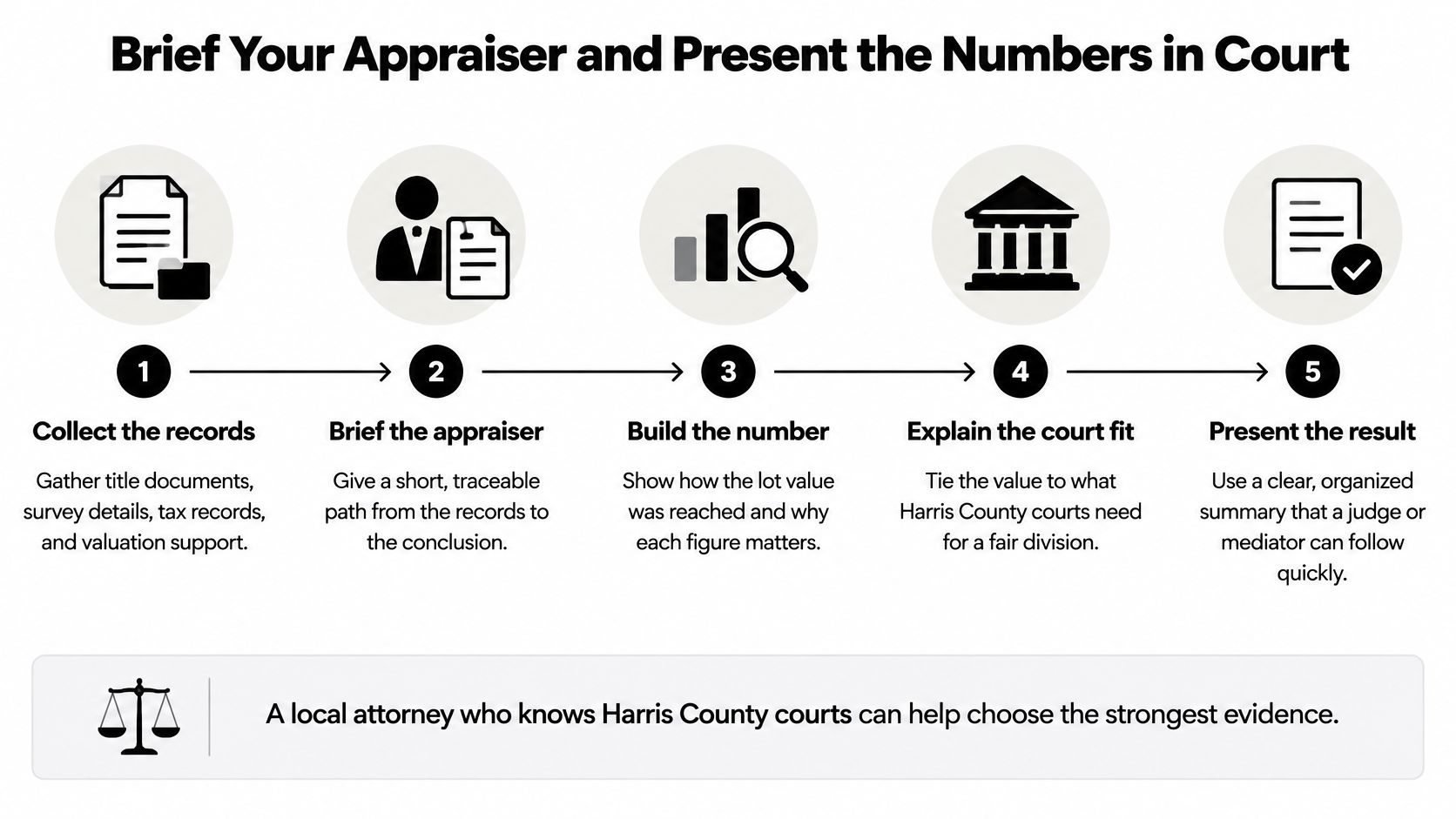
A useful valuation presentation links the assignment, records, and final figure. For a Walden waterfront lot, the appraiser should be able to identify what property rights were valued, which materials support the analysis, and how the comparable sales relate to the parcel.
The divorce attorneys at Law Office of Bryan Fagan have local experience with the courts, judges, and legal environment of Atascocita and surrounding counties. The firm's attorneys have negotiated, mediated, and litigated family law and estate planning cases. That experience can help organize the legal presentation while the appraiser explains the valuation.
Set the assignment before the inspection
- Choose relevant appraisal experience. Ask about waterfront-land assignments, divorce testimony, and mediation participation. Ask which local closed sales the appraiser has analyzed.
- Provide a written scope. Identify the legal description, valuation date established earlier, and ownership interest being valued. Specify whether the assignment includes docks, bulkheads, or other improvements.
- Deliver an indexed records packet. Group title materials, physical-condition evidence, market materials, and financial records. Mark unresolved questions clearly so assumptions are not presented as established facts.
- Separate expert responsibilities. Ask the appraiser to explain market value and comparable selection. Counsel can reconcile liens and settlement deductions in a separate schedule unless the appraisal assignment expressly includes that work.
- Address commingled funds with the right specialist. A forensic accountant may be appropriate when tracing requires reconstructing transactions across accounts. The appraiser's role is to value the property, not determine the legal character of purchase funds.
Prepare exhibits that answer predictable questions
- Preserve the underlying exhibits. Keep original listings, closing statements, MLS history, photographs, surveys, permits, and engineering reports. Label exhibits so the expert can locate supporting material during questioning.
- Require a plain-English explanation. Ask why each comparable was selected and why rejected alternatives were not equivalent. The explanation should distinguish open-water access from canal frontage and connect each adjustment to the property's specific features.
Keep competing opinions side by side. Identify whether the disagreement concerns property rights, condition, comparable selection, or adjustment method. A mediator or judge can assess the gap more readily when each position identifies the assumption behind its number.
Prepare a concise net-equity summary that matches the supporting report. Have counsel review exhibit disclosure and presentation requirements, then label each exhibit clearly so the expert can find its supporting records during questioning.
Choose a Buyout, Offset or Sale for Your Lot

Under Texas Family Code § 7.001, a court divides the spouses' estate in a manner it considers “just and right,” taking into account each spouse's rights and any children of the marriage. The lot's supported net equity is one part of that broader division, not an automatic half-share.
Compare the available paths
- Buyout: One spouse keeps the lot and pays the other an agreed or court-ordered share of its equity. The settlement may use half the supported net equity, but the court's division must be just and right under the circumstances. Confirm that the spouse keeping the lot can secure financing and that any required release from the existing loan is addressed.
- Offset: One spouse keeps the lot while the other receives different assets. Compare liquidity, tax treatment, and restrictions before treating cash, retirement funds, and land as equal in value.
- Sale: The spouses sell the parcel, pay authorized expenses and liens, then divide the proceeds under their agreement or court order. A sale may suit the parties if neither can afford to carry the property or both want to end their shared ownership.
Put workable terms in writing
Keep the lot only if you can cover its carrying costs and pending shoreline repairs. Compare those expenses with financing capacity, children's needs, and the timing of a transfer or sale.
A negotiated number also needs an enforceable implementation plan with deadlines and remedies. Specify payment dates, responsibility for expenses, transfer documents, and what happens if financing fails. For a sale, address listing decisions, repair authorization, and how offers will be accepted.
The Law Office of Bryan Fagan – Atascocita TX Lawyers helps clients address property division through divorce representation, settlement negotiation, mediation, and trial. Its divorce attorneys serve Atascocita, Harris County, and surrounding areas. An initial consultation with an Atascocita attorney is free.