You're sitting at the kitchen counter in Atascocita, trying to split a house you both know room by room, and the Harris County tax statement in front of you has a line neither of you can explain. It's not the mortgage. It's not school tax. It says Emergency Services District, and it's for a few hundred dollars at most, so one of you wants to skip it and the other wants to know who owes it.
That small line is worth 20 minutes of attention. A Harris County Emergency Services District assessment in a divorce affects your home's net equity, your monthly budget while the case is pending, and who pays if there's a past-due balance when you sell. At the Law Office of Bryan Fagan in Atascocita, we see this question from homeowners in Atascocita, Humble, and northeast Harris County who don't want a fight over a tax line. They want it identified, priced, and written into the decree clearly.
Why the ESD Line Belongs on the Divorce Inventory
Say you and your spouse spread out the combined tax statement to build a temporary budget. County, city, school district, and a municipal utility district each have their own line. Tucked among them is your Emergency Services District, or ESD.

In plain English, an ESD assessment is generally an ad valorem property tax based on your home's taxable value and that district's rate per $100 of value. It helps fund local fire protection and emergency medical service. It's billed apart from county, city, school, and MUD charges, which is why you can't fold it into another tax and guess.
Why a Small Line Still Changes the Math
Beside your mortgage payment, the ESD amount often looks minor. But an unpaid year, a penalty, an escrow credit, or a proration for the year you sell still changes what each of you walks away with. It also affects temporary orders, because someone has to keep the house current while the divorce is pending.
A countywide average won't help you. Harris County has many ESDs, each with its own boundary and rate, so your neighbor in Humble may not be in the same district you are.
Run This Identification Check First
- Find the exact name: Match the taxing entity named on the bill to this specific street address, not to a nearby subdivision.
- Confirm the type of district: Check whether it's an ESD or a different kind of fire or EMS district, because the taxing authority isn't identical.
- Separate sales tax and utility tax: Don't treat every emergency services charge as a charge on the house.
Practical rule: If you can't point to the ESD name, tax year, and dollar amount on the actual statement, you don't have a number you can put in a decree yet.
The Texas Comptroller utility tax guidance states that emergency services districts may impose local sales tax, but emergency services districts generally may not tax residential use of gas and electricity, and it separately identifies qualifying fire control, prevention, and EMS districts under Chapter 344 as an exception to the residential utility rule. That's your warning not to copy a shorthand label from a spreadsheet or utility bill and call it a home assessment. Preserve the full bill, confirm what service was taxed, and ask for a written accounting before you agree the amount is a marital liability. Then compare that confirmed district to the rates below.
What a Harris County ESD Assessment Costs
A $400,000 home can carry very different ESD costs depending on its district. Calculate the annual charge by dividing taxable value by 100, then multiplying by the district's rate. The Harris County Appraisal District sets the taxable value; the ESD board sets the rate, which may change each year. Harris County ESD No. 4's tax-rate information confirms that rates are based on appraisal district values and stated per $100 of home value.
For a concrete example, Harris County ESD No. 11's official 2025 order set a total rate of $0.038078 per $100 of assessed value: $0.031087 for operations and maintenance and $0.006991 for debt service.
How Much Rates Move Year to Year
ESD No. 11's rates varied over the years shown below. That matters when a divorce agreement assigns responsibility for future tax bills: a rate from one year is not a fixed charge for every year that follows.
Other districts can have higher rates. Harris County ESD No. 29's tax information reports a 2025 total adopted rate of $0.10000 per $100 and states that a $250,000 home would generate $250 in annual ESD taxes. HCESD 60's published rates list a 2024 no-new-revenue rate of $0.0689 per $100 and a voter-approval rate of $0.0723 per $100.
Sample Harris County ESD Property Tax Rates
| District | Year and rate type | Rate per $100 | What the rate includes |
|---|---|---|---|
| ESD No. 11 | 2025 total adopted | $0.038078 | $0.031087 operations and $0.006991 debt service |
| ESD No. 11 | 2021 adopted | $0.032305 | Total property tax rate |
| ESD No. 11 | 2022 adopted | $0.029336 | Total property tax rate |
| ESD No. 11 | 2023 adopted | $0.030175 | Total property tax rate |
| ESD No. 11 | 2024 adopted | $0.038294 | Total property tax rate |
| ESD No. 29 | 2025 total adopted | $0.10000 | $250 annual tax on a $250,000 home |
| ESD No. 60 | 2024 no-new-revenue | $0.0689 | Published no-new-revenue rate |
| ESD No. 60 | 2024 voter approval | $0.0723 | Published voter-approval rate |
Use the Table Like a Lookup, Not a Guess
At ESD No. 11's 2025 rate, a taxable value of $250,000 produces about $95.20 in annual ESD tax; $400,000 produces about $152.31. At ESD No. 29's rate, the same $400,000 taxable value produces $400. ESD No. 60's 2024 voter-approval rate produces about $289.20 on that value.
Use the row for the home's actual district. Apply the home's exemptions and taxable value, not just its market value. The district name and tax year belong beside the ESD amount on the divorce inventory, so both spouses can identify the carrying cost being divided.
Keep this ESD line separate from county, school district, and MUD taxes. MUD district assessments in divorce property division explains how to distinguish those utility-district costs from the ESD charge. Also keep ESD property tax separate from ESD sales tax. For the house, confirm the taxable value after exemptions, the applicable district rate, any delinquency, and how the agreement allocates the tax year.
How Texas Law Characterizes the ESD Charge
An ESD assessment follows the property-tax treatment of the home, but it does not decide who owns the home. Texas presumes property acquired during marriage is community property, including property acquired in an informal or common-law marriage, according to the Texas Comptroller's explanation of community property. The ESD amount is generally part of the home's carrying costs, rather than a separate personal debt created because one spouse paid the bill.
How Divorce Timing Changes the ESD Charge
| Situation | Usual character | What to negotiate | Proof to attach |
|---|---|---|---|
| Bought during marriage and paid from joint funds | Community carrying cost | Fold into net equity or split the tax year | Tax bill and joint account records |
| Accrued during marriage but paid after separation from community funds | Community expense with a possible credit | Reimburse only the proven amount | Payment date, source of funds, separation date |
| House owned before marriage, gifted, or inherited | Separate property; payments may support a reimbursement claim | Address reimbursement or an economic equity claim | Tracing of separate title and community payments |
| Taxes after award or closing | Future cost of the owner or seller as agreed | Name who pays until sale and any proration | Decree clause and closing statement |
A Harris County court divides the community estate in a just and right manner, so the ESD bill is not automatically split in half. The court may consider the tax obligation alongside the home and other assets or debts when deciding the overall division.
One House, Two Different Answers
An Atascocita home bought during the marriage, with a taxable value of $300,000, would have an annual ESD charge of about $114.23 at a rate of $0.038078 per $100, before exemptions or other adjustments. At the same rate, a $500,000 taxable value would produce about $190.39. If community funds pay the charge on a community home, the payment is ordinarily treated as a carrying cost, not a separate credit to the spouse who wrote the check.
For a home one spouse owned before marriage, community payments toward ESD taxes, mortgage principal, or improvements may support a reimbursement or economic equity claim. Paying the tax by itself does not transfer title or change the home's separate-property character.
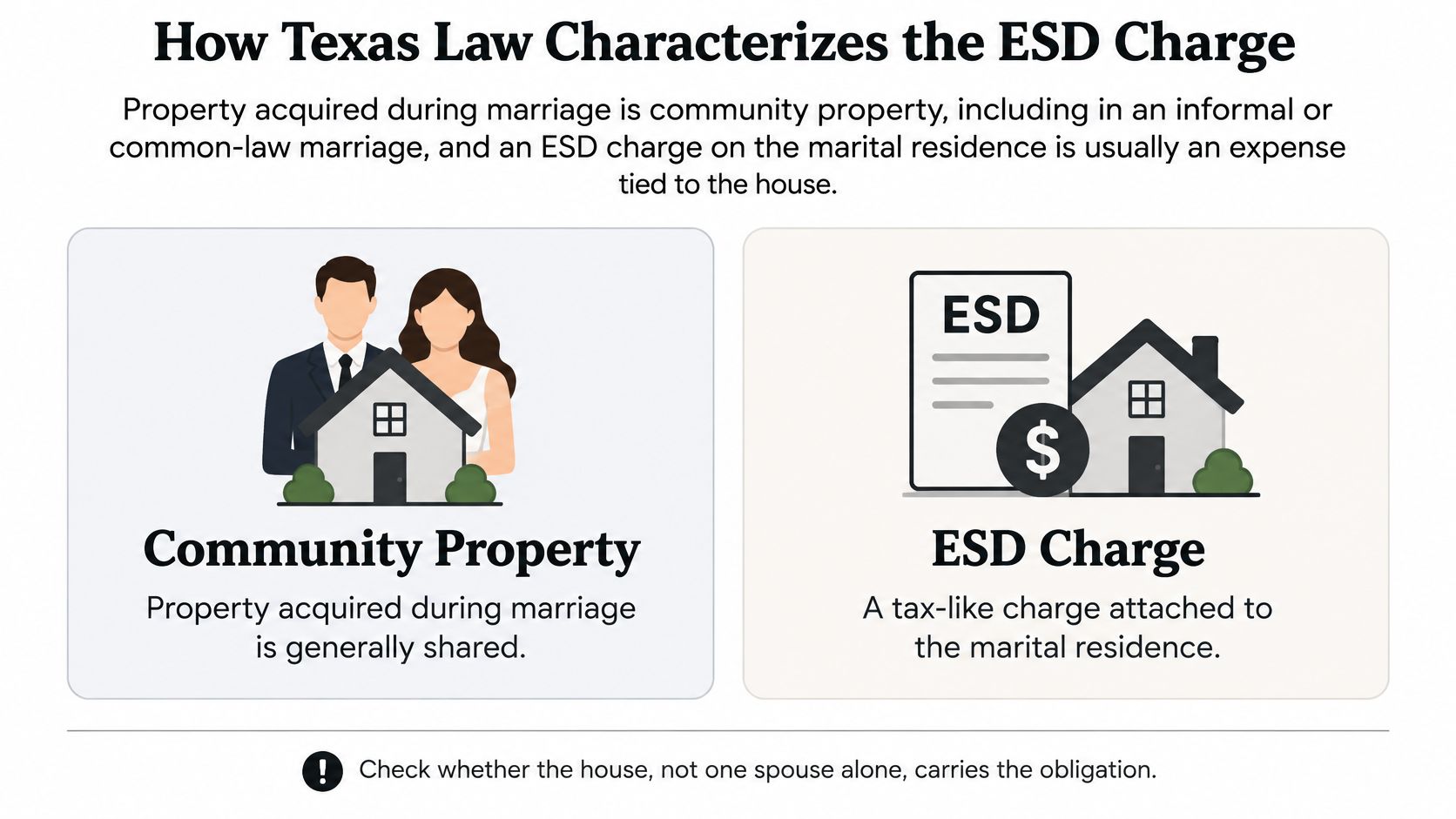
An ESD property-tax charge is separate from ESD sales tax. Keep the property-tax amount on its own line in the divorce inventory, apart from county, school, and MUD taxes. The guide to property division in divorce explains how a home's carrying costs fit into the broader division. The decree should state who is responsible for unpaid ESD taxes and how any tax-year proration will be handled.
Records to Gather Before You Divide the House
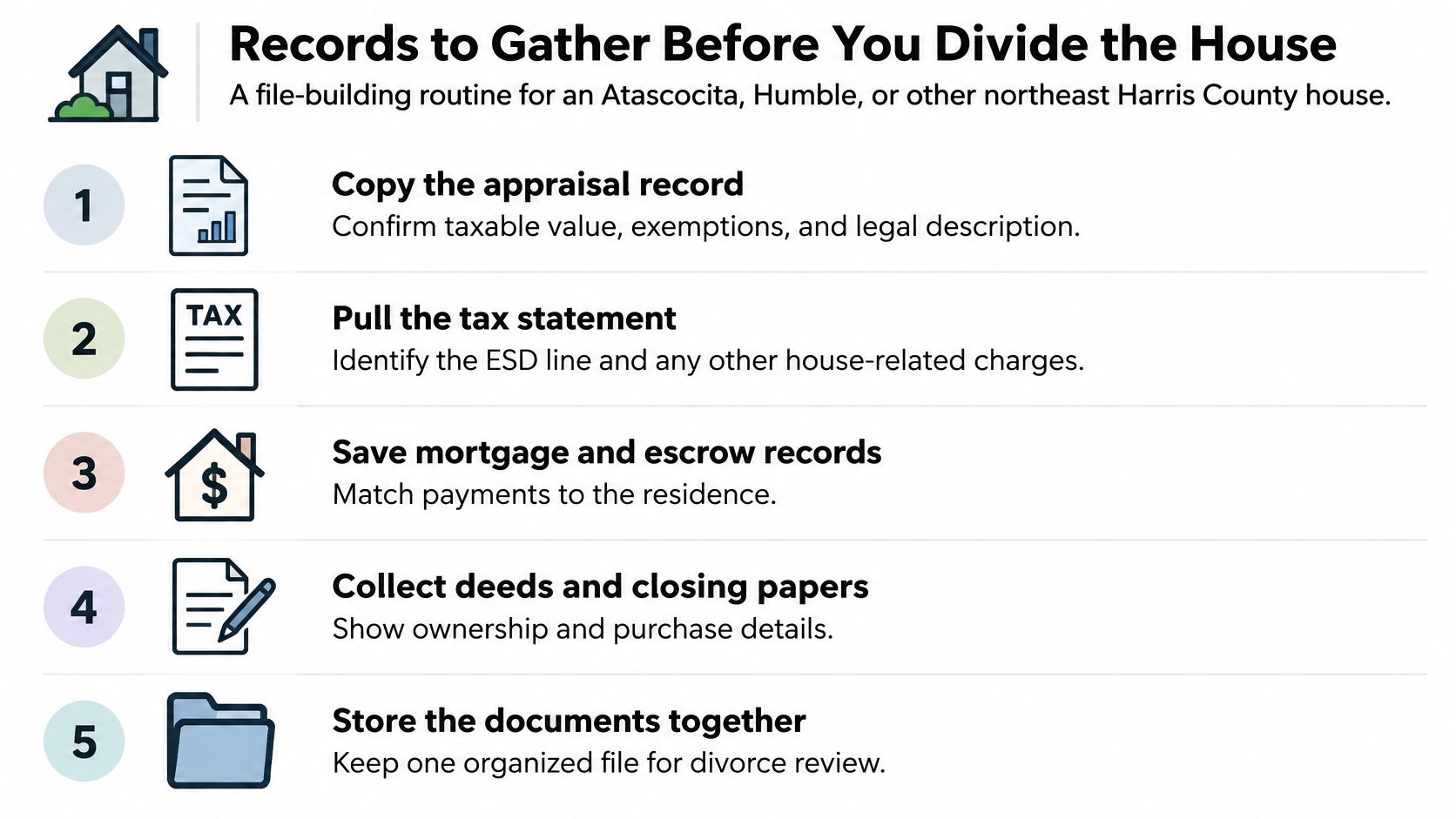
A home's ESD charge is one line in its carrying costs, separate from county, city, and school taxes. Gather records that identify the district, show what was paid, and track how the house's expenses fit into the divorce timeline.
Build the File in Eight Steps
- Copy the appraisal record: Confirm the taxable value, exemptions, and legal description for the property.
- Pull the complete tax statement: Mark the ESD line, district name, tax year, amount due, and any penalty. Keep the other tax lines visible so the ESD charge is not confused with county, city, or school taxes.
- Match payments to your timeline: Record each payment date and whether community or separate funds paid it.
- Print the escrow ledger: If the mortgage company collects taxes through escrow, use the ledger to account for prepaid amounts and avoid counting them twice.
- Add closing papers if you're selling or refinancing: Note any tax proration shown on the closing disclosure.
- Build a one-page worksheet: List the agreed home value, mortgage payoff, county, city, and school taxes, the ESD amount, delinquent penalties, and escrow credits on separate lines.
- Calculate reimbursement narrowly: Identify the proven payment for the period at issue rather than assuming the entire annual bill supports a claim.
- Raise it in temporary orders: If one spouse is paying the house's expenses while the case is pending, specify who pays the ESD tax during that period.
The State Law Library community property guide describes Texas's community-property presumption and the treatment of property owned before marriage or acquired by gift or inheritance. For an ESD-related claim involving a separately owned home, the useful records are the ones that show when the home was acquired and which funds paid the charge.
Watch the lien: An unpaid property tax can remain attached to the property. If the decree does not assign responsibility for the unpaid year, the spouse keeping the house may face a bill and a lien to clear before selling or refinancing.
If you and your spouse agree on the house, an Uncontested Divorce Lawyer in Atascocita can prepare the agreed paperwork. If you disagree about value, reimbursement, or who keeps the home, a contested divorce attorney in Atascocita can handle those disputes in Harris County. Bring the worksheet so the tax lines can be addressed clearly in the decree.
Sample Decree Language for Atascocita and Humble Homes
When one spouse stays in the house until it sells, or takes it in the divorce, the decree should say who pays the ESD charge for each tax year. Without that detail, an otherwise clear house award can leave the spouses arguing over a tax bill or escrow credit later.
Scene One: One Spouse Stays Until the House Sells
An Atascocita couple agrees that one spouse will live in the home until it sells next spring. The decree can assign the carrying cost during that period and specify how the sale-year taxes are divided.
- Model language: The spouse in possession shall pay the Emergency Services District assessment and all other ad valorem taxes on the property as they accrue until closing. Taxes for the year of sale shall be prorated between the parties on the closing statement.
Scene Two: One Spouse Is Awarded the House
A Humble spouse is keeping the home and refinancing it into her name alone. The decree should address both future ESD taxes and any delinquent balance identified in the tax statement.
- Model language: The spouse awarded the property assumes all Emergency Services District taxes for the year of this decree and each later year. The delinquent ESD balance shown on the tax statement attached as an exhibit is that spouse's sole obligation. Any delinquent ESD tax not disclosed on that exhibit remains the obligation of the spouse who failed to disclose it.
Scene Three: One Spouse Paid After Separation
If one spouse paid the ESD charge from a joint account after separation, specify the credit and its amount. That keeps the adjustment focused on the documented ESD payment rather than every tax on the bill.
- Model language: The paying spouse is credited the verified Emergency Services District portion paid after the date of separation, in the amount shown on the attached payment record, against that spouse's share of the community estate.
For any of these arrangements, state how to handle escrow funds as well: credit them to the spouse whose funds created the balance, or divide them as agreed. Attach the tax bill and one-page worksheet as exhibits to the agreed decree or mediated settlement agreement. Matching the exhibits to the decree gives the closing agent a clear instruction for the tax allocation and any escrow credit.
Frequently Asked Questions About ESD Assessments in Atascocita and Humble Divorces
Is the ESD Line the Same as County or School Tax on My Atascocita Bill?
The ESD line is a separate taxing entity's charge, based on the district serving your address. Your combined statement lists it apart from county, city, and school charges, much like separate items on one receipt.
Where Do I Confirm Which ESD Serves My Humble Home?
Start with the district name on your tax bill. Compare it with the Harris County Appraisal District record and tax assessor-collector records for your parcel's legal description. The address alone may not settle which taxing entities apply.
Does Paying the ESD Bill From My Account Give Me the House?
Paying the bill does not change the deed. If community funds paid taxes on a home one spouse owned separately, those payments may support a reimbursement claim. That claim concerns money paid, not ownership of the property.
Can Temporary Orders Make My Spouse Pay the ESD Tax While We Are Separated?
A court can allocate house carrying costs, including taxes, temporarily while the divorce is pending. Keep receipts for those payments. The final decree sets the long-term responsibility, so it should address any tax-year balance or credit that remains.
Do I Owe ESD Tax on a House I Am Leaving Before the Divorce Ends?
Responsibility depends on the tax year, when the charge accrued, and what the temporary orders, decree, or closing terms provide. The decree should state how the year's tax is divided when the home is transferred or sold.
Does an ESD Sales Tax Apply to My Home?
An ESD sales tax may apply to a taxable transaction within the district. The annual property tax line and a tax on a transaction belong to different records, so check the document showing the charge.
If the tax bill does not match the district records, compare the full statement with the parcel information. A summary may leave out the line needed to identify the charge.
When to Schedule an Atascocita Divorce Consultation
You don't need a lawyer to read a tax line. You may need one to keep that line from undoing a house agreement you thought was finished. Use this simple test.
Signs You Can Probably Settle This Line Yourselves
- The district is confirmed: The ESD name and rate on your bill match the appraisal record for your address.
- Taxes are current: There's no delinquent year, penalty, or dispute about an escrow balance.
- The house decision is made: You agree who keeps or sells the home, and your worksheet already prorates the current tax year.
Signs You Should Not Guess
- Separate property is in play: One of you owned the home before marriage, or received it by gift or inheritance, and community money paid its taxes or mortgage.
- Money is disputed or overdue: A reimbursement claim is contested, taxes are delinquent, or you disagree about selling versus awarding the house.
- The charge may be mislabeled: Someone called a sales tax or residential utility charge the home's ESD assessment, and no one has verified it against the actual bill.
A short review can prevent the most common mistake we fix, a decree that awards the house but says nothing about the tax year, the escrow account, or a tax lien. Silence doesn't make those costs disappear. It just assigns them to whoever gets surprised first.
If you're in Atascocita, Humble, or northeast Harris County, bring four things to a free consultation at our Atascocita office. Bring the appraisal printout, the full tax statement, the mortgage escrow ledger, and any proposed decree or settlement draft. We can connect the ESD number to your overall property division and tell you whether your case fits an agreed path or needs contested advocacy.
If weekdays are hard, ask about a weekend divorce consultation in Atascocita so you can review the house paperwork without missing work. The goal isn't a fight over a small line. It's a clear, fair division where every line was written down once, correctly, so you don't have to reopen it later.
If a Harris County Emergency Services District assessment in a divorce is holding up your house agreement, the Law Office of Bryan Fagan can review your tax statement, worksheet, and draft decree and turn that line into clear, enforceable language. Schedule a free consultation at our Atascocita office today by visiting Law Office of Bryan Fagan – Atascocita TX Lawyers, and bring your appraisal record and full tax bill so we can give you specific next steps for your home.