Unincorporated Atascocita has no city zoning code, yet deed restrictions aren't the only control because county permits, floodplain rules, plats, nuisance law, and private covenants can all limit your use. You'll hear neighbors, listing agents, and even contractors repeat the phrase Atascocita has no zoning, deed restrictions are the only control as if it settles every fence, rental, and home business question. It doesn't. The first half is mostly right, and the second half gets people fined, sued, or stuck removing work they've already paid for. If you live in Atascocita, Humble, or northeast Harris County, you need to check the recorded page for your lot and the public rules that sit beside it before you build, lease, or complain.
What No Zoning Means in Atascocita
Atascocita is an unincorporated census-designated place, not a city. It doesn't have its own zoning map, zoning board, city council, or zoning department. County-level government provides the public services, so you won't find a municipal officer who can rezone your street from residential to commercial.
That structure matters because growth happened through subdivisions, not a zoned city framework. Development began in the 1970s, and the U.S. Census Bureau QuickFacts page for Atascocita CDP records 88,174 residents in 2020, after the population reached 35,757 in 2000 and 65,844 in 2010. That's an increase of approximately 84.1% from 2000 to 2010, then another 33.9% from 2010 to 2020.
Why Covenants Became the Everyday Rulebook
Master-planned subdivisions supplied houses, amenities, and private standards for appearance and use. A developer could record restrictions for one section, then use a different set for the next section. Homeowners' associations later took over architectural review and day-to-day enforcement.
"No zoning" means there's no comprehensive municipal zoning code. It never means your lot is free from land-use limits.
Harris County building and development standards, floodplain and drainage rules, recorded plats, environmental requirements, utility districts, nuisance law, and Texas statutes can still block a project. A restriction may also sit in a declaration, plat, separate instrument, or amendment, and it follows subdivision, section, lot, and block lines rather than a city boundary. The house next door can sit under a different document.
Don't assume a fence, RV, home business, or rental is allowed until you've identified your subdivision and section. That legal description, not your street address or zip code, starts the answer.
Controls That Still Limit Your Property
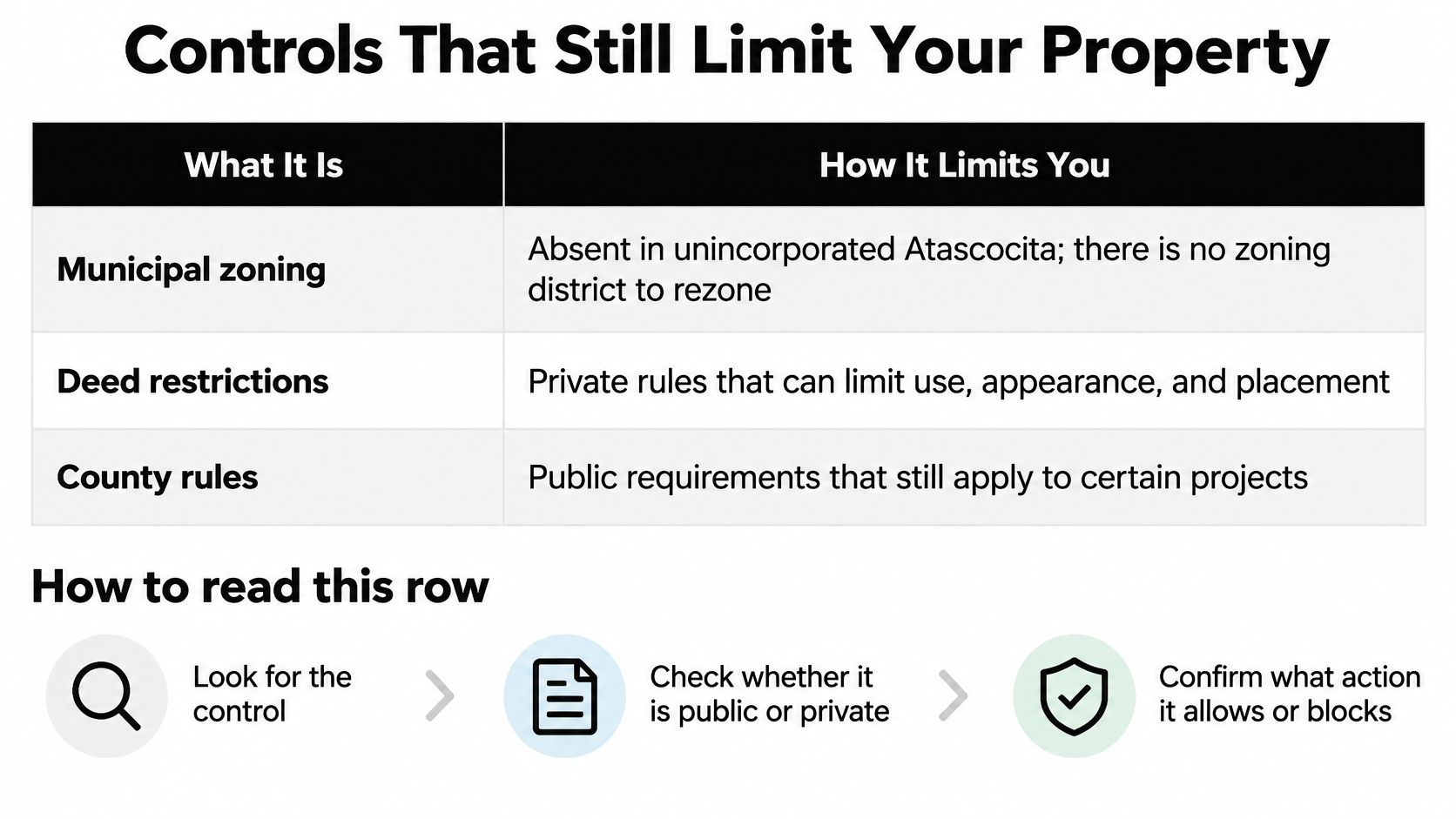
| Control | Where it comes from | What it commonly limits | Who enforces it |
|---|---|---|---|
| Municipal zoning | No city zoning code in unincorporated Atascocita | No zoning districts or rezoning | No zoning department |
| Deed restrictions | Recorded declaration, deed, plat, or amendment | Use, exterior look, fences, parking, rentals, additions | Eligible owners, the association, sometimes the county attorney |
| HOA or POA rules | Dedicatory instrument, bylaws, and adopted rules | Architectural review and authorized fines or approvals | The property owners association, within its granted authority |
| Subdivision plat | Harris County map, plat, or replat | Lot lines, easements, drainage, and access | County processes and affected private parties |
| Building and floodplain rules | Harris County and Texas requirements | Permits, elevation, drainage, and development standards | County and state regulators |
| Nuisance and other public law | Texas statutes and court-made nuisance rules | Health, safety, and substantial interference | Affected neighbors or the proper public official |
Read one row at a time. First, name the control. Second, decide whether it's private or public. Third, ask what action it allows, requires, or blocks. Mixing those layers is where most bad advice starts.
Private Controls That Run With the Land
Deed restrictions are private, recorded covenants. The City of Houston deed restriction guidance describes them as agreements binding on owners within a subdivision that "run with the property". A buyer can be bound even though the original developer left years ago, and a tenant's conduct can put the owner in violation.
Their effect depends on the recorded instrument, amendments, defined coverage, enforcement language, and expiration or renewal terms. There's no single Atascocita-wide rulebook you can download and apply to every lot in northeast Harris County.
HOA or POA rules are a narrower layer. A dedicatory instrument can include the declaration, bylaws, and properly adopted rules, but an association only holds the authority that those documents and Texas law give it. A board policy can't rewrite a clear covenant because a majority of board members prefer a new rule.
Public Controls You Can't Waive Privately
A plat can fix lot lines, easements, drainage areas, and access even when your current deed says nothing about them. County and state requirements can require permits, elevation review, safe construction, and drainage compliance. Neighbors can also use nuisance law when noise, odors, traffic, or unsafe activity substantially interferes with their use of their property, even if the declaration never mentions that activity.
Texas law keeps these powers separate. Texas Local Government Code Chapter 242 addresses subdivision regulation in unincorporated areas and doesn't eliminate county subdivision, platting, building, floodplain, drainage, environmental, or other regulatory authority. A covenant can't authorize work that public law forbids, and a county permit can't waive a private covenant.
Use this test before you spend money:
- Name the use: State exactly what you'll build, park, operate, or rent.
- Check the private page: Read the covenant sentence covering that lot.
- Check the plat: Confirm easements, setbacks shown on the plat, and lot boundaries.
- Check the public rule: Ask the county about permits, floodplain, drainage, and utilities.
If any layer says no, pause. Clearing three layers doesn't erase the fourth.
How to Find the Restrictions on Your Lot
A street address won't find your restrictions. County records are organized around recorded instruments and legal descriptions, so work in that order.
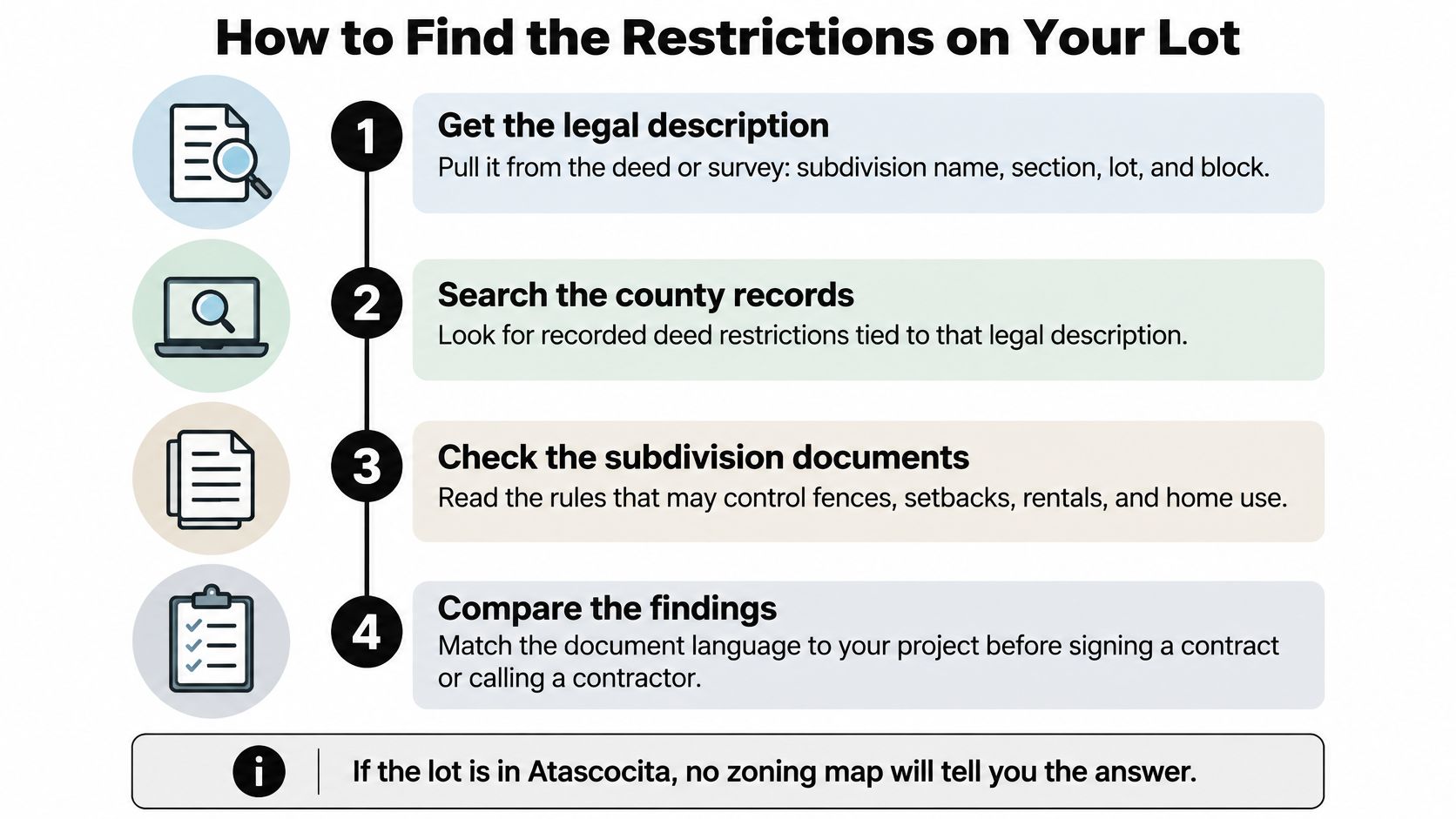
Seven Steps Before You Sign or Build
- Get the legal description. Pull the subdivision name, section, block, and lot from your deed, survey, or title commitment. A house marketed as Atascocita or Humble may sit in a section with its own declaration.
- Search Harris County Clerk records. The Harris County Clerk public records page states that deed restrictions filed after 1961 can be researched through its Real Property Index, with restriction filings searchable using the RESTR or AMEND document-type filters. Try the subdivision name as grantee, then narrow by instrument type.
- Pull the full chain. Get the original declaration plus every amendment, extension, release, and replat. Your current deed may incorporate the restrictions by reference without reprinting them.
- Plan for older or incomplete records. Older filings may need courthouse or microfilm research. If a dispute or closing depends on the wording, ask for certified or complete copies rather than relying on an index summary.
- Read the operative clauses. Find the coverage clause, architectural approval process, rental language, parking rules, expiration or renewal date, amendment threshold, and enforcement clause naming who may sue.
- Compare paper to ground. Line the packet up against your survey and intended use. Check whether a shed crosses an easement, a fence exceeds a height rule, or a planned rental fits the exact leasing sentence.
- Verify current association rules. Ask the association for its current bylaws, policies, and architectural guidelines, then confirm those rules were properly adopted under the declaration.
Why the Packet Is Broader Than Your Deed
Texas law treats the governing document as more than a short deed paragraph. Texas Property Code section 202.001 defines a "restrictive covenant" as a covenant, condition, or restriction contained in a dedicatory instrument, which can include a declaration, association bylaws, properly adopted rules, and lawful amendments. A properly recorded restriction isn't an informal neighborhood preference.
Records rule: If you haven't seen the amendment history, you haven't finished the search.
The same document-first habit helps families sort other Harris County filings. People who call about a restriction during a divorce or property division sometimes also need a Child Support Attorney in Atascocita for establishing, modifying, and enforcing child support in Harris County. Keep those records separate, but bring complete packets for each issue.
If coverage, an amendment, or the intended use is unclear, stop construction until a Texas real-estate lawyer reviews certified copies. A neighbor's summary is not evidence, and an online index hit may not show every page.
Who Can Enforce a Violation and How
A deed restriction may be recorded and still be difficult to enforce. The person seeking action must show that the governing document covers the lot and conduct, and that the chosen forum can grant the requested remedy. Atascocita has no municipal zoning inspector to resolve a private covenant dispute, though county rules and other limits may apply.
| Dispute | First stop | Court path | Remedy usually sought |
|---|---|---|---|
| Unapproved paint, landscaping, or minor exterior item | Association notice and architectural process | Justice court if no structural change | Compliance order or authorized fine |
| RV, boat, or trailer parking | Parking covenant and association demand | Justice or district court depending on the claim | Injunction to remove |
| Fence, shed, or room addition | Covenant plus any required county permit | District court when the change is structural | Stop-work and removal or approved rebuild |
| Home business or nuisance-level activity | Use clause and nuisance facts | District court for an injunction | Limits on the activity or an injunction |
| Short-term rental | Exact rental wording, not a general residential clause | District court if injunctive relief is needed | Allowed or stopped based on the covenant text |
| Commercial use inside a residential section | Use restriction and plat | District court | Injunction against the use |
Standing and Proof Come First
Private enforcement generally begins with the association or an owner who has the right to bring the claim. The claimant must identify the recorded instrument, show that the lot is within its coverage, and establish that the restriction applies to the conduct. Consent also matters: a deed may incorporate the covenant, authorize its adoption when the property was purchased, or another law may permit it.
Public enforcement is narrower, but it exists. Texas Property Code Chapter 203 allows a qualifying county attorney to seek an injunction or abatement for certain violations in counties with populations above 200,000. Whether that route applies depends on the statute and recorded instrument. A private dispute about a fence does not automatically become a county enforcement matter.
Match the Forum to the Remedy
The court depends on the claim and the change at issue. Some residential deed-restriction disputes that do not involve structural changes may fall within justice-court jurisdiction, while structural changes and broader title issues may call for district court. The cited Texas Public Law provision does not clearly establish that general jurisdiction rule, so it should not be relied on to determine the proper court. A lawyer can assess the applicable jurisdiction rules and whether alternative dispute resolution is available.
Defenses can shape the outcome:
- Waiver or uneven enforcement: The association overlooked comparable violations, which may weaken its claim.
- Expired covenant: The restriction's term ended and owners did not properly renew it.
- Unrecorded amendment: A later change was not correctly entered in county records.
- Rule beyond authority: The board adopted a policy the declaration does not authorize.
- Text does not cover the conduct: The covenant's wording is narrower than the complaint.
Short-term rentals show why the wording and facts matter. A general residential-use restriction does not necessarily answer whether a particular rental is prohibited. The exact sentence controls the outcome, along with the property's governing documents and the use in question.
Before filing, learn about the civil litigation process and identify the remedy you need. An injunction, damages, authorized fines, and agreed conditions involve different procedures and timelines.
HOA Action, Amendment, and Litigation Options
Start with the person or process that can resolve the issue at the lowest cost. Escalate only when the written record shows that step has failed.
Step One Through the Association
Send a written request that quotes the relevant covenant and asks for the architectural, variance, or appeal process. Attach the survey page and a simple drawing or description of the proposed use. Keep replies and note dates. A written record is more reliable than a phone promise from a manager or neighbor.
If the association refuses, ask it to identify the clause and any amendment supporting its decision. Request the adoption record, such as the minutes or written vote showing how the rule or amendment was approved. Compare those documents with the recorded declaration. A fine requires authority in the governing documents and Texas law.
Put the request, the clause, and the association's answer in writing. That paper trail can help clarify the dispute before mediation or court.
Step Two Through Amendment
When a restriction no longer suits the neighborhood, consider a formal amendment rather than quiet noncompliance. The declaration usually sets the required vote or signature threshold. For qualifying residential subdivisions in an unincorporated county with a population of 3.3 million or more, Texas Property Code Chapter 201 provides a petition framework. Informal agreement at a meeting does not release owners from a restriction. The amendment must be properly adopted and recorded to give future buyers notice.
Treat the declaration like a contract among lot owners. Before filing, consider whether compliance, damages, or a negotiated cure fits the dispute. The firm's overview of breach of contract remedies explains those general options.
Step Three Through Court
Use litigation as a last step. Before filing, gather the certified instrument, proof that it applies to the lot, evidence of notice, photos, association letters, and a clear statement of the result you want. A written demand, mediation, or negotiated compliance agreement can resolve a dispute without a contested suit.
Choose the path based on the outcome. For approval, complete the association's process. To change a restriction for the neighborhood, pursue an amendment. To stop construction or seek removal, prepare the evidence and records needed to ask a court for relief.
Fences, RVs, Home Businesses, and Rentals
Most Atascocita disputes aren't abstract zoning fights. They're driveway, backyard, and leasing decisions made before anyone reads the section restrictions.
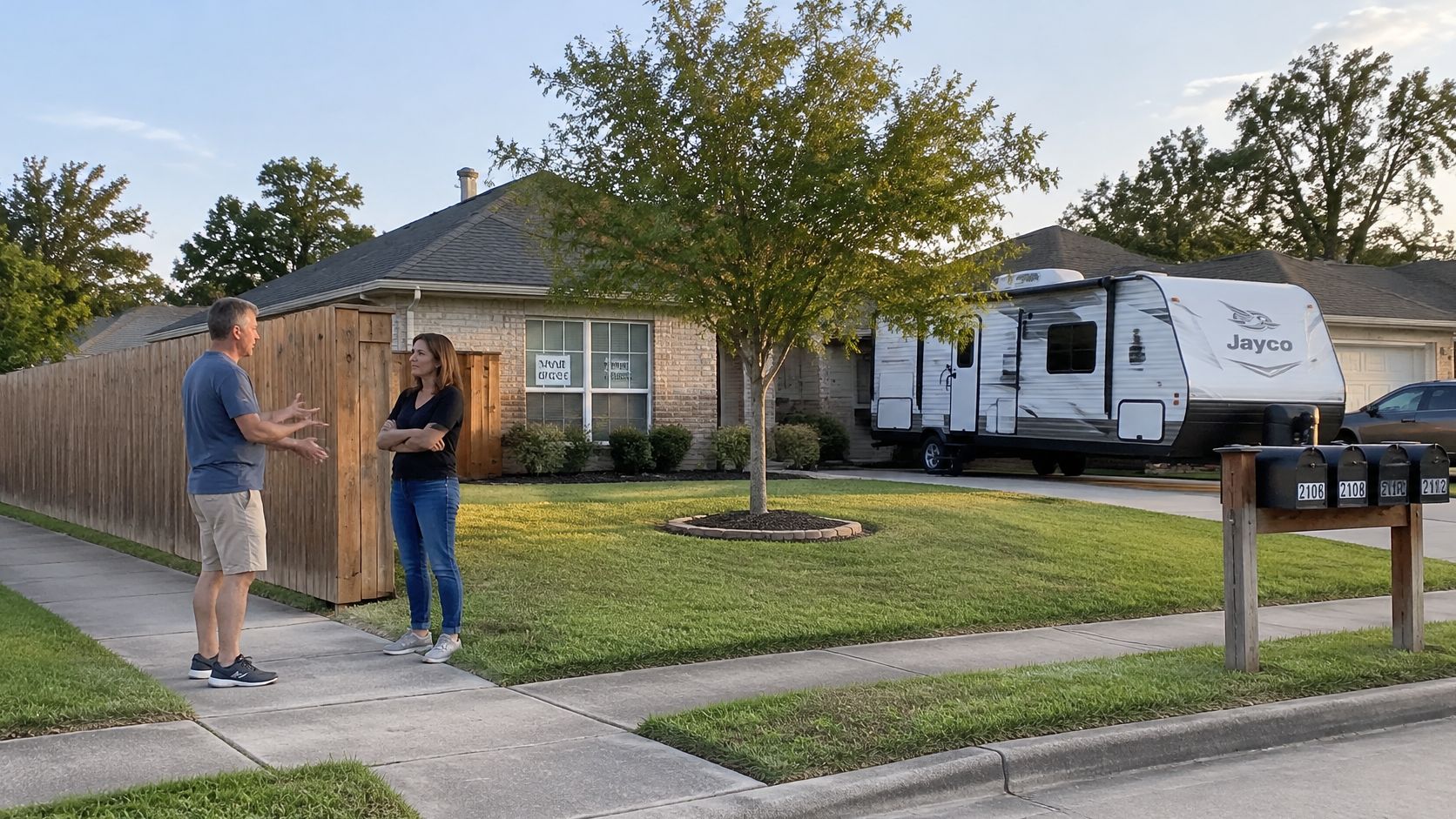
The scale is easy to underestimate. The Wikipedia summary of Census figures for Atascocita reports that 82.5% of Atascocita housing units were owner-occupied during 2020–2024, so most residents hold property shaped by recorded covenants and association rules. Covenants commonly regulate exterior appearance, fencing, parking, landscaping, additions, and visible improvements, and there's no single document for the whole community.
Four Street-Level Scenes
A taller fence or backyard shed. Say an owner in Atascocita Forest wants a shed behind a new fence. Architectural approval and a county permit are separate checks. Association approval doesn't clear a floodplain, easement, or setback problem, and a permit doesn't cure a height or materials violation. Match the drawing to the approval sentence before materials arrive.
An RV or boat in the driveway. This usually turns on a parking or storage clause, including time limits for loading and unloading. If someone lives in the RV, the dispute can also raise occupancy, utility, and nuisance issues. Photographs with dates matter more than a complaint that the vehicle is an eyesore.
A business operated from home. A bookkeeper working alone at a laptop presents different facts from a salon, daycare, or delivery hub that adds clients, employees, signage, and traffic. Read the residential-use clause, then examine the actual activity. The label "home business" doesn't decide the case by itself.
A weekend or monthly rental. A rental can survive if the declaration never clearly bans that lease length or type. A general single-family label may not be enough. Owners should check minimum lease terms, whole-home requirements, tenant registration rules, and any amendment adopted after short-term rentals became common.
Commercial conversion of a house is usually the clearest private-restriction fight, yet a lot at the edge of another section may not share that ban. End every scene the same way, with conduct matched to the recorded sentence for that lot.
Permits, Floodplain, and County Rules
Public review asks a different question from covenant review. The county isn't deciding whether your fence color matches the subdivision guidelines. It's checking safety, drainage, flood risk, access, and development standards.
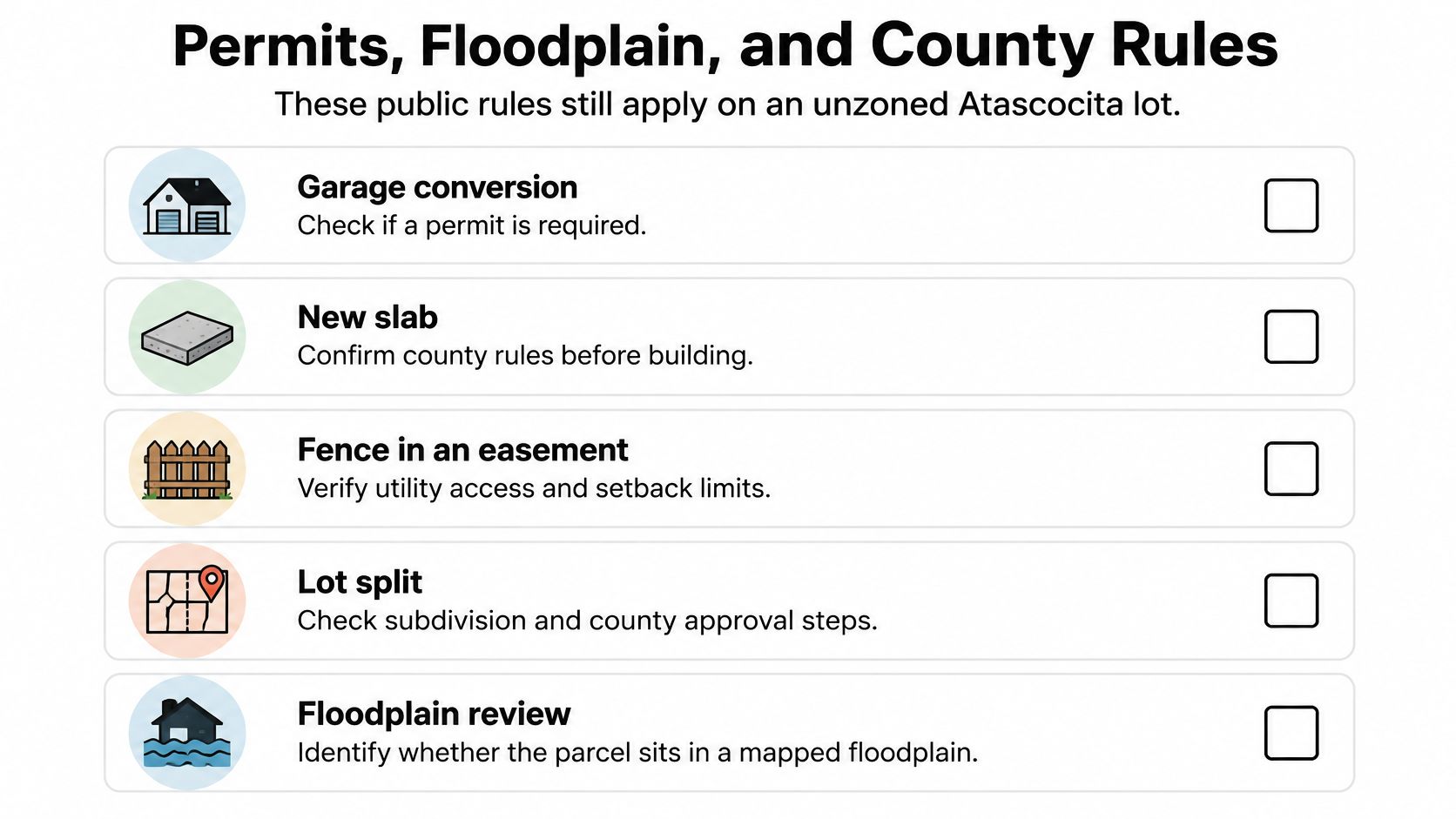
Identify the Jurisdiction First
Before a garage conversion, new slab, fence in an easement, room addition, or lot split, confirm whether the parcel sits in unincorporated Harris County, inside Humble city limits, inside another municipality's boundaries, or within a special district. A mailing address can mislead you. Houston's extraterritorial jurisdiction can also affect platting and filings, so review the firm's guide to Houston ETJ issues affecting Atascocita legal filings when a plat or development application is involved.
Then check four public subjects:
- Building and development standards: Confirm whether the project needs a permit, inspections, or engineered plans.
- Floodplain elevation: Ask whether the lot sits in a mapped floodplain and whether the slab or finished floor must meet elevation requirements.
- Drainage: Verify that added concrete or fill won't push water onto a neighbor or violate drainage conditions.
- Utilities and easements: Locate water, sewer, electric, and access easements before placing a structure or fence.
A recorded plat can dedicate an easement that makes a shed unlawful even when the declaration never mentions sheds. A neighbor's assurance that "everyone builds there" is weaker than a title search, survey, and certified declaration. Houston's deed-restriction guidance also points residents to county records rather than informal summaries, and a permit clerk's answer should be kept in writing.
This public checklist doesn't replace an engineer's flood determination or the county's permit review. Don't pour concrete based on a contractor's guess about floodplain status.
Pre-Construction Packet
Keep four items in one folder:
- Legal description: Deed or survey showing subdivision, section, block, and lot.
- County answer: Written permit, floodplain, drainage, or no-permit-required response.
- Restriction packet: Declaration, amendments, extensions, releases, and plat.
- Association position: Written approval, denial, or confirmation of the process if an association exists.
If one item conflicts with another, resolve the conflict before work begins. Removal costs more than a delayed start.
Schedule a Restriction Review Before You Build
No municipal zoning does not mean a project is automatically allowed. Deed restrictions, plats, permits, floodplain rules, and nuisance law can all affect what you may build or how you use your property. A review before work begins can clarify which rules apply to your lot.
Consider calling a local lawyer before closing if the seller cannot provide amendments or the title commitment raises questions. Get advice before pouring concrete for an addition, garage conversion, fence, or shed, and before advertising a rental. If a dispute is already underway, a lawyer can assess options before you demand removal, fines, or an injunction, or respond to an association threat involving a lien or structural teardown.
Use the pre-construction packet checklist above rather than assembling another document list. A focused review can determine whether a recorded restriction binds your lot, whether its wording covers the planned conduct, and who may enforce it. It can also help identify a practical path, such as seeking approval, negotiating, or pursuing relief in the appropriate court.
Amendment campaigns and private lawsuits can take time and cost money. Early review may help owners in Atascocita, Humble, and northeast Harris County address a problem before work or a dispute escalates. The Law Office of Bryan Fagan – Atascocita TX Lawyers handles civil property disputes, as well as family law, criminal defense, and estate planning matters. Do not assume no zoning means permission, or that a deed restriction guarantees a win. The recorded language and the facts matter.
If a fence, rental, home business, or association fine puts your property at risk, the firm can review your records and explain your options in plain English. It serves families and property owners in Atascocita, Humble, and northeast Harris County. Visit Law Office of Bryan Fagan – Atascocita TX Lawyers to schedule a free consultation at the Atascocita office before you build, lease, or file suit.