Skip to content

You're sitting at the kitchen table in your Balmoral home with two envelopes in front of you. One holds divorce paperwork. The other holds an HOA statement showing regular dues, a possible special assessment, and fees you've never had to think about separately before. It's easy to assume you'll each pay half and move on. That's rarely how it works, and guessing can leave you paying a charge the decree meant for your spouse, or watching sale proceeds shrink at closing. Understanding a Balmoral Atascocita HOA amenity assessment in a divorce starts with sorting each charge before you talk about settlement.
How Texas Courts Usually Split Balmoral HOA Assessments
A Texas court divides the whole community estate in a just and right manner, looking at assets and debts together. For a Balmoral HOA assessment, the date the charge arose and the money that paid it usually matter more than the fact that both spouses lived in the home at some point.
The decree works like an internal payment plan between spouses. The association still looks to the property for payment, so the decree can assign responsibility between spouses without changing the association's rights against the home. That is why one invoice can contain charges that receive different treatment. Dues from early in the marriage, dues after separation, and a resale fee that only arises at closing are not interchangeable. The guide to property division in divorce explains how individual debts fit into that larger division.
Three questions for every charge
Ask these about each line on the ledger:
- When did it arise? Was it due before marriage, during marriage, after separation, or only at sale?
- Which funds paid it? Did payment come from joint checking, wages during marriage, or a separate account?
- Who received the benefit? Did it preserve the home for both of you, or did one spouse have exclusive use at the time?
| Charge type | When it usually arises | Likely treatment in the decree | Proof to keep |
|---|---|---|---|
| Regular assessments | During marriage, before separation | Community debt, divided in a just and right manner | Ledger and bank records showing the payment source |
| Regular assessments | After separation, before the decree | Allocated by a cutoff date stated in the decree | Ledger, notices and records of who occupied the home |
| Approved special assessment | Due before or after filing | Fixed or contingent based on the due date and governing documents | Assessment notice, board minutes and due date |
| Amenity or capital charge | Tied to a project that improved the home | May support a reimbursement claim | Notice describing purpose, payment dates and valuation evidence |
| Resale transfer and setup fees | Only at sale or transfer | Usually negotiated as a credit at closing | Resale certificate and closing statement |
| Late fees and delinquency | Any time payments were missed | Often assigned to the party responsible for the default, if the decree says so | Account statement and payment history |
Evidence and clear decree language determine the final result for each row. A ledger line for a regular assessment paid from joint checking before separation gives both spouses the same date and funding source to point to. A special assessment approved before filing but billed in installments after separation turns on the decree's cutoff date and the governing documents.
Don't negotiate from a single balance total. A total hides the dates and purposes that decide treatment.
This week, request the account ledger from the association or management company, pull the declaration and bylaws, and order a current resale certificate. You want every charge to have a name, amount, and due date before settlement talks begin.
Sorting Each Charge by Category, Date and Funding Source
HOA paperwork uses similar words for different obligations, and that confusion causes real problems in divorce. Sorting charges into the right category is the work that makes every later decision possible, because it turns a single balance into a set of dated, purpose-labeled debts you can assign to one spouse or the other.
The three categories you'll see
A regular assessment funds recurring operations and maintenance. In Balmoral, that supports shared features residents use every week, such as the clubhouse, fitness center, pool, splashpad, sports facilities, and common areas. You pay it whether or not you personally used the pool that month, because it's tied to ownership, not attendance.
A special assessment is different. It's a one-time or limited charge for a major repair, an unexpected event, or an enhancement project. A clubhouse roof replacement billed two months before you file for divorce has a specific purpose, a specific approval date, and often a specific due date or installment schedule. All three details matter later.
An amenity-related charge covers access rights or services connected to community features. Don't assume it's optional just because it mentions an amenity. Read the notice. Some amenity charges are mandatory for every lot, while others depend on use or a separate election.
The State Law Library guide to property owners' association assessments and foreclosure separates regular assessments, which fund recurring maintenance and operating costs, from special assessments imposed for major repairs, unexpected events, or enhancement projects. The governing documents set the association's authority and may allow the board to change assessment amounts.
Why the association is not bound by your agreement
Your decree can assign payment between you and your spouse. It does not rewrite the association's rights against the property.
Here is how that gap plays out in practice. The decree awards the house to your ex and orders him to pay the outstanding pool assessment. He doesn't. Six months later the management company mails a delinquency notice to the address on record, and the lien attaches to the property whether or not your name still appears on the deed. An unpaid balance supports an association lien, and the declaration typically gives the association a foreclosure remedy to enforce it. The debt rides with the home, not with the person the decree named.
If the association collects from sale proceeds or pursues the account, you need a reimbursement or indemnity provision in the decree to recover from the spouse who was assigned the debt. Without that language, you can win the argument in family court and still lose money at closing.
Practical rule: The decree controls who owes whom between spouses. The declaration and ledger control what the association can collect against the home.
The declaration, bylaws, budget, assessment history, resale certificate and delinquency ledger are the same records the earlier checklist lays out, plus one addition for this step: the purpose line on each notice. That line lets you separate three things. Accrued unpaid assessments are current debt. Approved but unpaid special assessments are fixed or contingent liabilities depending on their due dates. Expected future increases are a marketability issue that belongs in the valuation conversation, not the payoff column.
Applying the community property presumption
Date and funding source do most of the work here. Under the Texas Family Code's marital property provisions, property acquired during marriage is presumed to be community property, and property possessed by either spouse during marriage or at dissolution carries that presumption. A charge incurred during marriage therefore usually gets traced to the community estate first.
The presumption is rebuttable, but the spouse claiming separate character needs proof. Bank records, premarital account statements, and closing documents carry more weight than memory. Documentation matters most when separate funds paid the charge, when it arose after separation, or when only one spouse received the benefit.
Two charges on one property can land in two different buckets. A Balmoral home purchased before the wedding, with one special assessment paid from premarital savings and another paid from joint checking funded by both paychecks, has a single deed history and two separate answers. The payment source for each assessment changes the analysis for that charge, which is why the ledger matters more than the total.
Build a simple spreadsheet as notices arrive. For each charge, record the exact date, amount, payment source, purpose, and governing document that authorizes it, then assign it to one category. If a notice doesn't state its purpose clearly, ask the management company in writing and keep the reply with the ledger.
Reimbursement When Community Money Improves a Separate Home
Reimbursement confuses people because the word sounds like a refund of every dollar spent. In Texas divorce law, it's narrower. It's a claim for money, not a claim to ownership of the home.

In Burton v. Bell, the Texas Supreme Court explained that reimbursement is a money claim rather than ownership of the land and that its measure may depend on the proportion of the contribution to the total enhancement, rather than automatically equaling every dollar spent. In Vallone v. Vallone, the Court recognized reimbursement when one marital estate uses funds, assets, or uncompensated labor to benefit and enhance another estate, while emphasizing that reimbursement is equitable and remains within the trial court's discretion.
Maintenance versus improvement
Ordinary dues that keep common amenities running usually preserve what's already there. They pay for operations, upkeep, and shared services. A documented special assessment that finances a capital improvement is different, because it may increase the value of a separately owned home.
Say joint funds pay a special assessment for a new fitness center in Balmoral. That project might make the neighborhood more attractive, but does it measurably enhance your spouse's separate-property home? You'd need valuation evidence, not just the invoice. A broader discussion of these claims appears in our page on economic contribution claims in divorce.
Gather this evidence before claiming reimbursement:
- The assessment notice: Keep the stated purpose and governing document reference.
- Payment proof: Save dates, amounts, and the account that paid.
- Valuation evidence: Obtain appraisals or comparable evidence showing enhancement.
- Identifiable benefit: Show how the project benefited that specific home.
Ask one decision question first. Did the charge maintain the community, or did it improve a specific separate home in a way you can prove? If you can't identify the enhancement, reimbursement becomes much harder to support, even when community money clearly paid the bill.
Documents to Gather and Decree Language to Request
Good decree language begins with a file that can trace every charge to a document. The ledger works like a map, and each notice or payment record pins a charge to a date and a dollar amount. Without that trail, the decree assigns a number nobody can defend.
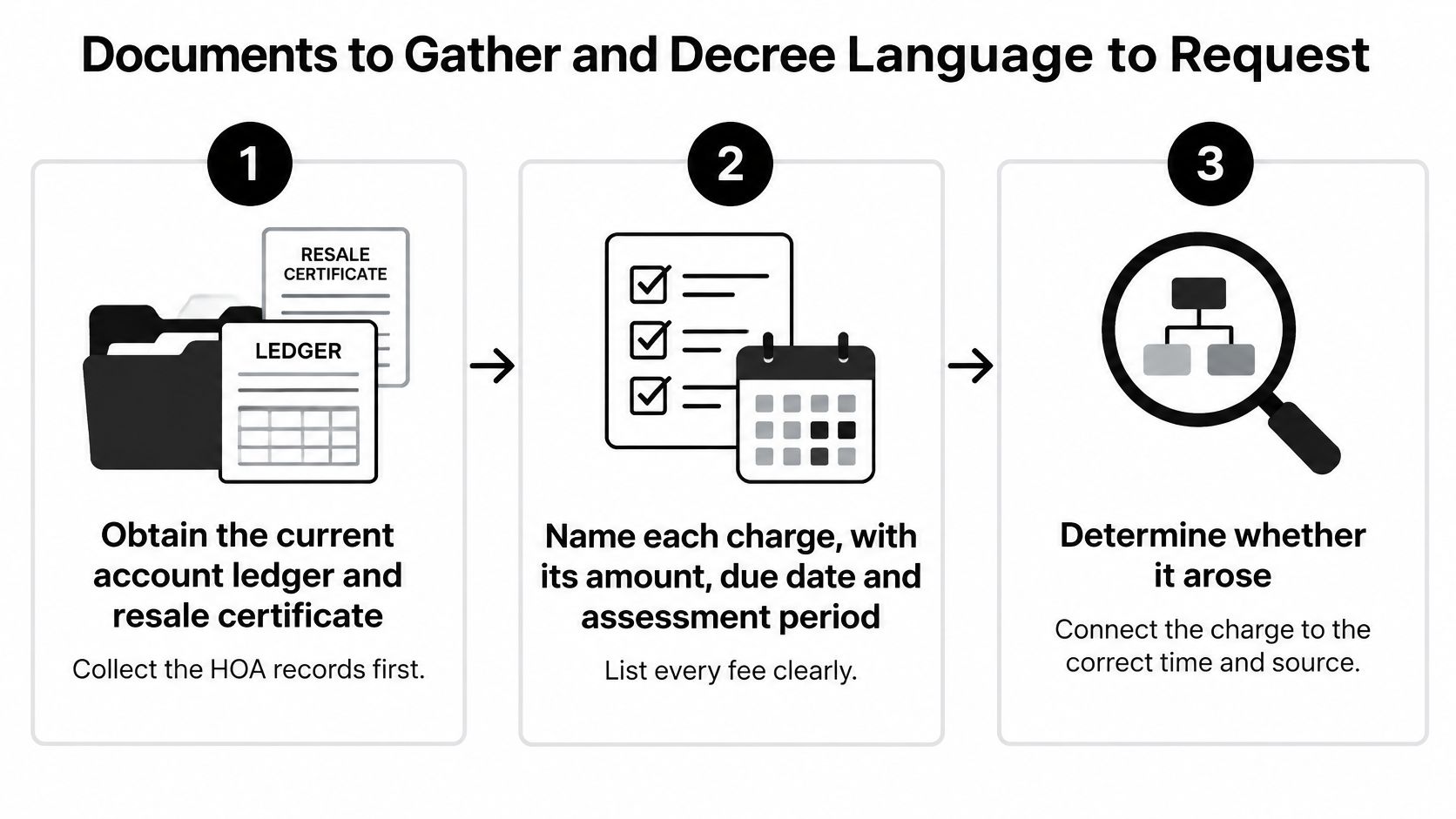
The State Law Library guide to community debt supports a documented sequence: obtain the ledger and resale certificate, identify each charge, determine timing and funding source, compare it with equity and other debts, and request express assignment in the decree. The association's right to collect from the property does not disappear because the decree assigns the bill between spouses, so the paper trail matters for both the divorce and any later collection question.
Six steps in order
- Revisit the ledger and resale certificate you already requested. Use them as the spine of the file, and add any updated statement that shows a new balance.
- Name each charge with its amount, due date, and assessment period. A named charge can be assigned. A lump sum invites disagreement later.
- Determine whether it arose before or during the marriage and whether community or separate funds paid it. Timing and source drive characterization.
- Compare each charge with the home's equity and other marital debts. The court divides the overall estate, so one invoice should not be viewed in isolation.
- Fix the cutoff date with ledger due dates and matching payment records. Balmoral timing matters here: a charge due before the cutoff follows one rule, and a charge due after it follows another.
- Ask that the decree expressly assign responsibility for each charge. Silence leaves both spouses exposed if the association collects from the property.
If association records are incomplete, you're not stuck guessing. Our attorneys write discovery requests and responses to gather information about assets and finances in divorce cases, which can help obtain missing financial records through the formal process.
Sample terms to discuss with your attorney
Exact wording must fit your case, but specific language looks like this: "Regular HOA assessments for the residence at [address], Atascocita, Texas, that became due before [cutoff date] are community debt and shall be paid by [spouse A]."
For future charges, consider: "Assessments due after [cutoff date] shall be paid by the spouse who retains the residence, who shall indemnify the other spouse."
The cutoff date controls the boundary between community responsibility and the responsibility of the spouse who keeps the home. It tells both spouses, the title company, and a future court which charges belong on which side of the line. Without a date, the decree leaves room for a later argument about every invoice that crosses it.
Before you finish, check the file against the ledger line by line. Every assessment in your spreadsheet should have a notice, a payment record, or a written explanation behind it. If a line has no document, flag it now rather than discovering the gap at mediation or closing.
Valuing the Home Net of HOA Charges and Resale Fees
A Balmoral home's list price isn't the same as its divisible equity. Mandatory dues, pending assessments, and resale fees affect what a buyer can afford and what you'll net, but they don't reduce value in a simple dollar-for-dollar way.
Don't take the tax appraisal and subtract monthly dues. That shortcut mixes two different things. A tax appraisal serves a taxing purpose, while divorce valuation needs market evidence at or near the divorce date. A certified residential appraiser should use date-specific comparable sales and explain them.
Ask the appraiser to document whether access to pools, trails, recreation facilities, or club features supports the price in comparable Balmoral sales. The appraiser should also consider required dues, anticipated special assessments, use restrictions, and pending capital projects. Well-maintained amenities may support demand, while high recurring charges may cause some buyers to discount what they'll pay.
Our related guide on waterfront lot valuation in a divorce shows how location-specific features require evidence rather than assumptions, and the same discipline applies to amenity packages.
Reported resale charges to verify
A public summary of Balmoral community charges reports a $950 community enhancement fee and a $340 resale-certificate charge, and notes that the association does not publicly publish its current annual assessment amount. Verify every figure below with the association, management company, governing documents, or a current resale certificate before using it in negotiation.
| Charge | Reported amount or formula | Confirm with |
|---|---|---|
| Community enhancement fee | $950 | Association or current resale certificate |
| Operating-fund capitalization fee | 50% of the annual assessment | Governing documents and resale certificate |
| Administrative fee | Up to one-third of the assessment | Management company statement |
| Adopt A School assessment | One-quarter of the assessment | Resale certificate |
| Transfer fee | $220 | Closing statement or management company |
| Account setup fee | $65 | Management company |
| Resale certificate charge | $340 | Management company |
| Current annual assessment amount | Not publicly published | Association, management company or current resale certificate |
Build one net equity worksheet: market value, minus mortgage payoff, selling costs, taxes, HOA balances, approved unpaid special assessments, and verified resale fees. In a simple hypothetical sale, adding only the reported enhancement fee and resale certificate charge already reduces proceeds by $1,290 before transfer and setup fees. Put every verified charge into that worksheet before settlement talks, so you're negotiating from net numbers.
Settling or Going to Court Over the Assessment
The Balmoral ledger usually picks the process for you. When the account statement and the resale certificate agree on every line and its cutoff date, a written agreement closes the issue in a sentence or two of decree language. Disagreement over value, timing or credit pushes those same numbers into mediation.
Under Texas Family Code section 7.001, a court must divide property in a manner that is "just and right," while considering the parties' rights and the children of the marriage. A judge may allocate a Balmoral assessment based on when it became due, whether it preserved or benefited the residence, which spouse controlled or occupied the property, and the parties' broader financial circumstances.
| Path | Best when | Who sets the result | Main risk |
|---|---|---|---|
| Written agreement | Both spouses agree on each charge and its cutoff date | The spouses, written into the decree | Vague wording leaves a gap the association can still pursue |
| Mediation | The dispute is about value, timing or credit | The spouses, with a neutral mediator | Unresolved items may need a court ruling later |
| Court trial | Characterization or reimbursement is contested | The judge, based on the evidence | Cost, delay and an allocation the parties cannot predict |
One rule the table cannot show: a charge that the account ledger and the resale certificate both document at the same dollar amount is not worth trying. The cost of the fight outruns the fee itself, and a judge reading matching records has little room to allocate the charge differently than the paperwork already does. Mediation earns its fee at the next step up, when you accept the documents but read one line differently, such as a community enhancement fee drawn from joint funds after one spouse had already moved out of the house.
Our Atascocita divorce attorneys guide clients through mediation on asset division and child custody, and represent them at trial when settlement stalls. A Divorce Lawyer in Atascocita, TX serves clients in Atascocita and Harris County.
Save the courtroom for the two questions only a judge can answer: whether a charge is community or separate debt, and whether one spouse owes the other reimbursement. A contested line item in the low hundreds rarely justifies a trial date and the months it takes to reach one. A disputed special assessment, or a reimbursement claim tied to community money improving a separate home, does.
Confirm the Assessment Terms Before You Sign
Before you sign, make the paperwork agree in three places.
- Ledger matches certificate: The account ledger and resale certificate should show the same balances. If they differ, settle the gap before signature, not after.
- Every charge is named: Each charge needs an amount and a cutoff date. A missing date lets a later bill look like it belongs to the other spouse.
- Payment and reimbursement are stated: The decree should name who pays each charge and how reimbursement works at closing. That is what keeps a paid charge from coming back to you.
Consult an attorney promptly if there is an unpaid special assessment, a dispute over community money improving a separate home, a pending Balmoral capital project, or a settlement that leaves one spouse carrying the home's dues alone. If you are still mapping the timeline, The Divorce Process in Atascocita: What to Expect walks through filing in Atascocita and Harris County.
Our divorce attorneys know the local courts and judges in Atascocita and surrounding counties. The Atascocita office can review the actual charges with you, so the checklist above is applied to real numbers rather than estimates.
If you're facing a Balmoral Atascocita HOA amenity assessment in a divorce and you aren't sure which charges are community debt, which belong at closing, and which could support reimbursement, bring your HOA ledger, resale certificate, and assessment notices to a free consultation at our Atascocita office. We'll help you sort each charge by date and funding source and draft decree language that names who pays, so visit Law Office of Bryan Fagan – Atascocita TX Lawyers to schedule your meeting.