Skip to content

You're at the kitchen table in Atascocita or Humble with a draft inventory, and the water well is written down as if it goes with the house. A Harris-Galveston Subsidence District well permit in a divorce doesn't work that way. The permit is a regulated authorization. It carries reporting duties, renewal checks, and groundwater limits that can change what the land is worth long after the deed is signed.
Texas community property rules still decide who owns the land and the equipment. The permit sits beside those assets, not inside them. The spouse who keeps the house may also keep annual reports, fees, and a cap on how much groundwater the property can use.
I would pull the District file before anyone makes an offer. A current permit, reports filed on time, and invoices that match the person who paid for the well give you a number you can defend. Gaps in that file are a negotiating point, not a reason to guess.
Records to Pull Before You Negotiate
Start with the paper, not the asking price. Each record answers a different question, and a missing one usually means the schedule is incomplete.
| Record | Where to get it | What it proves |
|---|---|---|
| Current HGSD permit | HGSD online portal or District records | Permittee, well number, and authorized groundwater amount |
| Annual groundwater-use reports | HGSD permit file | Actual pumping compared with the permit, due by January 31 each year |
| Renewal audit and compliance notices | HGSD correspondence | Whether the permit is current or under review |
| Ownership transfer filing | HGSD records | Whether the District recognizes the current owner |
| Permit fee receipts | Payment records | Whether fees are current and who paid them |
| Deed and marriage date | County real property records and the marriage certificate | Title to the land and whether it was acquired before or during marriage |
| Drilling and equipment invoices | Bank and card statements from both spouses | Who paid for the well and when |
The current permit names the permittee, the well number, and the authorized groundwater amount. The first question is whether the spouse named on it is the same person who holds title to the land. Those can be different people, and the difference matters when you build the property schedule.
The Harris-Galveston Subsidence District permit materials require each permit holder to submit annual groundwater-use information for the preceding January-through-December period by January 31. The District also runs renewal audits and preliminary compliance checks four to five months before a permit expires. A permit can look valid on its face while a report is already overdue.
The order that keeps the file honest
- Get the current permit from the HGSD portal.
- Pull the last three to five years of pumpage reports.
- Check fee receipts and renewal notices.
- Pull the deed and the marriage date from county real property records.
- Collect drilling and equipment invoices from both spouses' accounts.
A clean file has a current permit, reports filed on time, one named permittee, and invoices that match the person who claims to have paid. If a report, a receipt, or a transfer filing is missing, say so in the offer. Don't stop the case over a gap. Price it.
Sorting the Well Into Community or Separate Property
The HGSD permit is a regulatory authorization. It isn't automatically separate property or community property the way the land is. Texas presumes that property acquired during marriage is community property. A spouse who claims an item is separate must prove that claim by clear and convincing evidence, so tracing is the work, not a label on the inventory.
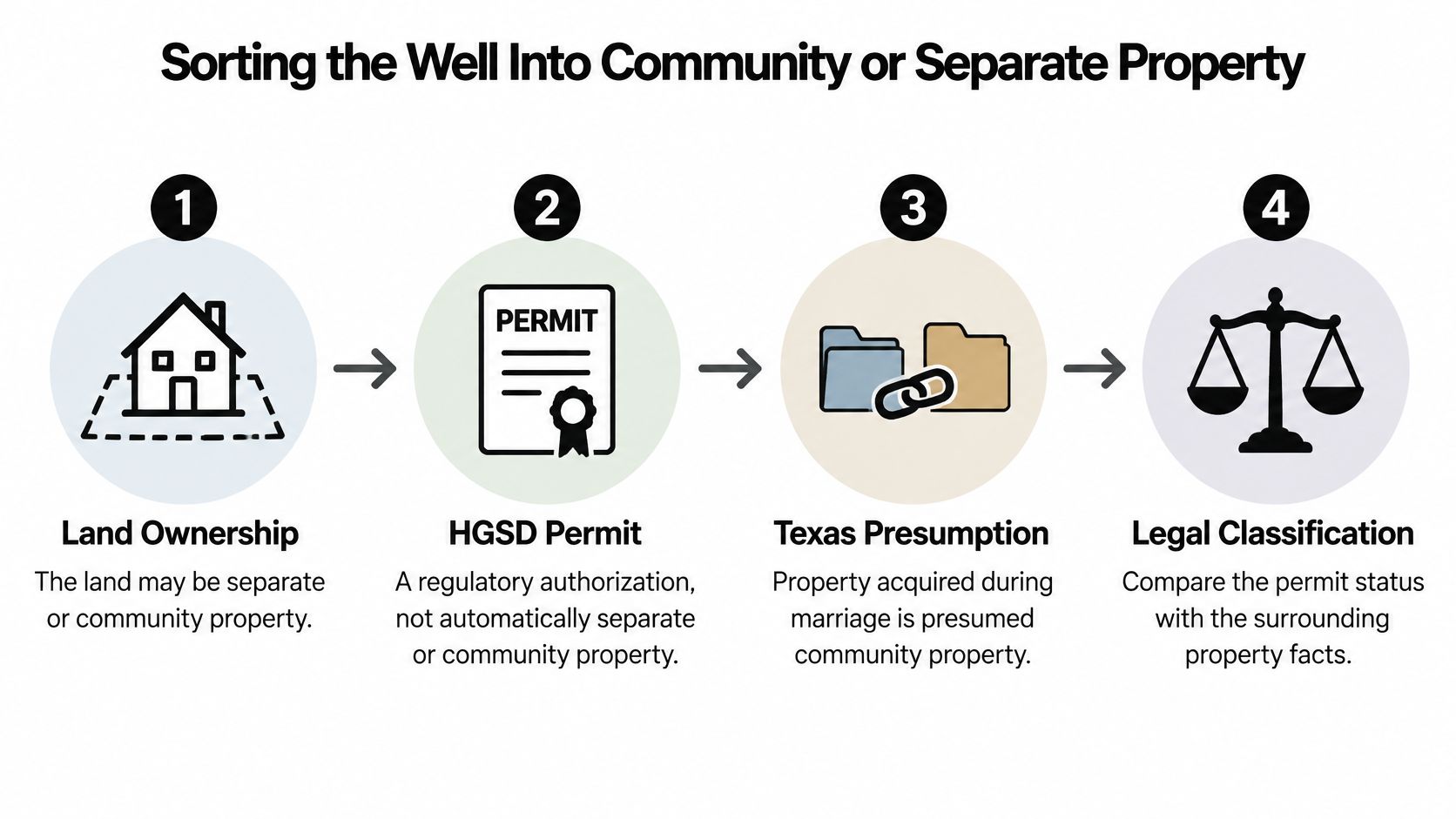
Match three facts against the marriage date. Who is on the deed. Who paid for drilling, equipment, maintenance, and permit fees. Which tracing documents show the source of those funds. Then value the land, the well infrastructure, and any groundwater allocation on separate lines. Mixing them into one number hides a reimbursement claim.
A Humble lot and a joint-account well
Say a couple marries, and the husband already owns a lot near Humble that he bought before the marriage. During the marriage they drill a well and pay the driller from a joint account. The land can remain his separate property. The well improvements paid for with community funds can be community property. That split can support a reimbursement claim under Texas law.
The spouse who paid the drilling bills typically has a stronger reimbursement claim than the spouse who only lived on the lot. Living there does not create a payment record. Bank statements, card charges, and the driller's invoice do.
Before any offer, answer one question in writing. Which assets were paid for with which funds, and which documents prove it. Our property division in divorce work treats that tracing as part of the marital estate, not as a side issue for the surveyor. A Divorce Lawyer in Atascocita, TX can put the land, the equipment, and the permit on the right lines of the schedule when the names don't match.
Practical rule: If the deed, the permittee line, and the person who paid the driller are three different names, don't treat them as one asset.
Regulatory Limits That Can Shrink the Asset
A well may appear to support a home, business, or irrigation operation, yet its permit can authorize less groundwater than the property needs. The District's groundwater authorization guidance says authorization depends on the well's location, available treated surface or reclaimed water, requested volume, participation in a Groundwater Reduction Plan, and credits used to offset pumping. These conditions can change how useful the property is and who should bear the cost of compliance.
For Regulatory Area 1, groundwater may supply no more than 10% of total water demand. In Regulatory Areas 2 and 3, the general limit is 20%, unless a well operates under a District-certified plan. The District's 2025 annual groundwater report executive summary describes a 40% limit beginning in 2025 for approved Groundwater Reduction Plan participants, followed by a 20% limit by 2035. The same report lists a regular permit rate of $26 per million gallons, an agricultural rate of $10, a disincentive rate of $12.52 per thousand gallons, and a $26 annual minimum.
| Regulatory area or plan | Limit or rate | What it means for the asset |
|---|---|---|
| Regulatory Area 1 | General groundwater cap | Limited groundwater may affect a property with substantial demand |
| Regulatory Areas 2 and 3 | General cap, subject to certified-plan rules | The permit may authorize less than the parties expect |
| Area 3 Groundwater Reduction Plan, permits issued from 2025 | Plan-specific cap | Confirm the applicable reduction schedule |
| Approved Groundwater Reduction Plan by 2035 | Lower future cap | Alternative-water arrangements may require investment |
| Regular permit rate | Permit charges and annual minimum | Include recurring charges in the operating picture |
| Disincentive rate | Higher charge for applicable withdrawals | Heavy use may create additional expense |
When the assumed supply isn't the authorized share
A family in Atascocita might assume a well can cover the property's full business or irrigation needs. Checking the regulatory area and permit terms may show that only a smaller share of demand is authorized. The District's permit page explains that the disincentive permit fee is set at 200% of the City of Houston's contract treated-water service charge without-airgap rate, plus the premium-over-contract-minimum rate, per thousand gallons of authorized withdrawal. Treat that potential charge as an operating obligation, not a minor detail.
The spouse who receives the property may also take on future compliance work and expense. Before agreeing to a buyout or assigning responsibility in a divorce decree, review the permit and supporting records together. The deed alone does not establish the amount of groundwater the owner may use, and a property's practical usefulness may fall as limits tighten.
- Regulatory area: Confirm which area covers the tract.
- Allocation: Check the authorized amount, rather than relying on the amount requested.
- Alternative water: Record whether treated surface or reclaimed water is available.
- Plan status and credits: Determine whether a Groundwater Reduction Plan or credits affect the applicable limit.
- Projected compliance costs: Account for conversion work and possible disincentive charges.
These details can affect both the property's future use and the fairness of a proposed division. Settlement terms should identify who will handle compliance and pay related expenses, rather than assuming the permit transfers with the deed unchanged.
Valuing the Permit, Well and Groundwater Use
Pumpage records may show three years of withdrawals far below the volume authorized by the permit. That gap matters in a divorce valuation: authorized production describes a regulatory allowance, while actual use helps show the well's practical value. Compare pumpage history with the authorized amount and the applicable area cap.

The District's description of how it regulates groundwater supports a record-based assessment. Retrieve at least three to five years of annual pumpage reports, renewal statements, fee payments, meter data, groundwater-reduction-plan records, and any violation notices. Reconcile authorized production with historical withdrawals. Unused capacity, restrictions, credits, or conditions can affect whether the authorization has market value or can be assigned without District approval.
Five schedules, not one lump sum
Separate the valuation into land value, physical well value, operating rights or allocation, liabilities, and post-divorce operating expenses. For the well itself, obtain an independent engineering estimate that addresses depth, casing, pump, electrical equipment, water quality, remaining service life, replacement cost, and abandonment cost. District fees belong among operating costs. They do not establish the well's fair-market value.
A property schedule that lists the permit's authorized volume as its value should be checked against pumpage reports and the area cap. If actual withdrawals are much lower, or the cap limits the share of demand that can be served, the schedule should reflect those constraints rather than assume the full authorization will be usable. The guide to septic system and water well valuation in an Atascocita divorce explains why the land, well, and operating rights should be valued separately.
Review the schedule for three common errors:
- Double-counting: The permit and the physical well are distinct assets. Avoid assigning the same value to both.
- Omitting duties: Reporting and renewal obligations can create liabilities even if no fine has been issued.
- Changing the name only: Awarding the permit to one spouse does not by itself update HGSD ownership records.
If the valuation cannot establish actual use, the operating right's value remains uncertain. The decree should state how that uncertainty affects the property division.
Transferring, Amending or Plugging the Well After the Decree
The decree can award the property and assign responsibility for the well, but the ownership filing still has to reach the District. If the filing is missed or the wrong person remains listed, the person responsible under the decree and the permittee in HGSD's records may not match.
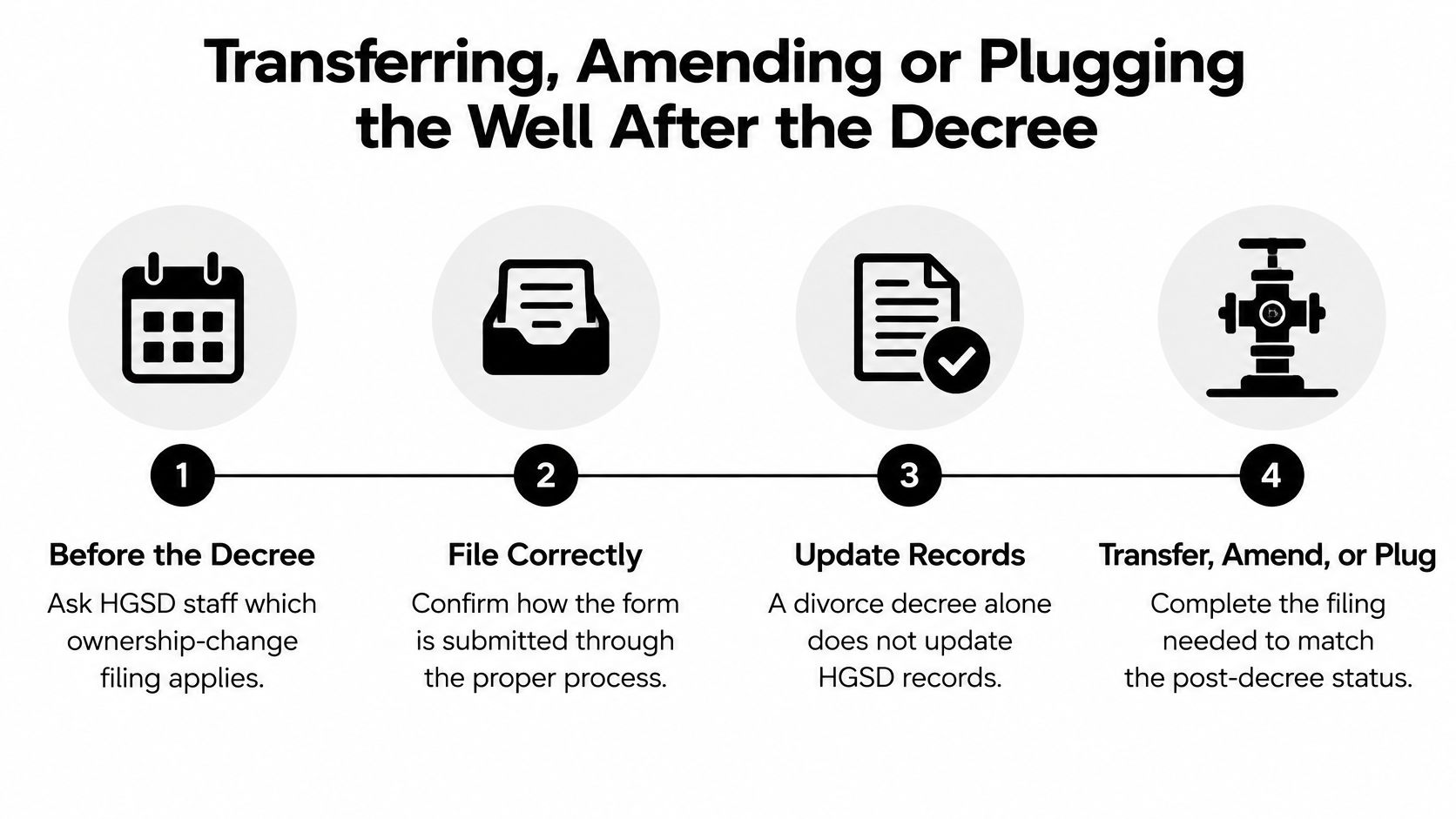
Before signing, confirm with HGSD which ownership-change filing applies, how to submit it through the online portal, and the applicable filing deadline. State in the decree who will file and require that person to provide the other spouse with confirmation. Keep the decree, deed, and inventory or closing documents together as evidence of the transfer. The same records discipline can matter for local charges, as explained in this overview of an Atascocita MUD tax lien and a divorce decree.
Stopping use does not close the permit
The District's permit FAQ explains that a permit requirement generally continues until the well's plumbing and power source are disconnected, the casing is capped, or the well is properly plugged. Leaving the well unused may leave the person keeping the property with continuing compliance duties. Before deciding to abandon it, confirm the required steps with HGSD and arrange for the work to be documented.
The FAQ also describes a narrow exemption for a well with a casing diameter less than five inches that serves only one single-family dwelling. The exemption does not apply to a new well in a platted subdivision with an available alternative water supply, which requires a drilling and operating permit; the District's registration requirements should be checked before drilling.
Keep a short post-decree checklist: confirm the transfer deadline already set out in the decree, identify who will handle the next required report and renewal, and retain proof of each filing. The annual reporting and renewal timing should follow the schedule established for the permit, rather than being assumed to change with the property transfer. If the well will be plugged, keep records showing that the required closure steps were completed.
Settlement Language to Put in the Decree
A short clause beats a long speech at mediation. The Harris-Galveston Subsidence District rules state that a person who becomes the owner of a permitted well must notify HGSD of the ownership change within 90 calendar days, and that a transfer becomes effective when the transfer registration is filed with the General Manager. Put that kind of date in the decree so nobody argues about it later.
- Identify the well: Name the permit number, the well number, and the permittee so the order can't be read as covering a different well on a neighboring tract.
- Assign the calendar: Say who files each annual report and each renewal, and name the date.
- Split the money by period: Assign fees, disincentive charges, and overage amounts for time before the decree and time after it.
- Set the transfer deadline: Use a clear date, such as 90 days after the decree, for the HGSD ownership filing.
- Cover the physical well: Allocate access, maintenance, and indemnity so the spouse who doesn't live there isn't stuck with repair calls.
- Plan for a tighter cap: Allocate conversion or alternative-water costs if the regulatory area or plan status changes what the well can supply.
- Credit drilling payments: Credit the spouse who paid drilling costs from community funds when the land itself is separate property.
- Require both signatures: Require both spouses to sign HGSD forms so one refusal can't freeze the file.
- Say what happens if the permit changes: State who bears the cost if a permit is denied, amended, or cancelled.
Sample sentence: "Spouse A shall file the HGSD transfer-of-ownership registration within 90 days after this decree is signed and shall file each annual groundwater-use report by the following January 31."
We handle the paperwork and negotiate settlements, so a clause that's hard to draft can be worked out with counsel before the mediation session rather than rewritten in the hallway.
Confirm Your Filings and Book a Free Consultation
Before the decree is drafted, contact the Harris-Galveston Subsidence District (HGSD) to clarify the permit's status and what steps it requires for a proposed change in ownership. The District can address its filing requirements; questions about how Texas law treats the property belong with a divorce attorney.
Bring the deed, permit records, and payment documents to counsel if ownership is disputed, the well supports a business or farm, or groundwater limits could affect the property's value. A permit's future limits and compliance duties can change what the property is worth, even when the deed and the permit records appear to describe the same asset.
Our divorce attorneys have local experience with courts, judges, and the legal system in Atascocita and surrounding counties. The firm represents clients in property division, child custody, and spousal support matters across Harris County.
Choose representation that fits the dispute. The Atascocita divorce lawyer page describes the firm's divorce services. If spouses disagree over the well or other issues, review the firm's contested divorce information. Couples who agree on the well and the rest of the estate can learn about an Uncontested Divorce Lawyer in Atascocita.
The Law Office of Bryan Fagan – Atascocita TX Lawyers serves families in Atascocita, Humble, and throughout Harris County. Its attorneys handle divorce steps from jurisdiction and filing through negotiation and finalization, including paperwork and settlement discussions. Visit Law Office of Bryan Fagan – Atascocita TX Lawyers for information about the firm's legal services.
Use the HGSD's filing requirements and the divorce decree together when deciding who will hold the well-related responsibilities. A settlement that allocates the property but leaves those responsibilities unclear can create avoidable disputes after the divorce.