Skip to content

In Texas, an Atascocita septic permit transfer after a divorce follows the legal transfer of the home itself, but the Harris County file still needs a change-of-ownership submission, and the owner of a single-family aerobic system has 30 days after transfer to obtain a maintenance contract or maintain the system personally. You're probably standing in a kitchen in Atascocita or Humble with a signed decree in one hand and a septic alarm, a refinance request, or a repair quote in the other, wondering why the house feels settled in family court but unsettled everywhere else. That gap is normal, and it's fixable once you separate three things that don't move at the same speed, the divorce award, the recorded deed, and the county permit record.
What Happens to the Septic Permit After Divorce
Say a couple in unincorporated Atascocita finishes a divorce and the decree awards the house to one spouse. There's no ordinary sale, no closing table, and no new buyer to trigger the usual paperwork, so both spouses assume the septic permit just follows the judge's signature. In legal terms, they're mostly right, and in practical terms, they're only halfway done.
Texas treats an on-site sewage facility, or OSSF, as part of the property's legal transfer rather than as a permit that ordinarily requires a divorce-specific approval, and TCEQ rules on OSSF permit transfer provide that an OSSF permit transfers automatically to a new owner upon the sale or other legal transfer of the property. That means the controlling event is usually the property disposition in your decree. If one spouse receives the home, that spouse becomes the owner associated with the permit. If you sell the home, the buyer does.
Why the County File Can Lag Behind Title
Automatic transfer under state rules doesn't mean a clerk in Harris County watches your divorce case and updates the septic file for you. TCEQ separately advises a purchaser to notify the local permitting authority after closing and ask about proper startup procedures, and the same habit protects a spouse who receives a home by decree. The available TCEQ materials don't establish a statewide filing deadline or transfer fee specifically for a divorce-related OSSF transfer, so you can't rely on a single state deadline to tell you when the county side is complete.
Use this table to check where you stand. Read your situation across, not just down the first column.
| Situation | Title result | County permit file | Immediate duty |
|---|---|---|---|
| Home awarded to one spouse | Decree plus a recorded deed should vest title | File may still list the former owner | Submit change-of-ownership papers and keep written confirmation |
| Home sold to a buyer | Buyer takes title at closing | Buyer should notify the local authority | Hand over the OSSF file and ask about startup |
| Temporary exclusive possession | Title often remains joint | Permit stays with the legal owners | Do not treat possession as a completed transfer |
| Decree signed but deed still joint | A partial ownership interest can remain | Both spouses may still be owners | Record a deed before relying on the award |
| Aerobic treatment system | Permit follows the new owner | Maintenance-contract data must be current | Obtain a contract within 30 days or maintain the system personally |
An OSSF owner isn't just the spouse whose name appeared on the original application. The definition reaches anyone with legal possession or a total or partial ownership interest in the property served by the system. Until a deed is recorded and the other spouse's interest ends, both of you can remain tied to the system in ways that surprise people who thought the prove-up ended everything.
Practical rule: Treat the decree as the court's instruction, the recorded deed as the title change, and the county submission as the proof that the septic file caught up.
Your first local question is jurisdiction, not forms. Confirm whether the lot sits in unincorporated Harris County or inside a city limit, because an Atascocita or Humble mailing address doesn't always map to the same permitting office. Preserve the final decree, recorded deed, septic permit, site evaluation, and maintenance records while you confirm which authority serves the property. That stack becomes the evidence every later office, lender, and contractor asks for.
Decree and Settlement Language That Makes the Transfer Work
A decree that says only "Wife is awarded the residence" gives a family court enough to divide property, but it may not give Harris County, a title company, or a septic contractor enough to act. Good settlement language anticipates the offices you'll visit after the divorce is final. You don't need to draft it yourself, but you should know which sentences to ask your lawyer to include before the prove-up.

Start with identification. State the home's full street address in Atascocita, Humble, or northeast Harris County, and state that the OSSF and its permit go with the house. That sounds obvious until a permit file uses a lot description, an old address format, or a prior owner's name and someone has to prove the system in the yard is the system in the file.
Clauses That Prevent a Second Dispute
Next, require action by a date. Your settlement should require the transferring spouse to sign a special warranty deed and any county ownership affidavit by a set deadline after the divorce is final. Without a deadline, a cooperative agreement in mediation can drift for months while mail, insurance, and service contracts keep arriving in both names.
Money needs its own sentences. Allocate who pays for a pre-transfer inspection, overdue pumping, needed repairs, and the next aerobic maintenance contract, and say whether any of those costs come from sale proceeds if the home will be sold. A system that hasn't been serviced during a long separation can turn a clean property division into an argument over a bill neither spouse budgeted for.
Authority matters, too. Give the spouse receiving the home written authority to speak with Harris County and with septic contractors after the award. Say a spouse near Lake Houston receives the house, then calls a repair company when effluent surfaces in the yard. If the deed and permit still list both names, the company may pause and ask who can authorize work, right when the homeowner needs help fastest.
That pause has a legal root. Texas rules define an OSSF owner broadly, and the TCEQ OSSF rules compilation includes anyone holding legal possession or a total or partial ownership interest in the structure or property served by the system. A leftover partial interest during the gap between decree and deed can therefore keep both spouses connected to the permit. The permit follows legally recognized ownership, not just the person who first applied.
Don't leave the mortgage as an afterthought. If a mortgage or home-equity lien is in both names, state who must refinance or assume the loan, by when, and what happens if the lender refuses, such as listing the home for sale. A lender isn't bound by your divorce decree, so a spouse can receive the house on paper and still share loan risk until the debt itself changes.
If you're reviewing a draft settlement, a Divorce Lawyer in Atascocita, TX provides divorce representation for clients in Atascocita and Harris County and can check whether these clauses fit the rest of your property division. You can also review general information at www.atascocitaattorneys.com before you sign. Bring four items to that conversation, a deed deadline, a septic-cost split, signing authority, and a mortgage plan, and ask that each one appear in plain language in the final documents.
How to Update the Harris County OSSF Record
Once the decree is signed, work in one sequence and finish each step before you rely on the next one. Skipping ahead to repairs or a refinance while the county file still names the wrong owner creates delays you could've avoided with a week of paperwork.
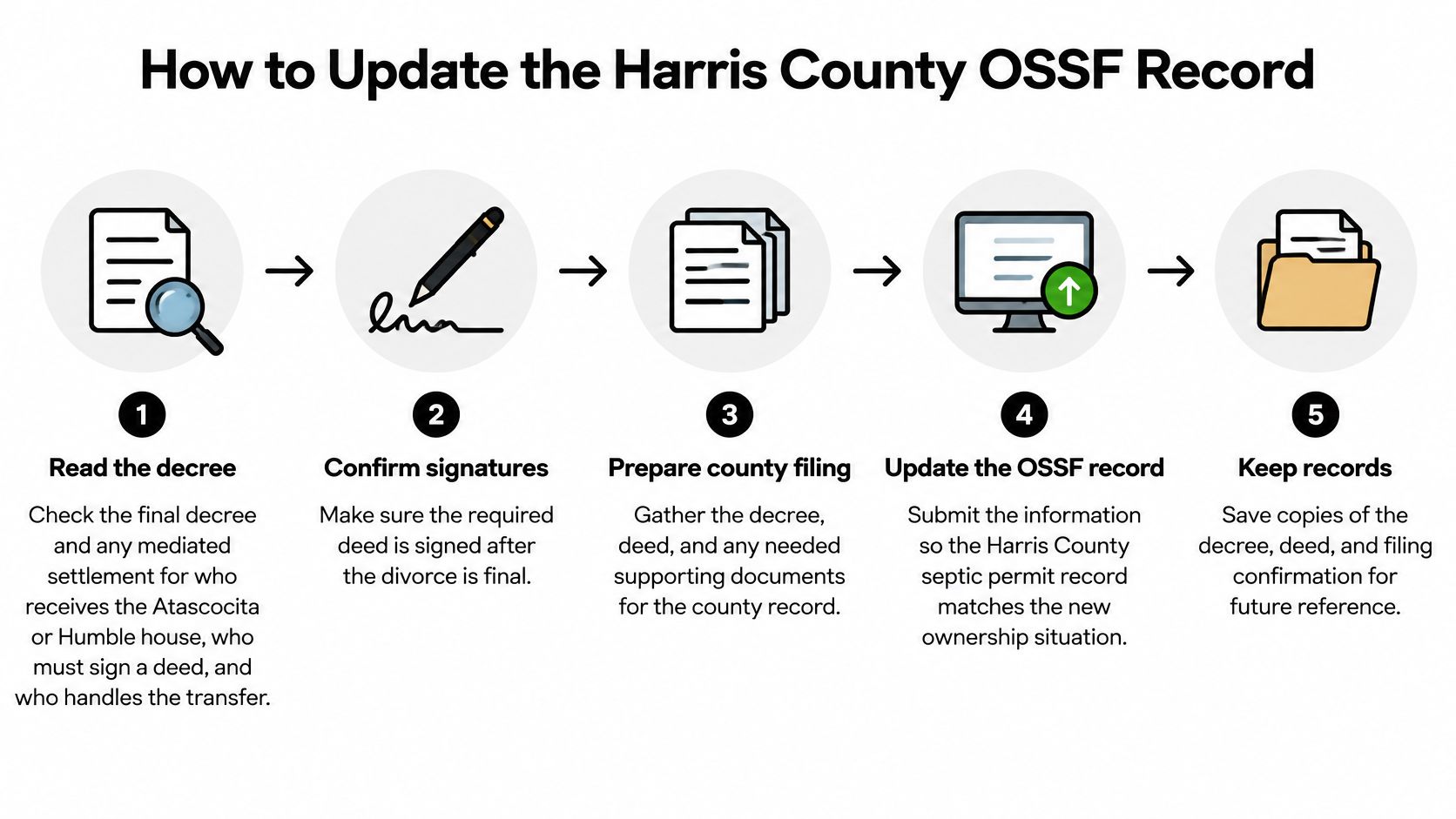
The Seven Steps in Order
- Read the final decree and settlement closely. Note who receives the Atascocita or Humble house, who must sign a deed, and who pays septic costs, because the county packet should match those terms exactly.
- Confirm jurisdiction before you file anything. Harris County's Office of the County Engineer issues OSSF permits for systems in unincorporated Harris County, and its wastewater quality permitting page explains that review evaluates whether a system satisfies both the Harris County Local Order and Texas Administrative Code section 285. A property inside a municipality may be handled by that city's authority instead.
- Pull the existing septic file. Gather the OSSF permit, site evaluation, and maintenance records, and ask the county for the planning file if the permit is missing, so you're updating a known system rather than guessing at its type or location.
- Record the deed or other conveyance. Title should match the award before you ask the permitting office to treat one spouse as the sole owner.
- Submit the county ownership packet. Harris County publishes an OSSF permit application and related ownership documents, and its regulations, standards, and forms page lists an OSSF Property Owners Statement, an Affidavit to the Public, and an affidavit permit-process document specifically identified for a change of ownership or change of business. Include the decree and recorded deed if the office requests them, since an informal note between former spouses may not be enough.
- Handle an aerobic system on its own clock. The new owner should obtain a maintenance contract within 30 days after transfer or maintain the system personally, and that date belongs on your calendar the day the transfer occurs.
- Keep written confirmation. Don't order major repairs, schedule a refinance inspection, or list the home for sale until you can show the updated record to the next person who asks.
Readers comparing this process with other property records sometimes also review our discussion of a Harris-Galveston Subsidence District well permit in a divorce, because wells and septic systems raise similar record-matching problems after an award. The offices differ, but the habit is the same. Match the decree, deed, and agency file before you spend money.
What Harris County Does Not Publish for Divorce Cases
The public Harris County index doesn't publish a divorce-specific fee or processing time for this update. Ask for the current fee and expected review timing when you file, and keep the receipt with the name of the person who accepted the packet.
| Item | Known rule | Action |
|---|---|---|
| Filing fee | No divorce-specific fee is published in the county index | Ask the Harris County Office of the County Engineer when filing |
| Processing time | No divorce-specific processing time is published in the county index | Ask for the expected review date and keep the receipt |
| Divorce-specific transfer deadline | None stated in TCEQ materials | Set a deed deadline in the decree |
| Aerobic maintenance contract | Within 30 days after transfer, or maintain the system personally | Calendar the date when the award is signed |
| Permit transfer after a sale | Buyer notifies the local authority after closing | Buyer asks about startup procedures |
A complete file at the end contains six items, the decree, recorded deed, septic permit, site evaluation, maintenance contract if the system is aerobic, and written county confirmation. Store copies together, not scattered between a divorce folder and a junk drawer. Future you, a buyer, or a lender will need the whole set at once.
Title Problems Liens and a Missing Permit
The most common stall is simple. The decree awards the house to one spouse, everyone exhales, and nobody records a deed, so title remains joint while daily life moves on as if it weren't. Months later, a refinance, repair, or sale forces both former spouses back into a transaction they thought ended at the courthouse.
Texas law requires an OSSF permit to be issued in the name of the person who owns the system and to identify the specific property address, and Texas Health and Safety Code section 366.054 does not clearly explain whether a divorce decree, deed, or property-settlement agreement automatically updates the permitting authority's records. Harris County identifies OSSF permitting as a county engineering function, but its public permit index does not explain a divorce-specific transfer procedure, required documents, fees, or processing time. That silence is why a stamped receipt or written confirmation from the actual permitting office matters more than an assumption shared by both spouses.
Problems That Stop Work Cold
| Problem | Why it blocks the transfer | Practical fix |
|---|---|---|
| Decree awards the home but the deed is still joint | A narrative award may not end a partial ownership interest | Record a deed that matches the decree |
| Permit missing or issued to a prior owner | The county cannot update a file it cannot match | Request the OSSF planning file before repairs |
| Mortgage or lien in both names | A lender may require clear title or an inspection | Plan a refinance, assumption, or sale term in the decree |
| Repair requested before authorization | Work on another person's system needs proof of authority | Get written owner authorization before the contractor starts |
| Wrong city or county office | An in-city lot is not reviewed as unincorporated Harris County | Confirm jurisdiction from the property address |
A missing permit deserves patience, not improvisation. If the permit names a prior owner or can't be found in the home's records, request the county planning file and match the address, system type, and site evaluation before anyone digs. Older homes around Humble and northeast Harris County may have changed hands more than once since installation, and a mismatch discovered early is a records problem, while a mismatch discovered during a repair becomes a delay with an open yard.
Liens create a different kind of block. A mortgage or home-equity lien in both names can prevent the receiving spouse from refinancing alone, and a lender may require clear title or a septic inspection before it proceeds. Property-related liens can also surface from other local obligations, which is why some homeowners review information about an Atascocita MUD tax lien and a divorce decree while they sort out who owes what on the same parcel. Your decree should say what happens if refinancing fails, rather than leaving both credit reports tied to a house only one person occupies.
Texas prohibits construction, alteration, repair, or extension of an OSSF without a permit and approved plan, and prohibits work on another person's system without proof of authorization.
That prohibition explains a contractor's caution. If you occupy the home but aren't yet the recorded sole owner, get written authorization before work begins and keep it with the service invoice. Verbal permission from a former spouse is hard to prove later if the bill or the quality of work is disputed.
The sale edge case is cleaner. When the home sells, the buyer, not either former spouse, becomes the owner at closing, and the buyer should notify the local authority and ask about startup procedures. Get written confirmation from the permitting office before repairs, refinancing, or listing in every scenario, because each of those events sends a new professional looking for a permit file that matches the deed.
Maintenance Costs and Local Rules to Check
Who pays for pumping during separation? Who renews the aerobic contract while one spouse has temporary possession? Those questions feel like permitting questions, but they're usually family-court questions, and confusing the two tracks leaves bills unpaid while each spouse waits for an office that was never going to decide.

Two Tracks Running at the Same Time
On the permitting track, the county cares who the recorded owner is and whether operational paperwork comes from that owner or an authorized representative. Texas requires permits for operating an OSSF and places the permit in the system owner's name, and the TCEQ OSSF permits page notes that local permitting authorities may impose requirements more stringent than state minimums. Harris County reviews OSSF permits in unincorporated areas, so a checklist borrowed from another county isn't safe to copy for an Atascocita property.
On the family-court track, the court decides who pays. Public guidance generally discusses new installations or ordinary sales, not who must pay for inspections, overdue maintenance, repairs, or contract renewal while spouses are separated, during temporary possession, or after one spouse receives the property. If you paid for pumping or an emergency repair during separation and want reimbursement, you may need language in the decree or later family-court relief supported by property-division documentation. The permitting office won't order your former spouse to repay you.
Temporary possession sits between the tracks and confuses almost everyone. Exclusive use of the house during the case isn't a permit transfer, and the occupying spouse's practical ability to call a service company stays separate from the record owner's formal authority. Temporary orders should therefore say who pays routine service, who can authorize non-emergency work, and how emergency costs are documented, even though final ownership hasn't been decided yet.
For aerobic systems, paperwork after a change matters beyond the county file. State law requires updated maintenance-contract and performance-bond information after a contract is terminated or modified, so tell the service provider when ownership changes instead of letting reports continue under a former spouse's name. Ask four questions early, whether the system is conventional or aerobic, whether the property lies in unincorporated Harris County or another jurisdiction, whether a maintenance contract exists, and whether the divorce order allocates future service costs.
Homeowners who are also dividing rural or semi-rural property value sometimes review our page on septic system and water well valuation in an Atascocita divorce to understand how system condition can affect the property discussion. Whatever the value, keep the site evaluation and service invoices with your award file. A later buyer or lender in northeast Harris County will ask for proof of maintenance, and a well-kept folder turns an unresolved ownership record from a hidden marital-property liability into a documented, transferable asset.
Bring the Decree and Septic File to a Lawyer
Some post-divorce permit updates are mostly clerical. If the decree is clear, the deed is recorded, both spouses cooperated, and the county confirms the updated record in writing, you may be able to finish the ownership packet without reopening legal issues. Don't force that simple path onto a file that has a conflict in it.
Bring the papers to a divorce lawyer first when you recognize any of these situations.
- The deed and decree conflict. One document awards the home to you while the other leaves title or obligations in both names.
- A spouse will not sign. The deed or county affidavit sits unsigned after the deadline in your settlement.
- A lien or mortgage is unresolved. Refinancing or assumption hasn't happened, or a lender has already refused.
- The permit cannot be found. The county file names a prior owner, or no one can match the system to a permit.
- Possession is tied up with children. Who lives in the home, and for how long, depends on custody terms that also affect when a transfer or sale can occur.
The Law Office of Bryan Fagan – Atascocita TX Lawyers handles divorce matters for Atascocita, Humble, and northeast Harris County, and clients can visit the Atascocita office for consultations. Our divorce attorneys have local experience with the courts and judges in Atascocita and surrounding counties. The attorneys listed on the Meet The Team page for the Atascocita office are Byron Shaw and Teresa J. Glascoe.
To schedule a free consultation, you can call 281-519-3083 or complete the firm's online contact form through www.atascocitaattorneys.com. That conversation is most useful when you bring the actual file rather than a summary from memory. Dates on a deed, names on a permit, and one sentence in a mediated settlement often decide the next step.
Do one thing this week. Gather the signed decree, recorded deed, septic permit, and any maintenance contract into a single stack, then either submit the county ownership packet or bring those papers to your consultation. You'll leave knowing whether you're finishing a records update or fixing a property problem, and that distinction saves you from spending money in the wrong order.
If your decree awarded you an Atascocita or Humble home but the deed, mortgage, or Harris County septic record still names both spouses, we can review the documents together and map the corrections in the right order. Visit Law Office of Bryan Fagan – Atascocita TX Lawyers to schedule a free consultation at the Atascocita office, and bring your decree, deed, and septic file so we can give you specific next steps for your property.