You've spent years getting up before the sun to check water troughs, count pairs and watch the gate for a heifer that looked like she might calve early. Then one evening the conversation you've both been avoiding lands on the kitchen table, and the first question in your head is a practical one nobody can answer over dinner: who feeds the cattle next week?
That question is where most Atascocita-area acreage and livestock divorces begin, and it's the reason this type of case doesn't fit the standard property division mold. A tract off FM 1960 or a few acres past the Beltway can hold a homestead, a barn full of hay, a trailer, a well, a pond and a working herd all at once. Sorting out atascocita acreage and livestock in a divorce means separating a home from a business, an inheritance from a marital investment and a living animal from a line item on a spreadsheet.
Owners can burn through savings fighting over who keeps the cow pasture while the herd's real value is consumed by feed bills, drought and time. What follows is how Texas law treats the land and the animals, what records you need to assemble before mediation, and how to keep the operation from falling apart while the case is pending.
How Texas Sorts Your Acreage and Livestock
The question most owners ask first is the one that feels most personal: is this land or this herd mine alone? Texas starts from a premise that surprises almost everyone. Under the Texas Family Code § 3.002, community property includes property acquired by either spouse during the marriage unless it qualifies as separate property, and Texas presumes that property possessed by either spouse at divorce is community property. If you claim the acreage, the cattle, the tractor or the sale proceeds are separate, the burden rests on you, and the standard is clear and convincing evidence, not a preponderance.
That single rule reshapes how people should think about a working operation. Acreage purchased after the wedding generally enters the community estate even if only one spouse's name appears on the deed. The title name alone doesn't settle it either, because Texas applies the inception of title rule when community and separate estates share an ownership interest. What does matter is tracing: dated deeds, inheritance records, gift documents, bank statements and a reliable accounting of later contributions.
Classification is the starting gate, not the finish line. Once every acre, animal and account is sorted, the court divides the estate in a manner it considers just and right, which is a different question from ownership. A tract can be partially separate and partially community, with reimbursement owed for marital money spent improving or paying down the separate portion.
| Scenario | Likely classification | Evidence to gather |
|---|---|---|
| Land owned before marriage, title in one name, no marital money paid toward it | Separate, if the premarital ownership is traced | Premarital deed, closing statement, bank records |
| Land bought during marriage, title in one spouse's name | Community; the title name alone does not control | Purchase contract, closing statement, source of down payment |
| Land inherited or received as a gift | Separate, if documented | Will or probate records, gift documents, deed |
| Premarital land with mortgage paid from marital earnings | Separate land with a reimbursement claim | Loan history, payment records, bank statements |
| Calves from a separate herd born during marriage | Usually follows the parent herd if the lineage is traced | Registration papers, breeding log, dam and sire records |
| Cattle bought or sale proceeds funded by marital income | Community | Sale receipts, bank deposits, purchase invoices |
Local context matters here more than a generic guide admits. Northeast Harris County tracts often function as both a homestead and a working operation, so a single property can carry a residence claim, a business asset and a separate-property component under one fence line. Our divorce attorneys have local experience with the courts, judges, and legal considerations of Atascocita and surrounding counties, which is useful when a mixed tract needs to be presented clearly rather than argued in the abstract.
Before you talk to anyone, including a well-meaning neighbor with strong opinions, sort every acre, every animal and every account into community, separate or mixed. Write it on paper. That list becomes the spine of everything that follows, and property division in a divorce moves much faster when it exists.
Assemble Records and Experts Before Mediation
Mediation rewards preparation and punishes surprise. Walking into a session without tag numbers and a clean title chain gives the other side room to argue that your herd count is guesswork, and once your credibility on the cattle is dented, everything else you say gets discounted too.
Start by fixing the valuation date with your attorney. Every count, balance and acre value is measured as of that date, so pulling records without one means you'll do the work twice.
**Practical rule:** Build the file backward from the valuation date. Anything dated after it explains movement, but it doesn’t change the number the court will use.
Step one: pull the title chain
Go to the Harris County Clerk's real property records and pull the deed, the closing statement and the loan history for every tract. A missing closing statement is the most common gap in an otherwise solid file, and it's the document that usually reveals where the down payment came from. That single page can decide whether a reimbursement claim exists.
Step two: tag every animal
A herd list without tag numbers cannot be checked by anyone, including your own expert. Record ear tag or brand, registration number, sex, age, breed, pregnancy or production status, and the ownership record for each animal. If an animal has no tag, photograph it, describe its markings and note where it runs. Then reconcile the list against veterinary files, breeding logs, feed purchases, sale receipts, insurance schedules and bank deposits.
Step three: follow the money
Pull bank statements showing where operating money came from and where sale proceeds went. Those two flows decide whether income is community and whether a sale was a business transaction or a distribution of marital value. Feed invoices and veterinary bills tell the same story from the expense side.
Step four: document the improvements
Photograph and date the barns, fencing, wells, ponds and equipment. Write down serial numbers for tractors, trailers and implements, because a trailer without a serial number in the file tends to get awarded to whoever is standing next to it. Dated photographs are worth more than a memory of when the barn went up.
Step five: build the marital balance sheet
One row per asset. Classification, value, debt and source documents in four columns. When a row has no document behind it, that's the row to work on next, not the row to argue about.
The four-stage workflow that works best is straightforward: classify each asset by acquisition date and source of funds, assemble the records described above, obtain separate expert opinions for rural real estate and livestock, and reconcile the valuation date, liabilities and proposed division on that balance sheet. For land, don't lean on county agricultural averages. Farm-real-estate estimates can include land, buildings and dwellings, which makes a highest-and-best-use appraisal essential for suburban Harris County acreage that could be agricultural, residential or development property. The appraisal should separately identify the residence, barns, fencing, wells, ponds, equipment, mineral interests and any business or homestead component, then allocate debt and appreciation consistently. Treating the tract as one undifferentiated asset is the pitfall that inflates and distorts more estates than any other.
Then line up five professionals in the order your attorney sets, so scope is fixed before anyone writes an opinion: a rural real estate appraiser, a livestock appraiser or auction data source, a large-animal veterinarian for herd health files, a CPA for income tax and depreciation consequences, and an Atascocita divorce lawyer to coordinate them so each asset is valued exactly once.
Valuing Land and Livestock Without Double Counting
The mistake that inflates most estates is simple: multiplying acreage by a rural-land average and calling it done. A tract near Humble or Atascocita may be worth considerably more as residential or development ground than as pasture, and the appraisal method has to match the likely use. USDA figures illustrate why broad averages mislead rather than resolve. National farm real-estate value averaged $4,080 per acre in 2023, cropland averaged $5,460 per acre and pasture averaged $1,760 per acre, according to the USDA land values report. Three numbers, three very different answers for the same ground.
So split the tract and value each component on the method that fits it.
| Component | Valuation approach | Evidence to collect |
|---|---|---|
| Residence and homestead | Residential comparable sales | Appraisal, tax appraisal notice |
| Pasture and grazing land | Highest-and-best-use appraisal, agricultural versus development | Current appraisal, zoning, utility and water access details |
| Barns, fencing, wells and ponds | Replacement cost less depreciation | Contractor estimates, build dates, dated photos |
| Breeding herd | Comparable auction results adjusted for breed, age and reproductive status | Tag list, registrations, veterinary files, sale barn results |
| Tractors, trailers and equipment | Market or auction value | Serial numbers, purchase invoices, photos |
| Offspring and sale proceeds | Value once; do not count calves and herd appreciation twice | Breeding log, sale receipts, bank deposits |
| Loans and feed debt | Subtract balances as of the valuation date | Loan statements, feed and veterinary invoices |
Why headcount estimates fail
A herd is an auditable inventory, not a number. Freeze the inventory at the legally relevant valuation date, identify every animal by tag, registration, sex, age, breed, pregnancy or production status and ownership record, then reconcile that list against the veterinary, breeding, feed, sale, insurance and banking records. The USDA farm sector balance sheet documentation explains that official inventory methodology values livestock changes by multiplying physical head count changes by average per-animal market values, and that NASS livestock estimates rely largely on probability surveys and, for some categories, near-total counts. That's the right tool for a state or county total. It's the wrong tool for a courtroom, where the question is what this animal, in this condition, is worth.
Replace averages with observable market evidence: comparable auction results, breed and quality adjustments, reproductive status, health, age, and transportation or sale costs. Separate operating inventory from capital assets like breeding stock, tractors, trailers and equipment, and test whether births, deaths, purchases, sales or appreciation after separation belong to the marital estate or reflect one spouse's post-separation labor.
Sale proceeds, offspring and herd appreciation can all describe the same value. Every dollar gets valued once, in one row, with one document behind it.
The traps that shrink a net estate
Double counting is the first. A calf counted as inventory and again as a sale receipt is counted twice. Ignoring liabilities is the second: feed balances, veterinary charges and secured loans all reduce net value as of the valuation date, and a herd that looks like a six-figure asset with a five-figure feed note is a different asset. Skipping tax consequences is the third, because ordinary income and depreciation recapture change what a sale nets.
Texas agriculture gives a sense of scale here. The 2022 USDA Census of Agriculture for Texas counted 46,412 Texas farms with cattle and calves, and the statewide inventory came to roughly 13.18 million head. Those are statewide figures, not an appraisal of your place, but they show why a herd is an asset category and not a household possession. County-level NASS numbers reconcile county totals to state controls, so they're a benchmark, never a substitute for a certified, animal-specific valuation.
Ask each appraiser for three things: a component breakdown, the valuation date, and the comparable sales used. If a report won't show its comparables, it won't survive cross-examination, and business valuation in divorce follows the same discipline for the operating side of the ranch.
Keeping the Operation Running During the Case
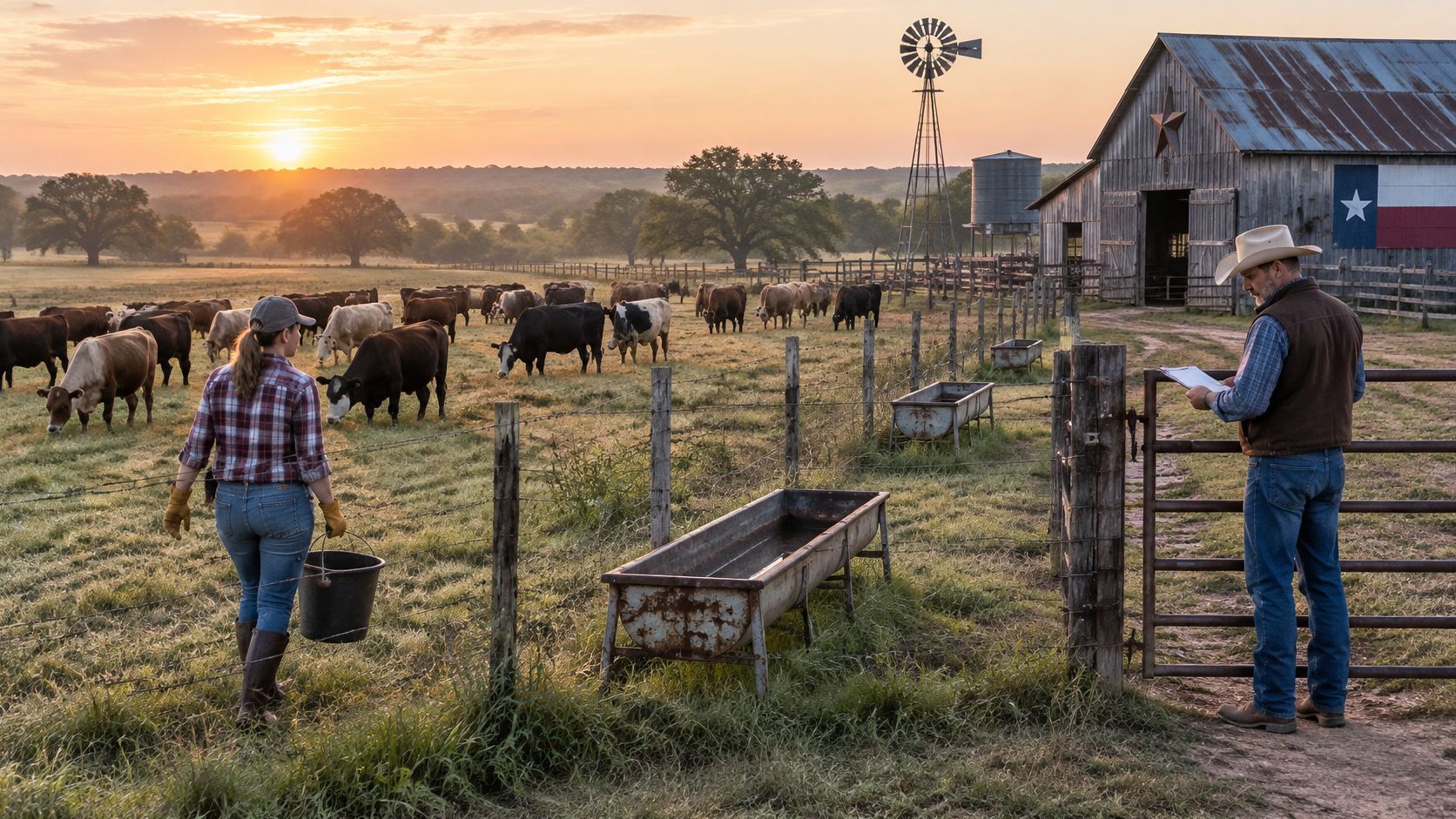
Consider a Humble couple with 40 acres and 22 head. She feeds every morning before work and knows which cow is due. He handles the sale barn and the books. Two weeks after he moves out, the hay barn is half empty, one heifer has hoof rot nobody treated and he has scheduled three head for Thursday's sale without telling her. Nothing in the divorce filing caused any of it. The absence of a plan did.
Livestock can't be frozen like a bank account. Animals need feed, veterinary care, breeding decisions, pasture, transport and insurance every single week, and those obligations don't pause for discovery. Texas family law guidance on temporary orders reflects the same practical reality: the presumption that property possessed at divorce is community property creates a need for an interim inventory and an operating plan, and valuation is far more involved than multiplying headcount by a market price. Breeder bulls, horses, embryos, semen, offspring, equipment, trailers and goodwill often require their own evidence, and horse values are especially subjective.
Write the interim operating plan before someone gets hurt
Put it in writing, even if it's a signed page between the two of you and your attorneys. Cover who feeds and treats the animals, which account pays each expense, how births and deaths get logged and within how many days, and whether any sale requires written consent. Then decide where proceeds go. Holding sale money in a joint or escrow account beats splitting it, because once proceeds are distributed, recovering them is a separate fight.
Temporary orders can be requested early in a Harris County case to set who manages the herd, who pays feed and veterinary bills, and whether sales or removal of animals are barred. Emergency relief is for animals at risk from neglect, removal or an unauthorized sale, and it needs to be requested quickly, backed by dated photographs, feed invoices and veterinary records. A judge responds to documentation, not to a description of how you feel about the cows.
What the courts actually want to see
A running ledger, monthly photographs of the herd, and a written record every time animals move. Those three habits answer the questions that otherwise turn into accusations: how many head were there on the valuation date, what died and when, and where the money went.
The counterintuitive part: the spouse who takes physical possession isn't necessarily the one getting the economic benefit. Possession carries continuing liabilities, feed and veterinary costs, and that burden can justify credits or offsets in the final division.
If the property operates as a boarding barn, a hobby farm or a small business, treat the operating side as a business with real expenses and real revenue, not as a sentimental attachment to acreage.
The orders that matter most here get set early, and they're worth discussing at the very start of the case rather than after the hay runs out.
Settling Acreage Through Buyout, Partition or Sale
Texas doesn't split marital land and herds fifty-fifty. Texas Family Code § 7.001 requires the court to divide the parties' estate in a manner it considers just and right, weighing the rights of each spouse and any children of the marriage. That standard permits an unequal division when the evidence supports it. The proof that moves the needle includes each spouse's income and earning capacity, separate-property resources, fault in the breakup, health, custody responsibilities, reimbursement claims and the economic consequences of awarding the land or livestock to one side.
Picture the common outcome: the spouse who runs the cattle keeps the pasture and the herd, and the other spouse receives cash, a larger share of retirement savings or the house in town to balance the estate. The court values the whole estate rather than treating the acreage as if it stood alone, which is exactly why appraisals, loan balances, livestock inventories, equipment lists, tax records and production records belong in the file before anyone negotiates.
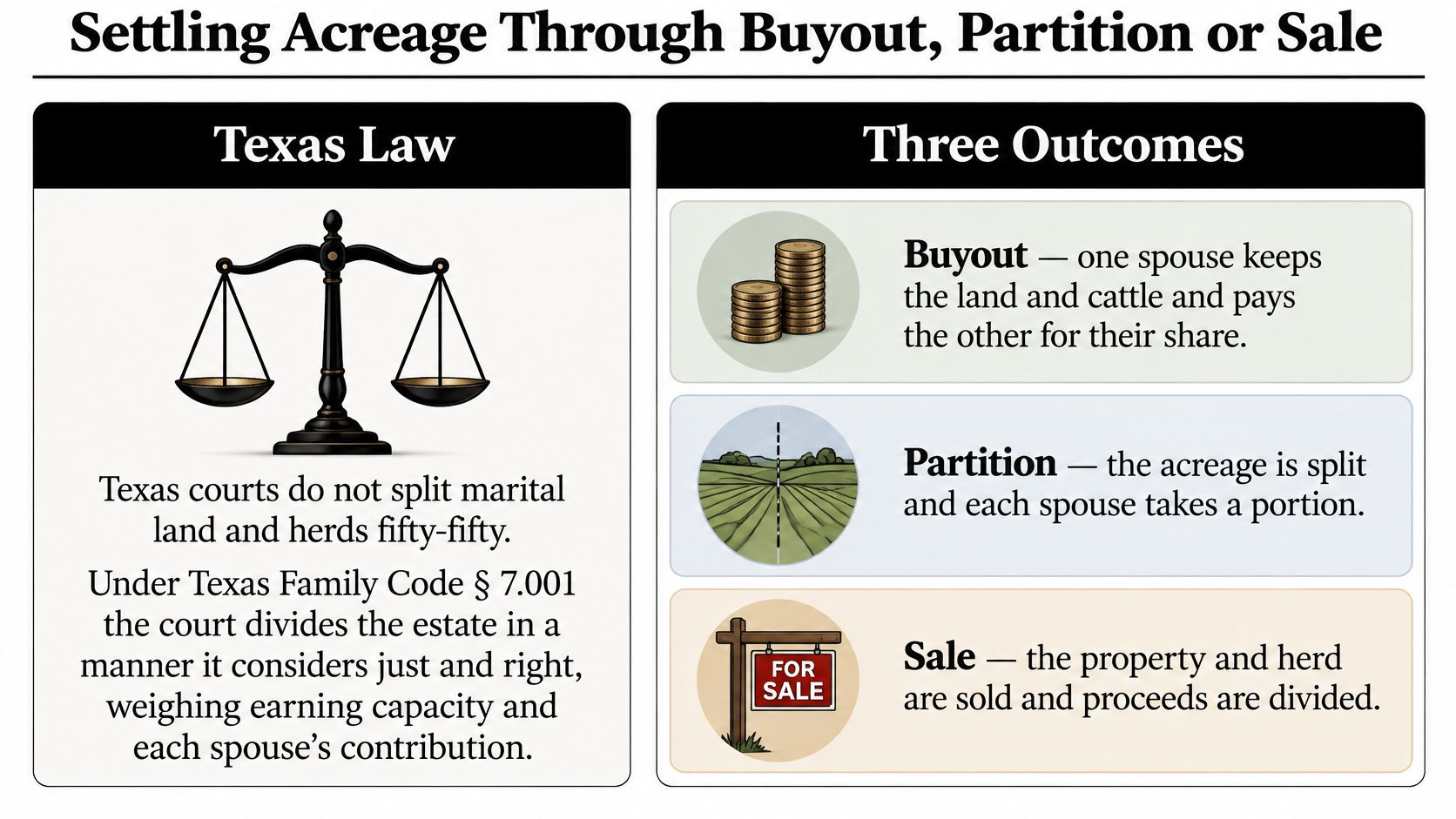
Four routes do most of the work, and they carry very different risks.
| Option | How it works | Best when | Main risk |
|---|---|---|---|
| Buyout with offset | One spouse keeps the acreage and herd and gives the other cash or other assets of equal value | The operating spouse wants to keep the farm and other assets can balance it | Appraisal disputes and financing the buyout |
| Sale and split proceeds | Land and herd are sold and net proceeds divided | Neither spouse can keep the property or both want a clean break | Forced-sale discount and livestock losing value during the sale |
| Court-ordered partition | The court divides or orders a sale when spouses cannot agree | Co-owners deadlock over use or ownership | Cost, delay and loss of control over the outcome |
| Keep with reimbursement credit | One spouse keeps the land and the other receives credit for marital contributions | Mortgage payments and improvements were paid with community funds | Credit calculations must be documented line by line |
How to choose between them
Ask which route keeps the operation viable and which one your valuation evidence supports. A buyout needs financing and an appraisal both sides accept, and a lender will look at the ranch's income, not its sentimental value. A quick sale solves a deadlock but usually at a discount, and cattle sold under time pressure rarely bring top price. Partition protects a spouse who can't agree on anything, at the cost of time and control.
Mediation resolves most of these cases because the parties know things an appraiser doesn't: which cows are worth keeping, which tractor is worn out, where the fence needs replacing. That knowledge can help in a negotiation but is worthless in a courtroom. The divorce process includes handling paperwork and negotiating settlements, and the firm's attorneys handle every divorce step, from jurisdiction and filing through negotiation and finalization, so the agreement you sign matches the appraisal you paid for. For couples who can agree, divorce mediation in Atascocita is usually faster and cheaper than a partition suit.
Schedule Your Free Consultation in Atascocita
A divorce that touches family land and animals cuts deeper than most. That acreage may have been in the family for two generations, and those cattle may be the reason you get up early. Feeling gutted about it doesn't make you unreasonable, and it doesn't mean you're handling it badly.
The herd still has to be fed while the lawyers talk.
What makes the difference is a local attorney who knows how Harris County courts handle mixed tracts and working herds, and who can tell you plainly which fights are worth having. The initial consultation with an Atascocita attorney is free. The firm serves clients in Atascocita, TX and has an Atascocita office where clients can visit for consultations, and you can also reach the office online at www.atascocitaattorneys.com.
What to bring with you
- The deed and closing statement for every tract, plus any loan history you have.
- Inheritance or gift paperwork, including wills, probate records and transfer documents.
- The animal list with tag numbers, matched to registration papers and breeding records.
- Veterinary and breeding files, because health and pregnancy status drive value.
- Recent sale receipts and bank statements, showing where operating money moved.
- Receipts for what went in after the wedding, including feed, fencing, equipment repairs and loan payments made during the marriage. Tracing those contributions usually matters more to the outcome than whatever the place appraises for today.
At the consultation, the attorney can explain how your acreage and herd are likely classified, which valuation evidence you need, and how an interim operating plan should be set up so the place keeps running while the case is open. If cooperation has already broken down, ask about temporary orders that protect the herd: who feeds, who pays the vet, and whether either side can sell animals before the case ends.
If you'd rather understand the process before you sit down, read the firm's Atascocita divorce lawyer page first. Then call and schedule your free consultation, so your land and your herd are protected while you plan the next step.
The Law Office of Bryan Fagan – Atascocita TX Lawyers represents Atascocita and Humble families in divorces where the marital estate includes acreage, livestock and the equipment that keeps a place running. Our attorneys can help you sort separate from community property, coordinate the appraisals your herd and land require, and negotiate a settlement that keeps the operation viable or unwinds it fairly. Visit Law Office of Bryan Fagan – Atascocita TX Lawyers to schedule your free consultation at the Atascocita office.