You're approaching the Beltway 8 and US 59 interchange, traffic has stopped, and the other parent is asking why you aren't at the exchange. Your child can hear the notifications. What should have been a routine handoff is becoming another argument about responsibility.
For an Atascocita custody exchange involving a Beltway 8 and US 59 commute, the drive should become part of the record, not part of the argument. A workable arrangement identifies where the handoff happens, who handles transportation, how delays are reported, and what evidence both parents preserve. That keeps the discussion focused on facts without putting your child in the middle.
Exchange Location Options Compared
A parking lot beside a freeway entrance can look convenient on a map and be difficult to use safely. Parents may arrive from opposite directions, struggle to find the same entrance, or need to cross a busy driveway with a child and school bags. Choosing a neutral address isn't enough. You need a usable handoff point.
Start with your court order. Under Texas Family Code Section 153.316, the standard exchange rule generally requires surrender at the managing conservator's residence when possession begins, or at the child's school when the possessory conservator elects the applicable school-dismissal beginning. A gas station, Beltway 8 entrance, US 59 park-and-ride, or shopping center isn't automatically an authorized replacement.
Exchange location options and what to check
Read the options by fit first, then check permission and access. The most convenient location may still be the wrong choice if your order doesn't authorize it.
| Location option | Best for | Confirm before using | Main drawback |
|---|---|---|---|
| Police station or sheriff's office lobby where the department permits exchanges | Higher-conflict cases or safety concerns | Written permission and posted hours | Limited availability |
| Monitored exchange program | Cases needing a neutral supervisor | Intake process and any fees | Advance scheduling required |
| Staffed store parking lot away from ramps | Low-conflict, short drives | Lot is not on a freeway ramp or merge lane | Peak-hour traffic and crowding |
| School or library parking lot | Exchanges tied to school pickup or activities | Order names the school as the point; obtain authorization for a library alternative | Gate hours and access limits |
| Home driveway or residence | Cooperative parents who live close | Order allows the residence | Little privacy and no neutral ground |
A police lobby doesn't necessarily provide supervision, and cameras don't guarantee that footage will be available later. A monitored program offers a different level of structure, but parents need to complete its intake requirements before relying on it.
Check the location on the ground
For Atascocita and Humble families, a workable location should have:
- Visibility: Staff or cameras near the actual handoff zone.
- Safe parking: Spaces that don't require the child to cross moving traffic.
- A clear meeting point: A named entrance or parking area, not an entire shopping center.
- Usable hours: Access during the scheduled exchange, including school breaks when relevant.
Call the non-emergency line of the agency patrolling your address, usually the Harris County Sheriff's Office for unincorporated Atascocita or the Humble Police Department inside Humble city limits. Ask whether its lobby permits custody exchanges and during what hours. For monitored programs, ask the Harris County family court clerk or your attorney about approved programs, intake, and fees.
This week, identify two candidate locations, check them against your order, and propose one in writing. If distance, traffic, or safety makes the existing point impractical, discuss a modification rather than switching unilaterally.
Writing Exchange Terms That Hold Up on Harris County Roads
An instruction to meet somewhere near Beltway 8 leaves too much unresolved. One parent may mean the frontage road; the other may mean a store across the freeway. Neither has an objective way to establish that the other arrived at the wrong place.
Texas Family Code Sections 153.257 and 153.311 address transportation duties to and from transportation facilities and agreed possession times: transportation duties must be specified, restrictions on a child's legal means of travel require good cause and a best-interest finding, and the specified possession terms control absent agreement. Our guide to the Texas standard possession order provides context for reading those provisions alongside your signed order.
Replace assumptions with specific terms
Use these drafting points when reviewing proposed language with counsel:
- Name the address and handoff zone. Identify the facility and the entrance or parking area.
- Assign transportation. State who delivers, who receives, and who may act for either parent.
- Define timing. Include the date, time, and any grace period.
- Address traffic notices. Specify whether documented delays excuse lateness and how notice must be sent.
- Choose a fallback. Identify the alternate location or procedure if the primary site is inaccessible.
- Use a traceable channel. Select text, email, or an agreed parenting application.
Ordinary congestion doesn't automatically change the schedule. Put any agreed adjustment in writing, and don't assume a proposed change has been accepted.
Drafting priority: A grace period, a notice requirement, and permission to change locations are separate terms. Don't use one as a substitute for the others.
Public exchanges also need practical provisions for parking, supervision, and handoff authority. Track whether the arrangement works through timely arrivals, notice compliance, documented incidents, and disputes requiring legal action, not promises that conflict will disappear.
Our divorce attorneys have local experience with the courts, judges, and legal system of Atascocita and surrounding counties. Before seeking advice, pull out your current order and mark every exchange term that's vague or missing.
Planning the Drive and Recording Each Exchange
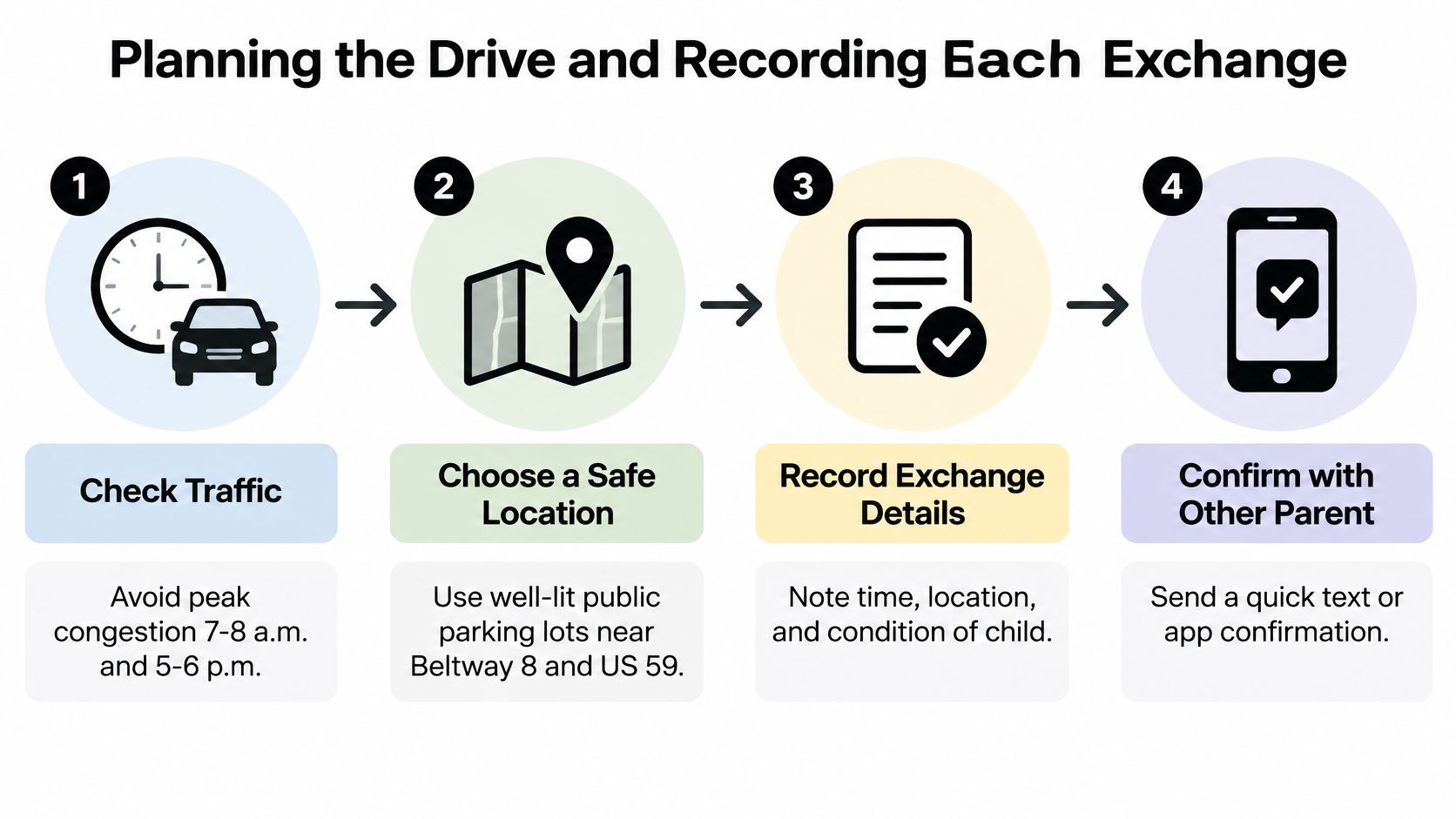
The rush-hour trap is straightforward: parents travel from work to school to the exchange at the same time other drivers are heading home. Houston TranStar's historical analysis identifies recurring congestion peaks from 7:00 to 8:00 a.m. and 5:00 to 6:00 p.m., and the TxDOT Houston District profile identifies Beltway 8 and US 59/I-69 as principal regional thoroughfares. Those windows tell you when to pad the schedule. Whether a particular late arrival was unavoidable depends on what was documented that day.
Before each exchange, run the same four checks: confirm the authorized location, review current conditions, send a departure notice, and record the handoff time.
Suggested buffers by time window on the corridor
Treat these as trial planning allowances to test against your actual route, including Will Clayton Parkway and Loop 494 approaches. Your order's timing terms control separately.
| Time window | Typical condition | Starting buffer |
|---|---|---|
| Before 7:00 a.m. | Usually lighter | 10 minutes |
| 7:00 to 8:00 a.m. | Peak congestion | 15 to 30 minutes |
| 8:00 a.m. to 5:00 p.m. | Moderate and variable | 15 minutes |
| 5:00 to 6:00 p.m. | Peak congestion | 15 to 30 minutes |
| After 6:00 p.m. | Lighter, check for incidents | 15 minutes |
A buffer means leaving earlier. It does not mean the receiving parent must wait beyond the order's requirements. If your observations show that the suggested allowance isn't enough, revise your departure plan rather than repeatedly relying on apologies.
Build a repeatable departure routine
Map the complete drive from home to the authorized exchange point, including the final parking-lot entrance. Test it on a weekday at 6:00 p.m. if that reflects your actual handoff schedule. Time the freeway portion along with the queue at the exit and the turn into the lot, because the last half mile is where many parents lose the buffer they built.
Check the TranStar travel-time report again before leaving. It provides route lengths, speeds, travel times, and delay information. Save the timestamp and the relevant incident details. A current estimate describes conditions at that moment, and conditions on this corridor can change fast.
Then follow a consistent routine:
- Prepare the vehicle: Check the child's car seat, phone charge, and needed school or medication bags before departure.
- Confirm the trip: Send a written departure notice with your expected arrival while you're parked.
- Plan an alternative: Know a lawful route if a crash closes lanes, without changing the authorized exchange location on your own.
- Drive without messaging: Keep the phone hands-free and never text while merging between Beltway 8 and US 59.
- Avoid roadside stops: Don't stop on the shoulder to send an update unless there's an emergency. Use a safe parking location.
For parents whose work travel creates recurring scheduling problems, the Atascocita-to-Generation Park commuter possession schedule guide offers a related way to think about work and possession logistics.
Keep a factual exchange log
Use a shared log if communication is safe and workable. Otherwise, maintain your own consistent record. Include the date, posted travel time, reported delay, weather, incidents, actual handoff time, adults present, and relevant observations about the child's condition.
Record observations. Writing that a child arrived without a required medication bag is more useful than assigning motives to the other parent.
Evidence rule of thumb: Preserve what you knew before departure, what changed during the trip, and what you communicated afterward.
Apply that rule at three moments:
- Before departure: Screenshot the travel-time report and save your departure message with its timestamp.
- During the trip: Note when and where conditions changed, such as a lane closure or a stalled vehicle, and pull into a safe parking location before sending any update.
- After the handoff: Write down the actual exchange time, who was present, and anything relevant while it is still fresh.
That sequence turns a bare claim that traffic was bad into a time-stamped record. A judge or mediator can then weigh the delay on documented facts rather than on which parent sounds more reasonable.
For example, a parked driver could send: Running about 15 minutes late because Beltway 8 is backed up near the US 59 interchange; traffic screenshot attached. That hypothetical message gives an estimate and a reason without blaming anyone. Preserve the screenshot and message timestamp, and keep angry commentary and the child's statements out of the record.
Watch the walkthrough below, then adapt the routine to the route and timing your own order requires.
What to Do When the Other Parent Is Late or Absent
Suppose the other parent is 20 minutes late and says the freeway is backed up. Your first response should be calm and factual, even if this feels familiar. Check the order's grace period and late-notice terms before deciding what the delay means.
The following tiers are practical suggestions, not legal deadlines. Your order's requirements override them, and the suggested waiting threshold doesn't create permission to leave early.
Late-arrival escalation steps
| Time late | Suggested response | What to record |
|---|---|---|
| Inside the order's grace period | Wait and send a written arrival estimate or request one | Time of message and any traffic check |
| Past the grace period, under 45 minutes | Call, confirm the estimate, and keep the child's routine calm | Call time, estimate given, screenshot of conditions |
| Over 45 minutes or no contact | Leave after the agreed window, document the attempt, and contact counsel before any change | Times of each attempt, witnesses, and all messages |
Wait through the period your order requires. Send a written message stating your arrival time and asking for an estimated arrival. Check traffic conditions and preserve a screenshot rather than arguing about whether the congestion is real.
If there's no contact after the applicable window, follow the order's departure procedure and document the attempt. Log when you arrived, whom you contacted, any response, and when you left. Consult counsel before refusing a later exchange or imposing your own replacement schedule.
Separate a delay from a pattern
An isolated delay doesn't automatically justify changing the order. Repeated late or missed handoffs warrant a review of the record and the available options, which may include clearer terms or enforcement. Our guide on what to do if an ex violates a custody order in Atascocita explains that broader concern.
Written notice deserves its own calendar entry. For certain summer-weekend arrangements, Texas Family Code Section 153.311 requires notice of pickup and return locations no later than the 15th day before the Friday beginning the designated weekend. Save proof of delivery; a proposal isn't necessarily an agreement.
Safety comes before proving that you followed an exchange routine.
If the other parent makes threats or you believe the child is at risk while you wait, call 911 first, then document the threat, time, and call when safe. Don't leave the child in an unsafe situation to make a point. Write down your order's grace period and keep it where you'll see it before every handoff.
Schedule a Free Consultation Before Your Next Exchange
A single late pickup near a Beltway 8 exit is a traffic story. The fifth late handoff in two months, each one timestamped in your exchange log, is a record a court can weigh. The best time to talk to an attorney is before the next exchange turns into the next accusation.
Certain triggers justify that call: handoffs that are repeatedly late or missed, an order that names no fixed exchange point, a proposed new location, or messages that have turned hostile. Our Child Custody Lawyer in Atascocita, TX page describes custody and conservatorship representation. When the order's existing terms are the problem, the custody and support modifications page explains how terms can be changed under Texas law.
Prepare for a useful conversation
Bring documents that show the issue without requiring you to reconstruct every disagreement:
- Your current order: Include signed modifications and relevant written agreements.
- Your exchange log: Bring arrival times, traffic screenshots, and complete message threads.
- Your questions: Identify the location, transportation, notice, or safety terms you need clarified.
In a consultation, an attorney can compare your log against your order's actual language, identify which terms leave the drive open to argument, and outline whether clearer wording, enforcement, or a modification under Texas Family Code §156.101 fits your record. We serve clients in Atascocita and throughout Harris County.
The initial consultation is free. Call 281-519-3083, complete our online contact form, or visit the Atascocita office at 7702 FM 1960 Rd E, Suite 212, Humble, TX 77346. You can also reach Law Office of Bryan Fagan – Atascocita TX Lawyers online to arrange a consultation this week.