 Skip to content
When you and your spouse can’t agree on the terms of your separation, you’re looking at what’s called a contested divorce. For residents here in Atascocita, Humble, and northeast Harris County, having the right contested divorce lawyer in Atascocita, TX, isn't just a good idea—it's essential for protecting your family and your financial future. At The Law Office of Bryan Fagan, we are a local firm that has guided countless families right here in our community through these exact challenges, and we do it with a focus on strength, strategy, and compassionate support.
We understand how overwhelming this process can feel, and our goal is to provide clear, practical guidance that empowers you to make the best decisions for your new chapter.
What is a Contested Divorce in Atascocita, Texas?
Not every divorce involves courtroom drama, but when you and your spouse hit a roadblock on one or more key issues, the divorce is considered "contested." This simply means you need a judge to step in and make the final decisions because you can’t reach an agreement on your own.
For the families we work with across Atascocita, Humble, and the Lake Houston area, these disagreements almost always boil down to a few critical areas:
- Property and Debt: Who gets the family home in Eagle Springs or The Groves? How do you untangle retirement funds and 401(k)s accumulated over the years? And who’s on the hook for that credit card balance? In Texas, we follow community property rules, which means most assets and debts acquired during the marriage must be divided in a "just and right" manner.
- Children and Custody: This is often the most emotional sticking point. We help parents establish clear, workable plans for where the children will live primarily, what the visitation schedule will be (possession order), and who has the final say on major decisions like schooling and medical care.
- Financial Support: Is one spouse entitled to spousal support to maintain their standard of living? How is child support actually calculated under Texas law, and how will it be paid?
These aren't just legal boxes to check; they're deeply personal questions that will define your new reality. The very first step in building a strong legal strategy is understanding whether your divorce is truly contested or uncontested. You can learn more by reading our detailed guide on the difference between contested and uncontested divorce.
To make this distinction clearer, here’s a straightforward comparison of what to expect in a Harris County divorce.
Key Differences Between Contested and Uncontested Divorce
| Aspect | Uncontested Divorce | Contested Divorce |
|---|---|---|
| Agreement | You and your spouse agree on all issues (property, custody, support). | You and your spouse disagree on at least one major issue. |
| Process | Primarily paperwork-driven with minimal court involvement. | Involves negotiation, mediation, and potentially a court trial. |
| Timeline | Can be finalized in as little as a few months. | Can take from six months to over a year to resolve. |
| Cost | Significantly less expensive due to fewer legal fees and court costs. | More costly due to attorney hours, expert fees, and court filings. |
| Control | You and your spouse retain control over the final outcome. | A judge makes the final, binding decisions for you. |
As you can see, the path you take depends entirely on your ability to find common ground.
Why Disagreements Arise
Divorce is an emotional storm, and it's easy for simple disagreements to escalate. Think about a common situation we see right here in our Atascocita community: one spouse was the primary earner while the other managed the household and raised the kids. The stay-at-home parent may feel they're owed a larger portion of the assets or ongoing spousal support to get back on their feet. At the same time, the working spouse might believe their financial contributions give them a greater claim to the marital estate. Neither person is necessarily "wrong," but their perspectives are miles apart.
At its core, a contested divorce is simply a divorce where you and your spouse need a judge to make the final decisions because you cannot reach an agreement together. This is where a skilled local attorney becomes your most important advocate.
Facing a contested divorce can feel isolating, but you're not alone. National statistics show that a significant number of marriages end in divorce, and these aren't just abstract numbers; they represent real families in Harris County who have navigated this difficult process. This is why having an experienced guide who knows the local courts and Texas law is so critical.
Our mission at The Law Office of Bryan Fagan is to help you understand your rights under the Texas Family Code and steer you toward a fair, sustainable resolution. While disagreements are a natural part of a divorce, they don't have to derail your life. With the right support, you can regain control and make informed choices that set you up for a better future.
The Contested Divorce Process in Harris County: A Step-by-Step Guide
If you’re facing a contested divorce in Atascocita, the thought of navigating the Harris County legal system can be overwhelming. It’s a world filled with its own language, rules, and procedures. Based on our experience helping local families through this, we know that having a clear map of the road ahead makes all the difference. Let's break down what that process actually looks like, step-by-step.
Everything officially starts when one spouse files a document called the Original Petition for Divorce with the Harris County Civil Courthouse. This petition doesn’t just say "I want a divorce"; it lays out what the person filing (the "Petitioner") is asking for when it comes to property, any children involved, and financial support.
Step 1: The Initial Filing and Mandatory Waiting Period
Once that petition is on file, the clock starts on a mandatory 60-day waiting period required by Texas law before any divorce can be finalized. People often call this a "cooling-off" period, but in a contested case, it's anything but idle time. This is when the crucial groundwork for your case is laid.
Of course, a lawsuit can't proceed until the other person is officially aware of it. After filing, your spouse (the "Respondent") must be formally notified through a procedure called "service of process." This usually means a constable, sheriff, or private process server will physically deliver a copy of the lawsuit papers to them. If you’re just starting and have questions about this first step, you can find a detailed breakdown of how to file for divorce in Harris County.
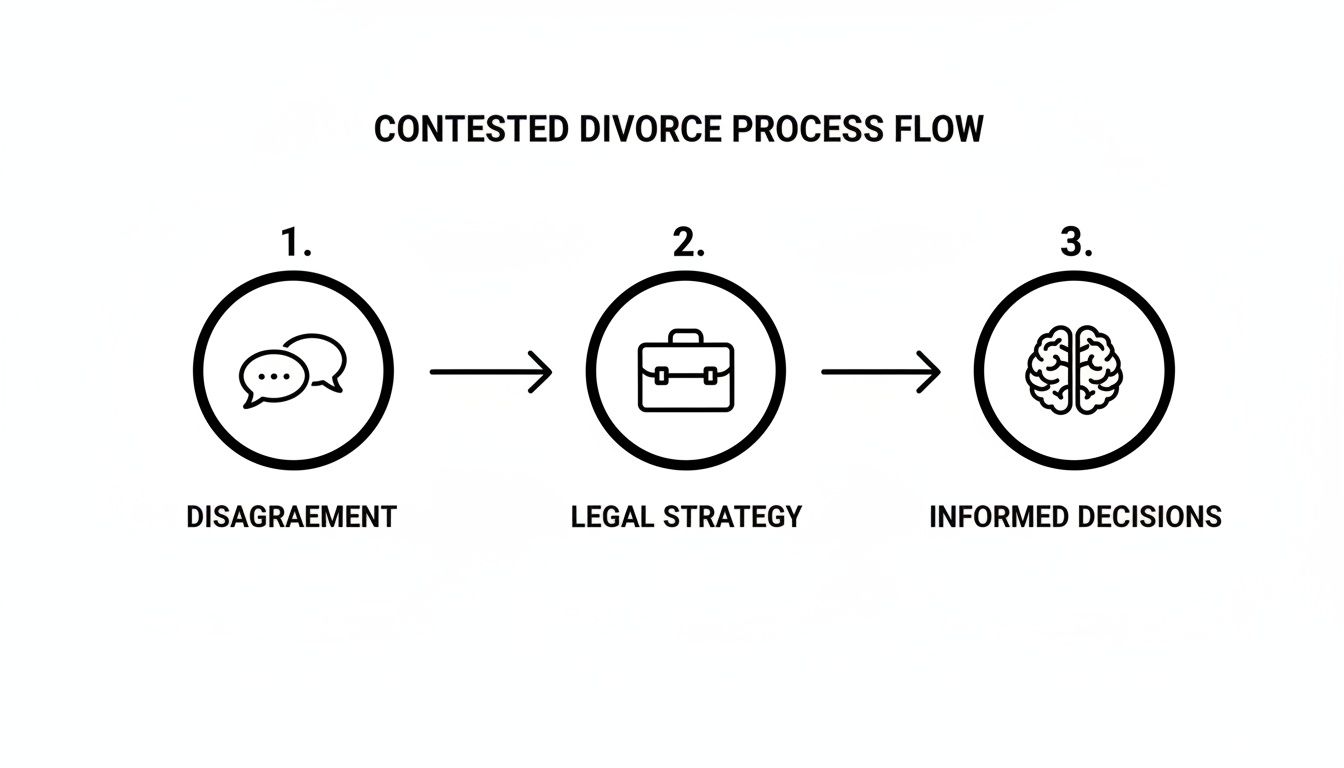
As you can see, the path from disagreement to a final resolution isn't always straight. Having a sound legal strategy is what bridges the gap between the initial conflict and making informed decisions for your future.
Step 2: Uncovering the Facts with Discovery
Next, your case moves into what lawyers call the discovery phase. Think of this as the official, court-supervised process for gathering evidence from your spouse. The entire point is to make sure both sides have all the relevant information, so there are no "gotcha" moments or surprises in court.
We use several tools to get this information:
- Requests for Production: Formal requests for documents like bank statements, property deeds, tax returns, and credit card bills.
- Interrogatories: A list of written questions that your spouse is required to answer in writing and under oath.
- Depositions: An in-person meeting where your attorney questions your spouse or other key witnesses under oath, with a court reporter transcribing everything.
Let's say there’s a dispute over the value of a family business in Kingwood. Through discovery, we can obtain the profit-and-loss statements, balance sheets, and client lists needed to get an accurate valuation. This is how we build a strong, evidence-based case for a fair division of assets.
Step 3: Setting Ground Rules with Temporary Orders and Mediation
A contested divorce isn't a quick process—it can take many months, or even over a year. You can't put your life on hold that long. That’s why we almost always have a Temporary Orders Hearing early on. A judge will listen to both sides and then create a set of temporary rules to govern your lives until the divorce is final.
These orders tackle the immediate, pressing questions:
- Who gets to stay in the family home in Atascocita?
- Which parent will decide where the kids live, and what will the visitation schedule be?
- How will the mortgage and other household bills be paid while the case is pending?
It's important to know that in Harris County, mediation is a required step before you can go to a final trial. This is a structured negotiation session where you, your spouse, and your respective attorneys meet with a neutral third-party mediator to try and settle your disagreements.
A huge number of cases that start out looking like they’re headed for a courtroom battle end up getting resolved in mediation. It saves everyone an immense amount of money, time, and stress. A big part of our job is to prepare you for that day, so you walk in feeling confident, informed, and ready to advocate for a fair outcome.
If mediation doesn't work out, the last resort is trial. This is where a judge (and sometimes a jury) hears all the evidence and makes the final, binding decisions on every issue you couldn't agree on. Trial is by far the most expensive and emotionally taxing way to end a marriage, which is why we work so hard to help our Atascocita clients find a resolution long before it ever gets to that point.
Choosing the Right Atascocita Divorce Lawyer for Your Case
Let's be direct: choosing your lawyer is the single most critical decision you'll make in this entire process. This isn't just about hiring someone to fill out forms. It's about finding a strategic partner who will have your back, protect what matters most to you, and navigate the often-confusing Harris County court system on your behalf.
For those of us in Atascocita and Humble, this means finding an attorney who isn’t just a Texas family law expert, but someone who is genuinely part of our local community. The person you hire will directly shape the outcome of your case, from how your assets are divided to the final custody agreement for your children. A great lawyer offers clarity, sets realistic expectations, and builds a strategy from day one, all aimed at securing your future.

Experience That Matters: Local Knowledge and Family Law Focus
When it comes to divorce, not all legal experience is equal. You wouldn't hire a foot doctor for heart surgery, so why trust a general-practice attorney with the complex details of your family's future? You need to find a contested divorce lawyer in Atascocita, TX, who lives and breathes Texas family law.
We can't overstate the advantage of having a lawyer who knows the Harris County family courts inside and out. They know the local judges and their tendencies. They understand the unwritten rules of the courthouse. They’ve gone up against the other local attorneys. This kind of specific, on-the-ground insight is invaluable, especially when you're in a tense negotiation or a crucial temporary orders hearing.
Key Questions to Ask During Your Consultation
The first meeting with a potential lawyer is your chance to interview them. Think of it as a two-way street—you're seeing if they're a good fit for you, and they're assessing the details of your case. Walking in prepared with smart questions is the best way to make an informed decision.
Don't be afraid to ask direct questions like:
- What percentage of your cases are family law, specifically contested divorces? This confirms you’re talking to a specialist, not a dabbler.
- If I hire your firm, who will be my main point of contact? You deserve to know if you'll be working directly with the attorney or primarily with a paralegal.
- Based on what you've heard so far, what's your initial take on a strategy for my case? This question cuts to the chase and shows you how they think about unique challenges, like a complicated business valuation or a high-conflict custody fight.
- How will you keep me updated on my case? A good firm will have a clear, consistent communication plan.
The right attorney won't just talk at you; they will listen. You should feel heard and understood. They need to be able to explain complex legal concepts in plain English, not hide behind confusing jargon. Your comfort and confidence in your legal team are paramount.
Vetting Credentials and Watching for Red Flags
Before you sign anything, do a little digging. It's easy to look up an attorney's credentials and check for any disciplinary history on the State Bar of Texas website. A clean record should be the absolute minimum standard.
You also need to trust your gut and be on the lookout for red flags. Here are a few things that should make you pause:
- Guarantees of a specific result. No ethical lawyer can ever promise you'll "win." The system is too unpredictable. A good lawyer promises effort, strategy, and advocacy—not a guaranteed outcome.
- Vague answers about fees. You should get a crystal-clear, written explanation of their retainer, hourly rates, and how they bill for costs.
- Poor communication from the start. If they're slow to respond or hard to reach before you've even paid them, imagine what it will be like once you're a client.
Ultimately, this is a very personal choice. You're looking for a skilled professional you can trust during one of the most difficult times of your life. At The Law Office of Bryan Fagan, we pride ourselves on being that trusted partner for our neighbors in Atascocita. We encourage you to reach out and see if our approach feels right for you.
Understanding the Costs of a Contested Divorce in Texas
Let's be honest: one of the first questions on anyone's mind when facing a divorce is, "How much is this going to cost me?" When you and your spouse can't agree on the major issues, that financial anxiety can become overwhelming. As a law firm that works with families right here in Atascocita every single day, we believe you deserve straight answers about the potential costs so you can plan for your future.
It's helpful to think of a contested divorce not as an expense, but as an investment in your new life. While no one wants to spend money to end a marriage, a skilled contested divorce lawyer in Atascocita, TX, is your best defense against costly mistakes. An unfair property division or an unworkable custody agreement can have financial consequences that last for years.
Breaking Down Attorney Fees and Retainers
The biggest line item in a contested divorce will almost always be your attorney's fees. Most family law attorneys, including our team, work on an hourly basis. To get started, you'll typically pay an initial fee called a retainer.
A retainer is essentially a down payment for our legal services. That money goes into a dedicated trust account, and as we work on your case, we bill our time against that fund. For instance, if you pay a $5,000 retainer and your attorney's rate is $350 per hour, that covers about 14 hours of legal work before the account would need to be replenished.
So, what does that hourly work actually involve?
- Drafting and filing all the necessary court documents.
- Communicating with you, your spouse’s lawyer, and the court.
- Preparing for and representing you at hearings and mediation.
- Conducting legal research and building the strategy for your case.
We make it a point to provide a clear, written fee agreement from the very beginning. You will always know exactly how we bill for our time, because building that trust with our Atascocita clients is non-negotiable.
The Financial Reality of a Contested Divorce
The cost of a contested divorce can vary widely. It depends entirely on the complexity of your issues and the level of conflict between you and your spouse. A case with one or two disagreements that settles in mediation will cost significantly less than one that involves multiple experts and a multi-day trial.
Investing in an experienced local lawyer from the beginning is the best way to control costs and prevent financial disasters down the road. An effective attorney focuses on efficient resolution, not endless conflict.
This financial reality is a serious concern for Harris County families, especially when you're dealing with complex assets like a family home in Fall Creek or a small business in Humble. It’s exactly why our primary focus is always on finding the most direct and efficient path to a resolution for you, whether through skilled negotiation, strategic mediation, or, if necessary, strong courtroom advocacy.
Strategies to Manage Your Legal Expenses
While a contested divorce is never cheap, you are not powerless over the final bill. From our experience, the clients who are most successful at managing their costs are the ones who are proactive, organized, and work as a partner with their legal team.
Here are a few practical strategies we encourage all our clients to adopt:
- Be Organized: Before you even meet with us, start gathering your financial documents. Having your tax returns, bank statements, and property deeds ready from day one saves us from spending billable hours hunting them down for you.
- Communicate Efficiently: It’s natural to have a lot of questions. Instead of calling or emailing with every single thought that pops into your head, try bundling your non-urgent questions into a single, well-organized email. This respects your attorney's time and, frankly, saves you money.
- Stay Focused on the Goal: Making decisions based on emotion is an expensive habit in a divorce. Try to separate the business of dividing your life from the personal hurt. Focusing on a fair and final resolution—rather than "winning" every small battle—is always the more cost-effective approach.
- Be Open to Negotiation: Going to trial is the single most expensive part of any divorce case. Your best opportunity to settle the case and avoid a costly courtroom fight is by being prepared to negotiate and compromise during mediation.
By partnering with your attorney, you can take an active role in managing the process and your budget. If you're worried about the financial impact of a contested divorce, we invite you to schedule a free, no-obligation consultation at our Atascocita office. We can walk through your specific situation and give you a much clearer picture of what to expect, so you can move forward with confidence.
Common Mistakes to Avoid in a Contested Divorce
Drawing from our years of experience representing clients all across Harris County, we know a contested divorce is as much about dodging landmines as it is about making the right legal moves. The emotional rollercoaster of a divorce can easily lead to impulsive decisions that you'll pay for long after the papers are signed. Frankly, knowing what not to do is just as important as knowing what you should do.
As a firm that’s deeply rooted in the Atascocita community, we’ve seen how simple missteps can spiral into major complications. A vent session on social media, a heated argument in front of the kids—your actions are under a microscope. Let’s go over some of the most common mistakes we see people make, using real-world situations we’ve helped clients navigate right here in our area.

Posting Your Personal Life on Social Media
It's second nature to share our lives online, but during a divorce, your social media profile becomes an evidence file for your spouse's attorney. That picture from a fun night out with friends? It can be twisted to paint you as an irresponsible parent. A frustrated post complaining about your spouse? It can be used as evidence that you're uncooperative and hostile.
Local Example: An Atascocita mom, completely fed up, posted a rant on Facebook about her ex always being late for child pickup. In court, his attorney pulled up a screenshot of that very post to argue she was actively trying to alienate the children from their father. What felt like a harmless way to blow off steam became a weapon used against her.
Our advice on this is blunt: stop posting about your personal life immediately. This includes your case, your finances, your new relationships, and your spouse. Assume every single thing you post, comment on, or "like" will eventually be printed out and handed to a judge.
Involving Your Children in the Conflict
This is perhaps the most damaging mistake of all, and it happens far too often. Your children are not your confidantes, your spies, or your messengers. Forcing them into the middle of an adult conflict causes emotional scars that can last a lifetime.
You must avoid these behaviors, no matter how tempting:
- Badmouthing the other parent: Never, ever speak negatively about your spouse in front of your kids. They are half of each of you.
- Asking them to choose a side: This puts them in an impossible position where they feel they have to betray one parent to please the other.
- Using them as go-betweens: All communication about the case should be directly with your spouse or handled by your attorneys.
The court’s guiding principle is always the "best interest of the child." Any parent seen to be causing emotional distress or using the children as pawns will face a judge who is not going to be pleased.
Your most important job as a parent right now is to be a source of stability and reassurance. You do that by building a firewall between your kids and the legal battle.
Hiding Assets or Making Emotional Financial Decisions
When you’re feeling angry, hurt, or scared, it's tempting to try and seize control of your finances. You might think about quietly moving money from a joint account, selling a community asset, or maxing out a credit card in your spouse's name. These are not just bad ideas—they can have serious legal blowback.
Under Texas law, you have a fiduciary duty to the marital estate during a divorce. Hiding assets is considered fraud on the court. If you get caught—and the discovery process is designed to uncover exactly these things—a judge can bring the hammer down. This might mean awarding a disproportionate share of the community property to your spouse or even making you pay their attorney's fees.
Local Example: A small business owner in Humble was terrified his wife would get half of the company he built. He started paying himself a tiny salary and funneling money to a friend as a "loan." When his wife’s contested divorce lawyer in Atascocita, TX, subpoenaed the business's bank records, the whole scheme fell apart. The judge awarded his wife a much larger share of the business to compensate for his deception.
The same goes for making big, emotional purchases. This is not the time to buy a new truck or luxury watch to get back at your spouse. Work with your attorney to get a clear picture of your financial rights and responsibilities. Every financial move you make from here on out needs to be strategic, not reactive.
Atascocita Contested Divorce FAQs
Even with a roadmap of the process, you're bound to have questions. It's completely normal. After all, your situation is unique. Here are some of the most frequent questions we hear from our clients in Atascocita and the surrounding Harris County communities.
How Long Does a Contested Divorce Take in Harris County?
This is the million-dollar question, and the honest answer is: it truly depends. Texas law sets a minimum waiting period—a divorce can't be finalized in less than 60 days from the day it's filed. But for a contested case, that's just the starting block.
Realistically, for a moderately contested divorce in Harris County, where there are disagreements but you eventually find common ground in mediation, you're likely looking at a six to nine-month timeline. If your case is more tangled, perhaps involving a complex family business or a high-conflict custody fight that goes all the way to a final trial, it could easily stretch to a year or even longer. The core issue is always the level of disagreement.
Can I Make My Spouse Pay My Attorney's Fees in Texas?
Yes, you can ask the judge to order your spouse to pay for your legal fees, and it happens. It’s not a given, though; it’s entirely up to the judge’s discretion. This is most common when there’s a major gap in what you and your spouse earn.
For instance, if you've been a stay-at-home parent with little or no income while your spouse is a high earner, a judge might award attorney's fees to "level the playing field." It ensures both of you have a fair shot at quality legal representation. A judge can also use attorney's fees as a sanction if your spouse is caught hiding assets or otherwise acting in bad faith.
Getting the other side to pay your fees isn't automatic. You have to specifically request it in your legal filings and make a compelling case to the judge. It’s a strategic move we can discuss if it fits your situation.
What Is a Temporary Restraining Order (TRO) and Do I Need One?
Think of a Temporary Restraining Order, or TRO, as a way to press the pause button. It's an initial court order, often filed right at the beginning of a divorce, that stops either person from doing anything rash or destructive while the case gets started.
A standard TRO is designed to maintain the status quo and generally prevents actions like:
- Selling or hiding community property
- Running up new debt on shared accounts
- Changing beneficiaries on life insurance or retirement plans
- Harassing, threatening, or disturbing the peace of the other spouse or children
We often recommend a TRO for our Atascocita clients as a simple, proactive measure. It helps prevent a spouse, who might be acting out of anger, from draining the bank accounts or maxing out credit cards. It simply sets some important ground rules from day one.
How Does Texas Handle the Division of a 401(k) in a Divorce?
In Texas, we live by community property rules. In simple terms, any money that went into a 401(k) or other retirement account during the marriage is considered community property. That portion of the account is subject to a "just and right" division by the court. The funds you contributed before you got married are your separate property and won't be touched.
Splitting a retirement account isn't as easy as cutting a check. It requires a specific, technical court order called a Qualified Domestic Relations Order (QDRO). This document is sent to the plan administrator, telling them exactly how to divide the account and transfer the funds to the other spouse's name without triggering huge tax bills or early withdrawal penalties.
For many of our neighbors in the Atascocita area, their retirement accounts are the most valuable assets they own. A mistake in drafting the QDRO can be devastatingly expensive. This is one area where having a lawyer who knows exactly what they're doing is absolutely crucial to protecting your nest egg.
We know that facing a contested divorce is a heavy burden, but you don’t have to carry it by yourself. The Law Office of Bryan Fagan – Atascocita TX Lawyers is here to offer the clear advice and determined representation you deserve. Our team lives and works in this community, and we are committed to helping our neighbors find practical solutions. Schedule your free, no-obligation consultation with our Atascocita team today to get answers and start planning your next steps.


