When a child doesn't come back after a court-ordered exchange in Atascocita, the fear hits fast. A parent can be standing in a driveway in northeast Harris County, checking the clock, texting, calling, and realizing the other side isn't bringing the child home the way the order says they should. In that moment, the question usually isn't abstract. It's, what can I do right now to get my child back safely and legally?
Texas gives parents a specific emergency tool for that situation, and it's more structured than many families expect. A writ of attachment can be used to help law enforcement take the child into custody and deliver the child where the court directs, but it only works when the paperwork and legal basis are lined up correctly. For Atascocita and Humble families, that means the difference between a frantic phone call and a court filing that moves the case forward.

A parent in this position often asks whether calling police is enough. Usually, it isn't, at least not by itself, because officers generally need a court order that tells them exactly what to enforce. That's why families looking for a writ of attachment to recover a child in Atascocita TX often need a filing strategy, not just a police report.
Practical rule: if there's already a custody order, the fastest path is usually to focus on enforcement in court, not on informal back-and-forth with the other parent.
The Law Office of Bryan Fagan – Atascocita TX Lawyers regularly helps families sort through these urgent custody problems with a calm, document-driven approach. If you're in Atascocita, Humble, or nearby Harris County communities and your child hasn't been returned, the next steps matter, and they need to be handled carefully.
What Happens When Your Child Is Not Returned in Atascocita
A common Atascocita scenario starts with something ordinary. One parent shows up for pickup after visitation, but the child never comes back, or the other parent starts saying the order “doesn't apply” the way it clearly does. In that moment, emotions run high, but Texas courts still expect the case to move through the right legal channel.
Why this feels different from a normal custody dispute
A missed exchange is not just a disagreement about parenting time. If there's already a valid order and one parent is keeping the child anyway, the issue becomes custody enforcement. That is why parents often need more than a polite demand letter, because the law looks at who has the superior right of possession and whether the child is being held contrary to that right.
Texas also treats the emergency pickup process as immediate enforcement, not a routine motion that can sit on a docket for weeks. The order can direct law enforcement to take physical custody of the child and deliver the child as the court directs, which is why this remedy gets used when waiting for a later hearing would defeat the point.
Families in northeast Harris County often feel stuck between urgency and process. They know the child should be returned, but they also know they can't just take matters into their own hands without risking a bigger legal problem.
What emergency relief can look like
The legal answer often begins with habeas corpus, which asks the court to recognize who has the superior right of possession. If the facts support it, the parent can also request a writ of attachment at the same time so the court can authorize immediate pickup. Texas Law Help describes that emergency order as one that lets law enforcement take the child into custody and deliver the child to the requesting party or another court-approved location. Texas Law Help's habeas corpus guide explains the core framework.
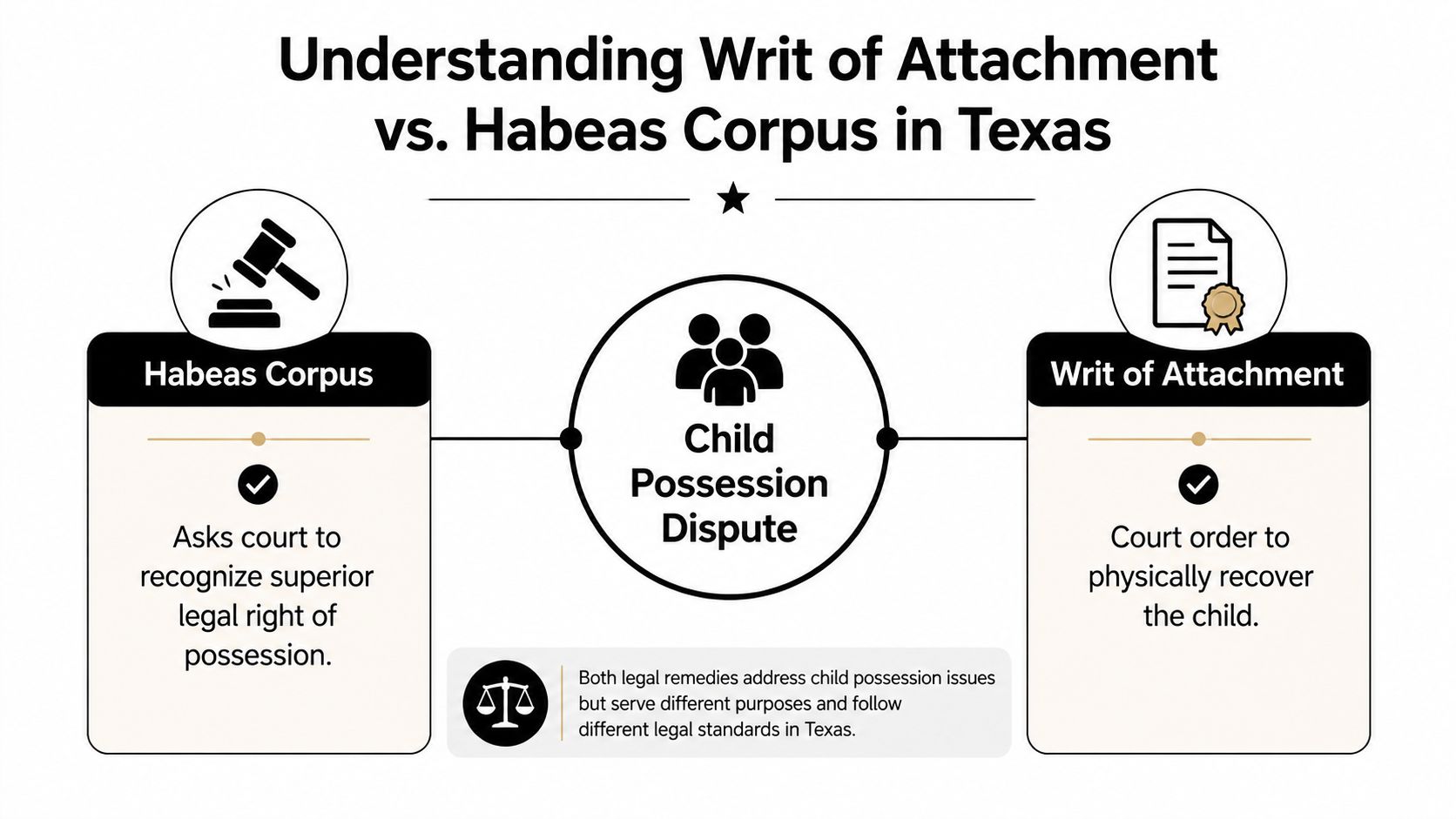
That distinction matters because many parents assume “custody enforcement” is one single filing. It isn't. In practical terms, habeas corpus asks the judge to confirm the right to possession, while the writ of attachment is the enforcement mechanism that can put that decision into action.
For families in Atascocita and Humble, local support helps keep the process organized when stress is already high. The right filing, the right order, and the right service method all matter, and missing one piece can slow everything down.
Understanding Writ of Attachment and Habeas Corpus in Texas
Texas family law uses two terms that sound similar but do different jobs. Habeas corpus asks the court to decide who has the superior legal right to possess the child. A writ of attachment is the emergency order that lets a sheriff or constable physically take the child and deliver the child the way the court says.
The simplest way to think about the difference
If habeas corpus is the court saying, “You have the stronger legal claim to possession,” the writ of attachment is the instruction that makes the child recovery immediate. It's not a general custody request, and it's not the same as asking the judge to modify the parenting plan. It's an enforcement tool for situations where the child needs to be brought back now, not later.
Texas procedure materials show that a writ of attachment is not a vague request. The court order directs a sheriff or constable to take physical custody of the child, and the court may issue the attachment after a verified pleading or affidavit under Texas Family Code § 105.001(c). Separate Texas court materials also confirm that the writ is served by law enforcement and executed in the same manner as a criminal writ under Chapter 24, which shows how immediate and formal this remedy really is.
That structure matters in Harris County because judges want to see that the request is grounded in sworn facts, not just frustration. A parent who says, “The other parent won't let me see my child,” has a concern. A parent who says, “Here is the order, here is the sworn statement, and here is why immediate enforcement is needed,” is presenting a court-ready request.
Where this fits in a Harris County case
Parents sometimes confuse this remedy with contempt, welfare checks, or even a change of custody. Those are different tools. Contempt punishes disobedience. A welfare check is a police response to a safety concern. Habeas corpus and attachment are about getting the child returned under an existing legal framework.
The court is not guessing. It wants the order, the sworn facts, and the exact enforcement relief requested.
If you're comparing local options, it can also help to look at Enforcement of Court Orders in Atascocita for divorce decree and custody order provisions in Harris County. That kind of enforcement work overlaps with child recovery cases, but the relief has to match the problem.
You can also watch a plain-English overview here.
For parents in Atascocita, the key takeaway is simple. Habeas corpus explains why the child should be returned. The writ of attachment is what lets the court enforce that return when the situation is urgent.
Who Qualifies and What Evidence Harris County Judges Require
Judges in Harris County don't issue a writ of attachment just because a parent is upset or worried. They look for specific legal facts, and those facts have to be shown through sworn paperwork. That's where many parents get tripped up, because urgency can lead to rushed filings that leave out the documents the court needs.
The legal tests the judge is looking for
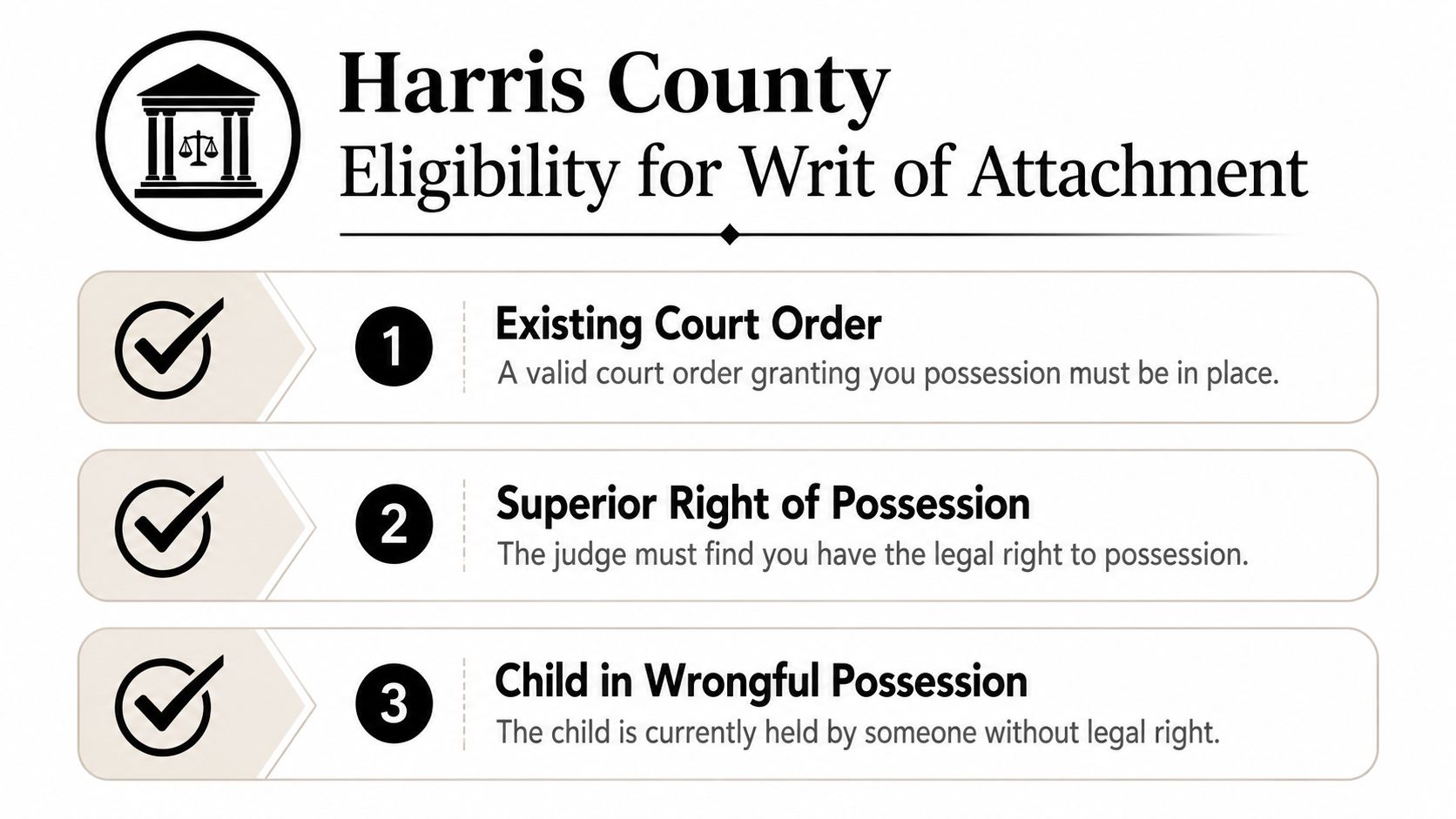
When a parent already has a court order granting superior possession, Texas Law Help says the judge must order the child's return if three conditions are met, the child has been illegally kept from that parent, the parent has not voluntarily given up possession for the prior 6 months, and there is no serious, immediate concern for the child's welfare. Those are the key findings that move the case from a dispute into an enforceable return order.
That doesn't mean every case is identical, but it does mean the judge needs a clear chain of proof. If there's a standing custody order, that order should be in the packet. If the child was supposed to be returned on a certain date, the facts showing the refusal or failure to return should be stated clearly in a sworn form.
Why the sworn paperwork matters so much
Texas Family Code § 105.001(c) allows the court to issue attachment after a verified pleading or affidavit, and that sworn basis matters because the judge is making an emergency decision. A bare petition without supporting details can leave the court with too little to act on, especially in a case where law enforcement may be sent to recover the child.
Texas Law Help specifically notes that if a prior possession order exists, a certified copy should be attached. That detail is easy to miss, but it can be the difference between a usable filing and one that gets delayed for more paperwork. If no order exists, the rules are different, and only a legal parent can proceed against a nonparent.
What Atascocita parents should gather first
For families in Atascocita and nearby Humble, the cleanest filings usually include the order, the sworn affidavit, and the facts about the missed return. Keep everything in one place.
- Certified custody order: bring the exact order the other party is supposed to follow.
- Sworn affidavit: state the facts plainly, including the missed return and why immediate action is needed.
- Exchange records: save texts, emails, call logs, or parenting-app messages that show the refusal.
- Current contact details: law enforcement and the court need accurate information to execute the order.
Practical rule: if the judge can't see the legal right to possession and the emergency need on paper, the writ is much harder to get.
For help building a stronger package, some parents compare their facts with evidence needed for a custody case in Harris County, Texas. That's especially helpful when the other side is disputing what happened or trying to blur the timeline.
The hardest part for many parents is that the court wants speed and completeness at the same time. A rushed filing can lose both. A careful filing gives the judge a legal basis to act.
How to File and Enforce the Writ in Harris County
An Atascocita parent usually feels the pressure first, then the paperwork. In Harris County, a writ of attachment case moves fastest when the filing is organized from the start and each step is lined up for the judge and the clerk.
Start with a verified filing package
The process begins with a verified petition or sworn affidavit filed with the district clerk. The custody order, the facts about the missed return, and any other documents showing the right to possession should be attached with it, because the court needs both the legal basis and the emergency facts in front of it before it can act.
The requested writ should also be prepared before filing, so it is ready for review if the judge is willing to sign quickly. If the pleadings and affidavit support immediate relief, the judge may sign an ex parte order, which means the order can be entered without waiting for the other side to appear first. That does not decide the full custody dispute, but it can give the parent the immediate pickup authority needed to recover the child.
File it with the Harris County District Clerk
Once the packet is ready, it is filed with the Harris County District Clerk. Many parents handle the filing through the clerk's e-filing system, while some still file in person, depending on the court and the case setup. Clerk fees can vary by filing type and by the procedural steps the case requires, so families should expect to confirm the filing cost before submitting the papers.
The filing itself matters, but so does the order of the steps. A judge cannot issue a meaningful recovery order if the petition is incomplete or the sworn facts do not clearly show why immediate relief is needed.
Request issuance after filing
After the petition is accepted, the next step is to request issuance of the writ. That request tells the court to turn the filing into an enforceable order instead of leaving it as paperwork in the file.
The writ of attachment to recover a child in Atascocita TX is strongest when the custody order, sworn affidavit, and supporting records are all assembled before the request is made. When those pieces match, the judge can review the case without stopping to ask for basic missing details.
Get the writ into law enforcement hands
Once the judge signs the order, the final step is service and execution by a sheriff or constable. The parent does not personally carry out the pickup. The law enforcement officer serves the order and carries out the recovery through the proper channel, so the process stays inside the court's authority.
That is why Harris County parents need a clean filing sequence, verified petition, district clerk filing, request issuance, then sheriff or constable service. It works like a relay race. If one handoff is missing, the recovery slows down.
Keep the paperwork ready for fast action
Families often lose time because they try to assemble everything after the emergency has already started. A better approach is to keep the order, the sworn facts, and the contact information in one place before the other parent refuses return. That way, if the judge is ready to sign, the file is ready too.
Atascocita parents often need speed, but the court still expects the paperwork to be complete and accurate. In Harris County, the filings that move best are the ones where the clerk can process them cleanly and law enforcement can act without confusion.
Choosing the Right Enforcement Option for Your Situation
An Atascocita parent can face a hard question very quickly, which court tool fits the facts right now? A child who is not returned after an exchange may call for immediate recovery, while a different dispute may need a hearing, contempt request, or another filing first. The wrong choice can cost time, and in a child recovery case, time is often the part families cannot spare.
How the main options differ
A writ of attachment fits best when a possession order already exists and the child needs to be recovered right away. Habeas corpus asks the court to decide who has the legal right to possession, while enforcement and contempt focus on the failure to follow an existing court order. Police welfare checks can help when there is an urgent safety concern, but they usually do not replace a court order. CPS involvement is for safety and neglect concerns, not for deciding possession between parents under an order.
The criminal-procedure comparison shows why attachment is treated as a real enforcement tool. Under Texas Code of Criminal Procedure article 24.011(b), if a person without legal cause fails to produce a child in court after a subpoena, the court may impose contempt penalties and may also issue a writ of attachment for both the person and the child. That tells Harris County parents that attachment is not an informal request, it is a formal remedy the court can use when the legal requirements are met.
A simple decision filter for Harris County families
Use the facts in front of you, not the label on the problem.
If there is already a possession order, the child is being withheld now, and the goal is immediate recovery, attachment is often the first option to examine. If there is no order yet, habeas corpus may not fit, because the court first has to sort out the legal right to possession. If the other parent keeps violating exchanges or refusing compliance over time, a motion for enforcement and contempt may address the pattern better than a one-time recovery request. If the concern is safety, a police welfare check or CPS report may be the right starting point, but those steps do not decide possession by themselves.
| Situation | Better fit | Why it fits the facts |
|---|---|---|
| Order exists, child withheld today | Writ of attachment | The court can use law enforcement to recover the child quickly |
| No possession order yet | Habeas corpus or a custody filing | The court first has to sort out the legal right to possession |
| Repeated refusal to follow exchanges | Motion for enforcement and contempt | The court can address ongoing violations and possible sanctions |
| Immediate safety concern | Police welfare check | Officers can check on the child's condition and urgent safety issues |
| Neglect or abuse concern | CPS report or investigation | Child welfare authorities handle safety and neglect concerns |
When the facts point toward attachment
If the order is clear and the other parent is withholding the child without a legal excuse, a writ of attachment may be the better fit. If the dispute is about changing custody terms, a recovery writ is usually the wrong first step. If the issue is a series of missed exchanges, enforcement may belong in a broader strategy instead of standing alone.
For families who are also dealing with support or collection problems, the legal picture can overlap in stressful ways. A Child Support Attorney in Atascocita can help sort out whether there are parallel enforcement issues that need attention at the same time. Child support and possession are different issues, but they often appear together in one household dispute.
A practical filter for Atascocita parents
Three questions help narrow the choice. Is there already an order? Is the child being withheld right now? Does the situation require the court to act fast enough that waiting for a later hearing would not solve the problem?
If the answer to all three is yes, the attachment route is often the one to evaluate first. If any answer is no, a different enforcement filing, a safety report, or a broader custody review may fit better.
Practical rule: the right remedy matches the problem. A careful lawyer helps you avoid using emergency tools when another filing would do the job better.
Get Trusted Help From Your Atascocita Child Custody Team
Child recovery cases are difficult because fear, paperwork, and time pressure all show up at once. Parents who handle them well usually act quickly and stay organized. They collect the order, document the refusal to return the child, and file a sworn request that gives the court a solid basis to act.
For Atascocita, Humble, and northeast Harris County families, the key point is simple. A writ of attachment is powerful, but it depends on careful documentation. It works best when the order, the facts, and the emergency request all line up. A rushed filing can slow the child's return. A complete filing gives the judge and law enforcement the information they need to enforce the order.
If your custody problem is part of a larger separation or divorce case, the Divorce Lawyer in Atascocita, TX page may help you see how the custody issue fits into the broader family law picture. Child recovery does not happen in isolation, and related divorce issues can affect the next legal step.
The Law Office of Bryan Fagan, Atascocita TX Lawyers handles these matters with a calm, local approach that fits the urgency of Harris County cases. The work focuses on protecting parental rights, preparing the right affidavits, and keeping the case organized so it can move without confusion. If your child has not been returned, gather the paperwork and ask for guidance before the chance for quick action closes.
If you are dealing with a child who was not returned in Atascocita, the Law Office of Bryan Fagan, Atascocita TX Lawyers can help you review the order, organize the affidavit, and decide whether a writ of attachment is the right next step. Visit Law Office of Bryan Fagan – Atascocita TX Lawyers to schedule a free consultation at the Atascocita office and get clear guidance for your Harris County case.