 Skip to content
Navigating the possibility of losing your parental rights is, without a doubt, one of the most frightening and stressful ordeals any parent in Atascocita can face. Our goal is to cut through the legal jargon and give you a clear, straightforward understanding of what this process involves, making you feel understood, informed, and supported.
Termination of Parental Rights (TPR) is the legal action that permanently and completely severs the relationship between a parent and child. It's often called the "capital punishment" of family law for a reason—it is an absolute final step that Texas courts only take when it is proven to be in the child's best interest.
What a Termination Order Actually Means for Your Family
For families here in Atascocita, Humble, and surrounding northeast Harris County communities, getting a handle on what this means is the first, most critical step. A Texas termination order is not just a change in custody; it is a permanent conclusion to the legal parent-child relationship.
When rights are terminated, the parent loses everything: the right to make decisions for the child, the right to visit or have possession of the child, and even the right to inherit from the child. The child's right to inherit from that parent is also extinguished.
Because this is such a profound and final step, the courts proceed with extreme caution. The law is built on the foundation of the parent-child bond. A judge will only grant a termination if it is the only way to protect a child's physical and emotional well-being.
The Two Ways Termination Can Happen
In Texas, a termination of parental rights case generally follows one of two paths. While the outcome is the same—the legal end of the parent-child relationship—how the process begins is very different.
To help clarify this, let's look at the key differences between a voluntary and an involuntary termination.
Voluntary vs. Involuntary Termination Key Differences
| Aspect | Voluntary Termination | Involuntary Termination |
|---|---|---|
| Initiation | The parent willingly consents to give up their rights. | A court action is filed against the parent's will. |
| Common Scenario | Often occurs in a stepparent adoption, where a biological parent in Humble agrees to the termination so a stepparent can adopt. | Typically initiated by the other parent, a relative, or Child Protective Services (CPS) due to allegations of abuse, neglect, or endangerment. |
| Legal Burden | The focus is on ensuring the parent's consent is knowing and voluntary, and that the termination is in the child's best interest. | The party seeking termination must prove specific statutory grounds (e.g., endangerment, abandonment) with clear and convincing evidence. |
| Court Process | Generally simpler and less contentious, often involving an affidavit of relinquishment. | A complex, adversarial legal battle requiring evidence, testimony, and a full trial. |
Understanding which path you might be on is crucial. A voluntary relinquishment for a stepparent adoption is a world away from fighting a petition brought by CPS.
It's also worth noting how Texas's approach to child welfare has been changing. After a 2015 ruling that was critical of the state's foster care system, there's been a significant shift toward family preservation. By 2024, the number of children removed from their homes had dropped by a staggering 55% compared to 2018 levels. Even more importantly, child deaths from abuse and neglect fell by 53%.
For families in Harris County, this means more resources are available to help keep families together. But when a termination case is filed, the need for an experienced legal advocate is as critical as ever. You can learn more about this shift by reading about the evolution of child welfare in Texas.
A court order for termination is not just a change in custody; it is a permanent conclusion to the legal parent-child relationship. This is why the standard of proof is so high and why securing experienced local legal guidance is essential.
Whether you are thinking about voluntarily relinquishing your rights to allow for a new adoption or you are in the fight of your life to keep your family whole, the road ahead is legally and emotionally draining. Here at The Law Office of Bryan Fagan, our Atascocita attorneys are committed to helping our neighbors in northeast Harris County face these challenges with compassion and expert guidance.
The Legal Grounds for Involuntary Termination in Texas
When a court is asked to force the end of a parent-child relationship, it's one of the heaviest decisions a judge can make in family law. This isn't something that happens lightly or on a whim. For a judge here in Harris County to take such a drastic step, the person bringing the lawsuit—whether that’s the other parent or Child Protective Services (CPS)—has to clear an incredibly high legal bar.
The process boils down to proving two separate things, and both must be proven with "clear and convincing evidence." This isn't your typical civil court standard. It’s a much tougher burden, demanding evidence that leaves the judge with a firm belief or conviction that the claims are true.
Proving a Specific Statutory Ground
First things first, the petitioner has to show that the parent’s conduct fits at least one of the specific grounds laid out in the Texas Family Code, Section 161.001. Think of this section of the law as a checklist of behaviors and circumstances that the state considers dangerous to a child.
While the full list is long, some of the grounds we see most often in cases around Atascocita and Humble include:
- Endangerment: Knowingly putting a child in a situation or environment that threatens their physical or emotional well-being. This could be anything from exposure to domestic violence to living in a home where drug use is rampant.
- Abandonment: Intentionally leaving a child with someone else, failing to provide support, and showing no intent to return.
- Failure to Support: For a full year (within the six months before the case is filed), failing to support the child financially as you are able.
- Criminal Conduct: Being convicted and imprisoned for a crime that directly interferes with your ability to be a parent.
- Substance Abuse: Using controlled substances in a way that endangers the child, especially after failing to complete a court-ordered treatment program.
It’s crucial to understand that a single mistake usually isn't enough. The court is looking for a pattern of behavior, a consistent history that shows the parent is unable or unwilling to give their child a safe and stable home.
Connecting Actions to Child Endangerment
Let's make this real with a local example. Picture a parent in Kingwood who is deep in a struggle with addiction. If they leave their toddler unsupervised while they use drugs, that's a direct act of endangerment. If this happens repeatedly and they refuse to get help when a court orders it, CPS has a strong argument that their conduct meets the statutory grounds for termination.
Likewise, if a parent is incarcerated for a long time, their absence alone can be the basis for termination because it physically prevents them from caring for their child. The court isn't just looking at the act itself, but its direct impact on the child's life, both now and in the future. Of course, a foundational part of this process is often confirming the parent-child relationship in the eyes of the law, and you can learn more about how to establish paternity in Texas in our detailed guide.
Proving one of these grounds is only half the battle. Even if a court agrees that a parent’s actions check a box in the statute, the case isn’t over. The judge must then make a second, equally critical finding.
The Best Interest of the Child
After proving a statutory ground, the petitioner still has to convince the court that termination is truly in the child’s best interest. This is a completely separate requirement. The judge will carefully weigh a list of factors—often called the "Holley Factors"—to figure out what will best serve the child's long-term physical, mental, and emotional health. We’ll dive deep into these factors in the next section.
The sheer gravity of these cases is reflected in court filings. For example, data from one major Texas county showed 413 termination of parental rights cases were filed in a single year, accounting for 27.6% of all child protection suits. These aren't just numbers; they represent families in crisis and underscore that while the system prefers to keep families together, termination is a necessary tool when a child's safety is on the line.
For any parent in northeast Harris County facing these allegations, it can feel like the world is collapsing. But remember: the burden of proof is entirely on the person trying to terminate your rights. With an experienced attorney by your side, you can build a defense, challenge the evidence, and make sure your story is heard. At The Law Office of Bryan Fagan, we're here to help you understand what you're up against and fight for your family.
Navigating the Court Process in Harris County
Facing the legal system can be incredibly daunting, especially when your family’s future hangs in the balance. If you live in Atascocita or Humble, understanding how the Harris County court system works can make all the difference, turning raw anxiety into a sense of preparedness. Think of this as your step-by-step guide through the entire termination of parental rights (TPR) court process.
The journey starts when someone, called the petitioner, files a formal legal document known as a Petition in Suit Affecting the Parent-Child Relationship (SAPCR). This is filed at the Harris County Civil Courthouse and clearly states the specific legal reasons—the statutory grounds—why they believe a parent's rights should be ended.
The Initial Stages of a TPR Case
After the petition is filed, the court has to make sure the parent whose rights are on the line—the respondent—is officially notified. This is a critical step called being served with citation. You'll receive a copy of the lawsuit and a legal notice commanding you to file an answer with the court by a strict deadline.
Ignoring this notice is the single worst mistake you can make. If you don't respond, the court can issue a default judgment, which means your parental rights could be terminated without you ever having the chance to present your side of the story.
This timeline illustrates the two-part legal test a judge must apply in every TPR case.
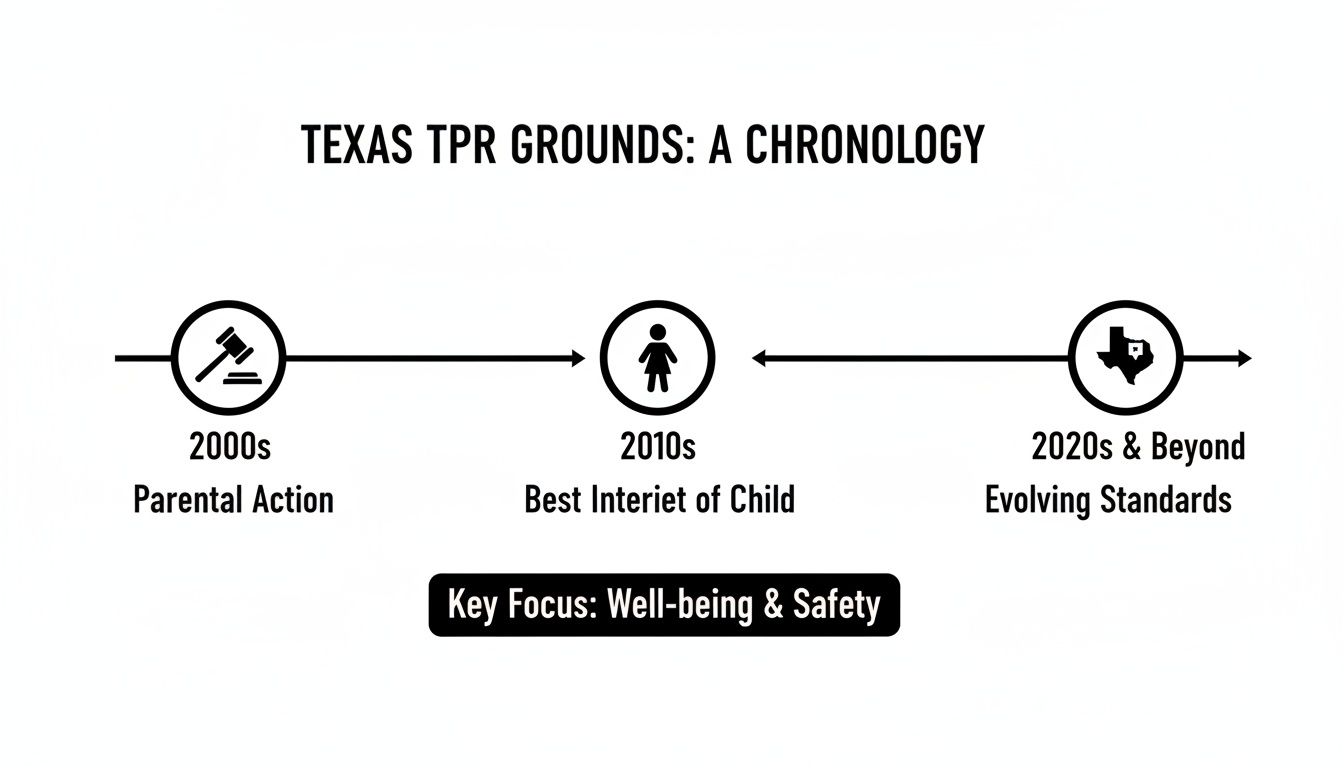
As you can see, the court first has to find that a parent’s conduct meets one of the specific statutory grounds. Only then can it move on to the second question: is termination truly in the child's best interest?
Very early in the case, the judge will appoint an ad litem attorney for your child. This isn't your lawyer or the other parent's lawyer; they are an independent attorney whose sole job is to advocate for what is best for the child. The ad litem will investigate the case by talking to everyone involved—parents, the child (if old enough), teachers, therapists—before making a recommendation to the court.
Timelines in a Harris County TPR Case
Every case moves at its own pace, but understanding a general timeline can help manage expectations. A contested case, where the parents don't agree, will naturally take much longer than one that settles.
Here's a rough breakdown of what to expect in the local courts.
Table: Timeline of a Typical TPR Case in Harris County
| Stage | Typical Duration | Key Activities |
|---|---|---|
| Filing & Service | 1-2 months | The petition is filed, and the other parent is located and served with the lawsuit. |
| Initial Orders | 1-3 months | A temporary orders hearing may occur to set rules for custody and visitation while the case is ongoing. |
| Discovery | 3-6 months | This is the longest phase, involving the exchange of documents, written questions, and depositions. |
| Mediation | 1-2 months | A mandatory settlement conference is held with a neutral mediator to try and resolve the case. |
| Final Trial Prep | 1-2 months | If mediation fails, both sides prepare witnesses and exhibits for the final hearing. |
| Final Trial | 1-3 days | The actual trial where the judge hears evidence and makes a final decision. |
Keep in mind that factors like a crowded court docket, extensive discovery disputes, or the need for psychological evaluations can extend these timelines.
Gathering Evidence and Seeking Resolution
Next up is the discovery phase, which is the formal process for gathering evidence. It’s where the real work of building a case happens. This stage typically involves:
- Written Questions (Interrogatories): You will likely receive a list of questions that you must answer in writing, under oath, about your history and parenting.
- Requests for Documents: Both sides can demand relevant paperwork, such as financial records, school report cards, or medical histories.
- Depositions: This is formal, out-of-court testimony. You sit in a conference room with the lawyers and a court reporter and answer questions under oath.
Discovery can feel intrusive and stressful, but it's essential for uncovering the facts. A skilled attorney is your best asset here, helping you respond appropriately and protecting you from improper requests.
In Harris County, the courts are focused on resolution. Judges will almost always order the parties to try and settle their differences before they will grant a final trial.
This means you will be required to attend mediation. It's a confidential meeting where a neutral professional, the mediator, helps you and the other side negotiate. The goal is to see if you can find enough common ground to reach an agreement and avoid having a judge make the final, life-altering decision for you. The skills needed for mediation are very similar to those you would use to prepare for a custody hearing.
The Final Trial
If you can't reach an agreement in mediation, the case is set for a final trial. This is the courtroom showdown where both sides present their evidence, question witnesses, and make their final arguments to the judge. The person asking for the termination has a very high burden of proof—they must prove their case with "clear and convincing evidence."
After hearing everything, the judge will issue a final ruling. The order will either deny the request to terminate or grant it, which legally and permanently severs the parent-child relationship. Knowing these steps helps demystify the process, empowering you to face it with more confidence—especially with a legal team that knows the ins and outs of the Harris County courts.
Understanding the Best Interest of the Child Standard
Even if a parent's behavior checks a legal box for termination, the judge’s job is only half done. The court then has to tackle a second, equally massive question: is permanently ending the parent-child relationship truly in the best interest of the child?
This isn't just a gut feeling. It’s a rigorous legal standard that forces a judge to look at the child's entire world from every possible angle. Think of it less like a single snapshot of a bad moment and more like a full documentary of the child's life. A Harris County judge needs to understand what that child’s future looks like with the parent—and without them.
The Holley Factors a Judge Considers
To make this incredibly difficult decision, Texas courts lean on a framework known as the "Holley Factors." These aren't new; they come from a landmark Texas Supreme Court case and act as a guide to make sure nothing important is overlooked. There's no magic number of factors that seals the deal. Instead, the judge weighs them all together to see the whole picture.
Here are some of the key questions a judge will be asking:
- What does this child need, emotionally and physically, today and down the road? Can this parent provide a stable, loving environment?
- Is the child in any danger, now or in the future? This digs into any history of abuse, neglect, or exposure to unsafe situations.
- What are the parenting skills of the person fighting to keep their rights? Does this individual have the ability to raise a healthy, well-adjusted child?
- How stable is the parent's home compared to where the child is now? The court will directly compare the two environments.
- What has the parent done (or failed to do) that suggests the relationship is unhealthy? This looks at the parent’s track record.
- Are there legitimate excuses for the parent's actions or inaction? The court will listen to the parent's side of the story and evaluate their explanations.
To get these answers, a judge will listen to everyone involved—social workers, teachers, therapists, and family members. It’s a 360-degree review, not a simple pass/fail exam.
How These Factors Play Out in Atascocita
Let's bring this home to our community. Picture a parent in Atascocita who has a history of substance abuse but has been clean for six months, is holding down a job, and never misses a support meeting. While their past actions might meet the legal grounds for termination, everything they are doing right now speaks directly to the Holley Factors.
A good attorney would flood the court with evidence of this turnaround. They would argue that keeping this family together is now squarely in the child's best interest.
The "best interest" standard is intentionally flexible. It has to be. It allows a judge to craft a decision based on the unique, messy, and complicated reality of each family, because what’s right for one child might be wrong for another.
This focus on the child’s total well-being means looking at all the support systems available. A crucial part of this is ensuring the child has access to resources that help them thrive. For instance, understanding the benefits of early intervention for child development highlights the kinds of support that can make a huge difference and that courts want to see in place.
Thankfully, Texas has been shifting its focus toward preserving families when it's safe to do so. Since 2018, major reforms have led to a 55% drop in children being removed from their homes and 53% fewer deaths from abuse. This shows that supporting families often works better than tearing them apart.
Still, federal audits have pointed out that Texas sometimes moves too quickly to terminate rights, which can get in the way of reunification. For families in Atascocita and Humble, this underscores just how critical it is to have a strong legal advocate fighting for you from day one. Even when things look bleak, there can still be a path forward.
How to Defend Your Parental Rights
Getting a notice that someone is trying to terminate your parental rights feels like the ground has fallen out from under you. It’s a terrifying and overwhelming moment, but it’s also the time to turn that fear into focused action. You aren't helpless here. The Texas legal system gives you fundamental rights and a chance to build a powerful defense.
This is where your story, your efforts, and your dedication to your child become your greatest assets. The goal is to show the court not just what happened in the past, but who you are today and the parent you are committed to being for your child's future. With the right strategy, you can make sure your side of the story is heard.
Know Your Fundamental Rights
Before you even think about strategy, you need to understand the legal ground you stand on. The law inherently recognizes how vital the parent-child bond is, so it builds in protections to ensure a fair process.
As a parent facing a termination case, you have the right to:
- Legal Representation: You absolutely have the right to hire an attorney. If a government agency like CPS is bringing the case and you can't afford a lawyer, the court must appoint one for you at no cost.
- Be Present at Hearings: You are entitled to be at every single court hearing and to actively participate in your own defense.
- Challenge the Evidence: You get to see, question, and push back against every piece of evidence and every witness the other side brings forward.
- Present Your Own Case: You have the right to show your own evidence and bring in your own witnesses who can speak to your character and your abilities as a parent.
These aren't just technicalities—they are the core of your defense. They guarantee you a fair shot to fight for your family.
Building a Proactive Defense Strategy
A successful defense is almost never a passive one. It’s about taking tangible, provable steps to show the court that keeping your relationship intact is what’s best for your child. It’s about proving you are a safe, stable, and loving parent.
Your attorney will help you craft a defense tailored to your situation, but it will likely revolve around a few key actions. The focus should be on demonstrating positive, lasting change and stability.
The most convincing defense comes from showing, not just telling, the judge that you are actively working to be the parent your child needs. In court, actions always speak louder than words.
Think about what triggered this case. Was it a substance abuse issue? An unstable living situation? Now is your chance to tackle those issues head-on.
- Complete Court-Ordered Services: If a judge has ordered parenting classes, therapy, or a substance abuse program, completing them is non-negotiable. Don't just check the box—engage with the process and get the paperwork that proves you did the work.
- Maintain Stable Housing and Employment: You need to show the court you can provide a safe and consistent home. That means holding down a job and keeping a clean, stable place to live in a community like Atascocita or Humble.
- Showcase Your Support System: Line up testimony from family, friends, neighbors, or faith leaders who can vouch for your positive changes and the strong bond you have with your child.
In some high-conflict situations, you might need more specialized help to protect the child's well-being, like learning how to handle co-parenting with a narcissist.
Arguing Against the Best Interest Standard
Here's a crucial point: even if the other party proves a legal ground for termination, they still have to convince the judge that it’s in your child's best interest. This is often where your defense can make the biggest impact. Your attorney can help you present compelling evidence showing the profound emotional damage that severing your bond would inflict on your child.
This might involve testimony from a therapist, letters from your child’s teachers, or even photos and videos that clearly illustrate your loving relationship. The mission is to paint a vivid picture for the judge: taking you out of your child's life would do far more harm than good. If the court’s ruling doesn’t go your way, it’s vital to know your next steps; our guide on how to appeal a family court decision can offer valuable insight.
Considering Your Next Steps? Let's Talk.
Walking through the process of terminating parental rights is one of the toughest, most emotionally charged journeys a person can face. Frankly, it's not something anyone should ever have to do alone. The legal and personal stakes are as high as they get in Texas family law, and the weight of it all can be crushing.
If you find yourself in this position in Atascocita, Humble, or anywhere in the surrounding northeast Harris County area, it's vital to hold onto a few core truths:
- This is the most final, irreversible action a family court can order.
- The person asking for the termination has to meet an incredibly high standard of proof.
- You have a constitutional right to defend your relationship with your child.
How We Can Help You Move Forward
The very first, and most crucial, step you can take is getting an experienced family law attorney in your corner. We encourage you to reach out to us at The Law Office of Bryan Fagan for a free, confidential consultation right here at our Atascocita office.
Think of this as a no-pressure conversation. It’s a chance to sit down with someone who understands, share your story, and get clear, straightforward advice on your rights and what the road ahead might look like.
Don't let another day go by feeling uncertain or unsupported. Our team is here to stand with you and fight to protect what you value most: your family. Give us a call today.
Frequently Asked Questions About Terminating Parental Rights
When you're dealing with something as serious as the potential termination of parental rights in Texas, it's natural to have a lot of questions. We've put together answers to some of the questions we hear most often from families in the Atascocita and Humble areas.
Can Parental Rights Be Reinstated After They've Been Terminated?
Think of a termination order from a judge as a final, permanent decision. While a very specific Texas law does open a narrow window for reinstatement, the circumstances are incredibly rare.
For this to even be a possibility, the child typically cannot have been adopted, and both the parent and an older child must consent to the reinstatement. Because this is such a long shot, it is absolutely critical to approach the initial termination case as your one and only chance to build the strongest defense possible.
Does Terminating My Rights Get Rid of Child Support?
Yes, once a court order terminates your parental rights, your obligation to pay any future child support also ends.
However, and this is a big one, the termination does not erase any past-due child support payments. If you had an outstanding balance (arrears) before the termination, the state can and will continue to collect on that debt.
What Happens If Just One Parent's Rights Are Terminated?
This is actually a very common scenario we see with local families. When the court terminates the rights of only one parent, the other parent becomes the child's sole legal parent, taking on all rights and responsibilities.
A perfect example of this is a stepparent adoption. The biological father, for instance, might agree to voluntarily give up his parental rights. This clears the way for the child's stepfather to legally adopt them, creating a new, officially recognized family unit. The child's legal connection to the terminated parent is completely cut, while their relationship with the remaining parent is unchanged.
How Long Does a TPR Case Take in Harris County?
The timeline for a termination of parental rights Texas case really depends on the unique facts of the situation. If it's an uncontested case where a parent willingly agrees to the termination, it could be wrapped up in just a few months.
On the other hand, a contested case is a different story, especially if Child Protective Services (CPS) is involved. These cases are much more complex and can easily take a year, or even longer, to navigate the Harris County court system from the initial filing to a final trial.
Facing these questions can feel overwhelming, but you don't have to figure it all out on your own. The team at The Law Office of Bryan Fagan – Atascocita TX Lawyers is here to offer the clear-headed, compassionate guidance you need. Schedule your free, confidential consultation at our Atascocita office today to talk about your situation and protect your family's future.


