If you've recently been arrested or received a notice to appear in a Harris County court, you've probably heard the word "arraignment." It’s a term that can sound intimidating, but it’s really just your first formal court appearance after the state has filed criminal charges. This isn't your trial. Instead, it’s a critical first hearing where you are officially told what you're being accused of, informed of your constitutional rights, and asked how you plead. For our neighbors in Atascocita, Humble, and across northeast Harris County, understanding this process is the first step toward reducing anxiety and taking back control of your situation.
Your First Day In Court: What Is an Arraignment?
Walking into the Harris County Criminal Justice Center for the first time can feel overwhelming. At The Law Office of Bryan Fagan, we understand that facing criminal charges is one of the most stressful experiences a person can go through. We want our neighbors in Atascocita and Humble to know that being informed is the best defense. Knowing what to expect at this initial step can make a world of difference, helping you feel supported and prepared.
Think of the arraignment as the official starting line of your criminal case. The main goal here isn’t to decide if you’re guilty or innocent—that comes much later. This hearing is all about handling the necessary administrative and procedural groundwork that sets the stage for everything to follow, ensuring your rights are protected from the very beginning.
The Purpose of the Hearing
In the Texas criminal justice system, an arraignment serves a few very specific purposes. Each one is a crucial piece of the legal puzzle, designed to make sure your rights are protected right from the start.
Here's what the court will accomplish during this hearing:
- Formally State the Charges: The judge or prosecutor will read the official charges filed against you. This ensures there's no confusion about what the state is accusing you of.
- Advise You of Your Rights: You will be clearly informed of your fundamental rights, including the right to have an attorney, the right to remain silent, and the right to a trial by jury.
- Address Legal Representation: The judge needs to know if you have already hired a lawyer. If not, they will ask if you need the court to appoint one for you.
- Accept Your Plea: You will be asked to enter a plea. The most common pleas are "guilty," "not guilty," or "nolo contendere" (which means "no contest").
- Set Bail and Release Conditions: If you are in custody, the judge will review or set the terms of your release while your case moves forward.
Key People in the Courtroom
To really get a handle on what’s happening, it helps to have a basic understanding criminal law and know who’s who in the room. When you step into that courtroom, you’re going to see several people, each with a very specific job to do.
Navigating your arraignment starts with knowing who the key players are and what they do. This simple knowledge can make the entire process feel less chaotic and more manageable.
Who You'll See at Your Harris County Arraignment
| Participant | Role and Responsibility |
|---|---|
| The Judge | Presides over the hearing, ensures rules are followed, advises you of your rights, sets bail, and accepts your plea. They are the ultimate authority in the courtroom. |
| The Prosecutor | Represents the State of Texas (the government). They present the charges against you and may argue for specific bail conditions. This is the lawyer on the other side. |
| The Defense Attorney | Represents you, the defendant. Their job is to protect your rights, advise you on how to plead, and argue on your behalf regarding bail and release conditions. |
| The Defendant | This is you. Your main role is to listen carefully, follow your attorney's advice, and answer the judge’s questions directly when asked. |
| The Bailiff | A law enforcement officer responsible for maintaining order and security in the courtroom. They may escort you and ensure everyone follows the judge's instructions. |
| The Court Clerk | Manages the official court records. They will be documenting everything that happens during the hearing, from the charges read to the plea you enter. |
Once you can put a role to each face, the courtroom becomes a much less intimidating place.
Knowing who is in the room and what they do can make the environment feel less overwhelming. It helps you focus on what truly matters: your defense.
At The Law Office of Bryan Fagan, we believe an informed client is an empowered client. If you are facing an arraignment in Atascocita, Humble, or anywhere in northeast Harris County, you don't have to navigate it alone. schedule a free consultation with our Atascocita office to discuss your case and ensure your rights are protected from day one.
A Step-by-Step Guide to the Arraignment Process
While every case has its own unique details, the arraignment hearing itself follows a very structured, predictable script. Knowing what to expect can make all the difference, helping you feel more grounded when you walk into a Harris County court. Think of it as a roadmap for your first official court appearance—there are specific stops along the way, and each one serves a clear purpose.
When you get to the courtroom, the docket is often packed, so you'll likely have to wait a bit until your name or case number is called. Once it's your turn, you’ll be asked to come forward and stand before the judge. This is where things officially kick off.
This diagram shows the basic courtroom setup and who the key players are during this process.
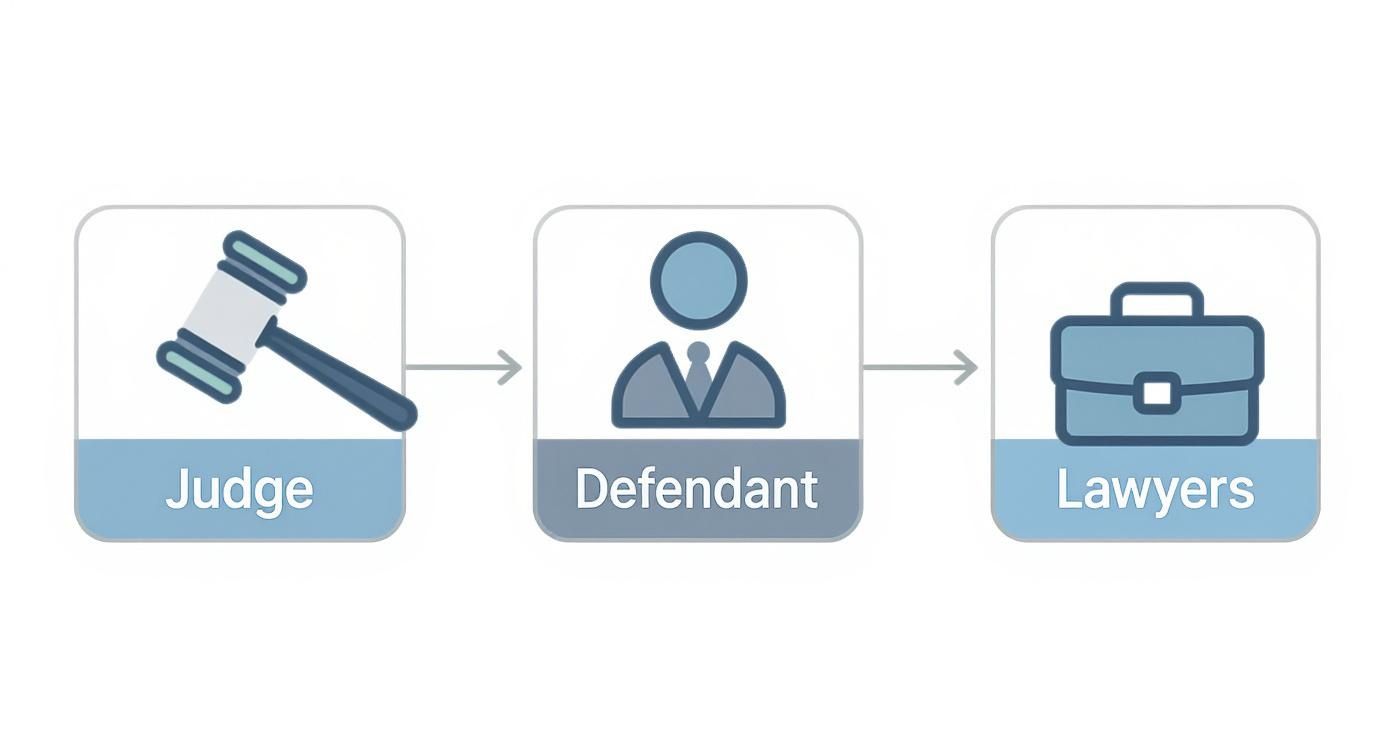
You can see how the judge, the defendant (that's you), and the attorneys all interact to make sure every procedural step is handled correctly.
The Formal Reading of Charges
First things first, the judge will confirm your identity. Then, they will formally read aloud the criminal charges the State of Texas has filed against you. These charges are laid out in an official document, which is called a complaint for misdemeanors or an indictment if you're facing a felony.
The entire point of this is to leave no room for doubt. You need to know exactly what accusations you're up against. It's a fundamental piece of your constitutional right to due process.
Advisement of Your Constitutional Rights
Next, the judge will run through your fundamental constitutional rights. This is a crucial moment, and it’s important to pay close attention.
The judge will inform you of several key protections, including:
- Your right to remain silent and not say anything that could incriminate you.
- Your right to have a lawyer represent you.
- Your right to a court-appointed attorney if you can't afford to hire one yourself.
- Your right to have your case decided by a jury.
This isn't just the court going through the motions. It’s a safeguard, ensuring you fully understand the protections you're guaranteed under Texas law before the case goes any further.
Entering a Plea
After explaining your rights, the judge will ask how you plead to the charges. In Texas, the main options are "guilty," "not guilty," or "nolo contendere" (which means no contest). For our clients here in Atascocita and Humble, we almost universally advise pleading "not guilty" at this initial stage.
Pleading "not guilty" isn't the same as saying you're innocent or denying something happened. It’s a procedural step. Pleading not guilty preserves every single one of your legal rights and gives your attorney the crucial time needed to get the evidence, investigate the state's claims, and start building a strong defense.
Entering a "not guilty" plea is the standard, strategic move at an arraignment. It keeps all your options on the table as the case proceeds.
Bail and Conditions of Release
Finally, the judge will turn to the issue of bail and any conditions tied to your pretrial release. If you're currently in custody, this is when your attorney gets the chance to argue for your release on a personal bond or for a reasonable, affordable bail amount.
The judge weighs several factors when making this decision, such as:
- The seriousness of the alleged crime.
- Your ties to the local community (like family and a job in the Atascocita area).
- Your criminal history, if you have one.
- Whether the court believes you might be a flight risk or a danger to the public.
Even if you are released, the judge can impose specific rules you have to follow, like a no-contact order or a requirement to check in regularly. Navigating this on your own is a huge risk. A skilled local attorney can speak on your behalf at every stage, making sure your rights are protected and fighting for the best possible outcome right from the start.
Navigating Your Plea Options in Texas
The single most important moment of your arraignment hearing is when the judge asks, "How do you plead?" This isn't just a question; it's a critical fork in the road, and your answer will dictate the entire path of your case from that point forward. In Texas, you have three potential answers, and truly understanding each one is the key to protecting your future.

If you're facing a hearing in Atascocita or Humble, it's natural to feel a ton of pressure to just get it over with. But this is one of those times where slowing down is absolutely vital. The right plea keeps all your doors open, while the wrong one can slam them shut before you've even had a chance to build a defense.
The Standard Choice: Pleading Not Guilty
In the vast majority of criminal cases, the most strategic and protective plea you can enter at an arraignment is “Not Guilty.” We know that can feel strange, especially if you think the evidence seems overwhelming. But this isn't about denying facts; it's about protecting your rights.
Think of it this way: pleading not guilty isn't you making a final statement. Instead, it's a formal legal maneuver that activates crucial constitutional protections.
- It puts the burden squarely on the prosecutor to prove their case beyond a reasonable doubt.
- It gives your lawyer the time and legal standing to request and examine all the evidence the state has against you (a process called "discovery").
- It opens the door for your legal team to conduct its own investigation, find weaknesses in the prosecution's arguments, and challenge how evidence was collected.
Pleading "not guilty" is essentially you saying, "I am exercising my constitutional right to a fair legal process." It’s the standard move that lets your attorney do their job and fight for the best possible outcome for you.
A "Not Guilty" plea is your key to unlocking the entire defense process. It’s not a final statement on the facts; it’s the procedural move that allows your attorney to fight for you.
The Consequences of a Guilty Plea
Pleading “Guilty” at your arraignment is a final, and almost always irreversible, decision. When you tell the judge you're guilty, you’re not just admitting to the crime—you are giving up a bundle of your most fundamental legal rights, including your right to a trial.
The case immediately jumps to the sentencing phase. There's no opportunity to go back, question the evidence, or negotiate the charges. This is why pleading guilty this early is almost never a good idea unless your attorney has already worked out a specific plea agreement with the prosecutor after a thorough review of your case.
Understanding Nolo Contendere or No Contest
Your third option is to plead “Nolo Contendere,” which is Latin for “no contest.” This is a unique plea. You're not admitting you're guilty, but you are telling the court you don't plan to fight the charges.
From the criminal court's perspective, it's treated the same as a guilty plea—the judge will find you guilty and move on to sentencing. The key difference is that a "no contest" plea usually can't be used against you as an admission of guilt if someone later files a civil lawsuit against you related to the same incident. It’s a very specific tool used in certain strategic situations, and it’s something you should only ever consider after a deep discussion with your lawyer.
The plea you enter is your first, and arguably most important, act of defense. To help clarify these choices, here’s a breakdown of what each plea means for your case.
Comparing Your Plea Options at a Texas Arraignment
Understanding the immediate and long-term consequences of each plea you can enter at your hearing.
| Plea Type | What It Means | Immediate Consequence | Why It's Chosen |
|---|---|---|---|
| Not Guilty | "I deny the charges and demand the prosecutor prove their case beyond a reasonable doubt." | The case proceeds. Your attorney can begin discovery, file motions, and build a defense strategy. | This is the standard, strategic plea that preserves all your constitutional rights and legal options. |
| Guilty | "I admit to committing the crime as charged." | You waive your right to a trial. The case moves directly to the sentencing phase. | Almost never recommended at arraignment. Used later only as part of a negotiated plea bargain. |
| No Contest | "I do not contest the charges, but I am not admitting guilt." | Same as a guilty plea in criminal court; you are found guilty and the case moves to sentencing. | A strategic choice to avoid admitting fault in potential future civil lawsuits. Requires expert legal advice. |
Choosing the right plea is your first line of defense, and it’s a decision that shouldn't be made alone. If you have an upcoming arraignment in Harris County, contact The Law Office of Bryan Fagan for a free consultation. Our Atascocita team is here to provide the guidance you need to make the best decision for your future.
Understanding Bail and Pretrial Release Conditions
For most families in Atascocita, the most stressful part of an arraignment isn't the legal jargon or the courtroom formalities. It's the one big question on everyone's mind: "Is my loved one coming home?" The judge's decision on bail and pretrial release has an immediate, real-world impact. This is the moment that determines whether you’ll wait for your next court date from a jail cell or from your own home.
This is precisely where having a local attorney who knows the ins and outs of the Harris County court system can make all the difference. Your lawyer's job is to build a strong case for your release, presenting you to the judge as a responsible community member who isn't a risk. The goal is simple: secure your freedom under the best possible terms so you can get back to your family and job in our community.
How Harris County Judges Decide Bail
A Texas judge can't just pull a bail amount out of a hat. They are legally required to consider several key factors before deciding whether to grant release and what conditions to set. It's a balancing act between protecting the community and upholding your rights.
Here’s what they’ll look at:
- The seriousness of the charge. A misdemeanor shoplifting case is viewed very differently from an aggravated assault.
- Your ties to the community. Do you have a steady job in Humble? Does your family live in Atascocita? Strong local roots suggest you're less likely to flee.
- Your criminal record. A clean history works heavily in your favor.
- Whether you pose a flight risk or a potential danger to anyone.
A skilled attorney knows how to frame these factors in the most positive light. They’ll emphasize your community connections and present you as someone who can be trusted to show up for court, which can have a huge impact on the judge's decision.
Different Types of Bonds in Texas
If the judge sets bail, you have a few ways to post it and get out of jail. The options can be a bit confusing, but they generally boil down to three main types:
- Personal Recognizance (PR) Bond: This is the ideal outcome. The judge agrees to release you based solely on your written promise to return to court. No money is required upfront.
- Cash Bond: You or your family pay the full bail amount directly to the court. As long as you show up for all your hearings, you get this money back when the case is over.
- Surety Bond: This is the most common route. You pay a fee, typically around 10% of the total bail, to a bail bondsman. The bondsman then posts the full amount with the court. That 10% fee is non-refundable—it’s the cost of their service.
Common Pretrial Release Conditions
Getting released often comes with strings attached. To ensure you stay out of trouble and show up for your next court date, a judge can impose certain rules you have to live by.
Think of pretrial conditions not as punishments, but as safeguards. The court puts them in place to ensure public safety and your appearance at future hearings. Breaking these rules is serious—it can get your bond revoked and land you right back in jail.
Some common conditions include:
- No-Contact Orders: Being forbidden from contacting the alleged victim or even going to certain places.
- Electronic Monitoring: Having to wear a GPS ankle monitor.
- Regular Check-ins: Reporting to a pretrial services officer weekly or monthly.
- Substance Abuse Testing: Submitting to random drug or alcohol tests.
Pretrial detention is a massive issue. Across the United States, hundreds of thousands of people are held in jail while awaiting trial, often because they cannot afford bail. This system can put immense strain on families and communities. An experienced local attorney will fight for the least restrictive conditions possible, giving you the best chance to keep your job, support your family, and live your life in Atascocita with minimal disruption while your case moves forward.
Why an Attorney Is Your Strongest Ally at Arraignment
Walking into a Harris County courtroom to face a judge and prosecutor is a deeply intimidating experience. It’s not something anyone should ever do alone. While the arraignment might seem like just a formality, the decisions made in those few minutes can echo for months, affecting your freedom, your finances, and the entire trajectory of your case.
This is why having an experienced local attorney by your side from the very beginning isn't just a good idea—it's your single greatest advantage.
Think about it. There's a world of difference between standing before the judge feeling lost and overwhelmed, and walking in with a dedicated advocate who knows the system inside and out. That's the immediate peace of mind our team provides. We become your voice when you're not sure what to say and your shield when your rights are on the line.
What an Attorney Does for You at Arraignment
A good lawyer does a lot more than just stand next to you. They're taking specific, strategic actions to protect your interests from the second your name is called.
Here’s what you can expect an attorney from our Atascocita office to do for you:
- Protect Your Constitutional Rights: We’re there to make sure every single procedure is followed to the letter and that your fundamental rights are protected from day one.
- Advise on the Correct Plea: We will almost always enter a plea of "Not Guilty" on your behalf. This is crucial because it preserves all of your legal options and buys us the time we need to start building a strong defense.
- Argue for Favorable Bail Conditions: We will make a strong, persuasive case to the judge for your release on a personal recognizance bond or for the lowest possible bail. We do this by highlighting your ties to the Atascocita and Humble communities and other stabilizing factors.
The impact of having a lawyer at this stage is well-documented. Proper arraignment hearings safeguard defendants' rights and prevent people from being locked up unnecessarily. An attorney ensures the court sees you as a person, not just a case number.
Speaking on Your Behalf
Maybe the most critical job your attorney has at the arraignment is being your spokesperson. We handle all the talking with the judge and the prosecutor. You won't have to worry about misspeaking or accidentally saying something that could hurt your case down the road.
We know exactly how to frame the arguments, present the right information, and negotiate from a position of strength, not desperation.
When your world is turned upside down by a criminal charge, a skilled defense lawyer is more than just a legal representative—they are a lifeline. They provide the clarity and advocacy you need during one of life's most challenging moments.
This is the heart of our criminal defense practice. We step in to handle the legal maze so you can focus on your life and your family. Knowing the local court customs is just as important as knowing the law, and understanding how criminal defense firms strategically market their services helps us connect with people who need help right away. Every part of what we do is geared toward providing immediate and effective support.
Don't face your arraignment alone. Let The Law Office of Bryan Fagan give you the expert guidance and strong representation you need to get through this.
Common Questions About Harris County Arraignments
It's completely normal to feel overwhelmed and have a million questions running through your mind when you're facing a court date. To help ease some of that anxiety, we've put together answers to the questions we hear most often from our clients here in the Atascocita community. Think of this as a practical, no-nonsense guide to help you feel more prepared for what's ahead.
Our goal is simple: to give you clear, supportive advice that directly addresses your worries.
What Should I Wear and Bring to My Arraignment in Harris County?
When it comes to your court appearance, perception matters. The best rule of thumb is to dress like you're going to an important job interview or a church service. Business casual is always a safe bet. This shows the judge and the prosecutor that you are taking the situation seriously.
Definitely leave the shorts, graphic t-shirts, and hats at home.
As for what to bring, keep it simple:
- Your government-issued ID (like a driver's license).
- Any and all paperwork the court or your attorney has sent you.
- Your lawyer's contact information, just in case.
A quick but important tip: most Harris County courtrooms have a strict no-cell-phone policy. Your best bet is to just leave it locked securely in your car to avoid any issues.
Can My Case Get Dismissed at the Arraignment?
This is a question we get all the time, and the answer is almost always no. It is extremely rare for a case to be thrown out this early in the process.
The arraignment isn't about arguing guilt or innocence; it's a procedural step designed to get the case officially started. Think of it as the formal kickoff. Your attorney will work towards a potential dismissal later on, but only after they've had a chance to dig into the evidence, file motions, and find weaknesses in the prosecution's argument.
An arraignment is the starting line, not the finish line. Its purpose is procedural—to officially start the case and ensure your rights are protected from the outset.
So, while a dismissal is often the ultimate goal, you should not walk into your arraignment expecting one.
What Happens If I Miss My Arraignment Date in Texas?
Missing your arraignment is a serious misstep with swift and severe consequences. The judge will, without a doubt, issue a warrant for your arrest. This means any future interaction with a police officer—even for a minor traffic stop in Atascocita or Humble—will likely land you in jail. On top of that, you'll automatically forfeit any bond money you've already posted.
If a true emergency keeps you from making it to your court date, you need to act immediately. Your first call should be to a criminal defense lawyer. An experienced attorney can often contact the court on your behalf, explain the situation, and ask for a reset, potentially stopping the arrest warrant from ever being issued. But time is absolutely critical.
If you find yourself in this situation, schedule a free consultation with our Atascocita office right away to figure out the next steps.
Navigating the legal system is complex, but you don't have to do it alone. The Law Office of Bryan Fagan – Atascocita TX Lawyers is committed to protecting your rights and guiding you through every step. For a free, confidential consultation to discuss your case, contact us today at https://www.atascocitaattorneys.com.