When you're not married, Texas child custody laws operate a bit differently, and the first thing to understand is this: at the moment of birth, an unmarried mother automatically has sole legal and physical custody of her child.
For fathers, the story is different. An unmarried father has zero automatic legal rights—not to custody, not even to visitation—until he takes a crucial legal step to establish paternity.
Your Rights as an Unmarried Parent in Texas
Figuring out child custody in Atascocita and Humble when you're not married can be a confusing and emotionally charged journey. The legal rules are not the same as they are for divorcing couples, which means you'll face a unique set of hurdles. Everything hinges on one specific legal action: establishing paternity.
Many people are surprised to learn that simply having a father's name on the birth certificate isn't enough. Without a court order establishing paternity, that signature doesn't give a father any enforceable rights to see his child or weigh in on big life decisions. For mothers, this automatic sole custody gives you immediate authority, but it often means shouldering the entire responsibility for the child's care without any court-ordered financial support.
The Starting Point for Mothers and Fathers
For mothers here in our community, from Timberwood to Eagle Springs, Texas law automatically puts you in the driver's seat. You have the right to make all the critical decisions for your child, including:
- Deciding where your child lives.
- Making all medical and school-related choices.
- Giving consent for any psychological or psychiatric care.
For fathers, the journey starts with a legal process. The Texas Family Code is clear: to gain parental rights, an unmarried father must either file a paternity lawsuit or have both parents sign a legal form called an Acknowledgment of Paternity (AOP). This is the absolute first step. It's what unlocks the door to asking a court for custody and visitation time.
No matter the parents' marital status, the court's guiding principle is always the "best interest of the child." A judge sees establishing a clear, legal relationship with both parents as essential for a child's emotional and financial well-being.
To make this crystal clear, here’s a quick breakdown of where each parent stands before any legal action is taken.
Default Parental Rights for Unmarried Parents in Texas
| Parental Right | Unmarried Mother's Status | Unmarried Father's Status (Before Paternity) |
|---|---|---|
| Legal Custody | Automatic sole legal custody | None |
| Physical Custody | Automatic sole physical custody | None |
| Decision-Making | Sole authority for all decisions | No legal say |
| Visitation | Controls all access to the child | No guaranteed right to visitation |
| Child Support | Can seek support after paternity | No obligation until paternity is established |
As you can see, the initial legal landscape is quite one-sided until paternity is formally recognized by the court.
Why Establishing Paternity Is So Important
Think of establishing paternity as building the legal bridge that connects a father to his child. Once that bridge is secure, a dad can walk across it and ask a Harris County court for his rights and responsibilities. For unmarried fathers, this is the only way to solidify your legal standing; getting a handle on fathers' visitation rights is a crucial part of this process.
This isn't just for dads, though. Establishing paternity also benefits the mother by creating a legal framework for co-parenting and, just as importantly, ensuring the child receives financial support from both parents.
At The Law Office of Bryan Fagan – Atascocita TX Lawyers, we understand how stressful these situations can be for families right here in our community. Our job is to offer clear, compassionate advice to help you protect your relationship with your child. If you're an unmarried parent in Atascocita or Humble with questions, we invite you to schedule a free consultation with our team.
How to Legally Establish Paternity in Texas
For an unmarried father in Texas, establishing paternity isn't just a legal formality—it's everything. It’s the essential first step that unlocks your ability to seek custody or visitation. Without it, you have no legal footing, no matter how involved you are in your child's life. Think of it as the foundation you must lay before you can build anything else related to your parental rights.
Thankfully, Texas law gives you two clear paths to make your role as a father legally official.
The simplest route is signing a voluntary Acknowledgment of Paternity (AOP). This is a straightforward legal document where both parents agree, under oath, that a specific man is the child's biological father. Many parents sign this right at the hospital after the baby is born, but it can be done later. When you and the mother are in agreement, the AOP is by far the fastest and most cooperative way to get it done.
The Two Main Paths to Establishing Paternity
For fathers in Harris County, your journey to securing parental rights boils down to one of two options. Each is meant for a different set of circumstances, but both achieve the same critical goal: legal recognition as your child's father.
-
Voluntary Acknowledgment of Paternity (AOP): This is the path of mutual agreement. If you and the child’s mother are on the same page, you can complete and sign the AOP form. Once it's filed with the Texas Vital Statistics Unit, it becomes legally binding and carries the same power as a court order.
-
Filing a Paternity Suit: What if the mother disputes paternity, refuses to sign an AOP, or either of you just isn't sure? The next step is a formal Paternity Suit. This means filing a case in court and asking a judge to make the official determination. This process almost always involves a court-ordered DNA test to get a definitive, scientific answer.
This decision tree breaks down the starting legal positions for unmarried parents.
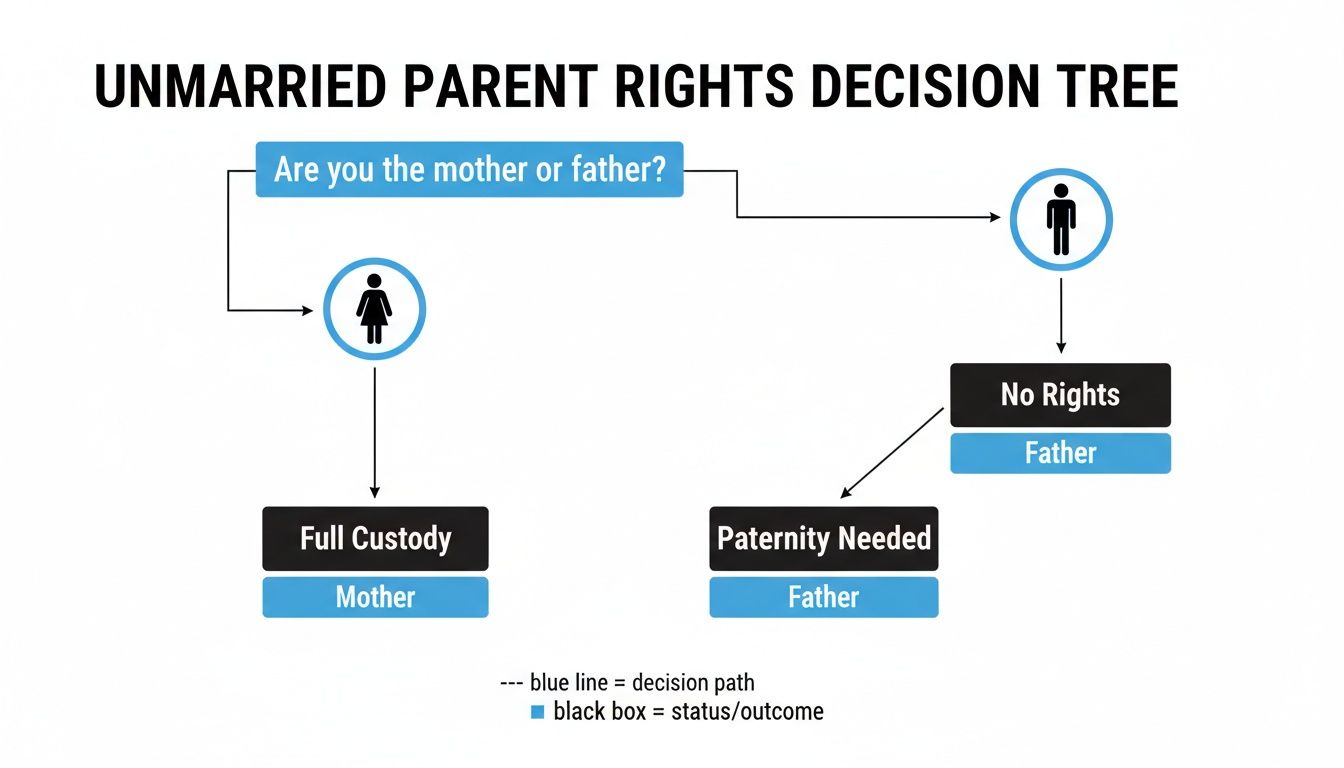
As you can see, the law automatically gives rights to the mother, while the father has to take that crucial first step to establish his.
A Closer Look at the Paternity Process
Going the AOP route is all about cooperation. You can get the form at the hospital or directly from the Texas Vital Statistics Unit. It's incredibly important for both parents to understand that by signing, you are giving up the right to genetic testing later on. Once the AOP is filed, the father's name can be added to the child's birth certificate, solidifying his legal status. For a complete walkthrough, you can learn more about how to establish paternity in Texas on our site.
If you have to file a Paternity Suit, things become more formal. You'll file a petition with the court, and the other parent will be officially served with the lawsuit. From there, a judge will almost certainly order a DNA test. Once the results are in and confirm paternity, the judge issues a final order that officially and legally names you as the father.
This is a critical point for both parents: legally establishing paternity isn't just about gaining rights, it's about taking on responsibilities, too. A court can't order a father to pay child support until he is legally recognized as the father. Both parents have a legal duty to financially support their child in Texas, but that obligation can only be enforced through a court order after paternity is settled.
Whether you're signing an AOP at a local Humble hospital or preparing to file a suit in Harris County, taking action is essential. If you aren't sure which path makes the most sense for your situation, we're here to help you understand your options and take the next step.
Understanding Conservatorship and Possession Orders
Once you’ve legally established paternity, the conversation shifts to what most people call "custody." But in a Texas courtroom, you'll start hearing specific legal terms like conservatorship and possession orders. It can feel like learning a new language, but these concepts are the foundation of your future as co-parents. Getting a handle on them now is the first step toward building a stable, predictable future for your child.

Here in Texas, we don't really use terms like "legal custody" or "physical custody." Instead, the law breaks it down into two key components:
- Conservatorship: This is all about the rights and responsibilities you have to make major decisions for your child. Think of it as your parental authority—the power to decide on things like school, medical care, and religious upbringing.
- Possession and Access: This is the nuts and bolts of the visitation schedule. It’s the calendar that clearly lays out when the child is with each parent.
These two pieces get combined into a final court order that becomes the rulebook for your co-parenting relationship.
Joint Managing Conservatorship: The Texas Standard
In the vast majority of cases we see with unmarried parents here in Harris County, judges name both parents Joint Managing Conservators (JMC). Texas law starts with the strong belief that it's in a child's best interest to have both parents deeply involved in their life, and the JMC designation reflects that.
When you're joint managing conservators, you share the rights and duties of raising your child. This generally means you have to work together and consult each other on the big decisions.
Being a Joint Managing Conservator does not automatically mean a 50/50 split of time with the child. It primarily refers to sharing decision-making powers. One parent is almost always designated as the "primary" parent who has the right to determine the child's residence.
The parent designated as the primary conservator gets to decide where the child lives, though it's usually restricted to a specific area (like Harris County and its neighbors). The other parent, the possessory conservator, has a set visitation schedule. We have more in-depth information on how these roles work in our guide to conservatorship in Texas.
When Is Sole Managing Conservatorship Awarded?
While JMC is the default, it's not a guarantee. In some situations, a judge can name one parent as the Sole Managing Conservator (SMC). This is a much rarer outcome and it only happens when there's evidence that giving the other parent joint authority would put the child's physical or emotional well-being at risk.
A court might award SMC if a parent has a documented history of:
- Family violence or neglect
- Drug or alcohol abuse
- Severe conflict that makes joint decision-making impossible
- Abandonment or a long-term absence from the child's life
In an SMC arrangement, one parent gets the exclusive right to make almost all major decisions. The other parent is named the Possessory Conservator and is typically still granted visitation rights.
The Standard Possession Order: A Predictable Schedule
To provide stability for families in Humble, Atascocita, and across the state, Texas law created a default visitation schedule called the Standard Possession Order (SPO). This is the go-to schedule for Harris County judges unless the parents have already agreed on a different plan or there's a compelling reason why the SPO isn't in the child's best interest.
For unmarried parents, navigating the emotional landscape can be tough, and understanding how to handle difficult dynamics, like co-parenting with a narcissist, is often critical when putting these orders into practice.
The SPO lays out a clear, predictable schedule for the non-primary parent, which typically includes:
- Possession on the first, third, and fifth weekends of a month.
- Alternating major holidays like Thanksgiving and Christmas every year.
- An extended period of summer possession, usually 30 days.
This schedule is designed from the ground up to ensure both parents can maintain a consistent and meaningful presence in their child’s life. Knowing what the SPO looks like from the start can help you and your co-parent set realistic expectations as you begin this process. Here at The Law Office of Bryan Fagan, we can walk you through how these legal frameworks apply to your family's unique circumstances.
How a Harris County Judge Decides Custody
When you and the other parent can’t agree on a custody plan here in Atascocita, the final decision lands in the hands of a Harris County family court judge. Unlike other areas of law filled with black-and-white rules, custody decisions all come down to one guiding principle: the best interest of the child.
This isn’t just a feel-good phrase; it’s the legal standard that a judge must use. They are required to step back and look at your family's entire situation, purely from your child’s perspective, to create an environment that will help them thrive physically, mentally, and emotionally.
The "Holley Factors": What a Judge Actually Looks At
So, how does a judge figure out what’s in a child’s best interest? They use a framework known as the "Holley Factors." These aren't a simple checklist where you score points, but rather a set of guidelines from a major Texas Supreme Court case that helps the judge get a complete picture of your family life.
The judge will weigh several real-world circumstances, including:
- The child's needs: What does your child need right now, and what will they need in the future? This covers their emotional, physical, and developmental well-being.
- Each parent’s abilities: The court carefully looks at who is better equipped to provide a safe, stable, and nurturing home.
- The stability of the home: Which parent can offer the most consistent and predictable environment for the child?
- Who has been the primary caregiver? A judge gives a lot of weight to which parent has historically handled the day-to-day work—things like doctor's visits, homework help, and packing lunches.
- Any potential dangers: The court has to consider any history of domestic violence, substance abuse, or neglect involving either parent or anyone else in their home.
For a parent in Atascocita, this means your everyday life is the best evidence. Proving your involvement in your child’s life—whether it’s attending events at their Humble ISD school or coaching their team at the Lindsay/Lyons Park Sports Complex—can be incredibly powerful. It’s smart to start documenting this now. Our guide on how to prepare for a custody hearing gives you practical steps for gathering this proof.
The End of Gender-Based Assumptions
Decades ago, there was an unwritten rule in many courtrooms called the "tender years doctrine," which basically assumed young kids were always better off with their mothers. That kind of thinking is long gone.
Today, Texas law and Harris County courts are completely gender-neutral. A judge is forbidden from favoring a mother over a father (or vice versa) simply because of their gender. The focus is squarely on which parent has been the primary caregiver and who is best prepared to meet the child’s needs going forward.
“The court will not presume that any person is the better parent for a child because of that person's sex… The best interest of the child shall always be the primary consideration of the court in determining the issues of conservatorship and possession of and access to the child.” – Texas Family Code § 153.003
This legal standard reflects how much families have changed. Courts now recognize what most of us already know: fathers are just as capable of being nurturing, primary parents as mothers are. This has led to far more balanced and fair outcomes in custody cases.
What if Your Child Has a Preference?
This is a question we hear all the time: does my child get to choose? The answer is a qualified yes. In Texas, if a child is 12 years of age or older, the judge is required to meet with them in private chambers to hear who they would prefer to live with.
But it's critical to understand that the child’s choice is not the final word. It's just one more piece of the puzzle for the judge to consider. The judge will try to figure out why the child has that preference and can overrule it if they believe the child's choice is not truly in their own best interest.
Ultimately, every fact, every piece of evidence, and every testimony helps the judge build a complete story of your family. At The Law Office of Bryan Fagan – Atascocita TX Lawyers, we work with unmarried parents to make sure their story is told clearly, focusing on the facts that show their deep commitment to their child's well-being.
Calculating Child Support and Financial Duties
Once you've sorted out paternity and a possession schedule, the next major piece of the puzzle is finances. For unmarried parents in Atascocita and Humble, figuring out child support and other expenses is absolutely essential for your child's long-term stability.
It’s a common misconception that custody and child support are the same thing. They're actually separate court orders. A judge can only order child support after paternity has been legally confirmed, ensuring both parents are contributing to their child's needs. The whole point is to give the child the financial resources they need to thrive, maintaining a standard of living as close as possible to what they would have had if the parents were still together.

How Texas Calculates Child Support
Texas doesn't leave child support up to guesswork. The law provides a pretty straightforward formula to keep things consistent from one case to the next. The calculation starts with the non-primary parent's (called the "obligor") net monthly resources.
So, what are "net resources"? Think of it as your take-home pay. It includes all your income—salary, commissions, overtime, you name it—minus a few specific deductions like federal income tax, Social Security taxes, and the money you spend on the child's health insurance.
From there, the court applies a set percentage based on how many children need support:
- 1 Child: 20% of net resources
- 2 Children: 25% of net resources
- 3 Children: 30% of net resources
- 4 Children: 35% of net resources
- 5 or more Children: 40% of net resources
These percentages are the standard starting point for every child support case in Harris County. A judge can order a different amount, but they have to have a very good reason and explain exactly why a deviation is in the child's best interest.
This is a crucial point to remember: Child support is for the child. It’s not a payment to the other parent. These funds are meant to cover the fundamental costs of raising a child—things like their share of the rent or mortgage, groceries, clothes, and all the other day-to-day expenses.
Example Texas Child Support Guideline Calculations
To make this less abstract, let's look at a few examples. This table shows what the standard guidelines might look like in practice for a parent living in our community.
| Number of Children | Percentage of Net Resources | Example Net Monthly Income | Estimated Monthly Support |
|---|---|---|---|
| 1 | 20% | $4,000 | $800 |
| 2 | 25% | $5,000 | $1,250 |
| 3 | 30% | $6,000 | $1,800 |
Keep in mind, these are just simplified estimates. The actual amount you might pay or receive will depend on the specifics of your own financial situation.
Other Essential Financial Duties
A good child support order covers more than just the monthly payment. It's a comprehensive plan to ensure a child’s needs are fully met.
- Health Insurance: The court will order one or both parents to provide health and dental insurance. The parent who pays the monthly premiums usually gets a credit for that amount, which lowers their net resources for the support calculation.
- Uninsured Medical Expenses: What about things insurance doesn't cover, like co-pays, deductibles, or braces? These costs are typically split between the parents, often 50/50.
- Extracurricular and School Costs: Depending on the family's situation, a judge might also order parents to share costs for things like school supplies, field trip fees, or activities like sports or music lessons.
Navigating the financial side of a custody case can feel overwhelming. At The Law Office of Bryan Fagan, we help unmarried parents in Atascocita understand their financial rights and obligations. If you have questions about child support, we invite you to schedule a free, no-obligation consultation at our local office to discuss your case.
How a Local Atascocita Attorney Can Help
Knowing the basics of the law is a great start, but actually navigating the Harris County court system is a different beast altogether. For unmarried parents in our community, going it alone in a custody case is a massive undertaking, and it's unfortunately easy to make mistakes that can hurt your case and your family.
This is where having an experienced local family law attorney on your side really makes a difference.
An attorney’s job goes way beyond just filling out forms. Think of us as your strategist and your guide, making sure your story is told clearly and effectively within the rigid rules of the court. The legal system has its own language, deadlines, and unwritten rules. One misstep can derail your case for months.
Avoiding Common, Costly Mistakes
So many parents try to represent themselves, and their intentions are good. But without a deep understanding of child custody laws in Texas for unmarried parents, they can unintentionally do serious damage to their own case.
Here are a few of the most common pitfalls we help our clients steer clear of:
- Missing critical deadlines: The court system runs on a strict clock. Failing to file a response or turn in evidence on time can lead to a default judgment—meaning you could lose without ever getting to make your case.
- Filing the wrong paperwork: Harris County courts are very particular about their forms. One small error or an incomplete section can get your entire case thrown out, forcing you to start over.
- Letting emotions drive decisions: Custody battles are emotional. That’s a given. But legal strategy needs a level head. We help you separate the emotion from the facts so you can make choices that benefit you and your child in the long run.
- Not understanding the rules of evidence: You can't just walk into court and tell your side of the story. You have to prove it, and there are very strict rules about what a judge is allowed to see and hear.
A good attorney makes sure your petition is filed correctly the first time, all your evidence is properly gathered and presented, and you’re fully prepared for every meeting, mediation, and court date.
Navigating a custody case isn't about winning arguments—it's about building a stable, predictable future for your child. A local attorney who knows the Atascocita and Humble courts understands what judges here want to see and can build a strategy that fits your family's unique situation.
Your Partner in a Tough Process
Whether we're negotiating a fair visitation schedule or standing up for you in front of a judge, our job is to protect your rights as a parent while keeping your child’s well-being at the center of everything. We handle the legal heavy lifting so you can focus on what matters most: being there for your child during a stressful time.
If you’re an unmarried parent in Atascocita, Humble, or anywhere in northeast Harris County facing a custody issue, you don’t have to figure this out on your own. The team at The Law Office of Bryan Fagan – Atascocita TX Lawyers is here to help. We invite you to schedule a free consultation at our Atascocita office. Let's talk about what's happening and build a clear plan to protect your family.
A Few Common Questions We Hear
When you're navigating Texas family law for the first time, a lot of questions come up. It's completely normal. Here are some of the most common ones we hear from unmarried parents in the Atascocita and Humble areas, along with straightforward answers.
What if the Father Is on the Birth Certificate but We Never Signed an AOP?
This is a big one. Yes, a hospital can add a father's name to the birth certificate when the baby is born. But here's the critical part: in Texas, that alone does not give him any legal rights.
Think of the birth certificate as a statement, not a court order. To get enforceable rights to custody or visitation, you need one of two things: a signed Acknowledgment of Paternity (AOP) or a court order that officially establishes him as the legal father.
We Agree on Everything. Do We Really Need to Go to Court?
Even if you’re the best of friends and have co-parenting down to a science, relying on a verbal agreement is a huge risk. Life happens. Circumstances change. A handshake deal isn't worth much when a disagreement pops up down the road.
Getting a formal court order takes your private agreement and makes it legally binding. It protects everyone—mom, dad, and especially the child—by creating a clear, enforceable roadmap for schedules, holidays, and who makes important decisions. It's about ensuring stability for your child, no matter what the future holds for your relationship.
The Other Parent Moved Our Child Out of Atascocita. What Can I Do?
This is a scary situation, and the answer depends entirely on whether you have a court order.
If your order includes a geographic restriction (which is common, often limiting the child's residence to Harris County and its neighbors), then moving the child without your permission or a judge's approval is a direct violation. You can go to court and file an enforcement action to bring the child back.
If you don't have an order, things get much more complicated and stressful. It becomes a much harder legal battle to get your child back. This is exactly why it's so important to establish formal custody orders sooner rather than later—it protects your rights as a parent before a crisis can happen.
Every family's situation is unique, and these general answers are just a starting point. To understand your specific rights and options, you need advice tailored to you.
The team at The Law Office of Bryan Fagan – Atascocita TX Lawyers is here to bring clarity to your case. We can help you create a plan that puts your child first. Schedule a free, no-obligation consultation at our Atascocita office to get started.