Terminating parental rights is one of the most profound and permanent actions a court can take in family law. It’s not just a legal step; it's a life-altering decision that permanently cuts the legal cord between a parent and their child. For families here in Atascocita and Humble, facing this reality is incredibly difficult. A Texas judge will only consider such a drastic measure when there is clear and convincing evidence that doing so is truly in the best interest of the child. Our goal at The Law Office of Bryan Fagan is to provide you with the clear, compassionate guidance you need during this challenging time.
What Does Terminating Parental Rights Mean in Texas
For families here in Atascocita, Humble, and northeast Harris County, the idea of terminating parental rights can feel overwhelming. It’s a legal process steeped in emotion, and it goes far beyond a simple change in custody. This court order completely and forever dissolves all legal ties, rights, and responsibilities a parent has for their child.
Imagine the parent-child relationship as a legal bond made up of many threads. These threads represent the right to make decisions about schooling and healthcare, the right to see your child, and the duty to support them financially. A termination order doesn't just cut one or two of these threads—it severs the entire bond, legally turning the parent into a stranger to their own child.
Two Paths to Termination
In Texas, the journey to termination typically follows one of two very different routes. Figuring out which path applies to your circumstances is the first, most important step for your family.
- Voluntary Termination: This happens when a parent makes the difficult decision to willingly give up their parental rights. We often see this in stepparent adoptions right here in our community, where a biological parent agrees to let their new spouse legally adopt their child, creating a new, stable family unit. Even when it’s voluntary, a Harris County judge still has the final say and must be convinced it’s what’s best for the child.
- Involuntary Termination: This is a court battle where one parent, another family member, or the state (often Child Protective Services) asks the court to end another parent's rights against their will. The burden of proof here is extremely high. The person bringing the lawsuit must prove specific, serious grounds—like endangerment, neglect, or abandonment—before a judge will even consider it.
To help clarify the differences, let's break down how these two pathways compare.
Voluntary vs Involuntary Termination Pathways
| Key Aspect | Voluntary Termination | Involuntary Termination |
|---|---|---|
| Parent's Consent | The parent willingly agrees and signs an affidavit to relinquish rights. | The parent does not consent and actively fights the termination in court. |
| Legal Basis | Based on the parent's consent, but must still be in the child's best interest. | Must prove specific statutory grounds (e.g., endangerment, neglect, abandonment). |
| Court Process | Typically less adversarial and often part of an adoption proceeding. | Highly contested, involving a trial, extensive evidence, and testimony. |
| Common Scenario | A stepparent adoption where the non-custodial parent consents. | A case brought by Child Protective Services (CPS) or the other parent. |
Ultimately, whether the termination is agreed upon or fought in court, the entire process is guided by a single, powerful principle.
The "Best Interest of the Child" Standard
Every decision a Texas judge makes in these cases comes down to one core question: what is in the best interest of the child? This isn't just a piece of legal jargon; it's the bedrock of family law. The court will carefully weigh the child's emotional and physical well-being, their need for a stable and safe home, and whether the harm of severing the parental relationship is outweighed by the benefit to the child's future.
A court order is always required to terminate parental rights, even if both parents are in agreement. The judge must be convinced that this permanent action truly benefits the child's future.
This is more than just a paperwork process—it's a legal procedure with massive consequences for your family’s future. The stakes couldn’t be higher. Federal data reveals that Texas leads the nation in severing these rights, having done so for 91,589 children since 2006.
Parental rights are the foundation of custody, or what Texas law calls conservatorship in Texas. As you navigate this difficult terrain, a deep understanding of the legal grounds, court procedures, and potential outcomes is absolutely essential.
Understanding the Legal Grounds for Termination
For a Texas court to take the monumental step of involuntarily ending a parent's rights, the person bringing the lawsuit has to clear two very high hurdles. First, they must prove that specific, legally defined reasons—what the law calls "grounds"—actually exist. Second, they have to convince the judge that termination is truly in the child’s best interest. The court won't even consider it unless both of these are proven by clear and convincing evidence, which is a much higher burden of proof than in most civil cases.
This whole process isn't designed to punish a parent; it's about protecting a child from harm. Let's walk through some of the most common grounds a Harris County judge will look at, explained in a way that makes sense for families right here in our Atascocita and Humble communities.
What Is Endangerment?
Endangerment is probably the most frequently cited reason for terminating parental rights in Texas. It's a broad term that covers a parent’s actions—or even their failure to act—that have put a child's physical or emotional well-being at risk.
This isn't about a single bad day or one poor decision. A judge is looking for a consistent pattern of behavior that creates a dangerous or unstable environment for the child. This could look like:
- Exposing the child to substance abuse: This could mean using drugs or being drunk in the home in a way that puts the child in a harmful situation.
- Allowing the child to be around domestic violence: Even if the child isn't physically hurt, just witnessing family violence can cause deep and lasting emotional trauma.
- Leaving a child in a neglectful or abusive situation: This applies if a parent knows about abuse happening—maybe from a partner or another relative—and does nothing to protect their child.
Think about it this way: a situation where a parent in Humble consistently leaves a young child unsupervised while they're high on illegal drugs would almost certainly be considered endangerment. The court’s primary concern is the environment the parent is creating and the risk it poses to the child's safety.
Abandonment and Failure to Support
Another common set of grounds centers on a parent's absence from a child’s life—whether that’s a physical, emotional, or financial absence. When a parent has effectively walked away from their duties, a court can find that they have given up their role, which can justify legally severing their rights.
In Texas, a judge will not sever parental rights lightly. There must be serious justification and clear evidence that the parent has demonstrated a pattern of harmful behavior or disinterest that makes termination necessary for the child's welfare.
Here’s how the law breaks these down:
- Abandonment: This can happen if a parent has voluntarily left the child and shown they have no intention of coming back. It can also happen if they have failed to maintain contact or provide any support for a specific period. For instance, if a parent leaves their home in Atascocita, doesn't tell the other parent where they've gone, and makes no effort to contact the child for six months, that could be seen as abandonment.
- Failure to Support: Consistently failing to provide financial support for a child for at least one year can also be a ground for termination. While unpaid child support by itself is rarely enough, when you combine it with a total lack of contact, it paints a pretty clear picture of a parent who has abandoned their responsibilities.
Other Significant Grounds for Termination
The Texas Family Code lists several other specific situations that can lead a court to terminate parental rights. These often involve very serious circumstances that directly impact a child's safety and the parent's ability to be a caregiver.
- Criminal Conduct: If a parent knowingly engages in criminal activity that leads to their conviction and imprisonment for at least two years, making it impossible for them to care for the child, this can be grounds for termination.
- Failure to Comply with a Court Order: This is a huge one, especially in cases involving Child Protective Services (CPS). When CPS is involved, a judge will almost always order the parent to complete a service plan—things like parenting classes, counseling, or drug treatment. Failing to complete these required services within the court's strict deadlines is a very common reason for termination.
This is a point where many well-meaning parents stumble. In Texas, terminations often happen not because of outright abuse, but because parents fail to complete these court-mandated services within rigid timelines—deadlines that can feel impossible to meet when you're also struggling with poverty or addiction.
It’s also important to remember that these grounds are closely tied to a parent's legal status. For instance, if a man's legal fatherhood hasn't been officially confirmed, that issue might need to be sorted out first. Understanding how to establish paternity in Texas is often a critical first step in these complex family law cases.
Navigating the Termination Court Process Step by Step
Walking into a Texas courthouse to terminate someone's parental rights can feel like stepping into a labyrinth. The path is complex, the stakes are incredibly high, and it's easy to get lost. For families in Atascocita, Humble, and across northeast Harris County, knowing the step-by-step court process can be the map you need to navigate this journey with clarity and purpose.
Let's walk through what actually happens, from the moment a case is filed to the day a judge makes a final, life-altering decision. Understanding the road ahead is the first step toward taking control of the situation.
The Initial Filing and Service
It all starts with a single document: the "Original Petition in Suit Affecting the Parent-Child Relationship." The person filing the lawsuit, known as the Petitioner, files this with the Harris County District Clerk. This isn't just a simple form; it's a formal legal pleading that names the other parent (the Respondent) and lays out the specific, statutory reasons why termination is being sought. Crucially, it must also argue why ending the parent-child relationship is truly in the child's best interest.
Once the petition is filed, the Respondent has to be officially notified. This isn't optional—it's a constitutional right. This formal notification is called service of process. A constable, sheriff, or a licensed private process server will hand-deliver a copy of the lawsuit and a legal summons called a citation. This ensures the other parent knows they are being sued and has a fair chance to respond.
Appointment of an Attorney Ad Litem
A child can't hire a lawyer or speak for themselves in court. That's why Texas law is very clear: in a termination case, the judge must appoint an attorney ad litem. This is an independent lawyer whose only client is the child. Their sole duty is to represent the child's best interests, acting as the eyes and ears of the court.
The ad litem's role is intensive. They will:
- Investigate everything: This involves interviewing parents, the child (if they're old enough), teachers, doctors, therapists, and anyone else who knows the family situation.
- Review records: They'll comb through school files, medical charts, CPS reports, and any other document that sheds light on the child’s well-being.
- Make a recommendation: After a thorough investigation, the ad litem reports their findings to the judge and recommends a course of action they believe is best for the child.
This is a serious investigation into the core issues that put a child's safety and stability at risk.
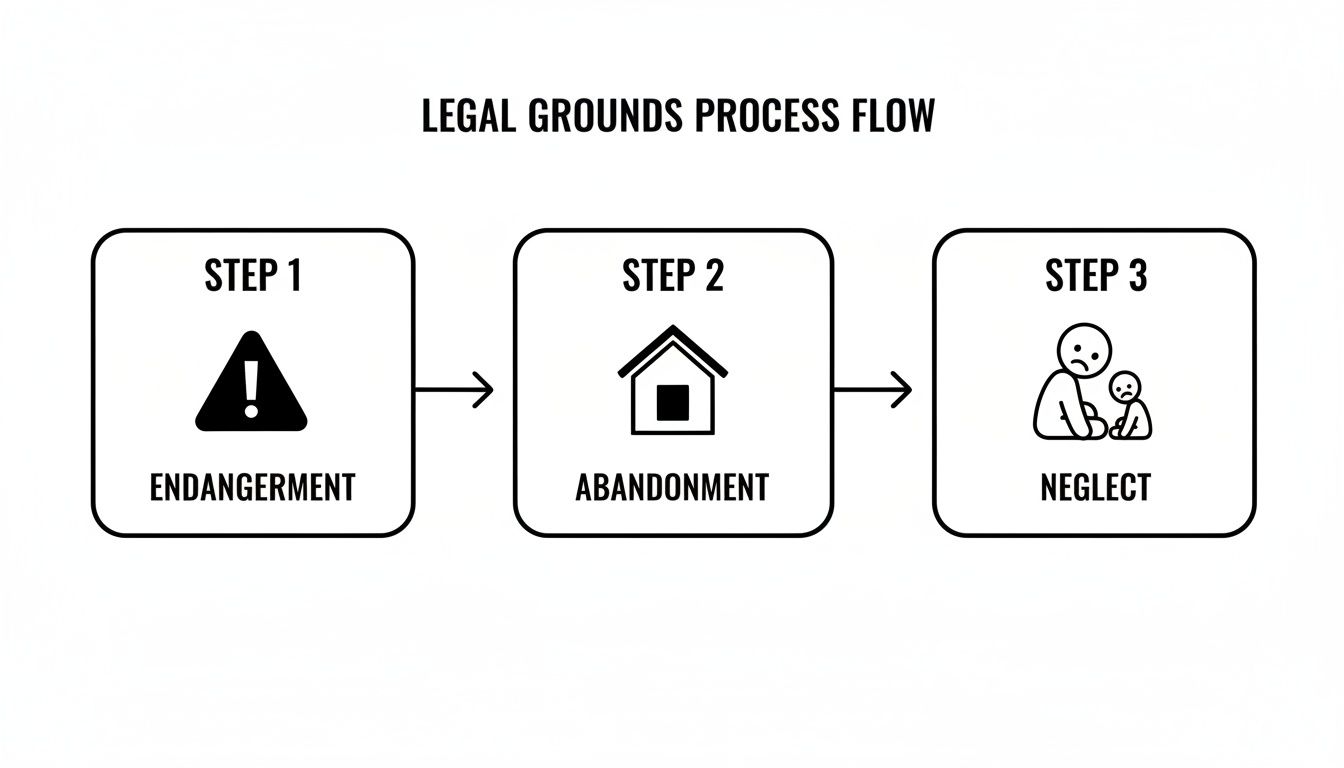
The grounds an ad litem often investigates—like endangerment, abandonment, and neglect—aren't just isolated mistakes. They represent severe patterns of behavior that threaten a child's fundamental well-being.
Discovery and Mediation
With the case officially underway, both sides enter the discovery phase. Think of this as the formal evidence-gathering stage. Lawyers use legal tools to get information from the other side, including written questions (Interrogatories), requests for documents (Requests for Production), and in-person, under-oath testimony taken outside of court (Depositions). This is where each side methodically builds its case, piece by piece.
Before you ever see the inside of a courtroom for a final trial, most courts in Harris County will order the parties to mediation. Here, a neutral third-party mediator works with both parents to see if they can find common ground and reach a settlement. It might sound impossible in such a heated dispute, but mediation sometimes provides a path to an agreement, sparing everyone the immense stress and expense of a trial.
A final trial is the last resort. The court process is designed with multiple stages, like the appointment of an ad litem and mandatory mediation, to ensure every possible solution is explored before a judge makes a permanent decision.
The Final Trial and Order
If mediation doesn't lead to a resolution, the case is set for a final trial. This is where both sides present their evidence, question witnesses on the stand, and make their closing arguments to the judge. This is the moment where having a skilled and prepared attorney is non-negotiable. Our guide on how to prepare for a custody hearing has some great tips that are just as relevant for a high-stakes termination trial.
After listening to all the testimony and reviewing the evidence, the judge will make a final decision. They will apply that critical two-part test: were one of the 21 statutory grounds proven, and is termination in the child's best interest?
If the answer to both is yes, the judge will sign a Final Order Terminating Parental Rights. This isn't just a piece of paper; it's the legal document that permanently and irrevocably severs the bond between that parent and child.
How to Build a Strong Case for Court
Whether you’re the parent asking the court to terminate another’s rights or the one fighting to keep them, your success rides entirely on the quality of your evidence. Texas courts don't take this lightly. The law demands "clear and convincing evidence"—a much higher bar than in most other civil cases. This isn't about simply having more proof than the other side; it's about presenting evidence so compelling that it gives the judge a firm belief that your claims are true.
Winning a termination case is like building a detailed mosaic. You piece together different types of proof—documents, testimony, expert opinions—to create a clear and undeniable picture for the judge. Each piece reinforces the others, constructing an argument that is too solid to be dismissed.
Gathering Powerful Evidence
The evidence you collect has to do two jobs. First, it must prove one of the specific legal reasons for termination, like endangerment or abandonment. Second, and just as important, it must convince the judge that termination is truly in the child’s best interest.
So, what does this kind of powerful proof look like in practice for an Atascocita family?
-
Witness Testimony: Nothing tells a story like a credible witness. Think of a teacher from an Atascocita ISD school who can talk about a child's chronic absences or signs of neglect. Or a family member who witnessed substance abuse firsthand. Even a neighbor in Humble who can confirm a parent was gone for months at a time can provide crucial testimony.
-
Official Records: Documents from neutral sources are incredibly persuasive. We're talking about things like school attendance records, report cards, medical reports detailing injuries or missed checkups, and police reports from domestic violence calls. These records are hard to argue with.
-
Professional Evaluations: Sometimes, the court needs an expert's view. A court-ordered psychological evaluation can shed light on a parent's ability to provide a safe home. A substance abuse assessment can confirm or deny a drug problem. These expert opinions carry a lot of weight.
-
Communication Records: In today's world, a person's digital footprint can be very revealing. Text messages, emails, and social media posts often contain admissions, threats, or simply show a complete lack of interest in a child's life.
The real strategy is to layer these different forms of proof. One witness statement might be dismissed as biased, but when it’s backed up by school records and medical reports all pointing to the same conclusion, your case becomes incredibly convincing.
Common Defenses in Termination Cases
If you are the parent whose rights are on the line, it’s easy to feel hopeless, but you absolutely have the right to mount a vigorous defense. The law starts with the assumption that keeping a family together is best for the child. The burden is entirely on the other side to prove otherwise.
A strong defense is all about showing the court why termination is the wrong move and would ultimately hurt your child. Here are some of the most effective strategies:
-
Demonstrate Real, Tangible Change: Have you done the work? If the court ordered you to complete a service plan, showing that you’ve done it is your best defense. Proof that you’ve graduated from a drug rehab program, attended every single parenting class, and secured a stable job and home is powerful evidence that the past is not the present.
-
Challenge the Opposing Evidence: Your attorney will scrutinize every piece of evidence presented against you. Is it weak? Is it misleading? Does it actually meet that high "clear and convincing" standard? They can challenge a witness’s credibility or provide crucial context for a text message that was presented in a negative light.
-
Prove Termination is Not in the Child’s Best Interest: This is the ultimate defense. Even if you've made mistakes, you can argue that severing your relationship would be devastating for your child. Evidence of a strong, loving bond, even an imperfect one, can show a judge that removing you from your child’s life would cause more harm than good.
Texas's system for terminating parental rights is one of the most aggressive in the country, designed with the goal of moving children into permanent, stable homes as quickly as possible. While well-intentioned, this has led to debates, with some experts warning it can rush to judgment, not giving a parent enough time to turn their life around. You can learn more about the Texas model and its impact. In such a high-stakes environment, building the strongest possible case is your only real protection.
The Permanent Consequences and Potential Alternatives

When a Harris County judge signs that final order terminating parental rights, it's not a temporary measure. This decision is permanent and irreversible. It’s a complete legal severance of the parent-child relationship, a profound and life-altering outcome for everyone involved.
It is absolutely critical to understand the finality of this court order. It erases every legal connection between parent and child. This means losing the right to see your child, the right to make decisions about their schooling or medical care, and even any right to inheritance. From a legal standpoint, it's as if the parent has ceased to exist in the child’s life.
This permanence is precisely why Texas law sets such an incredibly high bar for termination. The court's aim is to create lasting stability and safety for a child, often clearing the path for an adoption where a new, supportive parent can legally step into that role.
Looking Beyond Termination
Because the outcome is so severe, termination isn't always the only answer. A judge’s primary responsibility is to act in the child's best interest. Sometimes, a less permanent solution can provide that protection without completely severing a family bond forever.
Before taking this final step, a court will always consider whether other legal arrangements could give the child the stability they need. For families navigating this in Atascocita and Humble, knowing these options exist is important—they can sometimes offer a better path forward.
A termination order is often called the "death penalty" of family law. It's the most extreme action a court can take, which is why judges will always weigh less drastic alternatives if they can effectively protect the child.
Common Alternatives to Termination
When termination feels too extreme, a judge might look at arrangements that reassign parental duties without ending parental rights completely. These alternatives can give a child a safe home while leaving the door open for a biological parent to possibly re-engage later if their circumstances drastically improve.
Here are a couple of the most common alternatives a court will explore:
- Appointing a Different Managing Conservator: Instead of termination, the court can simply name another responsible adult—like a grandparent, aunt, or uncle in the Atascocita area—as the person with the primary right to care for the child. The parent’s rights aren’t gone, but their authority to make key decisions is handed over to someone who can provide a more stable environment.
- Establishing a Legal Guardianship: This is another path where a court appoints someone to care for a child and manage their affairs. While a guardianship grants significant authority, it isn't as permanent as termination and can be modified or even ended down the road if the parent gets their life back on track.
These options are often considered when the court sees potential for a parent to rehabilitate themselves over time. However, the swift nature of the Texas system has pushed adoption numbers up significantly. There were 5,703 finalized adoptions in 2016, a huge jump from just 2,248 in 2002. This trend is often fueled by the short timeline parents are given to comply with court orders. You can discover more about the trends in Texas adoption to see how this plays out. Understanding every possible outcome is crucial.
Why You Need an Experienced Atascocita Attorney
Let’s be honest: a case involving the termination of parental rights isn’t just another legal hurdle. It's one of the most serious and life-altering actions a court can take. The legal standards are incredibly high, the emotional stakes are even higher, and the court's final decision is permanent.
This is not a DIY situation. Having a dedicated family law attorney in your corner isn't a luxury—it's absolutely essential for protecting your family's future.
The process goes far beyond just filling out the right forms. It demands a deep understanding of the Texas Family Code, familiarity with Harris County court procedures, and a mastery of the rules of evidence. A seasoned local attorney brings the strategic thinking needed to build a powerful case, whether you are the one seeking to terminate rights or the one fighting to protect them.
How Our Firm Can Help
At The Law Office of Bryan Fagan, we know the unique challenges families in Atascocita and Humble face. Our team is here to provide comprehensive support from the very beginning to the final order. We are your neighbors, and we are dedicated to helping our community navigate these difficult legal waters.
We can help you with:
- Filing Petitions Correctly: We ensure every document filed with the Harris County District Clerk is accurate, persuasive, and sets your case up for success.
- Gathering Critical Evidence: We know exactly what it takes to meet the tough "clear and convincing" evidence standard. We'll help you pull together the necessary records, evaluations, and witness testimony.
- Representing You in Court: We will stand with you in the courtroom, presenting your case with strength, compassion, and a thorough knowledge of how local judges think.
- Negotiating and Mediating: We will advocate fiercely for your interests during mandatory mediation, exploring potential solutions before a contentious trial becomes necessary.
Navigating a Complex Legal System
The Texas legal system has its own quirks and strategies that can feel overwhelming without a guide. For example, it’s common for someone to file a petition for termination alongside other requests, a tactic called "pleading in the alternative." Critics often argue this puts unfair pressure on parents and can prioritize state convenience over keeping families together. Knowing how to respond to nuanced legal moves like this is critical.
Your family's future is too important to leave to chance. A knowledgeable attorney ensures your story is heard, your rights are protected, and that every legal avenue is pursued effectively.
When you're thinking about hiring a lawyer, understanding typical lawyer consultation fees can help you get ready for the financial side of things. We believe in being upfront and supportive from the very first conversation.
The Law Office of Bryan Fagan offers a free, confidential consultation at our Atascocita office. This is your opportunity to speak with a local attorney who understands your situation and cares about your case. Contact us today to discuss your case and find a clear path forward.
Frequently Asked Questions About Parental Rights
When you're dealing with the possibility of terminating parental rights, the legal jargon can feel overwhelming, and the emotional stakes are incredibly high. It’s a topic that brings up a lot of tough, practical questions. Let's walk through some of the most common ones we hear from families right here in our Atascocita and Humble communities.
Can I Terminate Parental Rights Just Because of Unpaid Child Support?
This is a big one. While failing to pay child support for over a year is one of the legal reasons a court can consider termination, it's almost never enough on its own.
The absolute most important factor for any Texas judge is the child's best interest. Courts are very reluctant to sever the parent-child bond over money alone, especially if the parent still tries to maintain some sort of relationship with their child. Think of it as a significant piece of the puzzle, but not the whole picture.
How Long Does This Process Actually Take in Harris County?
The timeline for a termination case can be all over the map. If everyone is in agreement—like in a voluntary termination for a stepparent adoption—things can move relatively quickly, sometimes wrapping up in a few months.
But if it's a contested case where one parent is fighting the termination, you need to prepare for a much longer road. These cases can easily take a year, sometimes even more. Several things can slow it down:
- The sheer volume of cases clogging up the Harris County court dockets.
- The time it takes to gather all the necessary evidence, a process called "discovery."
- Whether or not Child Protective Services (CPS) is involved, which adds another layer of complexity.
Is It Possible to Reverse a Termination Order Later On?
A court order that terminates parental rights is meant to be final and permanent. Once a judge signs that order, the legal relationship is gone for good. That means no more rights to visitation, decision-making, or even inheritance.
Trying to undo a termination order is an incredibly steep uphill battle. It's exceptionally rare and usually only possible if you can prove the original decision was the result of something like fraud or extreme pressure (duress). Clearing that legal hurdle is extraordinarily difficult.
Navigating this process alone is a risk you shouldn't have to take. At The Law Office of Bryan Fagan – Atascocita TX Lawyers, we offer both the strong legal experience and the compassionate support you need. If you're a resident of Atascocita, Humble, or northeast Harris County facing a situation involving parental rights, please reach out and schedule a free, confidential consultation with us today.