When a child is born to parents who are not married in Texas, the law has a very specific—and often surprising—starting point for parental rights. For many families in Atascocita and Humble, this creates an initial imbalance they don't expect.
From the moment of birth, the law automatically grants the unmarried mother sole legal and physical custody. The father, on the other hand, has zero legal rights until he takes formal steps to establish paternity. This is the baseline from which all custody cases for unmarried parents begin, and understanding it is the first step toward creating a stable, secure future for your child.
Your Rights as an Unmarried Parent in Atascocita
If you are an unmarried parent in Atascocita, Humble, or anywhere in northeast Harris County, we know that facing a separation is tough. The legal jargon can make an already stressful situation feel even more confusing. When you're not married, Texas law sets a default status for parental rights that catches many people off guard. Grasping this starting point is the most important step you can take toward securing a stable, court-ordered plan that protects your precious relationship with your child.
The key difference between married and unmarried parents boils down to a legal concept called presumption. The law presumes a husband is the father of a child born during the marriage, which automatically grants him parental rights. For unmarried couples, no such presumption exists for the father.
Default Parental Rights in Texas for Unmarried Parents
So, what does this look like in the real world for a family here in our community? Before any court gets involved, the legal landscape is tilted entirely in one direction. By default, the mother holds all the decision-making power.
This table breaks down the initial legal standing of each parent at the moment the child is born:
| Legal Right | Unmarried Mother (at birth) | Unmarried Father (before establishing paternity) |
|---|---|---|
| Decision-Making (Legal Custody) | Has sole authority | Has no authority |
| Right to Possession (Physical Custody) | Has sole right | Has no right |
| Child's Residence | Solely decides where the child lives | Has no say |
| Medical Consent | Has sole authority to consent | Has no authority to consent |
| Obligation for Child Support | Not formally established | Not formally established (but can be ordered retroactively) |
This legal reality means that even if a father's name is on the birth certificate, it isn't enough to grant him enforceable rights to see his child or have a say in major decisions. To be recognized as a legal parent, a father must take proactive legal steps.
What This Legal Imbalance Means for Your Family
It’s easy to see this default setup as a major roadblock, but it's more helpful to view it as a roadmap. The law provides a clear path for fathers to gain equal rights and for both parents to create a formal custody order that works for everyone.
The entire process is designed to move your family from a place of legal uncertainty to one of clarity and stability. It's about ensuring both parents can have a consistent, protected, and meaningful role in their child's life.
At its core, Texas law wants to ensure children have the support of two parents. The legal steps for unmarried parents, like establishing paternity, are the tools the system provides to make that goal a reality for families right here in Atascocita.
Understanding the different types of custody is also critical. For a deeper dive, check out our guide explaining the difference between legal and physical custody, which spells out exactly what rights and responsibilities are involved.
The journey starts by understanding your legal position right now. From there, you can take the right steps to secure your parental rights and build a positive future for your child.
Step One: Establishing Paternity in Harris County
For an unmarried father in Texas, everything starts with paternity. Think of it as the legal foundation for all of your parental rights. Until you have legally established that you are the father, you have no right to custody or visitation and no say in your child's upbringing—not their schooling, not their healthcare, nothing.
On the flip side, for a mother, establishing paternity is the critical step that legally obligates a father to provide financial support for the child. It is a process that protects both parents and, most importantly, the child.
Here in Harris County, there are two primary ways to legally establish a child’s father. The best path for your family will depend on your relationship with the child's mother and the specifics of your situation.
The Acknowledgment of Paternity (AOP)
The simplest and most straightforward route is signing a voluntary Acknowledgment of Paternity (AOP). This is a legally binding form, often presented at the hospital right after the baby is born. When both parents sign it, they are formally and legally agreeing on who the father is. It’s an ideal solution when there is zero doubt about paternity and both parents are cooperative.
However, do not take this form lightly. Signing an AOP carries significant legal weight and creates immediate rights and responsibilities.
- For Fathers: It gives you the legal standing to go to court and request custody and a visitation schedule.
- For Mothers: It opens the door to obtaining a formal child support order from the court.
- For the Child: It secures their right to inherit from their father and access potential benefits, like Social Security or veteran's benefits, through him.
The AOP is a powerful tool, but it should only be signed if you are 100% certain you are the father. Attempting to reverse it later is incredibly difficult and often impossible.
The Suit to Adjudicate Parentage
What happens if there's a disagreement? Or what if one parent simply refuses to sign the AOP? This is where the courts must get involved. Either parent can file a Suit to Adjudicate Parentage with the Harris County District Clerk. This is a formal lawsuit asking a judge to make a definitive ruling on who the child’s father is.
More often than not, this process involves the court ordering genetic (DNA) testing to get a clear, scientific answer. If the court orders a man to submit to a DNA test and he refuses, the judge can—and usually will—name him the father by default.
A Suit to Adjudicate Parentage isn't just about a DNA test. It’s the official starting point for every future court order involving your child. It resolves all uncertainty and creates the necessary legal framework for custody, visitation, and child support.
This flowchart illustrates just how different the legal starting point is for married versus unmarried parents in Texas.
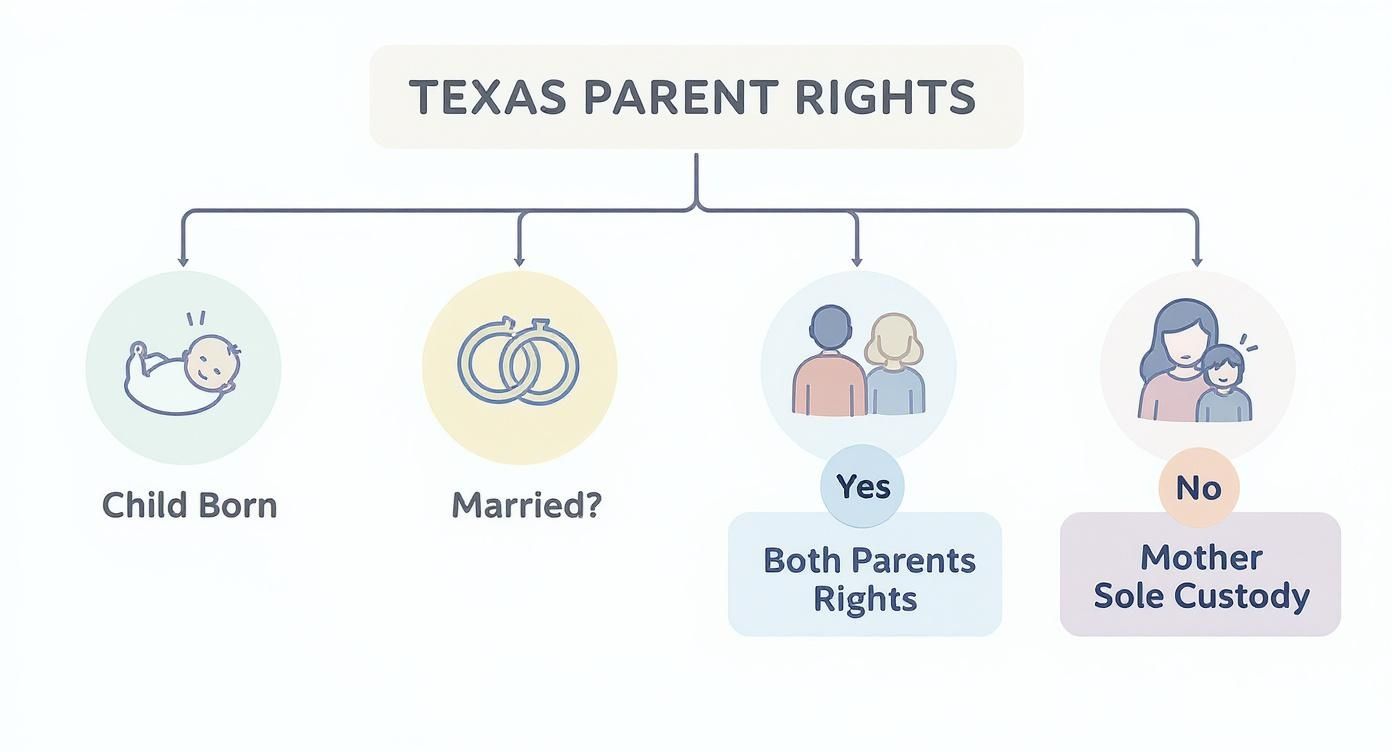
As you can see, marriage automatically gives both parents rights from day one. If you're not married, the law gives the mother sole rights initially, making it absolutely essential for a father to formally establish his paternity.
Whether you're right here in Atascocita, over in Humble, or anywhere else in our community, establishing paternity is the one step you cannot skip. It protects your role in your child's life and, just as importantly, protects your child’s right to have a meaningful relationship with both parents. Deciding between an AOP and a lawsuit can be confusing, but The Law Office of Bryan Fagan – Atascocita TX Lawyers is here to help you find the right path forward.
Navigating the Harris County court system and its required paperwork can be a real headache. You don't have to face it alone. If you have questions about establishing paternity, we encourage you to schedule a free, no-obligation consultation with our team in Atascocita. We’re here to help you understand what comes next and protect what matters most—your family.
Step Two: Filing a Suit Affecting the Parent-Child Relationship (SAPCR)
Once paternity has been legally established, you've laid the groundwork. Now what? For unmarried parents in Texas, the next critical step is filing a Suit Affecting the Parent-Child Relationship, or SAPCR (pronounced "sap-sir"). The name sounds formal and a bit intimidating, but its goal is simple: to get clear, court-ordered rules that spell out each parent’s rights and duties.
Think of a SAPCR as the process of creating the official playbook for how you and the other parent will raise your child while living in separate homes. This is the legal action that turns verbal agreements and uncertainty into a stable, predictable plan covering custody, visitation, and child support. If you live in Atascocita or Humble, filing this suit at the Harris County Civil Courthouse is how you lock in your parental rights and give your child's future the security it deserves.

What Does a SAPCR Actually Do?
A SAPCR is a lawsuit that asks a judge to make official rulings on all the major co-parenting questions. It’s not just about one issue; it bundles everything together into one case to create a comprehensive parenting road map.
When the case is concluded, the final court order from a SAPCR will clearly define:
- Conservatorship: Who gets to make the major decisions for your child (school, medical, etc.).
- Possession and Access: The calendar that shows exactly when each parent has the child.
- Child Support: Who pays what to support the child financially.
- Medical and Dental Support: Who is responsible for health insurance and how out-of-pocket costs are split.
Without a SAPCR, any "agreement" you have is just a handshake deal. It’s not legally enforceable. A court order gives you the structure and legal muscle to make sure both parents follow the plan, creating the stability that every child needs to thrive.
The Most Important Standard: The Best Interest of the Child
When a Harris County judge is deciding your case, every single decision they make comes down to one guiding principle: the best interest of the child. This isn't just a friendly suggestion—it’s the law. The court's primary job is to create an environment that will best serve the child's emotional, physical, and mental well-being.
The "best interest of the child" standard means the court's focus isn't on what's fair to the parents. It's about what's best for the child. Every argument and every piece of evidence is viewed through that lens.
So, what exactly does a judge consider? There’s no simple checklist, but Texas courts rely on a set of guidelines known as the "Holcomb factors." These include things like:
- The child’s immediate and future needs, both emotional and physical.
- Any potential emotional or physical danger to the child, now or in the future.
- The stability of each parent's home life.
- The parenting skills of each parent.
- The plans each parent has for the child's upbringing.
- Actions (or inactions) by a parent that might suggest an unhealthy relationship.
For instance, a judge will want to know who has been the primary caregiver. Who takes the child to their pediatrician in Atascocita? Who helps with homework for their school in Humble ISD? It’s all about showing a consistent history of responsible, hands-on parenting. The more you can prove you provide a stable and loving home, the better. You can find more practical advice in our guide on how to win child custody in Texas.
Filing a SAPCR can feel like a mountain to climb, but it’s the only way to formalize your rights and create a clear, enforceable plan for your family's future. The team at The Law Office of Bryan Fagan – Atascocita TX Lawyers can guide you through preparing your case and presenting the strongest arguments focused squarely on your child’s best interest.
Understanding Conservatorship and Possession Orders in Your SAPCR
https://www.youtube.com/embed/pIQEykYfNqE
When you first open court documents in a Texas custody case, the legal jargon can feel overwhelming. You’ll see terms like "conservatorship" and "possession and access" instead of the word "custody" you might hear on TV. Don't let the terminology throw you off. These Texas-specific terms are designed to break down a parent's role into two clear and separate parts.
To make it simple, think about it like owning a car. Conservatorship is like having the title—it’s the legal status that outlines your rights and responsibilities. This is your authority to make the big-picture decisions for your child, like where they go to school, what doctor they see, and any major choices about their upbringing.
Possession and Access, on the other hand, is the schedule. It's the calendar that dictates when you get the keys to the car. This part of the court order spells out the specific days, holidays, and summer weeks each parent will physically have the child.
The Two Types of Conservatorship
In Texas, the law starts from a simple premise: kids do best when both parents are actively involved. Because of this, courts have a strong preference for naming parents Joint Managing Conservators (JMCs). This is by far the most common outcome for unmarried parents in Harris County who have both established their legal rights.
Being a JMC doesn't automatically mean a 50/50 split of time with your child. What it does mean is that you share the rights and duties of raising them. Usually, one parent is designated as the "primary" conservator, which gives them the exclusive right to decide where the child lives—often within a specific geographic area, like Harris County or Humble ISD.
The alternative is a Sole Managing Conservatorship (SMC), which is much less common. A court will typically only order this in serious situations involving a history of family violence, substance abuse, or severe neglect. In an SMC arrangement, one parent is given the exclusive authority to make nearly all major decisions for the child.
For the vast majority of families in Atascocita and the surrounding areas, a Joint Managing Conservatorship is the expected outcome. The court’s goal is to keep both loving parents deeply involved in their child’s life.
To get a deeper look at how these roles play out in practice, you can learn more about conservatorship in Texas in our detailed guide. Knowing these terms is the first step toward building a realistic strategy for your case.
To help clarify the differences, here is a side-by-side comparison.
Key Differences Between JMC and SMC
| Feature | Joint Managing Conservatorship (JMC) | Sole Managing Conservator (SMC) |
|---|---|---|
| Decision-Making | Both parents share most rights and duties. Major decisions are made jointly or allocated between parents. | One parent has the exclusive right to make most major decisions (e.g., medical, educational). |
| Primary Residence | One parent is typically named the "primary" JMC and has the right to determine the child's residence. | The SMC has the exclusive right to determine the child's residence, often without geographic restriction. |
| Court Preference | Strongly favored by Texas courts as it's presumed to be in the child's best interest. | Reserved for specific circumstances like family violence, neglect, or substance abuse. |
| Parental Involvement | Designed to maximize the involvement of both parents in the child's life. | The other parent (Possessory Conservator) has limited rights and a set visitation schedule. |
This table shows why the JMC arrangement is the standard in Texas—it's built to keep both parents engaged and collaborating for the good of their child.
Decoding the Standard Possession Order
Once conservatorship is established, the next piece of the puzzle is the actual schedule. For parents living less than 100 miles apart—a very common situation for families here in the Atascocita and Humble area—Texas law provides a default schedule known as the Standard Possession Order (SPO).
The SPO is designed to create a predictable and stable routine that everyone can count on. It’s not just for the parents; it’s for the child, too. A typical SPO includes:
- Weekend Possession: The non-primary parent generally has the child on the first, third, and fifth weekends of a month.
- Holiday Schedules: Major holidays like Thanksgiving and Christmas are split and alternated between parents each year, so everyone gets a turn.
- Summer Visitation: The non-primary parent usually gets an extended period of possession, typically for 30 days, during the summer break.
While many parents hope for a true 50/50 physical possession schedule, it's important to understand that Texas courts rarely order them unless the parents agree. The system prioritizes stability for the child, which usually means having one primary home base. Instead, a judge is more likely to grant what’s called an Expanded Standard Possession Order, which gives the non-primary parent more time (like Thursday overnights during the school year) but still falls short of a 50/50 split.
This standard framework is an excellent starting point. The good news is that it can be customized to fit your family’s unique reality, whether that means accounting for a parent's work schedule or other specific needs. An experienced family law attorney can help you understand what a realistic and effective possession order might look like for your family.
How Child Support Works for Unmarried Parents
For unmarried parents in our Atascocita community, the conversation around child support can feel loaded with stress and uncertainty. We understand. Our goal here is to explain how Texas law approaches it—not as a punishment, but as a system designed for one reason: to make sure your child has the financial support they need to thrive.
At its core, child support is a legal right that belongs to the child. Both parents have a fundamental duty to provide for their children. A court order simply creates a clear, predictable roadmap for how that financial duty is shared when you live in separate homes. This protects everyone involved—the parent paying, the parent receiving, and most importantly, the child.

Calculating Child Support in Texas
Some states use complicated formulas that weigh both parents' incomes, but Texas keeps it fairly straightforward. The calculation is based on a percentage of the non-primary parent's (the "obligor's") net monthly resources. This isn't just take-home pay; it includes nearly all income sources—wages, bonuses, commissions, and even rental income—after taxes and a few other mandatory deductions are taken out.
The Texas Family Code provides a standard set of guidelines that judges use as a starting point:
- One Child: 20% of net monthly resources
- Two Children: 25% of net monthly resources
- Three Children: 30% of net monthly resources
- Four Children: 35% of net monthly resources
- Five or More Children: 40% of net monthly resources
These percentages can be adjusted if the paying parent is already legally responsible for supporting other children. And while these guidelines are the standard for any Harris County judge, they aren't set in stone. A court can deviate from them if there's a compelling reason that doing so is in the child's best interest.
It's essential to remember that these payments are for the direct benefit of the child. They are intended to help the primary parent cover essential costs like housing, food, clothing, and other daily expenses that contribute to a stable home environment.
Health Insurance and Medical Expenses
Child support is more than just a monthly payment. The court order will also address healthcare by assigning one parent the responsibility of providing health and dental insurance. Typically, the judge will order whichever parent can obtain quality coverage at the most reasonable cost—often through an employer—to carry the insurance.
What about costs that insurance doesn't cover? The order will also specify how to handle out-of-pocket medical expenses like co-pays, deductibles, and prescriptions. In most cases, these costs are split 50/50 between the parents, ensuring both are contributing to the child's healthcare needs.
Without a court order, these financial duties are vague and can become a source of constant conflict. A formal child support order brings clarity and predictability, outlining exactly who pays for what and when. That legal clarity is invaluable for co-parenting successfully.
Establishing child support is a critical piece of any SAPCR case. For families in Humble, Atascocita, and across Harris County, having a knowledgeable attorney to walk you through the calculations and legal requirements can make all the difference. At The Law Office of Bryan Fagan – Atascocita TX Lawyers, we can help you understand your rights and obligations. We invite you to schedule a free consultation at our Atascocita office to discuss your specific situation and learn how we can help protect your child's financial future.
When Life Changes: Modifying or Enforcing Your Custody Orders
You've gone through the process and now have a court order for custody and visitation. For a while, it brought much-needed stability to your family. But life doesn’t stand still. People change jobs, kids grow up, and circumstances shift. What worked for your family last year might feel completely impractical today.
The good news is that Texas child custody laws for unmarried parents are designed to be flexible. Your court orders are not carved in stone; they can and should adapt as your family’s reality changes. On the other hand, a court order is a legally binding document. If the other parent is ignoring the rules, you have powerful legal tools to enforce the terms and protect your relationship with your child.
When Can You Change a Custody Order?
To change an existing order, you must first show a judge in Harris County that there has been a “material and substantial change in circumstances” since the last order was signed. Think of this as the legal key that unlocks the courthouse door for a modification case.
What does this mean for a family in Atascocita or Humble? It could be any number of significant life events:
- Job and Schedule Changes: A parent lands a great new job, but the hours directly conflict with the current pickup and drop-off schedule.
- A Parent Relocating: The primary parent wants to move to a new school district for a better job or to be closer to family.
- The Child’s Needs Evolving: As your toddler becomes a teenager, their school, sports, and social schedules might make the old possession order unworkable.
- A Change in Home Environment: Unfortunately, sometimes a parent’s home situation can become unstable or even unsafe, which is a clear reason for the court to intervene.
Once you have proven a major change has occurred, the judge’s focus will shift to one central question: is changing the order in the best interest of the child?
Holding the Other Parent Accountable
What if the other parent simply decides to ignore the court order? Perhaps they're consistently late for exchanges, or worse, they're denying you your court-ordered time with your child. It is an incredibly frustrating and painful position to be in, but you are not helpless.
You can file an enforcement action with the court. This is a formal, serious request for a judge to compel the other parent to follow the rules. It’s not just a slap on the wrist; an enforcement action can carry heavy consequences for the parent who is violating the order.
An enforcement is more than just a request; it's a demand for compliance. If a judge finds the other parent has knowingly violated the order, the penalties can range from ordering make-up visitation time to imposing fines or even jail time for contempt of court.
Whether you need to adjust your custody plan to fit your life today or hold the other parent accountable, the process requires a smart legal strategy. You will need to present clear, convincing evidence to the court to make your case. Protecting your rights and your child’s well-being is what matters most.
The legal team at The Law Office of Bryan Fagan – Atascocita TX Lawyers has spent years helping local parents navigate both modifications and enforcements. We understand what’s at stake. Schedule a free, confidential consultation at our Atascocita office to go over your situation and determine the right next steps for your family.
Common Questions We Hear About Unmarried Custody
When you're trying to navigate Texas child custody laws for unmarried parents, it's natural to have a lot of questions. We talk to parents from Atascocita every day who are looking for clarity. To help you get started, here are straightforward answers to the questions we are asked most often.
Can an Unmarried Father Get Custody in Texas?
Yes, absolutely. Once a father’s paternity is legally established, he stands on equal footing with the mother when requesting custody from a court. The Texas Family Code is built on the strong belief that it's in a child's best interest to have both parents actively involved in their life.
This is why Harris County courts frequently name parents as Joint Managing Conservators. This arrangement allows both parents to share the rights and duties of raising their child. But remember, legally establishing paternity is the crucial first step to unlocking those rights.
If My Name Is on the Birth Certificate, Do I Automatically Have Rights?
This is one of the biggest and most costly misconceptions we see. For an unmarried father in Texas, having your name on the birth certificate, by itself, does not give you any legally enforceable rights to custody or visitation.
To gain the right to have possession of your child or make decisions for them, you need more. You must have either a signed Acknowledgment of Paternity (AOP) on file or a court order that officially declares you as the legal father. The birth certificate is an important starting point, but it is not the legal finish line.
Can an Unmarried Mother Just Move Out of State With Our Child?
She cannot legally do this without either the father's written consent or a specific court order allowing her to relocate. As soon as a custody case (a SAPCR) is filed, Texas courts will almost always put a geographic restriction in place in their orders.
This restriction is designed to keep the child’s world stable. It usually limits the child’s primary home to a specific area—often Harris County and the counties that touch it. The goal is simple: to protect the child’s relationship with both parents by making sure they stay close enough for frequent and meaningful contact.
Attempting to move a child outside the designated area without the court's permission can lead to very serious legal consequences.
It's easy to feel lost in all these legal details, but you don't have to figure it all out on your own. Our team at The Law Office of Bryan Fagan – Atascocita TX Lawyers is here to help families in our community understand their options and build a secure future. To get advice tailored to your specific situation, reach out and schedule a free, no-obligation consultation at our Atascocita office. You can learn more by visiting us at https://www.atascocitaattorneys.com.