You’ve probably heard it a thousand times on TV: "You have the right to remain silent." That phrase is so much more than a famous line from police dramas. These are your Miranda rights, a critical shield that protects you during any interaction with law enforcement. Understanding them is vital for any resident of Atascocita, Humble, or northeast Harris County.
At their core, your Miranda rights guarantee that you don't have to talk to the police and have the right to a lawyer's help. Our goal at The Law Office of Bryan Fagan is to ensure our neighbors feel informed and supported, especially during stressful legal situations.
Understanding Your Rights During an Arrest in Atascocita

Getting arrested in Atascocita, Humble, or anywhere else in Harris County is an incredibly stressful and confusing experience. When the pressure is on, knowing your rights isn't just a technicality—it's the single most important step you can take to protect yourself and your future. We at The Law Office of Bryan Fagan believe that every person in our community should feel empowered by the law, not intimidated by it.
Think of Miranda rights as your personal legal toolkit, designed to keep things fair when you're in police custody and they start asking questions. These rights come directly from the Fifth Amendment, which protects you from self-incrimination. In other words, you can never be forced to provide testimony against yourself.
The Core Components of Your Miranda Rights
The standard Miranda warning is built on four key pillars, each offering a distinct layer of protection. Knowing what these mean in the real world is crucial, so you can act confidently if you ever find yourself in this situation.
To make it crystal clear, we've broken down the warning and what each part actually means for you.
Your Miranda Rights Explained Simply
| Your Right | What This Means for You in Plain English |
|---|---|
| You have the right to remain silent. | You do not have to answer any questions from the police—about where you've been, what you were doing, or anything else. You can just stay quiet. |
| Anything you say can and will be used against you in a court of law. | This is a serious warning. Even casual remarks or attempts to explain yourself can be twisted and used by the prosecution to build a case against you. |
| You have the right to an attorney. | You can ask for a lawyer at any time. Once you do, the police are supposed to stop questioning you immediately until your lawyer is there with you. |
| If you cannot afford an attorney, one will be appointed for you. | This ensures your right to legal help isn't just for those who can afford it. Everyone, regardless of their financial situation, gets a lawyer. |
Understanding these points is the first step, but putting them into practice is what truly matters.
Why Silence and a Lawyer Are Your Best Defense
The moment you invoke your right to a lawyer, you bring a trained legal professional onto your team who knows how to navigate the system. It's your lawyer's job to guard your interests and make sure law enforcement plays by the rules. Once you ask for an attorney, the interrogation must stop.
Your Miranda rights are not an admission of guilt. They are an assertion of your constitutional protections. Exercising them is the smartest, safest step you can take after an arrest. A calm, clear request for a lawyer is your most powerful tool.
A solid defense starts with a solid understanding of these protections. Our firm is committed to providing experienced and compassionate criminal defense in Atascocita, and that mission begins with making sure our clients know their rights from the very start.
If you or someone you care about is facing criminal charges in the Atascocita area, the first move is always the same: stay silent and get legal help. Contact the Law Office of Bryan Fagan at our Atascocita office for a free consultation to talk about your case and ensure your rights are protected.
Why Your Miranda Rights Exist
To really get why your rights are so important, you have to look at where they came from. These aren't just abstract legal concepts; they were forged in the heat of real-life situations where the very fairness of our justice system was on the line. The story behind them is a potent reminder of why every single word in that warning matters, especially when you're in the middle of a stressful arrest right here in Atascocita or Humble.
Think of the Miranda warning less as a police procedure and more as a crucial safeguard. It’s there to balance the scales between the power of law enforcement and the individual. Before these rights were spelled out, police interrogations could be incredibly intense, intimidating environments. It was all too easy for someone, isolated and under immense pressure, to feel like they had no choice but to confess—whether they were guilty or not, or even understood what they were saying.
The Landmark Case That Changed Everything
The rules we live by today were born from a single, groundbreaking moment in American history. The whole idea of Miranda rights comes from the landmark 1966 U.S. Supreme Court case, Miranda v. Arizona. This case completely changed the game for criminal procedure, forcing police to tell suspects about their constitutional rights before questioning them. Chief Justice Earl Warren, writing for the majority, established what we now call the 'Miranda warning.' You can dig deeper into this foundational case and see just how much it shaped our justice system.
This ruling was a direct answer to growing concerns about police using coercion to get confessions. The Supreme Court recognized that a police interrogation room is, by its very nature, an intimidating place. Without being told otherwise, how would anyone know they had the right to stay quiet or the right to get a lawyer’s help?
The whole point of Miranda rights is to make sure that any statement you give to the police is genuinely voluntary. It's a shield to stop authorities from using pressure, fear, or your own lack of knowledge to get a confession.
The decision drew a clear, bright line for police to follow everywhere, from massive cities down to our local precincts in Harris County. It created a consistent standard of fairness, upholding every citizen's Fifth Amendment right against self-incrimination.
What This History Means for You in Harris County
This legal history isn't just a dusty old story; it has a direct impact on your life today. If you're ever arrested in our community—whether it's after a traffic stop on FM 1960 or an incident near Lake Houston—these rights are your first line of defense. They were put in place to protect you from the overwhelming pressure of a police interrogation and to keep you from accidentally saying something that could wreck your own case.
Understanding the "why" behind your rights is powerful for a few key reasons:
- It gives you confidence: Knowing these rights were designed to shield you from unfair pressure helps you use them without hesitation.
- It clarifies their purpose: These aren't some legal loophole or a trick to "get away with something." They are a fundamental part of a just system.
- It reinforces their value: The Miranda warning is your armor. It ensures the legal process begins on a level playing field, where your voice and your rights are respected right from the start.
At the end of the day, the story of Miranda is a story about fairness. It's about making sure that no matter the situation, every single person has the knowledge and the chance to protect their constitutional rights. This history is exactly why our team at The Law Office of Bryan Fagan is so committed to educating our neighbors in Atascocita—because knowing your rights is the first step to protecting them.
When Police Are Required to Read Your Rights
This is probably one of the biggest points of confusion we see in our Atascocita office. Thanks to TV and movies, almost everyone thinks the police have to read you your rights the second they slap on the handcuffs. The truth, under Texas law, is a lot more specific.
Understanding precisely when an officer must give you that Miranda warning is critical. It helps you know what to expect and, more importantly, how to protect yourself during a tense and stressful police encounter.
The warning isn't automatically triggered by the arrest itself. Instead, two things have to be happening at the exact same time. Think of it as a two-part test that must be met before your rights have to be read.
The Two Critical Conditions: Custody and Interrogation
For the Miranda warning to be legally required, you must be both in custody AND under interrogation. If even one of those pieces is missing, the police can ask you questions without reading you your rights, and whatever you say can often be used against you in court.
Let's break down what these terms actually mean in a real-world situation you might face here in Atascocita or Humble.
- Custody: This isn't just about being locked in a cell at the Harris County jail. Legally, you're "in custody" whenever a reasonable person in your shoes would feel like they aren't free to just get up and leave. That could mean being in the back of a squad car, handcuffed on the side of Will Clayton Parkway, or sitting in a small room at the police station. The key isn't the location; it's the restriction of your freedom.
- Interrogation: This goes way beyond a simple, direct question like, "Where were you on Tuesday night?" An interrogation is any word or action from an officer that they should know is reasonably likely to get an incriminating response out of you. It's a broad definition that covers all sorts of police tactics designed to get you to confess, even if they aren't phrased as direct questions.
The core principle is pretty straightforward: when the police have you under their control and are actively trying to get you to admit something, they must first tell you about your rights. This is to make sure that any statement you give is a real choice, not something you said out of pressure or ignorance.
When Police Are NOT Required to Read Your Rights
It's just as important to know when Miranda rights don't apply. A lot of people mistakenly believe that any time an officer talks to them, a warning is required. That's just not true, and this misunderstanding can lead people to accidentally say things that seriously damage their own case.
For example, say you get pulled over for a routine traffic stop on FM 1960. The officer walks up and asks if you've had anything to drink tonight. At this moment, you are not legally "in custody" for Miranda purposes—you're just being temporarily detained. Because you aren't in custody, the officer doesn't have to read you your rights, and your answer can absolutely be used as evidence against you.
Likewise, if you decide to go to the police station voluntarily to give a witness statement, you aren't in custody because you can leave whenever you want. Anything you say can be used without a Miranda warning ever being mentioned. Gaining a deeper understanding of your specific legal rights in Texas can provide even more clarity on these nuances.
This chart does a good job of showing how the process works and what triggers the need for a Miranda warning.
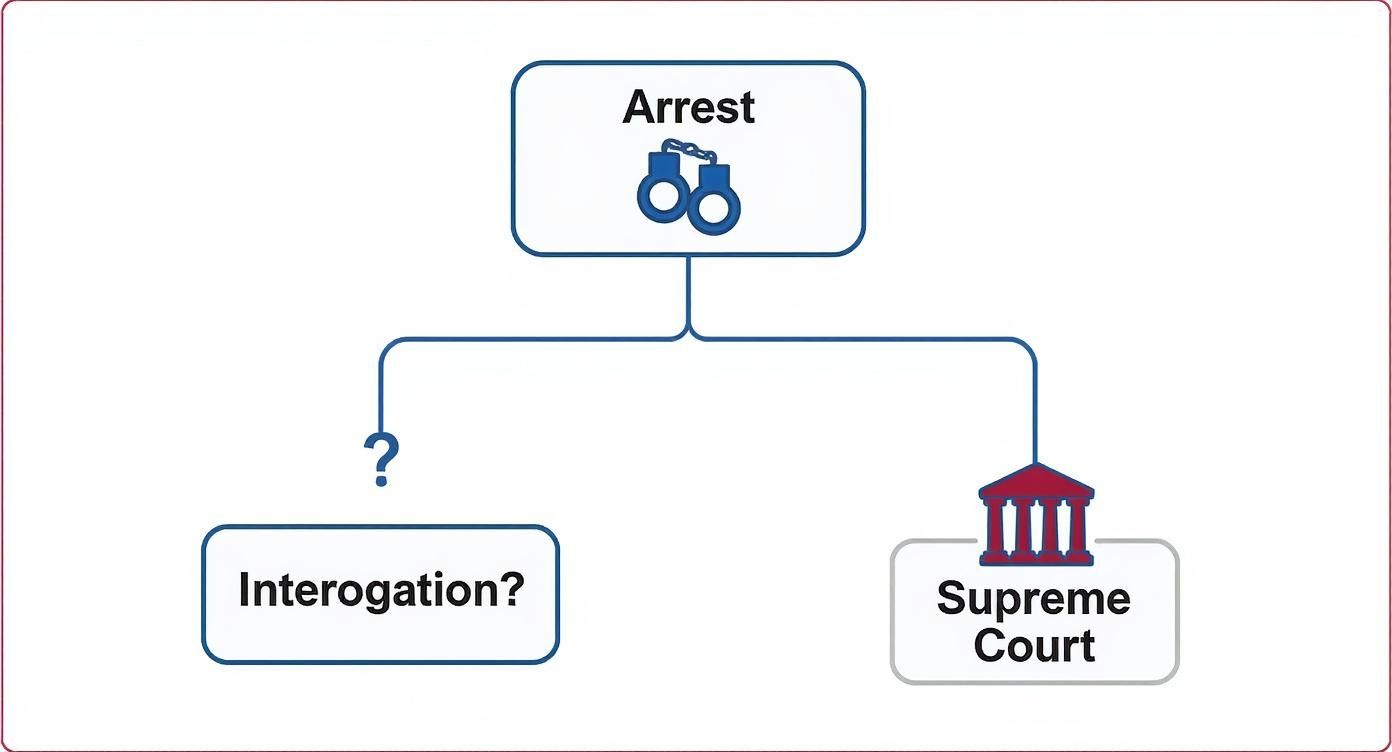
As the visual shows, you need both custody and interrogation to happen before the protections laid out by the Supreme Court kick in for questioning. If you or someone you care about is facing charges and you're worried your rights were violated, don't wait. Schedule a free consultation with us at The Law Office of Bryan Fagan in Atascocita to go over your situation.
Common Myths and Real-World Exceptions
What you see on TV isn't how things go down in a real Texas courtroom. Crime shows have done a number on the public's understanding of Miranda rights, often painting a simple—and flat-out wrong—picture of how they actually work. Believing these myths can lead people to make devastating mistakes during an already overwhelming encounter with the police.
One of the biggest fictions out there is that a case gets tossed out automatically if an officer forgets to read you your rights. That’s not how it works. Let's clear up the confusion and dive into the real-world exceptions that you absolutely need to know.
The "Case Dismissed" Myth
A lot of folks in Atascocita and across Harris County think that if they're arrested and don't hear the Miranda warning, the charges just disappear. This is a dangerous misunderstanding.
A Miranda violation doesn't make the arrest itself illegal. As long as the police had probable cause to arrest you, the arrest is valid—whether they read you your rights or not. The actual consequence of a Miranda violation is about the statements you make. If you were questioned in custody without being read your rights, your lawyer can file a motion to have those statements suppressed, meaning thrown out as evidence. The rest of the prosecution’s case, like physical evidence or what a witness saw, is still fair game.
The failure to read Miranda rights doesn't mean your case is automatically dismissed. It means the prosecution may be barred from using any confession you made during an improper interrogation. This can weaken their case, but it doesn't make it disappear.
The Public Safety Exception
In a few very specific, urgent situations, the police are allowed to question a suspect in custody before reading them their Miranda rights. The most important one to know is called the public safety exception.
This exception allows officers to ask questions aimed at stopping an immediate, serious threat. Think of a chaotic scene at Deerbrook Mall where police just arrested a suspect they believe ditched a loaded gun in a trash can. The questions have to be about the immediate danger, not about gathering evidence for the crime itself.
In that scenario, an officer could ask, "Where is the gun?" without first giving the Miranda warning. The priority is to find the weapon and make sure nobody gets hurt, not to get a confession. A suspect's answer revealing the gun's location would almost certainly be allowed in court because it was about a direct threat to public safety.
Volunteered Statements Are Not Protected
Here’s another big one: Miranda rights only protect you from the pressures of a custodial interrogation. If you just start talking on your own, without being questioned, what you say can be used against you.
Imagine you're arrested and sitting in the back of a Harris County Sheriff's patrol car. If you blurt out a confession without any prompting from the officer, that statement is considered voluntary. Since you weren't being interrogated, it's admissible in court, even if you hadn't been read your rights yet. This is precisely why the best advice is always, always to remain silent.
Understanding how things work in reality—not the TV version—is critical. Knowing your case won't just vanish and that there are major exceptions to the rule should tell you one thing: be cautious from the moment you interact with law enforcement. If you have questions about an arrest, don't rely on myths. Schedule a free consultation with our team at the Law Office of Bryan Fagan in Atascocita to get clear, straight answers.
How to Clearly and Effectively Invoke Your Rights
Knowing your Miranda rights is one thing. Actually using them under the intense pressure of an arrest is another challenge entirely. How you communicate with law enforcement in that moment can change everything. When you're stressed and confused, clarity is your best defense.
The police are trained to push boundaries, and any ambiguity on your part can be used against you. A hesitant, "I think I should maybe talk to someone," isn't going to cut it. You have to be firm, direct, and leave absolutely no room for misinterpretation when you decide to invoke your rights.

What to Say to Remain Silent
When you want the questions to stop, you have to say so. It might seem like just staying quiet would be enough, but courts have ruled otherwise. You need to verbally and clearly state your intention to stay silent.
Keep it simple and direct. Use phrases like these:
- "I am exercising my right to remain silent."
- "I invoke my right to remain silent."
- "I do not want to speak with you."
Once you've said those words, the most important part is to actually stop talking. Don't try to be helpful, don't make small talk, and definitely don't answer "just one last question." Your silence must be absolute.
How to Request an Attorney
Requesting a lawyer requires the same level of clarity. A wishy-washy statement gives officers an opening to keep questioning you. They can interpret an uncertain phrase as something other than a formal demand for a lawyer.
Think about it: a comment like, "I think I might need a lawyer," isn't a direct request. It's an observation. This isn't the time for politeness or hesitation; it's the time to be crystal clear to protect your future.
Use statements that can't be misunderstood:
- "I want a lawyer."
- "I will not speak to you without my lawyer present."
- "I am invoking my right to an attorney."
After you make this request, the interrogation has to stop until your lawyer arrives. Once you have representation, it's also good to know about the essential attorney-client privilege rules, which are designed to protect everything you say to your lawyer. This protection is what allows you to be completely honest with the person defending you.
A Practical Script for Atascocita Residents
If you're ever arrested in Atascocita, Humble, or anywhere else in Harris County, burn these two sentences into your memory. They are your shield.
- "Officer, I am exercising my right to remain silent."
- "I want to speak with a lawyer."
Say these words calmly, clearly, and then say nothing more. Don't get drawn into any other conversation. This simple, two-sentence script is the single most powerful way to activate your constitutional protections and stop yourself from accidentally hurting your own case.
Remember, using your rights is not an admission of guilt—it’s the smartest thing you can do in that situation. If you find yourself needing to use this script, your very next step should be to call a skilled attorney. The Law Office of Bryan Fagan is here to support our Atascocita community. Call us for a free, confidential consultation to make sure your rights are protected from the moment you need it most.
What Happens If Police Violate Your Miranda Rights
Let's imagine a scenario. You've been arrested in Atascocita, brought down to the station, and police start asking you questions for over an hour. Under all that pressure, you say something that could hurt your case. The whole time, though, not one officer mentioned your right to remain silent or your right to an attorney.
So, what happens now? There's a common misconception that if police forget to read your rights, your case just gets tossed out. It would be nice if it were that simple, but that’s almost never how it works. A Miranda violation doesn't automatically nullify the arrest or make the charges vanish. What it does do is give your defense attorney some serious ammunition.
The Exclusionary Rule: Shielding Your Statement
When the police fail to read you your rights before a custodial interrogation, a powerful legal principle called the "exclusionary rule" kicks in. This rule basically puts a legal barrier around any statement you made. It means the prosecutor is flat-out forbidden from using those words against you as direct evidence during your trial.
Think of the prosecution's case as a puzzle they're trying to build for the jury. If your "confession" was a critical piece of that puzzle, the exclusionary rule yanks it right off the table. Suddenly, their picture is incomplete. This can drastically weaken their case and often opens the door for a much better outcome for you.
How We Fight a Miranda Violation in Harris County
Getting that evidence thrown out isn't automatic. Your criminal defense attorney has to take specific, decisive action in the Harris County courthouse. We can't just casually mention the violation to a judge; we have to formally challenge the evidence.
Here's the step-by-step guidance on how we typically handle it:
- File a Motion to Suppress: First, we draft and file a formal document called a "Motion to Suppress." This motion clearly lays out the facts: you were in custody, you were being interrogated, you weren't read your rights, and therefore, your statement was obtained illegally.
- Argue at a Suppression Hearing: The judge will then set a special hearing to decide the issue. This is our chance to put the arresting officers on the stand and question them under oath about every detail of the arrest and interrogation. Our goal is to prove that a "custodial interrogation" happened without the required Miranda warning.
- Get the Statement Thrown Out: If we successfully convince the judge that your rights were violated, they will grant our motion. This order makes your statement inadmissible, meaning the prosecutor can't touch it when trying to prove you're guilty.
This entire protection exists because of the landmark Miranda decision. It's a fundamental safeguard that forces law enforcement to respect your constitutional rights during an interrogation.
A successful motion to suppress can completely change the direction of a case. By getting a confession thrown out, we can leave the prosecution with so little evidence that their only options are to offer a much better plea deal or, in some cases, dismiss the charges entirely.
Navigating these early stages of the criminal justice system is critical. For more information on your first court appearance, you can read our guide that explains what happens at an arraignment hearing.
If you think you were questioned improperly by the police, it is vital to speak with an attorney right away. At The Law Office of Bryan Fagan, we have extensive experience identifying and fighting Miranda violations for our clients in Atascocita, Humble, and across Harris County. Contact us for a free, confidential consultation to start protecting your rights today.
Your Miranda Rights Questions, Answered
Over the years, we've helped countless people from Atascocita, Humble, and across Harris County navigate the justice system. Naturally, a lot of the same questions about Miranda rights come up. We believe in providing clear, straightforward answers to help our community feel informed and confident.
Do police have to read me my rights just because they're questioning me?
Not necessarily. The key triggers for a Miranda warning are custody AND interrogation. Think of it this way: if you're not under arrest and you're technically free to leave, the police can ask you questions without reading you the warning. This applies to things like a casual chat on the street or a routine traffic stop on Atascocita Shores Drive.
I'm innocent, so why wouldn't I just explain my side of the story?
This is probably the most dangerous trap you can fall into. It’s completely understandable to want to clear your name, but trying to talk your way out of a situation rarely works. You're nervous, your words can get twisted, and police are trained to find inconsistencies in anything you say.
Whether you've done something wrong or are completely innocent, the smartest and safest thing you can do is state clearly: "I am exercising my right to remain silent, and I want a lawyer."
Can the police lie to me when they're interrogating me?
Yes, they absolutely can, and it's a common tactic. Police are legally allowed to use deception to get a confession. They might lie and say your friend already ratted you out, or that they have DNA evidence linking you to the scene. This is precisely why you need an attorney—to act as a shield against these high-pressure strategies.
If the police didn't read me my rights, does my case get thrown out?
That's a myth you often see on TV. A Miranda violation doesn't automatically get your entire case dismissed. What it does do is prevent the prosecution from using any statements you made during that improper questioning against you in court. Any other legally obtained evidence can still be used to build a case.
If you're facing a criminal charge or just have more questions, don't try to figure it out alone. The team at The Law Office of Bryan Fagan – Atascocita TX Lawyers is here to defend your rights and protect your future. Schedule your free, confidential consultation today.