In Texas, the term conservatorship might sound complicated, but it's the legal language we use for the rights and responsibilities parents have for their children. When a family's structure changes, such as in a divorce, the courts in Harris County use this framework to decide who makes key decisions and where the child will primarily live. The one goal guiding every decision is the child's best interest.
What Conservatorship Means for Your Family

For families in Atascocita, Humble, and the surrounding communities, legal jargon can feel overwhelming and impersonal, especially during a stressful time. "Conservatorship" sounds more like a business deal than a plan for raising your children. In reality, it's about creating a stable, supportive, and predictable world for your children as your family navigates a new chapter.
It’s important to understand that conservatorship isn't about one parent "winning" custody over the other. The law views it as a collaborative blueprint designed to keep both parents deeply involved in their child's life. In fact, the Texas Family Code begins with the assumption that it's best for a child when both parents share the rights and duties of raising them.
The Focus on a Child’s Best Interest
No matter the circumstances of your separation, Harris County courts make every decision based on one core principle: the best interest of the child. This isn't just a phrase; it's a legal standard that requires a judge to weigh many factors to build an arrangement that truly supports a child's well-being.
Some of the things a judge in our local courts will consider include:
- The child’s emotional and physical needs, both now and in the future.
- The stability of the home environment each parent can offer in places like Atascocita or Humble.
- How well each parent can prioritize the child’s needs above their own.
- Any evidence of family violence, neglect, or substance abuse that could impact the child.
This standard is designed to take the focus off parental disputes and put it squarely on creating a safe and happy future for your child.
For many families in our community, the legal process feels like the most challenging part of a separation. Our goal at The Law Office of Bryan Fagan is to explain conservatorship in plain English and show you that it’s a manageable process designed to protect what matters most—your relationship with your child.
Key Concepts You Will Encounter
As you begin this process, you’ll frequently hear two main terms: Joint Managing Conservatorship (JMC) and Sole Managing Conservatorship (SMC). The vast majority of Texas cases, including those here in Harris County, result in a JMC. This means parents share the responsibility for making major decisions about their child's education, healthcare, and general welfare.
In a JMC, one parent is usually named the "primary" conservator. This doesn't mean they are the more important parent; it simply gives them the right to decide where the child lives (often within a certain geographic area, like Harris County and its surrounding areas).
Trying to figure all this out while managing the emotional toll of a family change is a heavy burden. At The Law Office of Bryan Fagan in Atascocita, we're here to offer clear, straightforward guidance and genuine support. If you're facing a child custody case, we invite you to schedule a free consultation with our team. Let's work together to find a positive path forward for you and your family.
The Two Main Types of Conservatorship
When you're dealing with a Texas custody case, you'll quickly encounter the term "conservatorship." It’s the legal term Texas uses for custody, and it defines a parent’s rights and responsibilities. The court system in Atascocita and Humble primarily works with two main arrangements: Joint Managing Conservatorship and Sole Managing Conservatorship.
Understanding which one is appropriate for your family is crucial, as the court's decision will set the rules for how you and the other parent raise your child for years to come.
Texas law has a clear starting point. The Texas Family Code requires judges in Harris County and every other county to presume that a Joint Managing Conservatorship is in the child's best interest. This isn't just a suggestion; it's the legal default because our state believes children thrive when both parents are actively and meaningfully involved in their lives.
Understanding Joint Managing Conservatorship (JMC)
Think of a JMC as a legally binding co-parenting plan. In this arrangement, both parents share the rights and duties of raising their children. This means you must work together on the most important decisions.
This shared decision-making power typically covers key areas of a child's life:
- Medical Care: Choosing doctors, dentists, or deciding on non-emergency medical procedures.
- Education: Determining where the child goes to school, which is a major decision for families in the Humble ISD or surrounding districts.
- Psychological Care: Agreeing on therapy or other mental health treatments for the child.
Even within a JMC, responsibilities aren't always split 50/50. One parent is typically given the exclusive right to decide the child's primary residence. This parent is often called the "primary" parent and is usually the one who receives child support. The other parent has a standard possession (visitation) schedule and pays that support.
It's a common misconception that the "primary" parent holds all the power. In a JMC, both parents have an equal say on major decisions, regardless of who determines the child's home base.
To make things clearer, let's break down how JMC compares to the alternative, Sole Managing Conservatorship.
Joint vs. Sole Managing Conservatorship at a Glance
This table highlights the fundamental differences between the two main types of conservatorship in Texas. It's a quick reference to help you see how rights and responsibilities are divided in each arrangement.
| Feature | Joint Managing Conservatorship (JMC) | Sole Managing Conservatorship (SMC) |
|---|---|---|
| Decision-Making | Both parents share the right to make major decisions. | One parent has the exclusive right to make major decisions. |
| Legal Presumption | Presumed to be in the child's best interest. | Not presumed; must be proven necessary by evidence. |
| Parental Roles | Both parents are "managing conservators." | One parent is the "sole managing conservator," the other is the "possessory conservator." |
| When It's Used | The standard arrangement for most Texas families. | Reserved for cases with family violence, substance abuse, or extreme conflict. |
| Primary Residence | One parent is designated to determine the child's residence. | The sole managing conservator determines the child's residence. |
Understanding these distinctions is the first step in preparing for your own custody case and advocating for what you believe is truly best for your child.
When Sole Managing Conservatorship (SMC) is Ordered
While JMC is the standard, Texas courts recognize it isn't always a safe or workable solution. A judge can order a Sole Managing Conservatorship when one parent provides convincing proof that giving them exclusive rights is necessary to protect the child’s physical or emotional well-being.
An SMC is not ordered lightly; it is a serious measure for serious situations. A Harris County judge might award an SMC if one parent has a history of:
- Family violence or domestic abuse
- Neglecting or abandoning the child
- A documented history of drug or alcohol abuse
- Such extreme conflict that co-parenting is impossible
Under an SMC, one parent gets the exclusive right to make all major decisions—healthcare, schooling, and where the child lives—without consulting the other parent. The other parent is usually named a "possessory conservator" and is granted a visitation schedule. Depending on the reasons for the SMC, that visitation might even need to be supervised to ensure the child's safety.
Proving the need for an SMC, or defending against one, requires a solid legal strategy. You can learn more about how our firm handles these sensitive child custody matters in Atascocita. Whether you are aiming for a collaborative JMC or believe an SMC is necessary to keep your child safe, having an experienced local attorney is essential.
The Legal Process for Establishing Conservatorship
Navigating the Harris County court system for a conservatorship in Texas case can feel confusing, like trying to solve a puzzle without the picture on the box. But once you understand the step-by-step process, it becomes much more manageable. The path to a final court order follows a series of logical stages, all designed to protect your child's best interests.
Step 1: Filing the Petition
It all begins when one parent, the Petitioner, files an Original Petition in a Suit Affecting the Parent-Child Relationship. This formal document, filed with the Harris County District Clerk, officially starts the case. It outlines what you are asking the court to decide on issues like conservatorship, visitation schedules, and child support.
Step 2: Notifying the Other Parent
Once the petition is filed, the other parent (the Respondent) must be formally notified. This isn't a casual text message; it's a legal step known as service of process. A constable or private process server will personally deliver the lawsuit papers, ensuring the other parent is fully aware of the case and has an opportunity to respond.
The First Steps in Court
After the case is filed and served, it moves into the initial—and often most critical—phase. A common worry for families in Atascocita and Humble is what happens during the weeks or months it takes to get a final decision. This is where Temporary Orders come in.
A Temporary Orders Hearing is one of the first and most crucial hearings. The judge's goal is to set ground rules that provide stability for your child while the case proceeds. Both sides will present their case, and the judge will make temporary rulings on key issues like:
- Who gets to decide where the child lives for now.
- A temporary visitation schedule for the non-primary parent.
- Orders for temporary child support and health insurance coverage.
These orders are not permanent, but they are incredibly important. They create a sense of normalcy for your child during a time of great change and often set the tone for the rest of the case.
Mediation: The Path to Agreement
Before you get to a final trial in a Harris County courtroom, the judge will almost certainly require you and the other parent to try mediation. This is a confidential meeting where you both sit down with a neutral third-party mediator to see if you can work out an agreement on your own terms.
Mediation gives you and the other parent the power to create a parenting plan tailored to your family's unique needs, rather than leaving personal decisions up to a judge who doesn’t know you. It's often the most effective and least stressful way to resolve a case.
If you reach an agreement, it is written into a Mediated Settlement Agreement. Once signed, this agreement is legally binding. The judge will then use it to create your Final Order, allowing you to avoid the cost, stress, and uncertainty of a trial.
This infographic gives a simple visual of the two main outcomes in these cases.
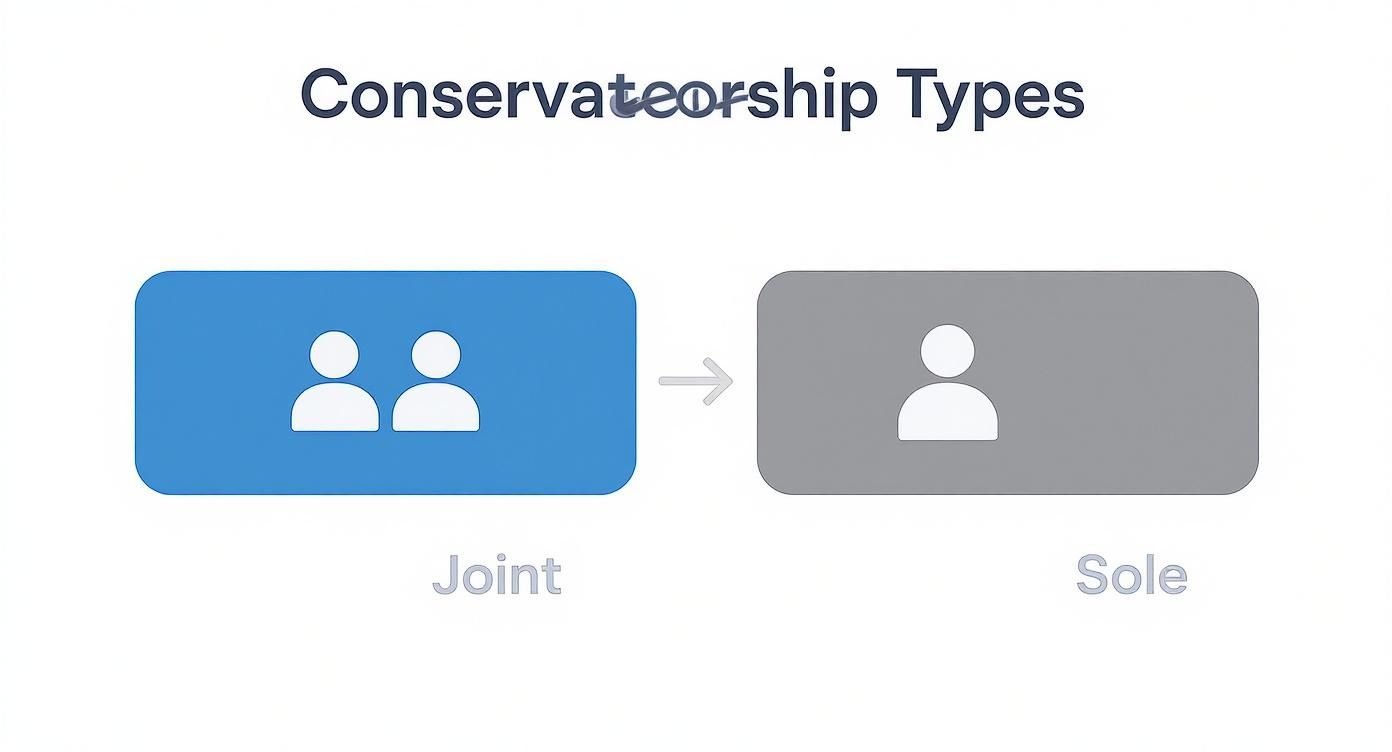
As you can see, the court system is built on the idea that having both parents involved is best, which is why a Joint Managing Conservatorship is the most common result.
When Cases Get More Complicated
Of course, not every case can be settled in mediation. When there are serious concerns about a child's safety or well-being, the court can bring in outside experts to investigate and provide a report. These professionals act as the judge's eyes and ears, providing the information needed to make the right decision.
Two of the most common experts appointed are:
- Amicus Attorney: The court appoints this attorney to represent the child's best interests, not either parent. The Amicus Attorney will interview the parents, the child, teachers, and counselors to form an independent recommendation for the judge.
- Social Study: This is a deep-dive investigation into the family's life. A social worker or mental health expert conducts home visits and extensive interviews to evaluate each parent's living situation and parenting skills, culminating in a detailed report and recommendation.
These tools are usually reserved for highly contested cases with serious disagreements or allegations. The entire legal journey has strict rules and deadlines, and one misstep can affect your rights. Having an experienced Atascocita family law attorney in your corner is the best way to ensure you and your child are protected from start to finish.
How to Modify an Existing Conservatorship Order
Life in communities like Atascocita and Humble is always changing. Jobs change, kids get older, and what worked for your family a few years ago might not work today. Texas law understands this. A court order for conservatorship in Texas is not set in stone forever. You can ask the court to update it through a legal process called a modification.
However, you can't go to court simply because you dislike the current arrangement. To ensure stability for children, the law requires a compelling reason to change a judge's prior ruling. To start a modification case, you must first prove there has been a material and substantial change in the circumstances of the child or one of the parents since the last order was signed.
What Counts as a "Material and Substantial Change"?
This legal phrase is the foundation of any modification case. The change cannot be something small or temporary. It must be a major life event that significantly impacts the child's well-being, making the current order impractical or no longer in the child's best interest.
Consider these real-world examples that families in our community face:
- Relocation: One parent gets a job offer in another state, making the current weekend visitation schedule impossible.
- Income Changes: The parent paying child support is laid off, or perhaps they get a significant promotion. The old child support amount no longer reflects the financial reality.
- A Child's Evolving Needs: An order designed for a young child may not work for a teenager with a demanding sports schedule or extracurricular activities.
- Safety Concerns: A parent develops a substance abuse problem or begins a relationship with someone who puts the child's physical or emotional safety at risk.
These are not minor disagreements; they are fundamental shifts that a judge is likely to consider material and substantial.
The Steps for Filing a Modification
The process of changing an order is similar to getting the original one. Here is a step-by-step guide:
- File a Petition: It starts by filing a Petition to Modify the Parent-Child Relationship in the same Harris County court that handled your original case. This document explains what you want to change and describes the material and substantial change that justifies it.
- Serve the Other Parent: Once filed, the other parent must be formally served with the lawsuit.
- Temporary Orders: If the issue is urgent, you can request a temporary orders hearing to get new rules in place while the case moves forward.
- Mediation: A judge will almost certainly require you and the other parent to try mediation to reach an agreement before trial.
- Final Hearing: If you cannot agree, your case goes before the judge. They will hear evidence from both sides and decide if the change has been proven and if your proposed new plan is in the child's best interest.
Modifying an order is a serious legal step that requires strong evidence and a clear understanding of the law. The burden of proof is on the parent requesting the change, and simply stating that things are different is not enough.
Change is a part of life, but navigating it within the legal system can be challenging. If your family's situation has changed significantly, it’s important to understand your options. The Law Office of Bryan Fagan's Atascocita team is ready to help you find the right path forward. Schedule a free consultation today to discuss your specific circumstances.
Conservatorship vs. Guardianship Explained
In Texas law, the terms conservatorship and guardianship are often confused. They may sound similar, but for families in Atascocita and Humble, they represent two very different legal paths. Understanding this distinction from the start is critical for protecting your loved ones.
In simple terms, conservatorship deals with the parent-child relationship. It's the legal framework family courts use in a divorce or custody case to define the rights and responsibilities each parent has for their child. Think of it as the official rulebook for co-parenting.
Guardianship, on the other hand, is used when a person—a child or an adult—is unable to care for themselves. It is the legal process for appointing a responsible person to manage their personal well-being (guardian of the person) or their finances (guardian of the estate).
Key Functional Differences
The clearest way to see the difference is by looking at what each process is designed to achieve. A conservatorship in Texas divides parental rights and duties. A guardianship provides care for a person who is legally incapacitated or a minor whose parents are no longer able to care for them.
- Conservatorship: This centers on who makes decisions for a child (medical, educational) and sets the possession schedule (visitation). It is handled in a family law court.
- Guardianship: This focuses on managing the daily life and/or finances of a minor or an incapacitated adult. These cases are handled in specialized statutory probate courts.
These cases don't even happen in the same courtroom. Conservatorship matters are heard in a Harris County family law court. Guardianship proceedings are handled by probate courts that deal with estates and cases involving incapacitated individuals.
While both are designed to protect people, conservatorship is fundamentally about defining parenting roles. Guardianship is a protective legal tool for those who cannot make safe decisions for themselves.
Because guardianship involves taking away a person's fundamental rights, the state monitors these cases very closely. Texas has made significant strides in this area. The Guardianship Abuse, Fraud, and Exploitation Prevention Program reviewed over 6,000 cases in fiscal year 2024 alone to protect wards from harm, as detailed in the official program report.
For adults in our community concerned about future incapacity, estate planning offers tools to avoid guardianship altogether. We often help clients create proactive legal documents. To learn more, take a look at our guide on what a Power of Attorney document is and how it can protect you.
Figuring out which legal path your family needs is the first and most important step. If you're unsure whether you are facing a conservatorship or guardianship issue, our team at The Law Office of Bryan Fagan can help you find clarity. We welcome you to schedule a free consultation at our Atascocita office.
How a Local Attorney Protects Your Parental Rights

Trying to handle a conservatorship case on your own is not just difficult—it's risky. The legal system is complex, the emotional stakes are incredibly high, and missing a single court deadline can jeopardize your rights as a parent. This is about more than just paperwork; it's about protecting your relationship with your child and securing their future.
When you have a dedicated lawyer from The Law Office of Bryan Fagan on your side, you gain a powerful advantage. A local Atascocita attorney doesn't just know the law; we understand the inner workings of the Harris County family courts. We are familiar with the local judges, court procedures, and the arguments that are most effective here.
Your Advocate in Negotiation and in Court
Many conservatorship disputes are settled through mediation. In these negotiations, having a skilled attorney is essential. We will fight for a fair agreement that protects your parental rights while always prioritizing your child's well-being. Our goal is to create a practical, stable parenting plan that sets your family up for long-term success.
But if the other party is unwilling to be reasonable, we are fully prepared to advocate for you in the courtroom. We will meticulously build your case, present evidence clearly, and ensure the judge understands your perspective. This ability to transition from a cooperative negotiator to a determined litigator is vital. The importance of finding a trustworthy expert is detailed in our guide on how to choose an estate planning attorney.
A conservatorship order will define your family's daily life for years. An experienced local lawyer isn't just an expense; it's your best strategy for preventing a negative outcome and building a better future.
Your Atascocita and Humble Legal Team
At The Law Office of Bryan Fagan, we are proud to be part of the Atascocita, Humble, and northeast Harris County communities. We live and work here, and we understand the unique challenges families in our area face. We provide the clear guidance and compassionate support you need during this difficult time.
Don't leave your relationship with your child to chance. We encourage you to schedule a free consultation at our Atascocita office. Let's talk through your situation and create a clear plan to protect what matters most.
Frequently Asked Questions About Texas Conservatorship
Going through a conservatorship case raises many questions. For families here in Atascocita and Humble, getting clear, straightforward answers is the first step toward regaining a sense of control. Here are answers to some of the questions we hear most often.
What Does "Best Interest of the Child" Actually Mean in Court?
This is the most important standard in any Texas family court case. To determine what is in a child's best interest, Harris County judges use a specific set of guidelines known as the "Holley Factors."
Think of these factors as a checklist the judge uses to get a complete picture of the child's life. They include:
- The child's emotional and physical needs.
- The stability of the home each parent can provide.
- Each parent's ability to put the child's needs first.
- Any potential physical or emotional dangers in either parent's home.
A judge carefully weighs all these points to create an arrangement that helps the child not just cope, but thrive.
Can My Child Decide Which Parent to Live With?
This is a common and sensitive question. In Texas, once a child is 12 years old or older, they have the right to speak with the judge in private to state their preference on which parent they would like to live with.
However, the child’s preference does not automatically determine the outcome. A judge will give the child's wishes serious consideration, but the final decision must still be based on the child's overall best interest. The judge will also consider the child’s maturity and the reasons for their choice when balancing it against all the other "Holley Factors."
What Is a "Possessory Conservator"?
In most cases where parents are named Joint Managing Conservators, the court designates one parent as the "primary" conservator. This is the parent who has the right to determine where the child lives (usually within a specific area, like Harris County) and typically receives child support.
The other parent is then called the possessory conservator. This simply means this parent has a set visitation schedule—what the law calls a "possession order"—and is typically the one who pays child support. It is important to remember that the possessory conservator still shares nearly all the same major decision-making rights and duties, such as having a say in the child's education and healthcare.
How Much Is This Conservatorship Case Going to Cost?
The cost of a conservatorship case varies greatly and almost always depends on the level of conflict between the parents.
If you and the other parent can find common ground, the case can often be settled efficiently through mediation, which saves a significant amount of money and stress. A highly contested case that involves multiple court hearings, expert witnesses, and a trial will naturally be much more expensive.
You deserve complete clarity from the start. We believe the cost of protecting your family shouldn't be a mystery. That's why we offer a free consultation to discuss your specific situation and provide a realistic understanding of the potential legal fees involved.
At The Law Office of Bryan Fagan – Atascocita TX Lawyers, we understand how stressful and overwhelming these situations can be for local families. If you have more questions or are ready to discuss your case, we are here to help. Schedule a free consultation today by visiting our Atascocita family law website.