Skip to content
When a Texas court terminates parental rights, it’s not just changing a custody arrangement. It’s issuing a permanent and irreversible order that completely severs the legal bond between a parent and their child. For a parent, this is the most extreme measure a family court can take, dissolving every right and duty that comes with the parent-child relationship.
Facing this possibility is an unimaginable challenge, but understanding the process is the first step toward protecting your family. At The Law Office of Bryan Fagan, we believe that every resident of Atascocita and our surrounding communities deserves clear, compassionate guidance during life's most difficult moments.
What It Really Means to Terminate Parental Rights in Texas

For any parent in Atascocita, Humble, or the surrounding Harris County communities, the idea of losing your child is terrifying. Receiving a legal notice that someone is seeking to terminate your rights is a life-altering event, filled with stress and uncertainty. It’s vital to grasp that this isn't about visitation schedules or who makes decisions for the child—it's about whether you are legally their parent at all.
This profound legal action can be set in motion in two very different ways. Understanding the distinction is the first step toward navigating the path ahead.
Involuntary vs. Voluntary Termination
Most often, termination is involuntary. This is usually when the Texas Department of Family and Protective Services (DFPS)—what most of us know as Child Protective Services or CPS—steps in. The state files a lawsuit because they believe a child has been endangered, and that severing the parental relationship is necessary for the child’s safety and well-being.
The other route is voluntary relinquishment. Here, a parent makes the difficult but conscious choice to give up their rights. This is common in stepparent adoptions, where a parent signs an affidavit to allow their child's stepparent to become the new legal parent, providing a stable, two-parent home for a child in our local community.
"A termination decree is more than a custody order; it is a final, binding, and irrevocable judgment that divests the parent and child of all legal rights, privileges, duties, and powers with respect to each other except for the child’s right to inherit." – Texas Family Code
Understanding the core differences between how parental rights can be ended in Texas is the first step. This table clarifies the distinction.
Involuntary Termination vs Voluntary Relinquishment at a Glance
| Key Aspect | Involuntary Termination | Voluntary Relinquishment |
|---|---|---|
| Who Initiates It? | The State (CPS/DFPS) or another party files a lawsuit against the parent. | The parent makes a conscious, willing choice to sign away their rights. |
| Core Reason | Allegations of abuse, neglect, endangerment, abandonment, or other statutory grounds. | To facilitate an adoption, typically by a stepparent or another family member. |
| Court Process | An adversarial legal battle; the state must prove its case against the parent. | A formal court process is still required, but it's based on the parent's consent. |
| Parent's Position | The parent is a defendant, fighting to keep their rights. | The parent is a consenting party, agreeing to the termination. |
While the circumstances are vastly different, both paths lead to the same permanent legal outcome.
This isn’t just a theoretical legal issue; it's a reality for many families in our state. In fact, Texas terminates parental rights at a higher rate than any other state. Back in 2018, Texas courts terminated the rights of parents to over 5,500 children.
No matter how the case begins, the court has one guiding principle: the best interest of the child. To ensure the child has a voice, a judge will appoint a special advocate, known as a Guardian ad Litem, whose sole job is to represent the child's needs.
Navigating this intimidating legal process is not something anyone should do alone. As a firm with deep roots right here in the Atascocita community, we're here to offer clear, straightforward guidance. If you're facing this unimaginable challenge, contact The Law Office of Bryan Fagan – Atascocita TX Lawyers today. We offer a free consultation to help you understand your options and protect your family.
Understanding the Grounds for Involuntary Termination

When the state steps in to terminate parental rights, it’s not a decision made lightly. A Harris County judge can't act on a whim or because they simply disagree with a particular parenting style. There have to be concrete, legally defined reasons to take such a final, life-altering step.
These reasons are called statutory grounds, and they are spelled out very clearly in the Texas Family Code. For a court to even consider a termination case, the person or agency filing the lawsuit—usually Child Protective Services (CPS)—has to prove that the parent's conduct meets at least one of these specific grounds. Think of it as a strict checklist the judge must follow, not a loose set of guidelines.
The Two-Prong Test for Termination
Every involuntary termination case in Texas hinges on a critical two-part test. It's like needing two separate keys to unlock a very secure door; you absolutely must have both.
- Proving a Statutory Ground: First, the petitioner has to prove that the parent's behavior fits one of the specific grounds listed in Texas Family Code § 161.001.
- Best Interest of the Child: Second, they must also convince the court that severing the parent-child relationship is truly in the child’s best interest.
This is a crucial point. Even if CPS can prove a parent is struggling with substance abuse, a judge won't terminate their rights unless it's also clear that doing so is what’s best for the child. Both of these "prongs" must be proven by a very high standard of evidence.
Common Grounds for Termination in Harris County
While the Texas Family Code lists nearly 20 different grounds for termination, some come up in Harris County courtrooms far more often than others. Knowing what they are can help you understand the specific allegations you might be up against.
- Endangerment: This is one of the most common reasons cited. Endangerment means the parent has knowingly put the child in situations or surroundings that threaten their physical or emotional health. This could be anything from exposing a child to drug use or domestic violence in the home to chronic, severe neglect.
- Abandonment: This applies when a parent has voluntarily left a child with another person without providing adequate support and has stayed away for a certain amount of time. It’s more than just being an absent parent; it’s a legal definition of disappearing from a child's life.
- Failure to Comply with a Court-Ordered Service Plan: Often, when CPS gets involved, a judge will order a parent to complete specific tasks—like parenting classes, therapy, or drug testing—to make the home safe. If a parent fails to follow through with this court-ordered plan, it can be used as a ground for termination because it suggests they are unwilling or unable to fix the problems.
- Certain Criminal Conduct: A parent’s criminal history can be a direct path to termination, especially if they've been convicted of a serious crime against a child or are responsible for the death or serious injury of a child.
In Texas, the law starts with the assumption that a fit parent acts in their child's best interest. The state has the very high burden of proving otherwise with clear and convincing evidence. This is a core protection for families in Atascocita and across Texas.
What Does Endangerment Look Like in Atascocita?
The word "endangerment" can sound broad and intimidating. For a local family, it might be a parent in Humble whose untreated addiction leads them to leave a young child home alone frequently. Or it could be a parent in an abusive relationship, forcing their child to witness terrifying physical fights in their Atascocita home.
It’s critical to understand that a single mistake or a bad day doesn't automatically equal endangerment. A court is looking for a pattern of behavior that shows a real, ongoing risk to a child’s safety and well-being.
Sometimes, an accusation of endangerment is actually a tactic used in a bitter custody battle, especially when parental alienation is at play. If you're worried about these complex dynamics, you can learn more by reading about how to prove parental alienation in court.
Ultimately, a judge has to look at the unique facts of every single case. They will weigh the parent's actions, the child's environment, and the direct impact on the child before ever making a final decision. Facing these allegations requires a powerful, fact-based defense, which is why getting experienced legal help on your side as early as possible is so important.
The Court Process: What to Expect in a Harris County Termination Lawsuit
When a lawsuit to terminate your parental rights is filed, it feels like the ground has been pulled out from under you. If you're a parent in Atascocita or Humble, knowing what the legal journey looks like can bring some clarity to a deeply frightening time. This isn't just one court date; it's a sequence of deliberate steps within the Harris County court system, each with its own set of rules and high stakes.
The process kicks off when a petition is filed with the court. In most cases, this is done by the Texas Department of Family and Protective Services (DFPS), which you probably know as CPS. This legal document is a roadmap of their case, outlining the specific legal reasons (the statutory grounds) they believe justify ending your rights and arguing that doing so is what’s best for your child.
Step-by-Step: From Petition to Hearing
Things move fast once that petition is filed. Here is the step-by-step guidance you need:
- You'll be Served: You will be officially served with legal papers and ordered to appear for an initial court date, often called an adversary hearing.
- Attend the First Hearing: This first appearance is incredibly important. A judge will take a hard look at the initial evidence to decide if there’s a serious, immediate danger to your child. Based on this, the judge can issue temporary orders, which might include removing your child from your home.
- Adhere to Temporary Orders: These orders are legally binding. The court will also appoint an attorney ad litem—a lawyer whose sole job is to represent your child's best interests throughout the entire legal battle.
- Engage and Participate: From the very first day, your active participation is absolutely essential. It’s your first and best chance to show the judge you're committed to your child. Make sure you attend every single hearing, act respectfully, and engage with the process.
It’s crucial to remember this: The burden of proof isn't on you to prove you're a good parent. The full weight is on the state (or whoever filed the petition) to prove, with a very high degree of certainty, that your rights must be terminated.
The High Bar of "Clear and Convincing Evidence"
This isn't like a standard civil case where "preponderance of the evidence" (basically, 51% sure) is good enough. Termination cases are held to a much stricter standard: clear and convincing evidence.
What does that actually mean? It means the evidence presented must be so compelling that it creates a firm belief or conviction in the judge's mind that the allegations are true. Think of it as a significant legal shield, designed to protect the fundamental parent-child bond from being broken unless there is powerful, persuasive proof of endangerment and a clear showing that termination is in the child’s best interest.
Discovery: Building Your Defense
After those initial hearings, the lawsuit moves into a phase called discovery. This is where both sides dig in and gather their evidence. The state's lawyers will be collecting documents and talking to witnesses. At the same time, this is your chance—working closely with your attorney—to build a strong defense.
Here’s what you need to focus on during this time:
- Work Your Service Plan: If CPS is involved, you will almost certainly be given a court-ordered service plan. This is a to-do list that might include parenting classes, counseling, or drug tests. Completing every single item on that list, without fail, is one of the most powerful statements you can make to the court about your commitment as a parent.
- Document Everything: Become a meticulous record-keeper. Keep every certificate from classes you complete. Write down the details of every visit with your child. Log every phone call and email with your CPS caseworker. This paperwork is no longer just paperwork; it’s your evidence.
- Get Ready for Trial: As the case progresses, your attorney will start preparing you for the final trial. This involves lining up witnesses who can speak on your behalf and getting your own testimony ready. Being ready is half the battle. You can find excellent advice in our article on how to prepare for a custody hearing, as many of the same strategies apply here.
Fighting a termination lawsuit is a marathon, not a sprint. If you're a parent in the Atascocita area facing this overwhelming challenge, please know you don't have to face it by yourself. The experienced attorneys at The Law Office of Bryan Fagan – Atascocita TX Lawyers are here to stand up for you. Call us for a free, confidential consultation to talk about your case.
When a Parent Chooses to Voluntarily Give Up Their Rights
Not every termination of parental rights case in Texas is a drawn-out court fight. Sometimes, a parent makes the incredibly difficult, often selfless, choice to give up their rights on their own. This is called voluntary relinquishment, and it's a profound decision that, while heartbreaking, can be the most direct route to a stable future for a child.
Here in Harris County, one of the most common reasons we see this happen is to clear the path for a stepparent adoption. This is a beautiful way for a new, committed parental figure to legally step into that role, giving a child the security and permanency of a complete two-parent home.
The Formal Legal Steps Involved
Voluntary relinquishment isn't something you can just agree to verbally. To be valid, it has to follow a strict legal roadmap. The central document in this process is the Affidavit of Relinquishment of Parental Rights.
This isn't a simple form you find online and sign. Texas law is very specific about how this document must be handled to be legally binding.
- It Must Be in Writing: The agreement has to be a formal, written statement.
- It Requires Witnesses: The signing must be done in front of two credible witnesses and a notary public.
- Irrevocable vs. Revocable: The affidavit can be written to be either revocable (it can be undone) or irrevocable (it cannot be taken back). For an adoption to move forward, it almost always needs to be irrevocable.
There's also a critical safeguard for birth mothers: she cannot legally sign this affidavit until at least 48 hours have passed after the child's birth. This mandatory waiting period ensures the decision is made with a clear head, free from the immediate physical and emotional pressures of childbirth.
The legal process for any parental rights lawsuit follows a clear path, starting with a petition and moving through court proceedings.
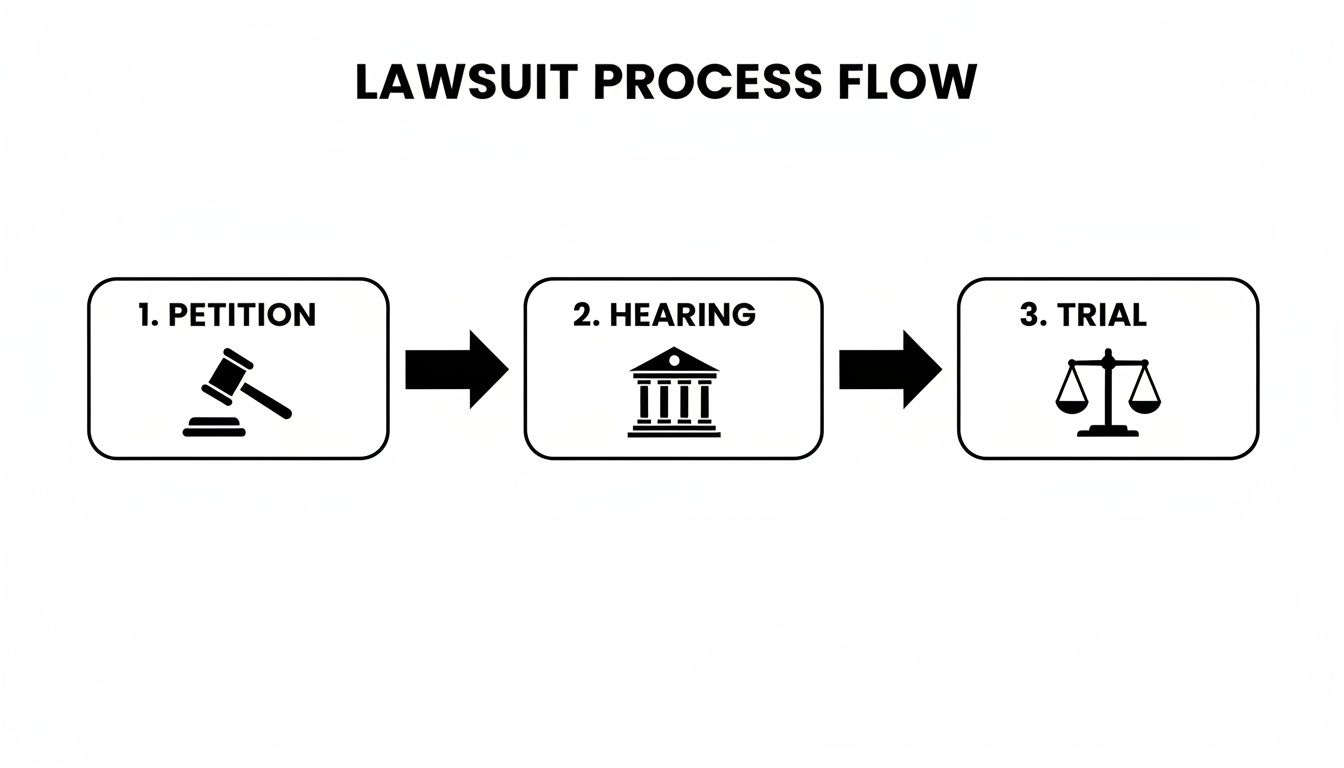
This diagram shows how a case formally begins with a petition, moves through hearings, and culminates in a trial if necessary.
A Real-World Example in Atascocita
Let's picture a family right here in Atascocita. A mother has remarried, and her new husband has been the primary father figure in her son's life for years. He takes him to school, helps with homework, and provides consistent love and support. The boy's biological father, meanwhile, has moved on and has very little contact. He sees that the stepfather is the one truly raising his son.
In a situation like this, the biological father might agree that the best thing for his child is to let the stepfather adopt him. By signing an affidavit of relinquishment, he voluntarily ends his legal rights. This opens the door for the stepfather to file for adoption and become the boy's father in the eyes of the law, cementing the bond that already exists.
Relinquishing your parental rights is a permanent, life-altering decision. It is absolutely critical that you speak with an attorney to fully understand the legal and emotional finality of this act before you sign anything.
This process isn't just about ending one legal relationship; it's about formalizing a new one. It gives the child an unshakable sense of permanency and belonging and solidifies the family unit that has been built on love and daily commitment.
Whether you're the parent considering relinquishment or the stepparent hoping to adopt, navigating this process requires an experienced and compassionate guide. The team at The Law Office of Bryan Fagan – Atascocita TX Lawyers can provide the clear advice you need. Contact us for a free consultation to talk about your family's unique situation.
The Lifelong Impact of a Termination Order

When a Harris County judge signs an order to terminate parental rights, it's not a temporary setback. It's a permanent, life-altering legal event that redefines a family in the eyes of the law. For any parent in Atascocita or Humble facing this, truly grasping the immediate and long-term consequences is critical.
The change is instantaneous. The moment that order is signed, the legal relationship between parent and child is gone. All rights to visit, to call, to even get updates on your child's life—they all vanish. It’s a complete and total legal separation.
This finality brings a cascade of specific changes that touch every part of the former parent-child connection.
The Immediate Legal Consequences
Once the gavel falls, the legal ground shifts beneath your feet. A number of key rights and responsibilities are immediately wiped away:
- End of Parental Rights: You lose all legal say in your child’s life. Decisions about their schooling, healthcare, and religious upbringing are no longer yours to make.
- Future Child Support Ends: Your obligation to pay future child support stops. It’s important to know, however, that this does not erase any past-due child support (arrears) owed up to that point.
- Removal from Birth Certificate: Your name can be legally taken off the child’s birth certificate, erasing the official paper trail of your relationship.
- Loss of Inheritance Rights: While your child might still be able to inherit from you, you lose any right to inherit from them.
These aren't just technicalities on a legal document; they represent a complete remaking of your family's reality.
The Future for the Parent and Child
The ripple effects of a termination order stretch for a lifetime, far beyond the courtroom walls. For the parent, it means a future with no legal connection to their child. There is no right to go to a school play, no right to be called in a medical emergency, and no right to contact, unless the child’s new legal guardians decide to allow it.
For the child, the order is designed to create legal stability. It frees them to be adopted. This is what allows another family—maybe the foster parents who have cared for them, or a stepparent in Humble who has raised them—to step in and form a new, legally recognized parent-child bond. It’s about giving the child a chance at a stable home and a fresh start.
Understanding the deep emotional impact is also key; for instance, many studies have explored the lasting effects of an absent father on a daughter, which can be relevant in these situations.
In Texas, a termination order is built to be final. The window to challenge the court's decision is incredibly small, and the reasons for a successful appeal are extremely limited, usually requiring proof of a major legal mistake during the trial.
This finality is exactly why a strong, proactive defense from day one is so essential. The time to fight for your rights is during the lawsuit, not after the judge has already made a decision. Once that order is signed, turning back the clock is next to impossible.
If you are a parent in the Atascocita area and have been served with a lawsuit to terminate your parental rights, the time to get help is now. At The Law Office of Bryan Fagan – Atascocita TX Lawyers, we know the weight of what you are carrying. Schedule a free, confidential consultation with our team today to talk about your case and start protecting your family’s future.
Exploring Alternatives to Termination in Texas
For many families here in Harris County, the idea of permanently severing the parent-child bond is a devastating prospect. The good news is that it’s not the only solution. The Texas legal system is built on the principle of acting in a child’s best interest, and courts recognize that often, there are better paths forward—ones that protect a child's safety while keeping the family connected.
Thinking about these alternatives is a message of hope. It means that even when things seem dire, you may have options that avoid the finality of having your parental rights terminated. An experienced family law attorney can be your best advocate in court, arguing for these less severe, more supportive resolutions.
Permanent Managing Conservatorship: A Key Alternative
One of the most powerful and common alternatives is a Permanent Managing Conservatorship (PMC). This is a court order that places a child in the legal custody of a relative—like a grandparent in Humble or an aunt in Atascocita—or another trusted adult without completely terminating the biological parents' rights.
Think of it as transferring the driver's seat. The conservator takes over the day-to-day decision-making and responsibility for the child's care, ensuring they're in a safe and stable home. But this arrangement keeps the legal door open for the future.
- What it preserves: Under a PMC, a parent’s rights are restricted, not completely erased. You may still have the right to visitation (often supervised at first), and the legal parent-child relationship remains intact.
- What it provides: It gives the child the stability they desperately need without the emotional trauma of legally severing ties with their parent.
- A path to reunification: Most importantly, a PMC leaves open the possibility of future reunification. If a parent can show the court they’ve made significant and lasting positive changes, they may be able to regain custody down the road.
When the challenges leading to a CPS case involve addiction, understanding the deep connection between substance abuse and family dynamics is critical. Exploring addiction and family healing strategies can be a vital part of the journey toward recovery and getting your family back on track.
Other Supportive Measures a Court Can Order
Beyond a full conservatorship, a Harris County judge has other tools to protect a child while still supporting the family unit. These measures are often combined to create a safety net tailored to the child's specific situation.
Some of these orders can include:
- Monitored Visitation: The court can order that all contact between you and your child must be supervised by a neutral third party. This ensures the child’s safety while allowing you to maintain a bond.
- Family-Based Safety Services: A judge can mandate specific services designed to help your family address the root causes of the problem, such as intensive therapy, in-home parent coaching, or substance abuse treatment programs.
The focus is shifting. The child welfare system is increasingly recognizing that children often do best when they can safely stay connected to their family of origin. The goal is to heal families, not just separate them.
This isn't just wishful thinking; it's a trend backed by real numbers. Thanks to recent reforms in Texas's child welfare system, we've seen measurable improvements. In 2018, Texas removed 20,685 children from their homes. By 2024, that number had dropped by 55% to just 9,220. This shows a significant and deliberate move toward keeping families together whenever it's safely possible.
If you are a parent in the Atascocita area facing a CPS case, don’t assume termination is the only possible outcome. There are often better, more hopeful solutions available. At The Law Office of Bryan Fagan – Atascocita TX Lawyers, we are committed to fighting for these alternatives. Call us for a free consultation to discuss a strategy that puts your child's well-being and your family's future first.
Your Questions Answered: Navigating Parental Rights Termination
When you're facing the potential loss of your parental rights, the questions can feel overwhelming. People in Atascocita, Humble, and across Harris County often have the same urgent concerns. Let’s tackle some of the most common ones we hear every day.
Can I Get My Parental Rights Back After They Are Terminated in Texas?
To put it plainly, a termination order in Texas is designed to be permanent. Once a judge signs that order, it’s incredibly difficult to undo. You can file an appeal right away, but you have to prove that the judge made a major legal mistake during the trial—a very high bar to clear.
There isn't a standard "reinstatement" process in Texas family law. After the window for an appeal closes, the court's decision is final. This is precisely why having a strong legal defense from the very start is so critical. The fight for your rights happens before the judge’s final decision, not after.
If My Rights Are Terminated, Do I Still Have to Pay Child Support?
Once a termination order is final, your obligation to pay future child support stops. The legal tie between you and your child, along with all its rights and responsibilities, is officially cut.
However, the termination does not wipe the slate clean on past-due child support. Any amount you owed up to the date of the termination order (called arrears) is still a debt you owe. The state can, and often will, continue to collect on that past-due amount. It's vital to get clarity on where you stand with any arrears.
The finality of a termination order underscores the urgency of your defense. The best time to protect your parental rights is before the judge makes a final ruling, not after.
How Long Does the Termination Process Take in Harris County?
This is a tough one to predict, as every case is different. When Child Protective Services (CPS) is involved, Texas law puts the case on a faster track to get the child into a permanent, stable home. In these situations, a final trial usually has to happen within one year of CPS taking temporary custody.
On the other hand, the process can move much faster if a parent voluntarily signs away their rights. It can also drag on much longer if the case involves tricky legal arguments, extensive evidence, or multiple appeals. A local attorney who knows the Harris County courts can give you a much better idea of the timeline based on your specific circumstances.
What Is the First Thing I Should Do If CPS Contacts Me?
Your absolute first step is to stay calm, be cooperative but careful, and call a family law attorney with experience in CPS cases immediately. You have a right to legal counsel, and you should never attend a meeting or interview with CPS alone.
Avoid signing any documents or agreeing to a "safety plan" without having your lawyer review it first. An attorney is your best advocate—they are there to protect your rights, guide you through the investigation, and work toward keeping your family together.
Facing a lawsuit that could take away your children is one of the most stressful experiences a person can endure. You don't have to face it by yourself. The dedicated team at The Law Office of Bryan Fagan – Atascocita TX Lawyers is here to offer the skilled, compassionate legal support you need. We are ready to stand up for your rights and fight for your family's future.
Contact us today to set up a free, private consultation at our Atascocita office. Let's talk about your options and start building the strongest defense possible.
Schedule Your Free Consultation with The Law Office of Bryan Fagan – Atascocita TX Lawyers