Skip to content

If you're considering a divorce in Atascocita, one of the first concepts your attorney will explain is the mandatory 60-day waiting period. This is a fundamental part of Texas family law that applies to every case. Essentially, the state requires a "cooling-off" period that lasts for at least 60 days, beginning the day after one spouse files the Original Petition for Divorce.
What does this mean for you and your family? It means a judge cannot legally finalize your divorce until the 61st day has passed. It's the absolute minimum timeframe, and understanding its purpose is the first step in navigating the road ahead.
Understanding The Texas Divorce Waiting Period
Going through a divorce is an overwhelming experience, and the idea of a mandatory wait can feel frustrating. We understand. But this delay isn't designed to be a hurdle. For families here in Atascocita, Humble, and across northeast Harris County, it's better to think of the divorce in Texas waiting period as a built-in window for preparation and reflection.
The Texas legislature put this rule in place to prevent people from making irreversible, life-altering decisions in a moment of anger or hurt. It ensures both spouses have a chance to breathe and properly address all the critical details—from property to parenting—before the marriage is officially dissolved.
This isn't just dead time. It's a crucial opportunity to get organized. It gives you and your attorney the space to:
- Gather Important Documents: You can start collecting financial records, property deeds, and other vital paperwork without the pressure of an immediate deadline.
- Establish Temporary Orders: This is the time to create stability for your family. We can ask the court for temporary orders that set the rules for custody, child support, and who lives in the family home while the divorce is ongoing.
- Develop a Clear Strategy: Together, we can map out your goals for dividing property, spousal support, and what you want your life to look like after the divorce.
- Explore Amicable Solutions: You can use this period to look into options like mediation, which often leads to a more peaceful and affordable resolution for everyone involved.
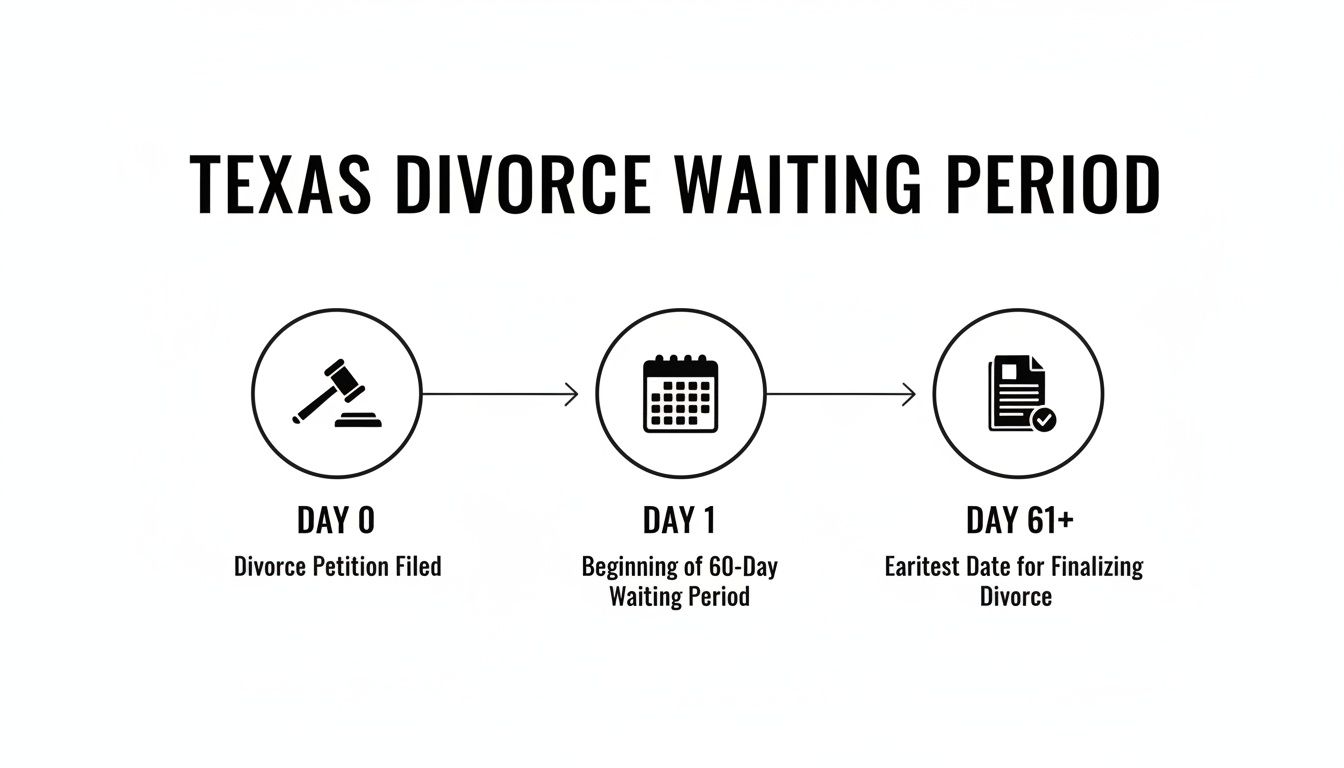
This visual gives you a clear picture of how the initial timeline works, from the day you file through the end of the mandatory 60-day period.
Understanding The Initial Divorce Timeline
To break it down even further, here's a simple step-by-step guide to the key milestones during the first couple of months of a divorce case in Harris County.
| Step | Action | What This Means for You |
|---|---|---|
| Day 0 | File the Original Petition for Divorce | This is the official start of your divorce case. Your attorney files this document with the Harris County District Clerk. |
| Day 1 | The 60-Day Clock Starts | The mandatory waiting period begins the day after the petition is filed. |
| Days 2-59 | Discovery, Negotiation, & Temporary Orders | This is the active phase for gathering information, negotiating terms with your spouse's attorney, attending mediation, and getting temporary court orders in place to protect your children and finances. |
| Day 60 | Final Day of Waiting Period | The mandatory waiting period officially ends at the close of this day. |
| Day 61+ | Eligible for Finalization | If all issues are resolved and an agreement is reached, your divorce can be finalized by a judge anytime from this day forward. |
It's important to remember that Day 61 is the earliest possible finalization date, not the average. Most divorces take longer, especially if there are complex property issues or disagreements over custody.
At The Law Office of Bryan Fagan, we help our Atascocita clients make these 60 days count. Instead of just watching the calendar, we're actively building the foundation for your case and your future. If you have questions about what the waiting period means for your specific situation, we encourage you to schedule a free consultation at our Atascocita office.
Navigating The Waiting Period In Harris County
If you’re facing divorce in our local communities, from Atascocita to Humble, understanding the 60-day waiting period is one of the very first steps. This isn't just a delay; it's a legal requirement that marks the official start of your case, and it all begins the moment your attorney files the Original Petition for Divorce with the Harris County District Clerk.
Once that petition is on file, the 60-day clock starts ticking the very next day. The next critical step is to make sure your spouse is formally notified of the lawsuit. In legal terms, this is called "service," and it’s a non-negotiable step to ensure everyone is on the same page and has a fair opportunity to respond.

Setting Realistic Expectations For Your Timeline
We can't stress this enough: 60 days is the absolute minimum amount of time for a divorce in Texas waiting period. It’s the starting line, not a guaranteed finish line. For the vast majority of families here in Harris County—especially if you have children, a house, or a business together—the process is going to take longer.
Think of it like planning a trip. The flight itself might only be an hour, but you still have to pack, drive to the airport, get through security, and board the plane. The waiting period in a divorce works the same way. It's just one piece of a much larger journey that includes negotiation, gathering documents, and making life-altering decisions.
At our Atascocita law office, we encourage clients to see the waiting period not as a frustrating pause, but as a crucial time for strategy and preparation. The last thing you want to do is rush decisions about your children's future or your financial stability.
How Harris County Courts Schedule Cases
The family courts in Harris County are incredibly busy. While your divorce is legally "pending" during those 60 days, other procedural timelines are already in motion. For instance, once your spouse is served with the divorce papers, they have a strict deadline to file their official Answer with the court.
We use these initial months to take proactive, productive steps. This is not a time to sit and wait.
- Filing for Temporary Orders: We can immediately ask a judge to set temporary ground rules. This covers things like who stays in the house, a temporary custody schedule, and who pays which bills.
- Beginning Discovery: This is the formal process of exchanging financial information. We ensure every asset and debt is accounted for so we can work toward a fair division.
- Scheduling Mediation: Most judges in Harris County will require you and your spouse to try mediation to settle your disagreements before they'll even consider giving you a trial date.
Each of these steps takes time and shapes the overall timeline of your case. Understanding the practical steps involved after filing a divorce in Harris County is the key to setting realistic expectations. The waiting period is just the first step, and our job is to help you use it wisely to lay a strong foundation for your next chapter.
Exceptions to the 60-Day Waiting Period Rule
One of the first questions clients ask when they sit down in our Atascocita office is, "Can we speed this up?" It's a completely understandable question. When you're emotionally ready to move on, being told to wait feels like the last thing you want to do.
But when it comes to the divorce in Texas waiting period, the law is incredibly firm. There's really only one situation where a judge can legally bypass it, and it's reserved for the most serious of cases.
Under the Texas Family Code, a judge has the authority to waive the 60-day waiting period only in cases involving documented family violence. This isn't a loophole; it’s a critical protection designed for situations where staying married for another two months puts a spouse or child in real, immediate danger.

What Is Required for a Waiver?
To convince a judge to grant this exception, simply stating that abuse occurred won't be enough. A Harris County judge is going to need solid, documented proof. The legal standard is high to prevent the exception from being misused.
Specifically, a judge will look for official records that prove family violence has occurred. The most common forms of proof are:
- A criminal conviction: If your spouse has been convicted of or received deferred adjudication for a crime involving family violence against you or a member of your household, that’s the kind of evidence the court needs.
- An active protective order: A judge may also grant the waiver if you have a protective order in place that was issued based on a finding of family violence.
This exception is a vital lifeline for people in dangerous home environments. If you are experiencing family violence in your Atascocita home, your safety and your children's safety must come first. Our legal team can help you understand the immediate steps needed to get protection.
A Common Misconception About Uncontested Divorces
Let's clear up a major point of confusion we often see with clients from Humble, Kingwood, and the surrounding communities. Even if your divorce is 100% amicable and uncontested—meaning you and your spouse agree on everything from property to parenting—you still have to wait the 60 days.
The waiting period is a statutory requirement, not a suggestion. Mutual agreement does not give a judge the authority to bypass this mandatory "cooling-off" period.
This rule applies across the board. It doesn't matter if your divorce is simple or complex, friendly or contentious. The only way around it is the family violence exception, which is strictly reserved for cases where someone's safety is on the line.
Navigating a divorce involving domestic violence requires an attorney who is both compassionate and strong. If you believe your circumstances might qualify for an exception, or if you simply need to discuss your safety and legal options, please contact The Law Office of Bryan Fagan. We offer a confidential and free consultation at our Atascocita office to help you understand your rights and get the protection you need.
How To Use The Waiting Period Productively
For most people here in Atascocita and Humble, the mandatory divorce in Texas waiting period just feels like a frustrating delay. You’re emotionally done and ready to move on, so being told you have to wait can be difficult. We get it. But instead of seeing these 60 days as wasted time, our attorneys advise clients to view it as a strategic preparation window.
This is your chance to get organized, make a plan, and take back a sense of control over your life.

Think of it as shifting from a reactive, emotional mindset to a proactive, logical one. Using this time wisely can dramatically reduce future stress, lower your legal costs, and help you build a solid foundation for your new life. It’s your opportunity to methodically prepare so that nothing gets missed.
Create Your Financial Inventory
One of the most powerful steps you can take right now is to start gathering all of your financial documents. Being organized doesn't just make your lawyer's job easier; it empowers you in negotiations.
Start a folder—a physical one or a digital one—and begin collecting these items:
- Proof of Income: The last few pay stubs for both you and your spouse, plus your tax returns from the past two or three years.
- Property Documents: Mortgage statements for your house in Atascocita, property tax records, and titles for any cars or other vehicles.
- Account Statements: Recent statements for every bank account (checking and savings), retirement funds (like 401(k)s or IRAs), and any investment accounts.
- Debt Records: Statements for every credit card, car loan, personal loan, or any other money you owe.
Having all this at your fingertips helps us build a crystal-clear picture of your marital estate, which is the cornerstone of fighting for a fair and just property division.
Establish Stability with Temporary Orders
Just because you can't finalize the divorce for at least 61 days doesn't mean your life has to be stuck in limbo. The waiting period is the perfect time to have your attorney ask the court for temporary orders. These are legally binding rules that create stability and predictability for your family while the divorce is ongoing.
Temporary orders act as a crucial rulebook for the separation period. They clearly define each spouse's responsibilities, which dramatically reduces conflict and uncertainty about day-to-day life.
These orders can set the ground rules for some of the biggest points of contention:
- Child Custody: A temporary possession schedule that spells out exactly when the kids will be with each parent.
- Financial Support: Temporary child support and, in some cases, spousal support payments.
- Bill Payments: Who is responsible for the mortgage, utilities, and other household expenses.
- Property Use: Who gets to live in the family home and who has use of which vehicle.
Explore Mediation And Focus on Healing
This 60-day window also provides an opportunity to explore settlement options like mediation. It’s a process where you and your spouse sit down with a neutral third party to work through disagreements. It can often save you a significant amount of time, money, and emotional energy. You can learn more by reading our guide on how to prepare for divorce mediation.
Finally, don't forget to take care of yourself. This is a crucial time for your own well-being. It’s an opportunity for personal healing and for learning how to forget about someone you love and start healing. Giving yourself the space to process what’s happening will help you make clearer, more rational decisions for the future you're building for yourself and your children.
How The Waiting Period Affects Your Divorce Timeline
When we sit down with clients in our Atascocita office, one of the first things we discuss is the divorce timeline. Many people naturally fixate on the 60-day waiting period as the main event, but that's a common misunderstanding.
Think of it this way: the waiting period is like the starting pistol at a track meet. It gets the race started, but it has no bearing on whether you're running a sprint or a marathon. The real length of your divorce journey is determined by the complexity of your family's circumstances.
The waiting period simply sets a floor, not a ceiling. It means your divorce will take at least 61 days. How much longer it takes from there depends entirely on what needs to be worked out between you and your spouse.
Comparing Divorce Timelines: Simple vs. Complex Cases
To give you a clearer picture, let's look at two common scenarios we see with families right here in our community. Of course, every family's situation is unique, but these examples show how certain factors can stretch a timeline well beyond that initial 60-day mark.
Scenario 1: The Uncontested Humble Divorce. Imagine a couple in Humble, married for four years. They don't have children and they rent their apartment. They’ve already talked and agreed on how to split their bank account and who gets which car. For them, the 60-day waiting period is genuinely the longest part of their divorce. Once day 61 hits, they can sign the final decree and be done because all the hard work is finished.
Scenario 2: The Contested Atascocita Divorce. Now consider an Atascocita couple married for 15 years. They have two children, own a home in Eagle Springs, and one spouse has a sizable 401(k). They can't agree on a custody schedule or how to value their home. Their timeline has very little to do with the 60-day rule. Instead, it will be dictated by custody negotiations, property appraisals, and financial discovery. Their divorce will almost certainly take many months, perhaps even a year, to resolve properly.
Factors That Truly Dictate Your Timeline
The mandatory divorce in Texas waiting period is a constant—every family must go through it. The real variables, the things that extend the process, are the issues that demand careful negotiation and skilled legal work.
Here are the most common factors that determine how long your divorce will actually take:
- Child Custody Disputes: Crafting a possession order and parenting plan that truly serves your children's best interests is often the most emotional and time-consuming part of any divorce.
- Complex Property Division: Valuing and dividing assets like the family home, a local business, or retirement accounts is not always straightforward. It requires a deep financial dive and often the input of outside experts. You can learn more by reading our guide on how to protect assets during divorce.
- High Levels of Conflict: Simply put, if communication has completely broken down, every small decision can turn into a drawn-out battle, which can grind the entire process to a halt.
The core takeaway is this: the waiting period is just a legal formality. The real work of untangling two lives is what truly sets the pace of your divorce.
In Texas, the law requires this mandatory 60-day "cooling-off" period, which starts the day after one spouse files the divorce petition (you can find this in Texas Family Code § 6.702). While this means the absolute earliest a judge can sign your decree is on the 61st day, the reality for most Harris County families is a timeline stretching anywhere from six months to over a year. This is especially true when issues like child custody or complex property division are on the table.
Let's Talk About Your Case – Atascocita Divorce Lawyers
Going through a divorce is one of life's most challenging experiences. It’s easy to feel lost and uncertain, but you absolutely do not have to navigate this journey by yourself.
That mandatory 60-day waiting period might seem like just another hurdle, but with the right legal team on your side, it becomes a crucial window to prepare and build a solid foundation for your future. If you live in Atascocita, Humble, or any of the surrounding communities, our team is here to provide the local support and clear guidance you need.
Reach out to The Law Office of Bryan Fagan for a free, confidential consultation to go over the specifics of your situation. We’re here to listen, answer your questions, and give you the confidence to take that next step forward.
Common Questions About the Texas Divorce Waiting Period
Going through a divorce brings up a mountain of questions. As family law attorneys serving the Atascocita and Humble communities, we’ve found that many people share the same concerns, especially about the mandatory 60-day waiting period. Let's clear up some of the most common points of confusion.
Does The Waiting Period Start The Day My Spouse And I Separate?
This is a common and critical question, and the answer is no. The 60-day clock does not start ticking until one spouse officially files the Original Petition for Divorce with the court and the clerk accepts it.
Any time you spend living apart before that legal filing, whether it's weeks or months, does not count toward the mandatory wait. The timeline is a strictly legal one, initiated only by filing the correct paperwork with the Harris County court.
Can We Skip The Waiting Period If We Agree On Everything?
Even in the most amicable, uncontested divorces where you and your spouse agree on every last detail, the 60-day waiting period is set in stone by Texas law. You cannot waive it just because you both want to move on quickly.
The only rare exception is in documented cases of family violence. This requires convincing a judge with solid evidence, like a protective order or a criminal conviction. A friendly, uncontested divorce, however, will not qualify for this waiver.
What Happens If We Get Back Together During The Waiting Period?
This is actually one of the reasons the waiting period exists—to give couples a final chance to cool off and potentially reconcile. If you do decide to get back together, you can simply file a motion to dismiss the divorce petition. That stops the court process completely.
Just keep in mind, if you decide to divorce again later on, you'll have to start all over. That means filing a brand new petition and beginning a fresh 60-day waiting period from day one.
Can I Get Child Support And A Custody Schedule During The Wait?
Yes, absolutely. In fact, getting these arrangements in place is one of the most productive steps you can take during the waiting period. You do not have to put your family's stability on hold for 60 days.
Your attorney can go to the court right away and request temporary orders to establish:
- A clear, enforceable child custody and visitation schedule.
- Temporary child support and, if applicable, spousal support payments.
- Rules about who gets to stay in the family home in Atascocita while the divorce is ongoing.
These orders provide a much-needed legal structure for your family, which helps minimize conflict and create predictability while you work toward a final resolution.
Trying to make sense of the waiting period and the divorce process as a whole can be overwhelming, but you are not in this alone. The dedicated team at The Law Office of Bryan Fagan – Atascocita TX Lawyers is here to provide the clear answers and compassionate guidance you deserve. We invite you to schedule a free, no-obligation consultation at our Atascocita office to talk through your situation and learn how we can help you move forward.
Contact Us Today: https://www.atascocitaattorneys.com