For grandparents in Atascocita, Humble, and the surrounding northeast Harris County communities, being cut off from your grandchild is a deeply painful experience. You’re likely wondering what, if anything, you can do legally. The short answer is yes, Texas law does provide a path for grandparents to seek visitation, but it's important to understand that it’s an uphill battle by design.
The entire case hinges on one critical concept: you must prove that denying you time with your grandchild would cause significant impairment to their physical health or emotional well-being. It's a very high bar to clear, and our goal is to help you understand what that means for your family.
Your Connection and Your Rights as a Grandparent
At The Law Office of Bryan Fagan, we understand. The thought of not seeing your grandchild, of missing out on their life, is heartbreaking. That special bond is a cornerstone for so many families here in our community. When that bond is threatened, it’s natural to feel lost and anxious.
However, Texas law starts from a place of strong legal deference to parents. The courts operate under the presumption that a fit parent is acting in their child's best interest—and that includes deciding who the child sees. To get a court to step in and order visitation against a parent's wishes, you have to present powerful, compelling evidence to overcome that presumption.
Simply being a loving grandparent or a positive influence, unfortunately, isn't enough to win in court. A Harris County judge needs to see clear proof that your absence from the child's life would cause actual, tangible harm. This strict standard is in place to protect a parent's constitutional right to raise their children, making this a tough legal journey that absolutely requires a solid, compassionate legal strategy.
Understanding the Legal Framework in Texas
The specific rules governing this process are found in the Texas Family Code, which lays out a very demanding test for any grandparent seeking access to a grandchild. This legal standard was shaped significantly by a landmark U.S. Supreme Court case that reinforced parental rights.
To even get your foot in the courthouse door, you have to satisfy several conditions at once. Falling short on just one of them can bring your case to a halt.
Let's break down exactly what the law requires in plain English. The Texas Family Code has a very specific set of criteria that a grandparent must meet to successfully petition for visitation.
Texas Grandparent Visitation Requirements at a Glance
| Legal Requirement | What This Means for Atascocita Families |
|---|---|
| Parental Rights Intact | The rights of at least one of the child's biological or adoptive parents must not have been terminated by a court. If both parents have had their rights terminated, this specific legal path isn't available. |
| "Significant Impairment" Standard | This is the toughest hurdle. You must prove that denying you visitation would significantly harm the child's physical health or emotional well-being. This requires more than just showing the child would be sad; you need compelling evidence of actual harm. |
| One Parent Still Has Rights | At least one of the child’s parents must still have their parental rights. This is a foundational requirement for this type of suit. |
| Petitioner is a Biological or Adoptive Grandparent | The person filing the lawsuit must be the biological or adoptive parent of one of the child’s parents. |
These requirements mean that successful court-ordered grandparent visitation is rare. The standard is incredibly high, similar in some ways to what’s needed when figuring out how to win child custody in Texas.
At The Law Office of Bryan Fagan, we know this isn't just a legal fight; it's a deeply personal matter that impacts the heart of your family. Our job is to give you a clear, honest assessment of your situation, explain the law in plain English, and set realistic expectations right from the start.
We’re here to help our neighbors in Atascocita, Humble, and Kingwood understand their options and figure out the best path forward for them and, most importantly, for their grandchild. For a compassionate and confidential talk about your specific circumstances, schedule a free consultation with our Atascocita legal team today.
The “Significant Impairment” Standard Explained
If you're a grandparent in Atascocita, Humble, or anywhere else in Texas, the single most difficult part of seeking visitation rights is proving “significant impairment.” This legal phrase is the absolute heart of every case and the highest hurdle you’ll have to clear. Getting a handle on what it means is the first step in your entire legal journey.
Simply put, Texas law starts with a powerful assumption: a fit parent knows what’s best for their child. To get a court to override a parent's decision, you must do much more than just show you’re a loving, positive influence. You must prove with clear, compelling evidence that denying you visitation will cause your grandchild actual and substantial harm—either to their physical health or their emotional well-being.
What Does Significant Impairment Look Like in Real Life?
A Harris County judge isn't just looking for a sad child who misses their grandma or grandpa. They need to see a direct line connecting your absence to a genuinely negative impact on the child's life. This isn't about what’s fair to you; it’s entirely about protecting the child from harm.
At its core, the question a judge is asking is this: "Will this child's emotional development or physical health be genuinely damaged if I do not order this visitation?" Your entire case must be built to answer that question with a firm "yes," backed by solid, credible proof.
So, what kind of situations actually rise to this level? While every family is different, Texas courts tend to look for specific, serious circumstances when evaluating grandparent visitation rights.
- You were the child's primary caregiver. Perhaps you were the one taking your grandchild to school in Humble ISD every day, handling all the doctor’s appointments at their Atascocita pediatrician, and putting dinner on the table for months or even years. If you were the primary caregiver, a court is far more likely to agree that ripping that stable bond away would be incredibly disruptive and harmful.
- A deep, established bond exists that looks like a parent-child relationship. This is about more than just fun weekend visits and holiday gifts. It means you’ve played a central, formative role in the child’s life. Removing you would create a massive emotional void that could easily lead to anxiety, depression, or serious behavioral problems.
- The child's current home is unstable or harmful. If you can show that a parent’s choices or living situation are actively hurting the child, your presence can be seen as a necessary, stabilizing force. The court might view your involvement as a crucial counterbalance to an otherwise damaging environment.
Why Being a Great Grandparent Isn't Enough
This is the part that’s often the most painful for grandparents to hear. You might have a wonderful, loving relationship with your grandchild. You might host the best holiday dinners in all of Atascocita and never forget a birthday. But under Texas law, none of that is enough on its own to win court-ordered visitation.
The law isn’t there to enforce ideal family relationships. It's designed to step in only when a parent’s decision to cut off contact is actively harming the child.
Think of it as an emergency safety net, not a tool for improving family dynamics. The court intervenes not to make a good situation better, but to stop a bad one from causing real damage. That’s why gathering strong, specific evidence isn’t just a good idea—it’s everything. Understanding this from the start is the key to building a realistic and effective legal strategy.
The Three Legal Hurdles You Must Clear
Before a Texas judge will even consider granting you visitation with your grandchild, you first have to prove you have the right to be in court at all. This is called legal standing, and it's not just a formality—it's a series of non-negotiable gates you absolutely must pass through. For many grandparents right here in Atascocita and Humble, this is where the fight begins, and sometimes, where it ends.
Why is the bar so high? Because the law fiercely protects the constitutional right of parents to raise their children as they see fit. Let's break down these three essential conditions, one by one, and look at what they mean for real families in Harris County.
Hurdle 1: One Parent Must Still Have Parental Rights
The first requirement is straightforward but absolutely critical: at least one of the child's biological or adoptive parents must still have their parental rights intact.
In other words, if a court has already terminated the parental rights of both parents—usually in very serious cases of neglect or abuse—a grandparent can't use this specific law (Texas Family Code §153.433) to ask for visitation. The court's priority at that point is to find a new, permanent, and stable home for the child, often through adoption.
Hurdle 2: The "Significant Impairment" Standard
We've touched on this before, but it’s the heart of the matter and the second condition for standing. You have to convince the court that cutting off your access would significantly impair your grandchild’s physical health or emotional well-being.
This is, without a doubt, the toughest hill to climb. You’re up against a powerful legal presumption that a fit parent always acts in their child's best interest. It’s not enough to say the child will be sad or miss you. You have to bring forward solid, compelling evidence that your absence will cause real, tangible harm.
This decision tree helps visualize the high standard the court applies.
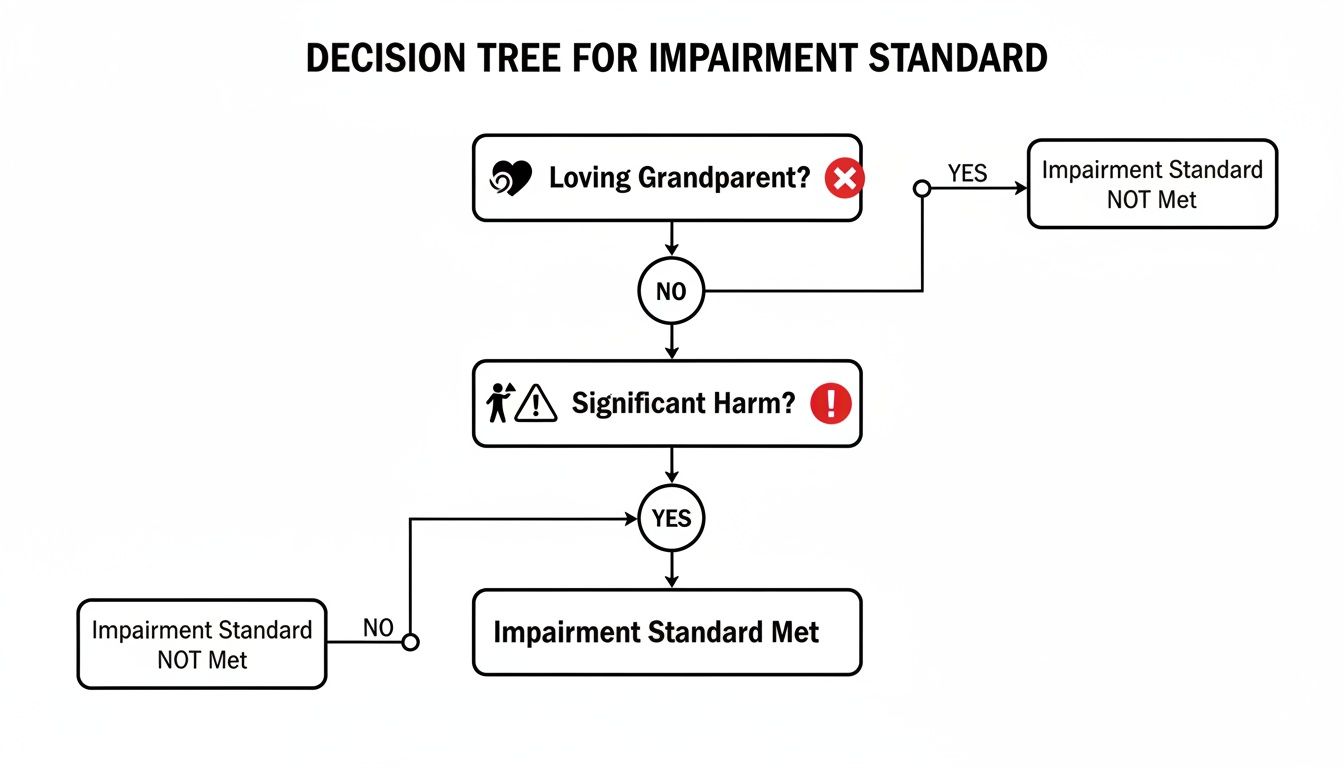
As you can see, the focus isn't on how wonderful a grandparent you are; it's entirely on whether the child will be actively harmed without you.
Hurdle 3: Your Own Child's Circumstances
The third and final piece of the puzzle is that you must be the biological or adoptive parent of the grandchild's parent, and your child must fall into one of these specific situations:
- Has passed away. The law recognizes that when your son or daughter is gone, maintaining that family link through you can be vital for the grandchild.
- Is incarcerated. If your child has been in jail or prison for at least the three months leading up to you filing your lawsuit, this condition may be met.
- Has been declared incompetent by a court. This requires a formal judicial finding that your child is legally incompetent.
- Has no court-ordered access to the grandchild. This often comes up after a difficult divorce where your child (the parent) was denied any visitation rights in the final court order.
Let's look at an example for our Atascocita community. Say a couple in Kingwood divorces. The mother gets sole custody, and your son, the father, is completely shut out by the court—he has zero possession or access. In that specific scenario, you, as the paternal grandparent, might now have standing to file your own petition to see your grandchild.
These three conditions aren't a menu you can choose from; they are a single, three-part test. You must meet all of them. If you fail to prove even one, the court will almost certainly dismiss your case.
Understanding these strict rules is the first step toward setting realistic expectations. The path for grandparent visitation rights in Texas is intentionally narrow. The attorneys at The Law Office of Bryan Fagan in Atascocita can help you analyze your case against these tough legal standards. We invite you to schedule a free consultation to talk through your situation with a lawyer who truly understands our community.
How One Supreme Court Case Changed Everything
To really understand why Texas law on grandparent visitation is so tough, we need to look at a single, incredibly important U.S. Supreme Court case that fundamentally changed the game for families nationwide. For those of us here in Atascocita, Humble, and across Harris County, this isn't just a boring legal history lesson. It's the key to understanding why our courts place such a massive burden of proof on grandparents.
The case is Troxel v. Granville, and its shockwaves are still felt in every family courtroom in Texas.
At its core, the case boiled down to one huge question: who gets the final say in what's best for a child? The Supreme Court’s answer was loud and clear.
They ruled that good, capable parents have a fundamental constitutional right to raise their children as they see fit. That includes the right to decide who their children see and spend time with. This landmark decision basically put up a stop sign for the government, telling judges they can't just step in and overrule a parent's decision simply because the judge has a different opinion on what's "best."
The Troxel Ruling and Its Impact on Texas Law
This ruling created a powerful legal presumption that parents are acting in their children’s best interests. In plain English, a judge must start with the assumption that a parent's decision to cut off or limit visitation is the right one.
It’s up to the grandparent to come forward with compelling, powerful evidence to prove otherwise.
Before Troxel, some state laws were a lot looser. A judge could order visitation if they just felt it would be a good thing for the child. The Supreme Court put an end to that, forcing states like Texas to tighten their laws to be much more protective of a parent's rights.
“The liberty interest at issue in this case—the interest of parents in the care, custody, and control of their children—is perhaps the oldest of the fundamental liberty interests recognized by this Court.” – Troxel v. Granville, U.S. Supreme Court
This is the "why" behind the incredibly high bar you have to clear. It’s the very reason you must prove that your grandchild will suffer significant impairment without you. It's the only justification strong enough to challenge a parent's constitutional right to make decisions for their own child.
How Texas Adapted After the Supreme Court's Decision
The legal ground for grandparent visitation rights in Texas shifted almost instantly. When the U.S. Supreme Court handed down its decision in Troxel v. Granville, the rules changed. The Texas Supreme Court quickly fell in line, reinforcing the idea that while the grandparent-grandchild relationship is special, a parent’s authority comes first unless there's a serious problem.
The legislature had to rewrite the rules to meet this stricter standard, which is why the path to getting court-ordered visitation is so narrow today. You can discover more insights about the Troxel decision's impact on Texas law and see exactly how it shaped the statutes we now have to navigate.
This history isn't just something for law books; it's the practical reality that dictates the strategy for every single grandparent visitation case filed in Harris County. It shows the law isn't just being difficult for the sake of it—it's built on a bedrock constitutional principle that puts parents in the driver's seat.
A Grandparent's Step-by-Step Guide to the Harris County Court Process
If you’ve weighed the heavy legal standards and believe you have a strong case for visitation rights in Texas, your journey will lead you to the courthouse. For grandparents in Atascocita, Humble, and the surrounding communities, this means navigating the Harris County family court system. Knowing what to expect can make this intimidating process feel much more manageable.
The first official step is to file a legal document called an Original Petition in Suit Affecting the Parent-Child Relationship. This petition is filed with the District Clerk at the Harris County Civil Courthouse, and it tells the court who you are, how you're related to your grandchild, and why you believe you meet the legal requirements to be granted visitation.
After filing, the grandchild's parents have to be officially notified of the lawsuit. This isn't just a courtesy—it's a critical legal requirement known as service of process. It ensures everyone has a fair chance to respond.
Your Case's First Steps
Once the petition is filed and everyone is notified, your case starts moving. This initial phase is all about setting the stage and usually involves a few key procedures.
Often, the very first thing a judge will order is mediation. This is a structured, confidential conversation guided by a neutral professional. The goal is to see if you and the child’s parents can find common ground and reach an agreement without a drawn-out court battle. Texas courts encourage mediation because it saves families time and emotional energy, giving them control over the final decision.
If you can't reach an agreement, the court might appoint an amicus attorney or a guardian ad litem. These are attorneys whose only job is to represent the child’s best interests. They act as the court’s eyes and ears, investigating the family situation, interviewing you, the parents, and the child (if they're old enough), and then making a recommendation to the judge.
Building Your Case for a Harris County Judge
As the process unfolds, your focus shifts to building the strongest possible case. Remember, you have to prove your absence would cause significant impairment to your grandchild. Your own testimony about your loving bond is a start, but it's rarely enough by itself.
You'll need to gather powerful, specific proof. This isn't just about telling a story; it's about showing the judge the reality of your relationship and the potential harm of its absence.
- Document Everything: Pull together photos, emails, text message threads, and greeting cards that illustrate the history and depth of your connection with your grandchild.
- Gather Your Witnesses: The right testimony can be incredibly compelling. Think about teachers, neighbors from your Atascocita neighborhood, family friends, or counselors who have seen your bond firsthand and can speak to the positive role you play in the child's life.
- Show, Don't Just Tell: If you were a primary caregiver, find the proof. Were you the one taking the child to their school in Humble ISD? Do you have medical records from doctor’s appointments you took them to in Atascocita? This kind of evidence solidifies your central role.
Putting this evidence together is a detailed effort. Knowing what to collect is one thing; knowing how to present it effectively is another. It’s crucial to have a clear strategy, because many of the same principles for how to prepare for a custody hearing apply here.
A local attorney who knows the Harris County judges can be your most valuable asset. They can help you sift through your evidence, identify what will be most persuasive, and package it in a way that is clear and effective. The goal is to demystify the legal process and give you the best shot at a positive outcome.
If you're a grandparent in the Atascocita area facing this uphill battle, you don't have to walk this path alone. The Law Office of Bryan Fagan offers a free, no-obligation consultation to talk through your specific situation. Call our Atascocita office today to see how we can help you navigate this complex and emotional journey.
Exploring Alternatives to a Court Battle
Jumping into a lawsuit for grandparent visitation rights in Texas is a huge step. It's not just financially costly; it's emotionally exhausting and can drive an even deeper wedge into family relationships, creating scars that last a lifetime.
For most families we work with here in Atascocita and Humble, a drawn-out court battle is a last resort. If the real goal is to preserve those family bonds for your grandchild's sake, it's worth taking a hard look at more collaborative, less combative options first.
The Power of Mediation
Mediation is a structured, private conversation guided by a neutral professional. It gets you and the child's parents in the same room—away from the tension of a courtroom—to talk things through. The mediator's job isn't to pick a side but to help you find common ground.
The goal here isn't to "win." It's to work out a solution that everyone can live with, always centered on what's truly best for your grandchild. Often, this process opens up lines of communication that have long been shut down, leading to a written agreement on visitation that feels like a shared victory instead of a court-mandated defeat.
An Honest Look at Court Outcomes
Before you go down the legal road, it’s important to understand the reality of the situation. To be direct: most grandparent visitation lawsuits in Texas fail.
Winning grandparent visitation rights through the courts is incredibly rare. Judges grant these petitions because the legal bar—proving "significant impairment"—is set extraordinarily high. While exact statistics are hard to come by, successful cases almost always involve tragic situations like the death or imprisonment of a parent.
Understanding these odds isn't meant to discourage you; it's meant to prepare you. Knowing just how tough this fight is reinforces why we must explore every single alternative before heading to the courthouse.
Sometimes, the best strategy has nothing to do with lawyers. It's about personal outreach, showing you're willing to respect the parents' authority, and patiently rebuilding trust.
Of course, if your concerns go beyond just visitation and you are genuinely worried about the child's safety, the conversation changes. In those serious cases, we might need to discuss more protective measures, which could mean exploring options like learning how to get guardianship of a minor.
Here at The Law Office of Bryan Fagan, our Atascocita team can help you navigate these sensitive choices. We'll give you clear-eyed, practical advice so you can decide what's truly best for your family. Give us a call to schedule a free consultation and let's talk through your unique situation.
Common Questions About Grandparent Rights in Texas
When you're facing the possibility of being cut off from your grandchild, it's natural to have a lot of questions. Here in our Atascocita office, we sit down with grandparents from all over the Humble and Kingwood areas who are worried, confused, and just want to know where they stand. Here are some of the most frequent questions we answer.
Can I get visitation if my child and their spouse are still married?
This is, frankly, the toughest mountain to climb. Texas law places a very high premium on the rights of parents in an intact family to make their own decisions. A judge is going to be incredibly reluctant to step into a functioning household and overrule two fit parents. To even have a chance, you'd have to prove that the child's current situation is actively causing them serious physical or emotional harm. This is a very high legal bar to clear.
What happens to my rights if my grandchild is adopted?
Adoption creates a major legal shift. If your grandchild is adopted by anyone other than a stepparent, any visitation order you might have is almost always wiped away. The adoption legally severs the ties to the biological family tree, including the rights of grandparents. At that point, the adoptive parents have the sole authority to decide who gets to see the child.
What's the difference between "visitation" and "possession"?
These words might seem interchangeable in everyday conversation, but in a Texas family courtroom, they mean very different things.
- Possession and Access are terms reserved for parents in a custody order. This isn't just about seeing the child; it comes with a bundle of rights, like making decisions about their schooling, healthcare, and upbringing.
- Visitation is what a non-parent, like a grandparent, is granted. It's a much narrower right. It simply gives you court-ordered permission to see your grandchild at specific times. You don't get the legal authority or decision-making power that comes with being a parent.
Understanding these differences really drives home how carefully the legal system protects parental authority. It's why navigating this process requires a guide who knows the specific terrain.
Making your way through the strict requirements for grandparent rights demands a solid grasp of both Texas law and the way local Harris County courts operate. At The Law Office of Bryan Fagan – Atascocita TX Lawyers, we offer clear, realistic advice to help you see the full picture. If you're a resident of Atascocita, Humble, or northeast Harris County and are being kept from your grandchild, let's talk about your options. You can schedule a free, confidential consultation with our Atascocita legal team today by visiting https://www.atascocitaattorneys.com.