Filing for divorce in Texas isn’t just about filling out forms; it’s a formal legal process that starts with meeting specific state and local requirements. For families in Atascocita and the surrounding Humble area, understanding these rules from the beginning is key. Before a Harris County court will even consider your case, you have to prove you belong there. This means at least one spouse must have called Texas home for the past six months and lived in Harris County for the last 90 days.
A Clear Path Forward for Atascocita Families
Making the decision to divorce is never easy. It’s a major life event, and when you're in the middle of it, the path forward can feel foggy and uncertain. For folks in Atascocita, Humble, and our corner of northeast Harris County, knowing what to expect legally can provide a much-needed sense of control. Getting these first steps right is crucial—it lays the groundwork for the entire process and helps you sidestep common mistakes that cost time, money, and emotional energy.
Think of this guide as a conversation with a local attorney who understands what you're going through. We'll walk through the practical, step-by-step process of filing for a Texas divorce, focusing on how it works right here in our community.
The First Steps in the Texas Divorce Process
Before a single document is filed with the court, we have to establish that the court has the authority—or jurisdiction—to handle your case. This boils down to two simple but non-negotiable points: residency and grounds.
- Confirming Residency: You must meet the state's six-month and the county's 90-day residency rules. It’s pretty straightforward. If you’ve been living in your Atascocita home for the last year, you've met the requirement to file your case in Harris County.
- Choosing Grounds: The vast majority of Texas divorces are filed on "no-fault" grounds. We cite "insupportability," which is the legal way of saying the marriage has broken down to the point that it just can't be fixed. This is the most common and practical route because it avoids the need to prove someone did something wrong.
This infographic gives you a bird's-eye view of how a Texas divorce gets started, from checking off the residency box to actually filing the first petition.

As you can see, it's a sequence of deliberate legal actions. Each step builds on the last, moving your case from start to finish with purpose.
A Quick Look at Texas Divorce Filing Requirements
To make it even clearer, here’s a simple table breaking down what’s required to get started on a divorce in Harris County.
Texas Divorce Filing Requirements at a Glance
| Requirement | Details for Harris County Filers |
|---|---|
| Residency | Must have lived in Texas for at least 6 months and Harris County for at least 90 days prior to filing. |
| Grounds | Most commonly "insupportability" (no-fault). Fault grounds (like adultery or cruelty) exist but are used less frequently. |
| Key Forms | The process starts with an Original Petition for Divorce. Other forms will be needed depending on your situation (e.g., children, property). |
| Filing Location | You will file with the Harris County District Clerk. |
| Average Timeline | Texas has a mandatory 60-day waiting period after filing. Uncontested cases can finish soon after, while contested cases can take 6-12 months or more. |
This table serves as a quick checklist for the initial phase. Having these basics in order is the first step toward a more predictable and manageable process.
Understanding Divorce Trends in Our State
While the decision is deeply personal, it’s interesting to see where Texas stands. Our state actually has one of the lowest divorce rates in the country. In 2021, the rate was just 1.4 per 1,000 people, placing Texas among the three states with the lowest rates nationwide. For more context, you can explore the data and analysis of Texas divorce rates here.
At The Law Office of Bryan Fagan, we firmly believe that an informed client is an empowered client. When you know what’s coming, a daunting process is transformed into a series of clear, manageable steps.
Our team has years of experience navigating the local divorce process and is here to provide the answers and support your family needs. We pride ourselves on offering guidance with both compassion and clarity.
If you live in Atascocita or Humble and are thinking about what comes next, you don’t have to piece this all together on your own. Give our Atascocita office a call to schedule a free, no-pressure consultation. We’ll sit down with you, listen to your story, and help you understand your options.
Meeting Residency Rules and Choosing Grounds for Divorce
Before you can even think about filing for divorce in Texas, you have to clear two initial, but crucial, hurdles. First, you need to prove you actually belong in a Texas courtroom by meeting the state’s residency requirements. Second, your petition has to state the legal reason—the "grounds"—for why the marriage is ending.
Getting these two things right from the very start lays the foundation for your entire case. For folks here in Atascocita and Humble, this means showing a solid connection to both Texas and, more specifically, Harris County. This is all about jurisdiction; the court needs to be certain it has the authority to make decisions for your family.
Proving You Belong in a Texas Court
Texas law is very clear about who gets to file for divorce here. You have to demonstrate a consistent, established presence in our community.
The rule is broken down into two simple parts:
- State Residency: One of you must have lived in Texas for at least the last six months before you file the divorce petition.
- County Residency: That same person must have also lived in the county where you plan to file—for us, that’s Harris County—for the 90 days leading up to the filing date.
It’s easier to picture with a real-world example. Let's say a family has been living in the Fall Creek area of Humble for the past five years. If they decide to divorce, either spouse easily meets both the six-month state and 90-day Harris County rules, allowing them to file locally.
But what if a couple just moved to an apartment in Atascocita from Louisiana three months ago? They’ll have to wait another three months to hit that six-month state residency mark before they can legally file their petition in a Harris County court.
A common point of confusion is whether both spouses have to meet these timeframes, but that's not the case. The law only requires one of you to satisfy the six-month state and 90-day county residency rules to establish the proper venue for your divorce.
Choosing Your Grounds: No-Fault vs. Fault
Once you’ve confirmed you’re eligible to file, you have to state the reason for the divorce in your initial paperwork. Texas gives you two main options: "no-fault" or "fault-based" grounds. The path you choose isn't just a technicality; it can sometimes influence how a judge divides property or makes decisions about your kids.
The Simplicity of a No-Fault Divorce
The vast majority of Texas divorces are filed on the grounds of insupportability. This is our state’s version of a no-fault divorce, and it's the most common for good reason. It simply means the marriage has broken down because of disagreements or personality conflicts to the point that there’s no reasonable chance of getting back together.
Opting for insupportability is almost always the most practical and least contentious route. You don't have to air personal details in court or get into a blame game over who did what. For most families in our community, this approach saves a ton of emotional energy and often leads to a much more amicable outcome.
When a Fault-Based Divorce Makes Sense
While less common, there are definitely times when alleging fault is the right strategic move. Texas law recognizes several fault-based grounds, but you have to be ready to prove that your spouse’s bad behavior directly caused the marriage to fail.
These grounds include:
- Cruelty: When one spouse's conduct makes living together simply unbearable.
- Adultery: You'll need to provide proof of infidelity.
- Felony Conviction: This applies if your spouse was convicted of a felony and has been in prison for at least one year.
- Abandonment: When one spouse leaves with the intention of never coming back and has been gone for at least a year.
- Living Apart: A simple one—you and your spouse have lived in separate places without cohabitation for at least three years.
So why would anyone choose this path? It can have a real impact on the outcome. For example, if one spouse wasted thousands of dollars of community money on an affair, a judge might award the other spouse a larger, disproportionate share of the marital property to make the division "just and right." It's a striking fact that adultery is cited as a reason for divorce by 60% of individuals in Texas, highlighting just how often these issues come into play. You can discover more insights about the reasons behind Texas divorces to get a clearer picture of these trends.
This decision—no-fault or fault—sets the entire tone for your case. Here at The Law Office of Bryan Fagan, we can walk you through the real-world consequences of each option, helping you choose the approach that best protects your interests and makes sense for your unique situation.
Preparing And Filing Your Divorce Paperwork Correctly
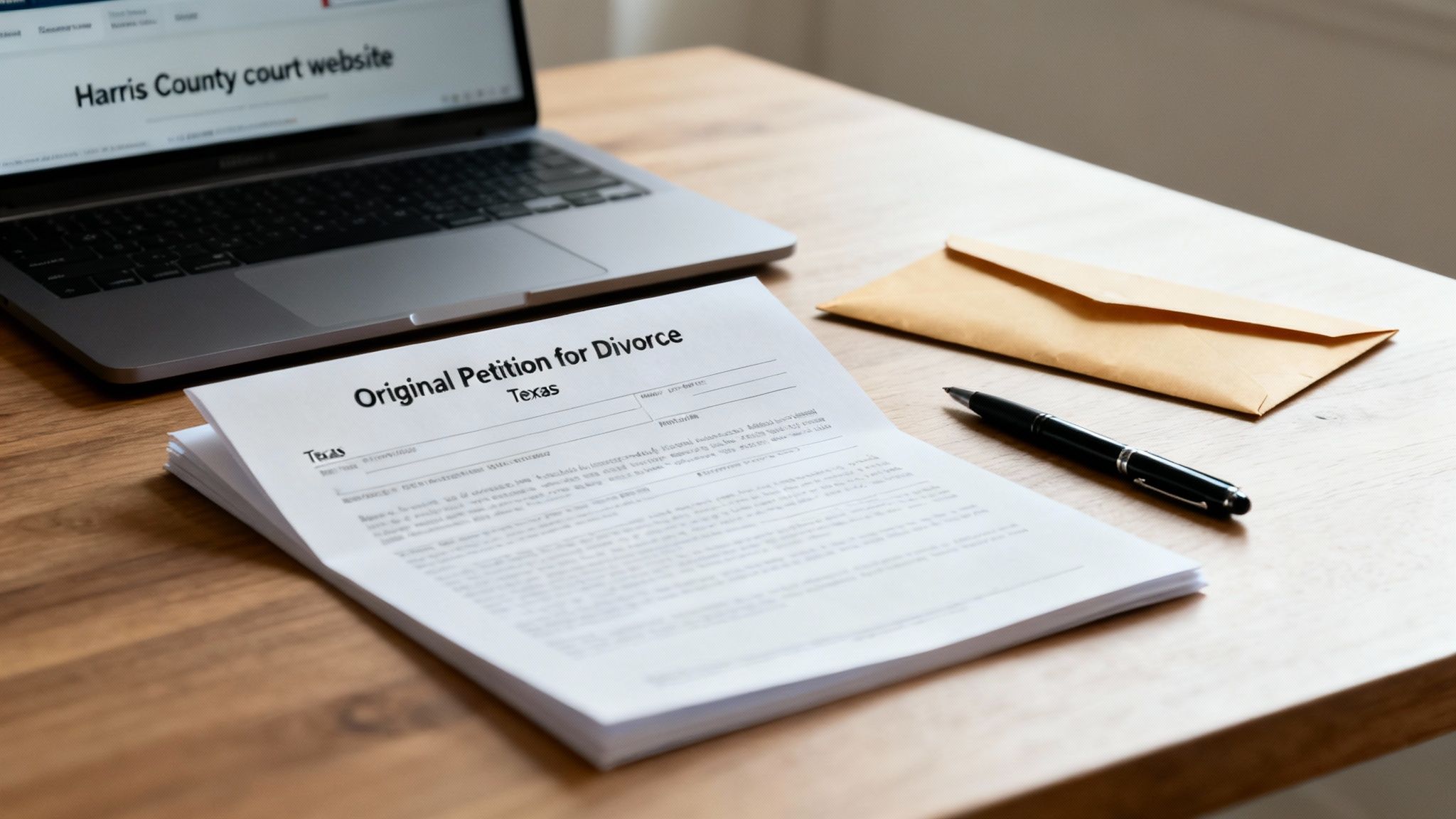
After meeting Texas’s residency rules and locking in your grounds for divorce, you’re ready to turn that decision into formal court action. For many in Humble and Atascocita, this stage feels overwhelming—but it doesn’t have to be. Think of these documents as your roadmap, laying out who you are, what you want, and why it matters to your family's future.
When one spouse—now the Petitioner—files an Original Petition for Divorce, the clock starts ticking. Getting this and the accompanying forms right can prevent weeks of back-and-forth and keep your case on track.
The Key Documents That Start Your Divorce
Here’s the core set of filings the Harris County courts expect. While your specific circumstances might call for additional forms, these are non-negotiable:
Original Petition for Divorce
- Introduces you, your spouse, and confirms residency
- States the grounds (commonly insupportability)
- Outlines requests regarding children, property division, and support
Civil Case Information Sheet
- An administrative form the District Clerk uses to categorize your lawsuit
- Includes basic case details for internal tracking
If children or urgent orders are involved, you may need additional forms—such as temporary custody requests or motions to protect your assets.
Navigating The Harris County District Clerk Website
All official filings go through the Harris County District Clerk’s website. It’s packed with information, but pinpointing the exact forms can feel like searching for a needle in a haystack. The state also offers blank forms via TexasLawHelp.org, though those generic templates often lack the specific language needed to protect your interests.
One of the most critical aspects of the Original Petition for Divorce is ensuring it includes all necessary requests and protections. Forgetting to ask for a temporary restraining order to prevent a spouse from draining a bank account, for example, could have immediate and severe financial consequences.
An experienced local attorney crafts a petition that anticipates and addresses your unique concerns from the outset, protecting you and your family from day one.
The Filing Process Explained
Once your forms are finalized, you’ll submit them electronically through the eFileTexas portal. After uploading your petition and paying the fee, you’ll receive a stamped, official copy from the clerk.
Typical Filing Fees in Harris County
| Fee Description | Amount | Fee Waiver Option |
|---|---|---|
| Divorce Filing Fee | $300–$350 | File a Statement of Inability to Afford Payment of Court Costs |
If the court approves your inability statement, these filing costs are waived. Once the clerk assigns your cause number and courtroom, your case is officially active.
Common Filing Mistakes To Avoid
A single typo or missing signature can send your case back to square one. Watch out for:
- Incorrect spellings or dates
- Unsigned documents
- Filing in the wrong county (must meet the 90-day residency rule)
- Leaving critical sections blank
Any of these errors triggers a rejection—and a delay you can’t afford.
Your initial paperwork sets the tone for everything that follows. If you’re unsure about forms, filing fees, or deadlines in Harris County, the team at The Law Office of Bryan Fagan is here to help. Schedule a free consultation at our Atascocita office, and let us guide you through each step with clarity and confidence.
What Happens While the Divorce Is Pending? A Guide to Temporary Orders and Mediation

Once you've filed the Original Petition for Divorce, the clock starts ticking on a mandatory 60-day waiting period. A Texas court legally cannot finalize your divorce before then. But life doesn’t just hit pause. Bills keep coming, the kids need stability, and urgent decisions about your home and finances can't wait two months.
This is exactly why Temporary Orders exist.
These are essentially the "rules of engagement" for your separation, put in place by a judge to create a stable framework while the divorce proceeds. For the families we work with in Atascocita and Humble, getting clear Temporary Orders is often the single most important step to bring a sense of calm to a chaotic time. They provide immediate, enforceable answers to the most pressing questions, stopping small disagreements from spiraling into major court battles.
Why You Can't Afford to Skip Temporary Orders
Think of Temporary Orders as the official, court-ordered rulebook for your separation. A Harris County judge lays down legally binding directives on everything from who stays in the family home on Lake Houston Parkway to who handles school drop-offs and pickups.
The entire point is to maintain the peace and keep things as stable as possible, especially for the kids. A judge will issue these orders to prevent one spouse from making big, unilateral decisions that could hurt the other spouse or the children.
Here are some of the most common issues we see addressed in Temporary Orders:
- Custody and Visitation: Who will the kids live with primarily? What will the possession schedule look like? Who gets to make important decisions about school and medical care?
- Child Support: The judge will almost always order one parent to start paying temporary child support right away.
- Spousal Support: If one spouse qualifies and doesn't have the means to cover their basic needs, a judge can order temporary spousal maintenance.
- Property Use: Who gets exclusive use of the family home? Who drives which car?
- Financial Guardrails: These orders can stop a spouse from draining a joint bank account, selling off assets, or racking up new debt on a shared credit card.
Without these orders, you're living in a state of limbo. Having them gives you clarity and, crucially, legal backup if your spouse doesn't follow the rules.
How to Get Temporary Orders in Harris County
So, what if you and your spouse can't agree on these arrangements? You'll have to ask a judge to make the call. This is done by filing a Motion for Temporary Orders, usually at the same time as your initial divorce petition. Once filed, the court sets a hearing where both sides can present their case.
At the hearing, your attorney's job is to explain to the judge why your requests are necessary and what's in your children's best interest. We might present a detailed budget to show why you need temporary support, or bring in testimony about which parent has always been the primary caregiver. The judge hears both arguments and then issues a ruling that stays in place until the divorce is final.
Many of our Atascocita clients get nervous thinking a Temporary Orders hearing is like a full-blown trial on TV. It’s not. It's a much shorter, more focused process. The judge’s only goal is to make swift, practical decisions that create a stable environment for everyone while the case moves forward.
But don't be mistaken—this hearing is incredibly important. The outcome often sets the tone and can even influence the final divorce decree, so being prepared is non-negotiable.
The Power of Mediation to Settle Your Case
Long before you'd ever see the inside of a courtroom for a final trial, Harris County judges will almost universally require you to try mediation. It's a mandatory step in the vast majority of Texas family law cases for a reason: it works.
Mediation is a confidential, structured negotiation led by a neutral third-party mediator. The mediator’s job isn't to pick a winner or loser. Their role is to help you and your spouse find common ground and build your own agreements. This process puts the power back in your hands, letting you make the decisions for your family instead of a judge who only knows you from a stack of paperwork.
For our clients in the Humble and Kingwood area, mediation typically happens at a neutral office. You and your attorney get one room, and your spouse and their attorney get another. The mediator goes back and forth between the rooms, relaying offers and helping you work through the sticking points.
This approach has some major advantages over battling it out in court:
- You Keep Control: You and your spouse decide the final terms, not a judge.
- It’s Completely Confidential: Nothing you say or offer in mediation can be used against you in court if you don’t reach a deal.
- It Saves Time and Money: A successful mediation can resolve your entire divorce in a single day, saving you the incredible expense and stress of a trial.
The key to a successful mediation is preparation. That means working with your lawyer to set clear goals, get a firm grasp on your finances, and map out a solid negotiation strategy. At The Law Office of Bryan Fagan, we walk our clients through this entire process, making sure they’re ready to advocate for a fair settlement that protects their interests. We have deep experience helping clients with tough issues like child custody negotiations, and we're ready to put that experience to work for you.
If you’re starting the divorce process and feel uncertain about your living situation, your finances, or your children's routine, don't wait. Contact our Atascocita office for a free consultation to discuss how Temporary Orders and a smart mediation strategy can protect your family's future.
Finalizing Your Divorce Decree

As you get closer to the end of the divorce process, the main goal is to create one single, legally binding document that ties up every loose end. This document is the Final Decree of Divorce, and it’s much more than a piece of paper—it’s the official rulebook for your life moving forward.
The smoothest way to get there is by creating a Marital Settlement Agreement (MSA). Think of this as a detailed contract you and your spouse build together, usually with the help of a mediator. It's where you put everything you've agreed upon into writing.
Crafting an Airtight Agreement
A solid Marital Settlement Agreement is all about clarity. It needs to address every single aspect of your shared life to shut the door on future arguments. For our clients in Atascocita with children, getting these details right is absolutely essential.
A well-drafted MSA must cover:
- Division of Property and Debts: This means a complete inventory of everything you own and owe, spelling out who gets what. We're talking about everything from the family home in Eagle Springs to the balance on the Target credit card.
- Child Custody and Possession: You’ll need a rock-solid parenting plan. This defines who has the right to make key decisions for the kids (conservatorship) and lays out a detailed schedule for possession—including holidays, summer breaks, and regular school nights.
- Child Support and Medical Support: This section includes precise calculations for monthly child support payments and clear rules on who provides health insurance and pays for out-of-pocket medical costs.
From our experience in Harris County family courts, we’ve seen firsthand that hammering out complex child custody arrangements within the MSA is the key to creating long-term stability for a family. The details really matter here.
The Final Decree of Divorce is more than just the end of your marriage; it's the legal foundation for your new beginning. A thorough, unambiguous decree is your best protection against future disputes and court dates.
From Agreement to Final Judgment
Once you and your spouse have signed the Marital Settlement Agreement, it goes to a Harris County judge. The judge’s job is to review the agreement to make sure it is "just and right" and follows Texas law. They pay special attention to ensuring the terms are in the children's best interests.
If the judge approves it, they will sign the Final Decree of Divorce, officially making your private agreement a formal court order.
But what if you just can't see eye to eye? If mediation doesn't work and you're at a standstill, the only option left is to go to trial. At trial, both you and your spouse will present evidence and testimony, and the judge will make the final call on all the issues you couldn't resolve on your own.
Your To-Do List After the Divorce is Final
Getting the judge's signature is a huge milestone, but it's not quite the finish line. Finalizing the divorce kicks off a new set of tasks you’ll need to complete to truly secure your independent future.
Some of the most important post-divorce steps include:
- Updating Your Estate Plan: A divorce can automatically invalidate parts of your will. It's critical to draft a new one and, just as importantly, update the beneficiaries on any life insurance policies and retirement accounts.
- Changing Your Name: If you asked to restore your maiden name in the divorce petition, the decree gives you the legal right to do so. You’ll need that signed decree to update your Social Security card, driver's license, and bank accounts.
- Refinancing Property: If one spouse is keeping the house, they will almost always need to refinance the mortgage. This is the only way to get the other spouse's name—and financial liability—off the loan.
Working through these final steps can feel like a lot, especially after everything you've just been through. But you don't have to figure it all out alone. The Law Office of Bryan Fagan is here to guide you through finalizing your divorce with confidence. Contact our Atascocita office today for a free consultation.
Common Questions We Hear About Harris County Divorces
When you're facing a divorce, a million questions can run through your head. As attorneys who practice right here in the Atascocita area, we've pretty much heard them all. Let's tackle a few of the most practical and frequent questions we get from clients navigating the Harris County court system.
How Long Does My Spouse Get to Respond?
Once you've filed the Original Petition for Divorce and had your spouse officially served with the papers, the clock starts ticking.
They don't have forever to answer. Under Texas law, your spouse has until 10:00 a.m. on the first Monday after 20 days have passed since the day they were served. It's a very specific deadline, and if they miss it, you could potentially move forward and ask the judge for a default judgment.
What Happens If I Can't Find My Spouse to Serve Them?
This is more common than you'd think, particularly if you've been separated for some time. But you can't just let the case stall because your spouse has disappeared.
If you've made a real, good-faith effort to find them and can't, you can ask the court for other options. These alternative methods might include:
- Substituted Service: This allows the papers to be left with another adult at their last known address or workplace.
- Service by Posting: This involves posting a notice at the courthouse doors, which is often a last resort.
The key is showing the judge you've done your due diligence in trying to locate them first.
How Do We Sort Out Arguments Over Our Property?
It's rare for a couple to agree on every single item. When disagreements pop up over who gets what, the process doesn't just grind to a halt. The first step is almost always negotiation, whether it's between you and your spouse directly or, more often, through your attorneys.
If you still can't reach an agreement, the court will typically order you into mediation. This is where a neutral third-party mediator helps you both try to find a middle ground. Understanding the local court's expectations is crucial here. For a closer look at the rules that shape these negotiations, you can find more information about the specifics of Harris County law.
It's important to remember that Texas courts aim for a "just and right" division of community property. That doesn't automatically mean a 50/50 split. A judge can award a disproportionate share if there's a good reason, like one spouse being at fault for the breakup of the marriage.
At The Law Office of Bryan Fagan – Atascocita TX Lawyers, we know you have questions that need clear, direct answers. We’re dedicated to helping our neighbors in Atascocita, Humble, and all over Harris County figure out the best way forward. Let's talk about your situation. You can schedule a free, no-pressure consultation with us by visiting our Atascocita office website.