When you are facing a divorce in Texas, one of the most empowering things you can do for yourself is to get a clear picture of your finances—and do it quickly. Before any legal documents are filed, your first step should be to take an honest, thorough inventory of your financial life. This means methodically gathering key documents like tax returns, bank statements, and deeds. From there, you can speak with an attorney who understands Texas community property law and can guide you on protecting your future.
For our neighbors in Atascocita, Humble, and across northeast Harris County, taking control of your financial information isn't just a good idea; it's the most critical first step toward ensuring a fair and just outcome.
Your First Financial Steps in a Texas Divorce
It’s completely normal to feel overwhelmed when thinking about money during a divorce. For most families we work with here in our Atascocita office, the financial uncertainty is the most stressful part. But you can replace that anxiety with confidence by taking a few smart, deliberate steps right from the start.
This isn’t about hiding assets or looking for a fight. It’s about creating a transparent financial baseline so that everyone is working from the same complete and accurate set of numbers. A divorce is essentially the untangling of a financial partnership, and a fair division can only happen when all the cards are on the table.
Create a Complete Financial Inventory
Before you do anything else, you need a comprehensive list of everything you and your spouse own and owe. Think of it as a financial snapshot of your marriage. This inventory becomes the bedrock for every negotiation and decision that follows, so don't leave anything out, no matter how minor it seems.
Your list should include assets common to many families in our community:
- Real Estate: The family home in Atascocita, any rental properties in Humble, or that piece of land out in Harris County.
- Bank Accounts: Every single checking, savings, and money market account, whether it's in your name, your spouse's name, or held jointly.
- Vehicles: Cars, trucks, boats, RVs—if it has a title, put it on the list.
- Retirement Accounts: This is a big one. List all 401(k)s, IRAs, pensions, and other retirement funds.
- Debts: Mortgages, car loans, credit card balances, personal loans, and any other liabilities.
This first step gives you a bird's-eye view of your community estate, which is absolutely essential for protecting your interests down the road. This process is simpler than it sounds. You’re essentially just taking stock of what you have, gathering the proof, and then getting it organized.
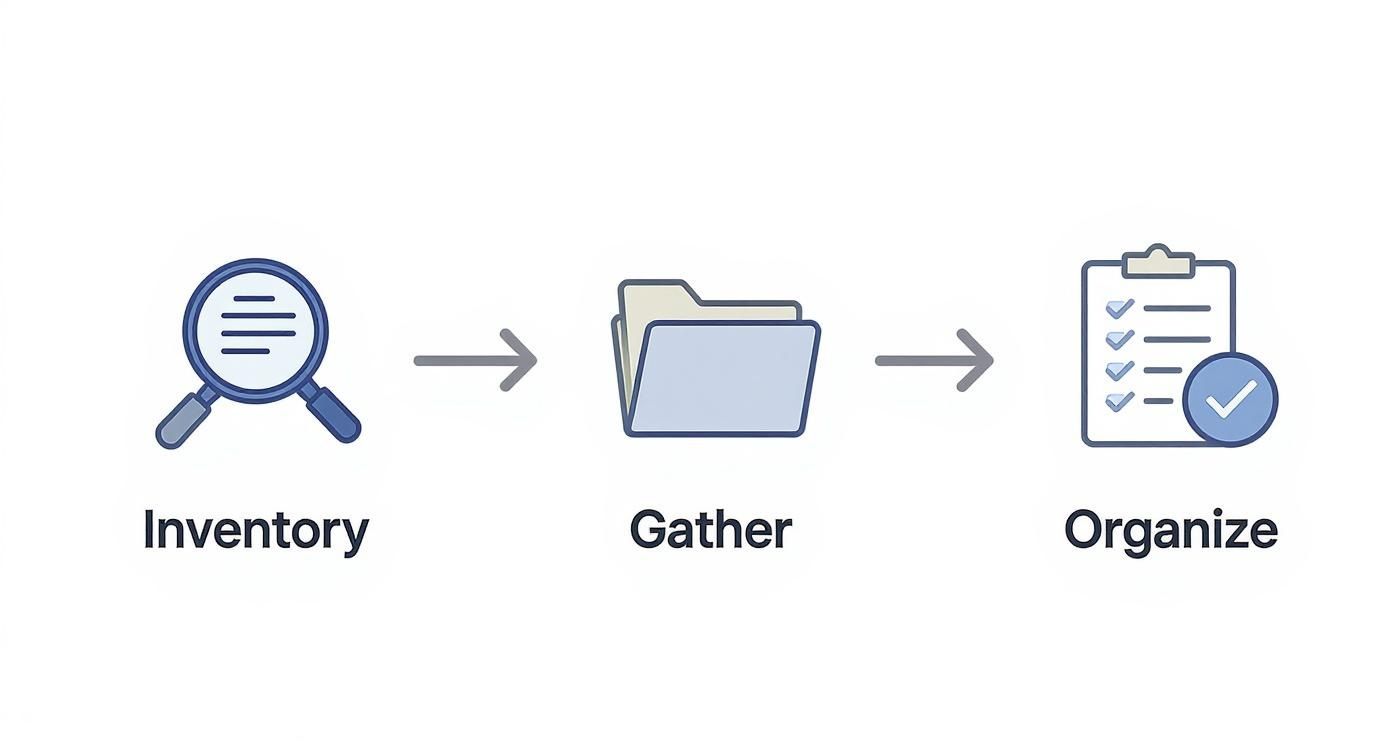
Following these three steps—Inventory, Gather, Organize—ensures you're building your case on a solid foundation of facts from day one.
Gather and Secure Important Documents
Once you have your list, it's time to collect the paperwork that proves the existence and value of each item. It’s a smart move to make copies of these documents and store them somewhere safe where only you can access them. This could be with a trusted friend in Kingwood, a family member, or in a new safe deposit box that’s only in your name.
Here is a quick checklist of the initial steps you should consider to get your financial house in order.
Immediate Financial Protection Checklist for Harris County Residents
| Action Item | Why It's Important for Your Case |
|---|---|
| Open a New Bank Account | Establishes your financial independence and gives you a safe place for your income. |
| Run a Credit Report | Uncovers any hidden debts or joint accounts you may have forgotten about. |
| Change Online Passwords | Secures your email, social media, and online banking from unauthorized access. |
| Inventory Your Home | Creates a record of personal property (furniture, art, jewelry) before items can disappear. |
| Secure Important Papers | Protects originals of your birth certificate, passport, and Social Security card. |
Taking these actions isn't about being sneaky; it's about being prepared and protecting yourself from potential financial gamesmanship.
I’ve seen it time and again in my practice: taking the time to organize your financial records is one of the most powerful things you can do. It prevents nasty surprises, can stop a spouse from draining accounts, and puts you in a much stronger position for negotiation.
Your goal is to collect documents like:
- Recent pay stubs for both you and your spouse.
- Tax returns (both personal and business) for the last three to five years.
- Bank and credit card statements going back at least a year.
- Mortgage statements and property deeds.
- The most recent statements for all retirement and investment accounts.
It’s also crucial to know who has legal authority over financial matters. For example, reviewing any existing power of attorney documents will tell you who can legally act on your behalf. You can learn more about what a power of attorney document is and what it means for your case in our detailed guide.
Protecting your future starts with being informed and prepared. The Law Office of Bryan Fagan is here to help residents of Atascocita, Humble, and the surrounding Harris County communities. Schedule a free consultation with our Atascocita office today to discuss your case.
The First Rule of Texas Divorce: Know Your Property
When a couple decides to part ways in Texas, one of the first questions I always get in my Atascocita office is, "So, who gets what?" It's the million-dollar question, sometimes literally. The answer isn't always simple, but it all starts with understanding two crucial Texas law concepts: community property and separate property.
Getting this right from the beginning is the single most important step you can take to protect what's yours.

Here's the starting point for every divorce case in Texas: the law presumes that everything you and your spouse acquired from the day you said "I do" until the day the divorce is final is community property. It doesn’t matter whose paycheck bought it or whose name is on the deed. If it came into your lives during the marriage, it's considered part of the marital estate to be divided.
What’s in the "Community" Pot?
Think of community property as everything you built together as a team. This is the shared pot of assets that a Harris County judge will divide between you in a way that is “just and right.” While that often ends up being a 50/50 split, it doesn't have to be. The judge looks for a fair outcome based on the specifics of your case, not just a mathematically even one.
So, what usually goes into this pot?
- The Family Home: If you bought your house in Humble or Atascocita after you were married, it’s almost certainly community property.
- Your Incomes: All the paychecks, bonuses, and commissions earned by both of you during the marriage are community funds.
- Retirement Savings: The portion of a 401(k), IRA, or pension that was earned during the marriage belongs to the community.
- Vehicles and Other Stuff: Cars, furniture, boats, and electronics bought while you were married are all community assets.
This "community property presumption" is incredibly powerful. It means the burden of proof falls on the spouse who wants to claim something is not part of that shared pot.
What is Considered Separate Property?
Separate property is exactly what it sounds like—it’s yours and yours alone. The court cannot divide it. But you have to prove it. Texas law is very clear on what qualifies.
Your separate property typically includes:
- Anything you owned before the marriage. This could be the savings account you had since college, a car you paid off before the wedding, or a condo you bought while you were single.
- A gift received during the marriage. If your parents wrote you a check for your birthday, and it was intended just for you, that's your separate property.
- An inheritance received during the marriage. Money or assets you inherited from a family member's will or trust belong solely to you.
The catch is that you must be able to prove it with "clear and convincing evidence." This is a high legal standard, and it’s why keeping excellent financial records is absolutely critical.
The Danger of "Commingling"
In the real world, finances get messy. This is where a lot of people in Atascocita and Humble get into trouble. Commingling is what happens when you mix separate property with community property until you can't tell which is which anymore.
A Common Scenario: Let's say you inherit $50,000 from your grandmother (that's your separate property). You deposit it into the joint checking account you share with your spouse. From that same account, you both deposit paychecks (community property) and pay the mortgage and grocery bills. That $50,000 has now been commingled. Without meticulous records tracing every dollar, a court might declare the entire account community property.
To keep your separate property safe, you have to keep it truly separate. Open a separate bank account for inherited funds. Don't use community money to pay taxes on a separate property investment.
This gets especially tricky with major assets like a house. Say you owned your Harris County home before you got married—it's your separate property. But if you used your joint income (community funds) to make mortgage payments for 10 years, your spouse now has a right to be reimbursed for their share of the community funds that increased the value of your separate asset.
Understanding the difference between these property types isn't just a legal formality; it's the foundation of your entire financial strategy in a divorce. When you know the rules of the game, you can negotiate from a position of strength and clarity. The attorneys at the Law Office of Bryan Fagan are here to help you navigate this. Schedule a free consultation at our Atascocita office to go over your specific situation.
Using Legal Tools to Secure Marital Assets
https://www.youtube.com/embed/VfqRos71K7I
Once you've filed for divorce in Harris County, the legal process begins. This is the time to move from simply gathering information to actively using the legal system to protect your financial stability. The law provides powerful tools to keep things fair and prevent your spouse from making any rash, damaging financial decisions.
These legal instruments are designed to freeze the financial picture as it is, making sure neither of you can empty the accounts or sell off property before it can be fairly divided.
The Power of Temporary Orders
The moment a divorce petition is filed in a Texas court, something called a Standing Order usually kicks in automatically. This is especially true here in Harris County. Think of it as the court's immediate set of ground rules that both you and your spouse must follow.
Your attorney can also ask the judge for a more tailored Temporary Restraining Order (TRO). While the names are different, they both accomplish the same critical goal: keeping the peace and preserving your property.
Typically, these orders will legally bar both of you from:
- Selling, giving away, or hiding any community property.
- Opening new lines of credit or racking up debt in the other person's name.
- Removing a spouse as the beneficiary on a life insurance policy or 401(k).
- Cutting off the power at the family home or canceling the car insurance policy.
- Taking the children and moving out of the county or state without the court's permission.
These aren't just polite suggestions; they are direct commands from a judge. If your spouse ignores them, they can face serious consequences, from hefty fines to time in jail. These orders are your first line of defense, designed to stop financial games before they can even start.
When to Bring in a Financial Detective
Sometimes, especially if your spouse handled all the finances or owned a business, you might have a nagging feeling that money has already gone missing. Maybe the bank statements look strange, or cash income just isn't accounted for. If your gut is telling you something is off, it might be time to call in a forensic accountant.
A forensic accountant is a financial detective. Their entire job is to dig through years of financial records—bank statements, business books, credit card bills—to trace where every dollar went. They are trained to spot red flags you would never notice.
We often bring in forensic accountants for our Atascocita clients when a spouse owns a cash-based business or we suspect funds are being funneled into secret accounts. Their expertise can be the key to ensuring a truly fair and just property division.
Hiring one is a major strategic move. A good forensic accountant can prove if a spouse is intentionally undervaluing a business, hiding income to lower child support, or spending marital funds on an affair. Their report becomes powerful evidence for the court, ensuring you get your rightful share of the community estate. This is particularly crucial if you suspect assets held in a trust are being mismanaged. You can get a better sense of how these structures work by reviewing the pros and cons of a revocable trust in Texas.
Putting these legal tools to work effectively takes skill and experience. The attorneys at the Law Office of Bryan Fagan have secured these protective orders for countless clients in Humble, Atascocita, and throughout Harris County. To see how we can help safeguard your financial future, Schedule a free consultation at our Atascocita office today.
Dividing Complex Assets Like Businesses and Retirement Funds
For many families here in Humble and Atascocita, the most significant assets aren't just the house or the cars. When a small business you’ve poured your heart into or a retirement account you've faithfully contributed to for decades is on the table, things get complicated—and fast.
These assets aren't just line items on a spreadsheet; they represent your life's work and your future financial security. Protecting your fair share requires a much more careful and strategic approach than just splitting a bank account down the middle. This is where a deep understanding of Texas family law is absolutely critical.
Valuing and Dividing a Family Business
If you or your spouse started a business during your marriage, Texas law presumes that business is community property. The very first step is figuring out what it’s actually worth, a formal process called business valuation. This isn't a ballpark guess; it requires bringing in a neutral financial expert—usually a CPA or a certified valuation analyst—to conduct a thorough analysis.
An expert will dig into several key areas to determine a real-world value:
- Company Assets: Everything from cash and real estate to equipment and inventory.
- Financial Performance: They'll look at revenue, profits, and cash flow, typically over several years.
- Goodwill: This is the intangible value of the business’s reputation and customer base, especially within the local Atascocita community.
Once a fair market value is established, the next job is to determine how much of that value is actually community property. For instance, if your spouse started the business before you got married, a portion of its initial value might be considered their separate property. It's the increase in value during the marriage that typically belongs to the community.
From there, you have a few ways to handle the division. One spouse might buy out the other's interest, other community assets can be used to offset the business's value, or, in some rare situations, the business might be sold and the cash divided.
Protecting Your Share of Retirement Accounts
Retirement funds—like 401(k)s, pensions, and IRAs—are often a family’s most valuable asset right after their home. In Texas, it doesn't matter whose name is on the account. Any contributions made and any growth earned on those accounts from the date of marriage to the date of divorce are considered community property.
To divide these funds correctly without being hit with massive tax penalties, you need a special court order.
What is a QDRO? A Qualified Domestic Relations Order (QDRO), pronounced "kwah-dro," is a specific court order that instructs a retirement plan administrator on how to pay a portion of the plan’s benefits to the other spouse. It's the only legally recognized way to split most types of retirement plans in a divorce.
Trying to withdraw funds to pay your spouse without a properly drafted QDRO can be a costly mistake. The IRS could treat it as an early distribution, which means you'd be on the hook for income taxes and a 10% early withdrawal penalty. These documents are highly technical, and if they aren't done perfectly, the plan administrator will reject them.
Navigating Buyouts vs. Future Shares
When it's time to divide retirement funds, you generally have two main choices:
- Take a lump-sum buyout. In this scenario, you might receive other community assets (like more equity in the house or a cash payment) equal to the value of your share in the retirement account. This gives you access to funds right away.
- Wait for a future share. The QDRO is filed with the court and the plan administrator, and you receive your portion of the funds when your ex-spouse retires or is eligible to take distributions. This often makes sense for traditional pensions where the future benefit is guaranteed.
The right choice really depends on your immediate financial needs and long-term goals. Dividing these complex assets requires an attorney who truly understands both Texas family law and the financial complexities involved. The Law Office of Bryan Fagan is committed to helping families in Atascocita and Humble protect their financial futures. Schedule a free consultation at our Atascocita office to discuss your specific circumstances today.
How Prenuptial and Postnuptial Agreements Work
Most people think about protecting their assets only when divorce is already on the table. But honestly, some of the most effective strategies are put in place long before—either before the wedding or even during the marriage. Prenuptial and postnuptial agreements are powerful legal tools that let you and your spouse set your own financial ground rules from the start.

Let's be clear: these agreements aren't about planning for failure. They're about creating clarity, communication, and mutual respect. By deciding on the financial terms ahead of time, you can sidestep much of the conflict and guesswork that can make property division so painful, ensuring a much smoother road if your paths diverge.
Prenuptial Agreements Before "I Do"
A prenuptial agreement, often called a "prenup," is simply a contract you and your partner sign before you get married. It lays out exactly how your assets and debts will be handled if you ever divorce. This is a practical step for many folks in Atascocita or Humble, especially if you:
- Own a business and want to keep it separate.
- Are bringing significant personal assets into the marriage.
- Have children from a prior relationship and want to protect their inheritance.
- Anticipate receiving a large inheritance down the road.
For a prenup to hold up in a Texas court, it must be done right. The agreement must be in writing and signed voluntarily by both of you. The most critical piece? There must be fair and full disclosure of all assets and liabilities before anyone signs. Trying to hide assets is the quickest way to have an entire agreement thrown out by a judge.
Postnuptial Agreements During Marriage
What if you're already married in Harris County and are just now realizing the value of setting clear financial boundaries? It's not too late. A postnuptial agreement does the same job as a prenup, but you create it after you've tied the knot. We often see couples go this route after a major financial shift, like one spouse launching a business or receiving a substantial inheritance.
By creating your own rules through a marital agreement, you are choosing to decide your own future. You're taking that power away from a judge who doesn't know you and putting it back in your own hands.
In Texas, a particularly useful type of postnup is a Partition and Exchange Agreement. This document lets a married couple agree to change community property into one spouse's separate property. For instance, a couple in Kingwood could sign an agreement that makes the wife's new tech startup and all its future profits her separate property, shielding it from division in a potential divorce.
This strategy gives couples the power to manage their financial lives in a way that makes sense for them. At the end of the day, these agreements are about smart communication and planning. They allow you to write your own financial rulebook instead of having one forced on you by a court. If you want to discuss whether a marital agreement is the right move for you, schedule a free consultation with our experienced family law attorneys at the Atascocita office of The Law Office of Bryan Fagan.
Common Questions About Protecting Your Assets
Going through a divorce brings up a ton of questions, and that’s perfectly normal. Here in our Atascocita office, we see families from all over Harris County who share many of the same worries. Let's walk through a few of the most common questions we hear to give you some clarity and help you feel more in control.
Can My Spouse Empty Our Joint Bank Account?
Technically, yes, a person on a joint account can withdraw the funds. But legally, in the context of a divorce, it's a terrible idea. A Harris County judge is going to see that for what it is—a breach of their duty to the community estate and an act of bad faith.
More often than not, the court will order them to return every penny or, in some cases, award you a larger portion of the remaining assets to make you whole again. Our first step is often to file for a Temporary Restraining Order right away to legally block them from touching those funds.
My Humble Home Was Mine Before We Got Married. Is It Safe?
For the most part, yes. The home itself is considered your separate property. But there's a key detail you need to be aware of in Texas law.
If you used "community" funds—that’s money either of you earned during the marriage—to pay the mortgage or make home improvements, your spouse likely has a right to get their share of those contributions back. This is what we call a reimbursement claim, and it’s something we deal with all the time in Texas divorce cases.
The absolute best defense for your separate property is a rock-solid paper trail. Without detailed records, proving an asset is truly yours becomes a real challenge, especially after years of commingling it with community money.
What if I Think My Spouse Is Hiding Assets?
Tell your attorney. Immediately. Hiding assets is a serious matter, and Texas judges do not take it lightly.
We have legal tools at our disposal to get to the bottom of it. We can use formal discovery requests, depositions, and subpoenas to follow the money and uncover hidden accounts or property. For really tangled financial situations, we’ll often bring in a forensic accountant to make sure everything is brought into the light.
Resolving these kinds of property disputes often comes down to skilled negotiation. Taking the time to learn how to prepare for divorce mediation can put you in a much stronger position to protect what’s yours and settle these issues effectively.
At The Law Office of Bryan Fagan – Atascocita TX Lawyers, we believe that when our clients have good information, they are empowered to make the best choices for their future. If you’re a resident of Atascocita, Humble, or northeast Harris County and are worried about protecting your assets during a divorce, we are here to provide clear, step-by-step guidance. Schedule a free, confidential consultation with our Atascocita legal team today by visiting us at https://www.atascocitaattorneys.com.