Skip to content
It's a tough conversation to have, but one of the most important for any family in Atascocita: what happens if you can't make your own medical decisions? In Texas, a living will is your voice when you can no longer speak for yourself.
Officially called a Directive to Physicians, this legal document lays out your specific instructions for end-of-life medical care. It only comes into play if you're diagnosed with a terminal or irreversible condition and can't communicate your wishes. This simple act of planning is about taking control, ensuring your values are honored, and giving your loved ones in Humble and northeast Harris County the gift of clarity during a difficult time.
Your Voice for Future Medical Decisions
When we think about planning for the future, our minds usually jump to finances, property, and leaving a legacy for our kids. But one of the most compassionate parts of any solid estate plan is making your healthcare wishes known ahead of time. For families here in Atascocita, Humble, and across northeast Harris County, a living will brings an incredible amount of peace of mind.
It ensures your personal values about medical treatment are respected, even when you can't express them. This isn't about giving up—it’s about preserving your dignity and autonomy through every stage of life, guided by a local attorney who understands our community's needs.
What Does a Living Will Actually Do?
At its heart, a living will tackles one of the most gut-wrenching questions a family can face: what to do when a loved one is in a terminal or irreversible state. This document lets you decide ahead of time what you want regarding life-sustaining treatments.
Here’s what it accomplishes for you and your family:
- It Provides Clear Instructions: Your living will tells doctors and family exactly what you want—or don't want. This includes things like ventilators, feeding tubes, or other forms of artificial life support.
- It Prevents Family Conflict: When your wishes are in writing, it lifts the heavy burden of decision-making off your loved ones. They won't have to guess or argue during an already emotional time.
- It Protects Your Dignity: This is your final say. It guarantees that the care you receive at the end of your life aligns with your personal beliefs and desires.
The Legal Framework in Texas
A living will in Texas isn't just a heartfelt note; it's a legally binding document with a specific name and real power. The state officially calls it a 'Directive to Physicians and Family or Surrogates.'
Its authority comes from the Texas Health and Safety Code Chapter 166, a law that has been empowering Texans in their healthcare choices since 1991. You can explore more about the history and specifics of these healthcare laws to see exactly how the state protects your rights.
This legal backing means that when your directive is properly signed and witnessed, healthcare providers must follow it. It becomes your personal medical roadmap for those very specific, very challenging circumstances.
To help you get a clear picture, here’s a quick breakdown of what a living will means for you and your family.
A Quick Look at Your Texas Living Will
This table summarizes the fundamental aspects of a living will, giving Atascocita residents a clear, at-a-glance reference.
| Key Aspect | What It Means for Your Family |
|---|---|
| Official Name | Directive to Physicians and Family or Surrogates |
| When It's Used | Only when you have a terminal or irreversible condition and can't communicate. |
| What It Covers | Your specific wishes about life-sustaining treatments. |
| Main Benefit | It eliminates guesswork and prevents family disputes during a crisis. |
| Legal Authority | Grounded in the Texas Health and Safety Code, making it legally enforceable. |
Ultimately, this document gives your family the gift of certainty, allowing them to honor your wishes without doubt or guilt.
A living will is one of the most profound gifts you can give your family. It replaces uncertainty with clarity, and potential conflict with peace, allowing your loved ones to focus on honoring you instead of debating what you would have wanted.
Creating a living will is a proactive step that every adult in the Atascocita community should consider. It’s a straightforward way to protect yourself and support your family. If you're ready to take this important step, The Law Office of Bryan Fagan is here to help. Schedule a free consultation at our Atascocita office to discuss how a living will fits into your overall estate plan.
Making Your Texas Living Will Legally Binding
Creating a living will is a powerful first step, but for your wishes to be honored by medical teams at local hospitals like HCA Houston Healthcare Kingwood, the document has to be legally sound. Simply writing down your preferences on a piece of paper won’t cut it. Texas law has very specific rules to make your directive official and enforceable. Think of it like a key to a lock—without the right cuts, the key just won't turn.
For our neighbors here in Atascocita and Humble, getting these legal details right is absolutely crucial. A small mistake in how your living will is signed or witnessed could unfortunately make it invalid. That would put your family right back in the agonizing position you were trying to prevent in the first place. The good news? The process is straightforward once you know the rules.
The Essential Steps for a Valid Directive
To make your Texas living will legally binding, you have to follow a clear set of requirements. These aren't meant to be complicated legal hoops; they're safeguards designed to confirm that the document truly reflects your intentions. The two most critical pieces are your signature and the signatures of qualified witnesses.
Here is a step-by-step guide to making your living will official:
- Draft Your Wishes: Clearly state your preferences regarding life-sustaining treatments.
- Sign the Document: You must sign the living will yourself.
- Secure Two Witnesses: Sign it in the presence of two credible adult witnesses who meet Texas's specific legal requirements.
- Notarize the Document: Have your signature and the witnesses' signatures acknowledged by a notary public.
A properly executed living will is your legal shield. It ensures that when you can no longer speak for yourself, your written wishes speak with the full authority of Texas law, protecting both you and the loved ones who must carry them out.
Choosing the right witnesses is every bit as important as the act of signing itself.
Who Can and Cannot Be a Witness
Not just anyone can serve as a witness to your living will. Texas has specific rules to prevent any conflicts of interest and ensure the people witnessing your signature are completely impartial. Getting this part right is non-negotiable for your document to be valid.
Your witnesses must be competent adults, but they cannot be:
- A close relative: This includes your spouse, parents, children, or anyone related to you by blood or marriage.
- A beneficiary: Anyone named in your will to inherit from your estate is disqualified from witnessing.
- Your attending physician: The doctor directly responsible for your care cannot act as a witness.
- An employee of your healthcare facility: Staff at the hospital or nursing home where you're a patient are also excluded, with the notable exception of a staff chaplain.
At least one of the two witnesses must be someone who fits none of the disqualifying descriptions above. This structure is designed to guarantee impartiality and protect the integrity of your directive. It’s a big reason why many people in the Atascocita community choose to have their documents professionally prepared and witnessed—it simply avoids any potential challenges down the road. Working with a knowledgeable guide on how to choose the right estate planning attorney can make this process smooth and worry-free.
The Role of Notarization
Beyond witnesses, Texas law adds another important layer of validation: notarization. A living will must be signed by two witnesses and notarized to be considered legally binding. A notary public's job is to verify your identity and confirm that you signed the document of your own free will.
This formal acknowledgment makes your living will effective immediately upon execution. It also provides flexibility, as you can revoke it verbally or in writing at any time. Once your document is signed, witnessed, and notarized, the final step is making sure it gets into the right hands. Give copies to your primary doctor, your designated agent under a Medical Power of Attorney, and close family members. Keep the original in a safe but accessible place—not a bank safe deposit box that can't be opened after hours—so it’s available the moment it's needed most.
Living Will vs. Other Texas Advance Directives
When you start thinking about the future, it’s easy to get tangled up in legal terms. Words like "living will," "Medical Power of Attorney," and "DNR" get thrown around, and it can be hard to tell them apart. But under Texas law, each of these documents has a very specific and crucial job. As your local Atascocita law firm, we want to make these concepts clear so you can build a plan that truly protects you and your family.
Think of your overall healthcare plan as a well-coordinated team. Each player has a distinct role. A living will handles the what—it spells out your exact wishes for end-of-life care. A Medical Power of Attorney, on the other hand, names the who—the person you trust to make medical decisions if you can't speak for yourself. These documents don’t compete; they work in tandem to make sure all your bases are covered.
Medical Power of Attorney: The Decision-Maker
A Medical Power of Attorney (MPOA) is a powerful tool to have alongside your living will. While a living will clearly states your preferences for very specific end-of-life scenarios (like a terminal or irreversible condition), it can't anticipate every possible medical twist and turn.
That's where your MPOA agent comes in. Let's say you're in a car accident on W. Lake Houston Parkway and are temporarily unconscious but not terminally ill. Your living will wouldn’t kick in yet, but your agent could immediately give consent for a life-saving surgery. They are empowered to make a broad range of healthcare decisions, always guided by what they know you would want. You can learn more about how a power of attorney document works in our detailed guide.
Do Not Resuscitate (DNR) Order: The Immediate Instruction
A Do Not Resuscitate (DNR) order is a completely different document. This isn't a planning document you create yourself; it's a direct medical order signed by a doctor. It gives healthcare providers one specific instruction: do not perform CPR if your heart stops or you stop breathing.
A DNR is an active medical order for an immediate, specific situation, while a living will is a directive for future, potential scenarios.
A living will is a broader document that only takes effect once two physicians certify your condition. A DNR, however, is effective the moment it's signed and is often put in place for individuals with severe, advanced health problems. For a Humble resident in hospice care, for example, a DNR provides clear, immediate instructions to paramedics and hospital staff, preventing unwanted interventions.
Comparing Your Advance Directive Options in Texas
To make these distinctions crystal clear for our Atascocita and Humble neighbors, it helps to see them side-by-side. This chart breaks down the unique role each document plays in your healthcare plan. Understanding their specific functions will help you see how they all fit together to form a complete safety net for your future.
| Document | Primary Purpose | When It's Used | Key Decision Maker |
|---|---|---|---|
| Living Will | States your wishes for end-of-life, life-sustaining treatment. | When you have a terminal/irreversible condition and can't communicate. | You (through the document). |
| Medical Power of Attorney | Appoints a trusted person (agent) to make medical decisions for you. | Any time you are incapacitated and unable to make your own decisions. | Your appointed agent. |
| DNR Order | Instructs medical staff not to perform CPR. | Immediately, if your heart or breathing stops. | Your physician (based on your request). |
This simple breakdown shows there’s no overlap in their primary jobs. They are all distinct tools designed to work together.
This flowchart maps out the simple but essential steps for making sure your living will is legally sound and enforceable here in Texas.
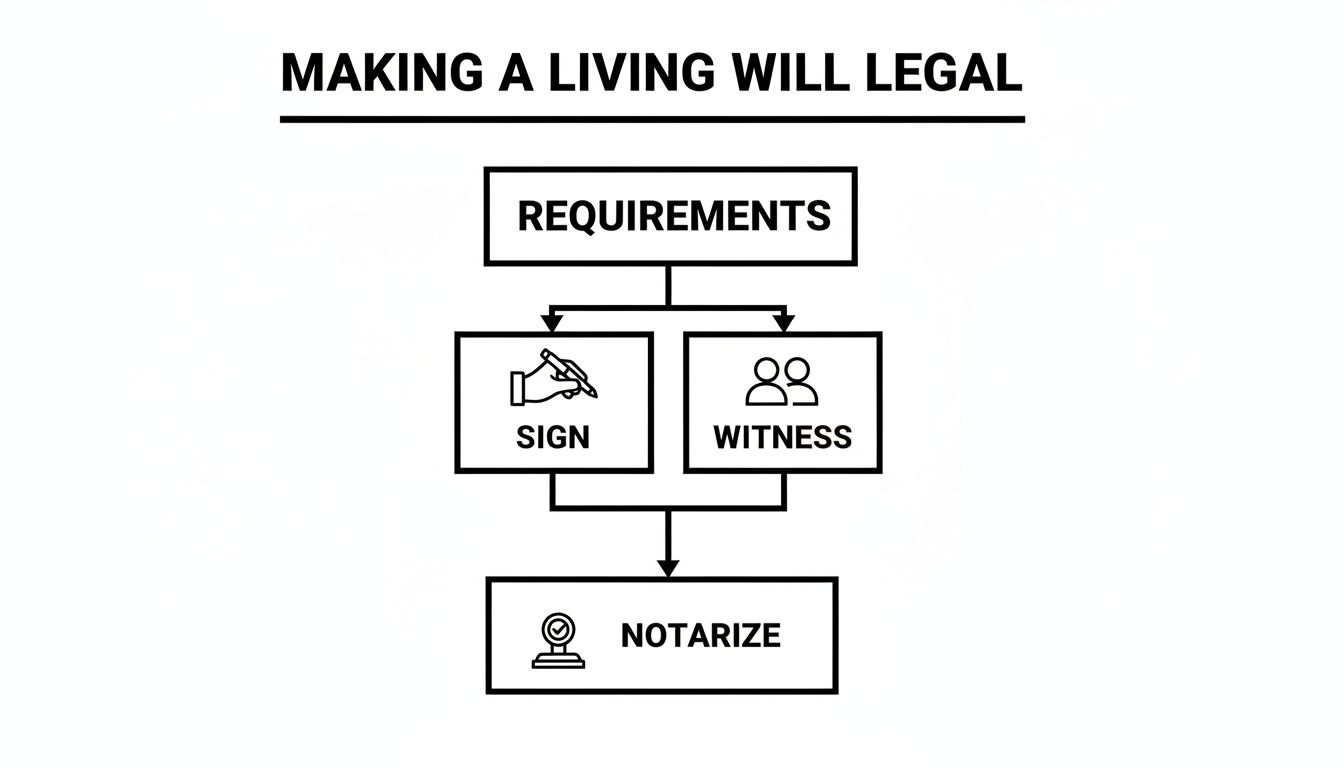
As you can see, the core requirements—signing the document in front of the right witnesses—are the foundation for ensuring your wishes are honored.
A truly comprehensive plan almost always includes both a living will and a Medical Power of Attorney. The living will provides your direct instructions, and the MPOA empowers a trusted person to see those instructions through and navigate any unexpected medical issues that arise.
When and How Your Living Will Actually Takes Effect
One of the biggest worries we hear from our clients in Atascocita is the fear that a living will might be activated too soon. It’s a completely valid concern. You want to know for certain that this powerful document is used only in the exact circumstances you intended, and not a moment before.
Thankfully, Texas law has very specific safeguards built right in to prevent that from ever happening.
Your living will doesn't become active the second you sign it. Think of it as a safety net, carefully folded and stored away, waiting for a true emergency. It only comes into play when two very specific conditions are met.
First, you must be unable to communicate your own medical wishes. Second, your attending physician and at least one other doctor must certify—in writing—that you have a "terminal" or "irreversible" condition. This dual-physician requirement is a critical check and balance designed to protect you.
What “Terminal” and “Irreversible” Really Mean in Texas
To feel confident in your living will, you need to understand what Texas law means by these terms. They aren't vague concepts left to interpretation; they have precise legal definitions.
- Terminal Condition: This is an incurable condition from an injury, disease, or illness that, even with life-sustaining treatment, will cause death in the near future, based on reasonable medical judgment.
- Irreversible Condition: This refers to a condition that might not be immediately fatal but leaves you unable to care for yourself or make decisions. Without life-sustaining treatment, it is fatal, and there is no reasonable prospect of recovery.
This distinction is important. It ensures your living will only applies in the most serious medical situations where a meaningful recovery isn't expected, putting your wishes front and center at the most critical time.
The Activation Process in the Real World
Let's look at a scenario involving a family from Humble. A retired oil and gas worker had a massive stroke that left him completely unresponsive. Years earlier, he had created a living will, making it crystal clear he didn't want artificial nutrition or hydration if he had no hope of recovery.
The medical team at their Harris County hospital followed the legal process to the letter. His primary doctor and a consulting neurologist both examined him and independently concluded his condition was irreversible. They formally certified this in his medical record and then presented the living will to his family.
A living will transforms a moment of potential crisis and conflict into one of clarity and peace. It allows a family to unite in honoring their loved one's wishes rather than being divided by the burden of making an impossible choice.
Because his wishes were documented so clearly, the family didn't have to argue or agonize over what to do. They could focus on just being with him, holding his hand, and saying their goodbyes, all while knowing they were fulfilling his final request. His foresight gave them the incredible gift of peace during an impossibly difficult time.
Creating a living will is a profound act of love for your family. If you're ready to put this protection in place, The Law Office of Bryan Fagan is here to guide you. Schedule a free consultation at our Atascocita office today.
Updating or Changing Your Living Will
Life changes, and your plans should be able to change, too. A marriage, a divorce, the birth of a grandchild, or a new health diagnosis can completely reshape your perspective. Thankfully, a living will isn't a "set it and forget it" document. Texas law treats it as a flexible, dynamic tool that you can—and should—update as your life evolves.
This flexibility is one of the most powerful features of a living will. You always remain in the driver's seat. For folks here in Atascocita and the surrounding communities, that means you can be confident your healthcare directive always reflects what you want right now. It's called a "living" document for a reason—it's meant to grow and change with you.
How to Revoke Your Living Will
Canceling your living will in Texas is surprisingly straightforward. You don’t need to jump through a bunch of legal hoops. The law recognizes that in a medical situation, things need to be simple and clear.
You can revoke your directive in a couple of ways:
- In Writing: The most common and recommended way is to simply create a new living will. The newest version automatically cancels out any old ones. You could also just sign a written statement declaring your intent to revoke it.
- Verbally: You can also just say it out loud. For an oral revocation to be valid, you must state your intention to revoke the directive directly to your attending physician. Once you tell your doctor, they are required to document it in your medical record, and your old directive is officially void.
This simplicity is designed to ensure you can change your mind at any time, even from a hospital bed.
A Local Example of Staying Current
Let’s think about a retired couple who have called Atascocita home for over 30 years. When we first helped them create their living wills, their kids were just starting their own careers, and both of them were in great health. But a decade later, one spouse was diagnosed with a serious medical condition, which changed how they felt about certain life-sustaining treatments. They also wanted to make sure their children, who now had families of their own, knew about their updated preferences.
They came back to our Atascocita office to go over their entire estate plan. We helped them draft new living wills that captured exactly how they felt in that moment. This simple review process gave them tremendous peace of mind, knowing their plan was current and wouldn't cause any confusion for their doctors or their family.
Your living will should be reviewed every few years or after any major life event. A periodic check-in ensures the document that speaks for you is telling your most current story.
This couple’s story really drives home why it's so important to view your estate plan not as a one-time chore, but as an ongoing conversation with yourself and your family. Life’s milestones are a natural nudge to make sure your legal documents still line up with your personal values.
At The Law Office of Bryan Fagan, we encourage our clients in Atascocita and Humble to think of us as long-term partners in their planning. If your circumstances have changed and you need to update your living will, we are here to help. Schedule a free consultation with our team to ensure your wishes are always protected.
Why Every Atascocita Adult Needs a Plan

We've walked through the legal ins and outs of what a living will is in Texas, but let's be honest—this document is so much more than a piece of paper. Think of it as a profound gift you give to the people you love the most. It's a way to provide peace of mind, prevent agonizing family disputes, and protect your own dignity by making sure your choices are heard and respected.
For everyone here in our Atascocita and Humble communities, this kind of planning is critical. It doesn't matter if you're a young parent just starting out or a retiree enjoying your golden years. This is about moving past the legal jargon and focusing on the very real, very human impact of these decisions.
What Happens Without a Living Will
If you don't have a living will, Texas law doesn't leave your doctors guessing. The Health and Safety Code has a default pecking order for who gets to make medical decisions for you. Generally, it goes like this:
- Your spouse
- Your adult children
- Your parents
- Your nearest living relative
That sounds simple enough on the surface, but it can quickly lead to heartbreaking conflict. Just imagine your adult children having a fundamental disagreement about your care, or your spouse being forced to make an impossible choice all alone, second-guessing every move. This kind of situation puts an immense emotional burden on your family when they're already going through a traumatic time.
A living will is one of the most selfless documents you can create. It replaces a family’s potential for conflict and guilt with clarity and peace, allowing them to focus on supporting one another and honoring your memory.
An Act of Love for Your Family
Creating a living will is your chance to take the reins of your future and shield your family from painful uncertainty. By stating your wishes in black and white, you lift that heavy weight of decision-making off their shoulders. They won’t have to guess what you would have wanted—they will know for sure.
This single document can prevent fractured relationships and help your family stay united in honoring your choices, not divided by them. It's especially powerful when it's part of a comprehensive estate plan. While a living will directs your medical care, you can also learn about the pros and cons of a revocable trust for handling your financial assets.
Taking this step is truly an investment in your family's future harmony. Here at the Law Office of Bryan Fagan, we're dedicated to helping our Atascocita neighbors secure that peace. We invite you to schedule a complimentary consultation at our Atascocita office to talk about how you can protect the people who matter most.
Common Questions About Texas Living Wills
Thinking about a living will brings up a lot of important questions. It’s a big step, and you should feel completely clear on how it all works. Here in our Atascocita and Humble offices, we hear many of the same concerns from families just like yours. Let's walk through some of the most common ones.
Will My Texas Living Will Be Honored in Another State?
This is a really smart question, especially if you travel often or have family scattered across the country. The good news is that most states have what are called "reciprocity" laws. This means they'll generally recognize a living will that was legally created in another state, including Texas.
However, the exact rules can get a little tricky from state to state. The best way to make sure your wishes are respected, no matter where you might be, is to have an attorney draft your document. We can build it to be as "portable" as possible. In some situations, it might even make sense to create a separate document for a state you spend a lot of time in.
Can My Family Overrule My Living Will?
In short, no—and that's the entire point. A properly executed living will is your voice, legally documented. It's designed specifically to lift the burden of these gut-wrenching decisions from your family's shoulders and to prevent potential disagreements about your care.
When a living will is drafted professionally by an Atascocita attorney who understands local families, it leaves no room for interpretation. This clarity makes it incredibly difficult for anyone to successfully challenge your stated wishes in a court of law.
What if a Doctor Refuses to Follow My Directive?
Texas law has a built-in safeguard for this exact scenario. A physician can't just disregard your living will because of their personal convictions.
If a doctor is unwilling to follow your instructions, they have a legal and professional obligation to try to transfer your care to another physician who will honor your directive. This ensures your document has real authority in the medical world.
"While state forms are available, a one-size-fits-all document rarely addresses unique family or health situations. Consulting an experienced attorney ensures your living will is correctly executed, fully reflects your personal wishes, and integrates seamlessly with your complete estate plan."
This level of detail is what gives you and your family true protection.
Do I Really Need a Lawyer for a Living Will?
You can certainly find generic forms online, but they're a bit like a one-size-fits-all t-shirt—they rarely fit anyone perfectly. Those templates can't account for your specific family dynamics, complex health issues, or personal values.
Working with an attorney from our Atascocita office ensures every "i" is dotted and every "t" is crossed. We can help you think through situations you haven't even considered and make sure your living will doesn't accidentally conflict with your other estate planning documents, like your medical power of attorney. It's about creating a comprehensive plan with no weak spots, tailored for our northeast Harris County community.
At The Law Office of Bryan Fagan – Atascocita TX Lawyers, we believe every resident deserves the peace of mind that comes with a solid plan. Schedule your free, no-obligation consultation with our compassionate team today to protect your future and your family. Visit us at https://www.atascocitaattorneys.com to get started.