If you live in Atascocita, Humble, or northeast Harris County, you've probably heard the term community property, especially in the context of divorce. In Texas, this concept refers to nearly any asset or debt that you or your spouse acquire from the day you get married until the day a divorce is finalized. This means the income you both earn, the family home you bought, the cars in the driveway, and the retirement accounts you contributed to during the marriage are considered jointly owned by both of you. It doesn’t matter whose name is on the title or who earned the paycheck that paid for it.
Navigating a divorce is one of the most stressful experiences a person can go through. Understanding how your property will be divided is a critical first step toward regaining a sense of control and planning for your future. At The Law Office of Bryan Fagan, we're here to provide our Atascocita neighbors with clear, compassionate guidance through this complex process.
Your Guide to Community Property in Texas

If you're facing a divorce in Atascocita, the legal jargon around 'community property' can feel overwhelming. Let’s break it down with a simple analogy: Texas law views marriage as a partnership. Everything you and your spouse acquire from the day you say "I do" until the divorce is final is considered shared partnership property.
Think about the salary you earn, the family home you bought in Humble, or the retirement savings you both contributed to over the years. This legal framework isn't meant to be punitive; it's a longstanding system designed to ensure a fair division of the life you built together. At its core, the law recognizes that both partners contribute to a marriage in different—but equally valuable—ways.
Understanding the Basics
The fundamental idea is that both spouses are equal partners. It doesn't matter if one spouse was the primary breadwinner while the other managed the household and cared for your children; Texas law values both contributions. The property acquired through either partner's efforts during the marriage belongs to the "community."
In a Harris County divorce court, the judge starts with a crucial presumption: any asset you or your spouse possess at the time of divorce is presumed to belong to the marital community. This puts the burden of proof squarely on the spouse who claims an asset is their own separate property.
What Is Separate Property?
The flip side of community property is separate property, and this distinction is absolutely critical. Why? Because separate property is not subject to division in a divorce. Understanding this concept is the first step toward navigating your divorce with confidence and protecting what is rightfully yours.
Generally, separate property includes:
- Assets you owned entirely on your own before the marriage.
- Property you received as a gift meant specifically for you during the marriage.
- An inheritance you received during the marriage.
To give you a clearer picture, here's a quick comparison of how assets are typically classified for families in our community.
Community vs Separate Property at a Glance
This table provides a quick summary to help you distinguish between the two main types of property under Texas law.
| Asset Category | Generally Considered Community Property | Generally Considered Separate Property |
|---|---|---|
| Income & Wages | All income earned by either spouse during the marriage. | N/A (Income from separate property may be community). |
| Real Estate | A house or land purchased during the marriage. | A house owned by one spouse before the marriage. |
| Vehicles | Cars, trucks, or boats bought during the marriage. | A car owned by one spouse before the marriage. |
| Retirement Accounts | Contributions and growth during the marriage. | The account balance before the date of marriage. |
| Gifts & Inheritance | N/A | Property received as a gift or inheritance by one spouse. |
| Bank Accounts | Funds deposited from earnings during the marriage. | An account containing only pre-marital or inherited funds. |
Keep in mind, these are general rules. The lines can get blurry, especially when funds are mixed together, a process known as commingling. This can make proving an asset is separate a complex task.
Successfully identifying and proving what constitutes separate property is essential for protecting your assets. Our team at The Law Office of Bryan Fagan can help you understand these critical distinctions. For a deeper look into safeguarding your assets, read our guide on how to protect assets during a divorce.
If you are a resident of Atascocita, Humble, or anywhere in Harris County and have questions about your property, we are here to help. Contact The Law Office of Bryan Fagan – Atascocita TX Lawyers today to schedule a free, no-obligation consultation to discuss your specific situation.
Where Texas Property Law Comes From (It's Not Where You Think)
If you've ever watched a courtroom drama and felt like the rules for divorce in Texas are from a different planet, you're not wrong. Our approach to marital property doesn't come from the English common law system used by most of the country. Instead, it’s a direct descendant of Spanish legal traditions that were the law of the land long before the Lone Star State even existed.
This unique history isn't just a fun fact; it's the entire foundation of our marital property system. It stems from a deeply ingrained belief that marriage is a genuine partnership of equals. And that, in a nutshell, is why Texas is a community property state.
The "It's All Ours" Starting Point: The Community Property Presumption
This Spanish legal heritage gives us a core legal principle that every Harris County divorce case starts with: the community property presumption. Think of it as the default setting for all marital assets.
Put simply, Texas law assumes that everything you or your spouse own at the time of divorce belongs to the marital community. It doesn't matter whose name is on the title or which bank account paid for it. The court starts with the idea that it's all community property, ready to be divided.
This creates a crucial dynamic. The spouse who claims an asset is their own separate property bears the burden of proof. They have to come forward with clear and convincing evidence to rebut that powerful presumption. If they can't, the asset stays in the community pot.
Locked in From Day One: The Inception of Title Rule
Another key concept that builds on this foundation is the inception of title rule. It sounds a bit technical, but the idea is actually pretty simple and incredibly important for figuring out who owns what.
The inception of title rule establishes that the character of an asset—whether it's separate or community property—is determined the moment you acquire it. Its status on day one is its status forever.
Let's make this real. Imagine a couple buys a home in Atascocita a few years into their marriage. Even if only the husband's name is on the deed and the mortgage, the house was acquired during the marriage. Under the inception of title rule, that house was stamped as community property the second the ink dried on the closing documents. Its identity as a shared asset was locked in.
This historical framework isn't an accident. Texas formally adopted its community property system way back in 1840, modeling it directly on Spanish marital law. This decision has shaped Texas family law for over 185 years. As written in the Texas Family Code today, any property owned by either spouse when a marriage ends is presumed to belong to the community. You can explore the historical context of Texas property statutes to see just how deep these roots go.
This history ensures that the law recognizes and values the contributions of both spouses. If you're wondering how these centuries-old rules apply to your assets, getting clear guidance is essential. The team at The Law Office of Bryan Fagan – Atascocita TX Lawyers is here to help. Schedule a free consultation with us today to protect your rights.
Sorting It Out: What's "Yours," "Mine," and "Ours" in a Texas Marriage
When you're facing a divorce in Atascocita or Humble, one of the first steps is to take a hard look at your finances. Think of it like you're partners in a business that's dissolving. You have to create a complete inventory and figure out what belongs to the partnership ("ours") and what belongs to each partner individually ("yours" or "mine"). This step—identifying community and separate property—is absolutely essential for a fair outcome.
The law in Texas gives us a very clear place to start: everything you and your spouse acquire from the day you say "I do" until the day you divorce is presumed to be community property. This is a powerful starting point. It means the paychecks you both earned, the family home you bought together, the cars you purchased while married, and the money put into a 401(k) during those years all belong to the marital estate. Separate property is the exception, not the rule.
So, What Counts as Separate Property?
To claim an asset is yours and yours alone, the burden is on you to prove it with clear and convincing evidence. Fortunately, the most common types of separate property are pretty straightforward.
- Property You Owned Before Marriage: Anything you had in your name before the wedding day is still yours. This could be a house, a car, a bank account, or an investment portfolio you started in your single days.
- Gifts Received During the Marriage: If a friend or family member gives you a gift that was clearly intended just for you—not for you and your spouse as a couple—that gift is considered your separate property.
- Inheritances Received During the Marriage: Any money or property you inherit from a loved one's estate while you are married is yours alone.
For instance, if you owned a condo in Kingwood before you ever walked down the aisle, that condo remains your separate property. If your grandmother passed away and specifically left you her antique jewelry collection in her will, that jewelry is also your separate property. The key, however, is keeping these assets truly separate and not mixing them with community funds.
Common Examples of Community Property
It helps to have a clear picture of what usually falls into the community property bucket. For most families here in northeast Harris County, the marital estate represents the bulk of the assets that will need to be divided.
Here are a few everyday examples:
- Salaries and Wages: All the income either of you earned from your jobs during the marriage is community property.
- The Family Home: The house you bought together in a neighborhood like Eagle Springs or Fall Creek after getting married is almost certainly community property, even if only one name is on the deed.
- Retirement Accounts: The portion of any 401(k), pension, or other retirement plan that was earned or funded during the marriage is community property.
- Vehicles and Personal Items: Cars, furniture, electronics, and other things bought with community funds during the marriage belong to the community.
Here’s a critical point that trips many people up: In Texas, the income generated from separate property is actually considered community property. So, if you rent out that pre-marital condo you own, the rental income you collect during the marriage belongs to both of you.
This rule really shows how strong the community property presumption is in Texas. This core principle has been part of our state’s law since 1840 and means that everything a couple has at the time of divorce is considered community property unless one spouse can definitively trace it back to a separate source. This is a huge difference from the 41 common law states where the name on the title often decides who owns what.
The Importance of a Clean Paper Trail
Because it’s up to you to prove an asset is separate, keeping meticulous records is your single best defense. If you inherited money and deposited it into a joint checking account where it got mixed in with paychecks and used for household expenses, it becomes incredibly difficult—sometimes impossible—to untangle it later. This process is called "commingling," and it can turn separate property into community property by default.
This is exactly why we spend so much time advising our clients on how to handle their finances. We provide detailed strategies on how to protect your assets during a divorce in our dedicated guide on the topic. Taking the time to clearly identify and categorize your property isn't just a legal chore; it's a vital step toward finding clarity and control during a very stressful time.
Sorting Out Commingled Assets and the Art of Tracing
In a perfect world, all your finances would stay in neat, separate boxes. But marriage isn't like that, and neither is your money. This is where things can get complicated in a Texas divorce, especially when dealing with commingled assets.
Commingling is simply a legal term for what happens when separate property gets mixed in with community property, making it difficult to tell who owns what.
Let’s say you inherit $25,000 from your grandmother. That’s your separate property, hands down. But then you deposit it into the joint checking account you share with your spouse. From that account, you pay the mortgage on your home in Humble, buy groceries, and fund a family vacation. You've just commingled it. The lines are now blurred, and that once-separate inheritance is now tangled up with the community's money.
This diagram helps visualize how property gets its identity from the very beginning—before marriage, during marriage, or through an inheritance.
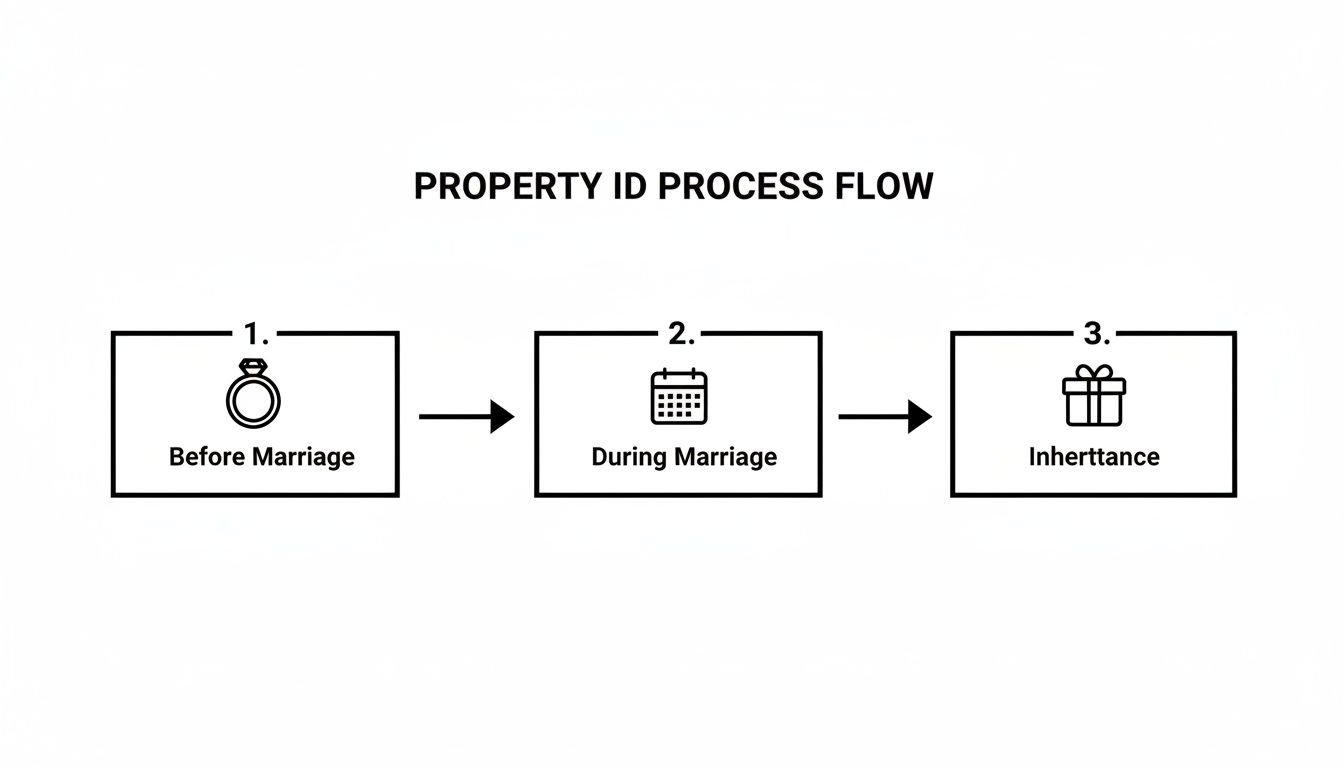
As you can see, the character of an asset—whether it’s yours, theirs, or ours—is locked in the moment it's acquired. The trouble starts when those assets get mixed together.
The Challenge of "Unscrambling the Eggs"
Once funds are commingled, trying to separate them is a lot like trying to unscramble eggs. It’s a messy, difficult job. It’s not enough to just point to an old bank statement showing the initial deposit. Under Texas law, the spouse claiming something as separate property has the burden of proving it with clear and convincing evidence.
This is where a legal process called tracing comes in.
Tracing is basically financial forensics. It involves meticulously following the paper trail of an asset, from its origin as separate property all the way through its tangled journey, to prove that a specific portion of it remains separate. You have to show not only where the money came from, but exactly where it went—and prove it wasn't spent on community living expenses.
To successfully trace your assets, you'll need to gather documents such as:
- Bank Statements: Showing the initial deposit of separate funds and every single transaction that followed.
- Deeds and Titles: Proving when a property was purchased and with whose money.
- Gift Letters and Wills: Official documents that prove the intent behind a gift or inheritance.
- Financial Records: This includes everything from brokerage statements and receipts to canceled checks.
Proving What Is Rightfully Yours
The legal bar for tracing is set incredibly high. If you can’t provide a clean, unbroken paper trail, a court is very likely to decide the entire commingled account or asset is community property.
In Texas, a powerful legal doctrine called the “inception of title” rule determines an asset’s character. This rule says that if you acquired title to an asset before the marriage or bought it with your separate funds, it stays your separate property—even if you acquired it in another state.
This exact principle was cemented in a landmark case, CAMERON v. CAMERON, which made it clear that separate property keeps its character regardless of where it came from. The ruling confirmed that Harris County courts can only divide true community property. This makes the ability to trace and prove your separate assets absolutely critical. You can learn more about this foundational Texas family law case to see how it shaped current law.
Because tracing is so detailed and document-heavy, it's not something you want to tackle alone. Having a skilled Atascocita divorce lawyer is essential. We can help you gather the right evidence, work with financial experts if necessary, and build a solid case to protect what’s rightfully yours. This careful work can make a world of difference, reducing the stress and uncertainty that commingled assets create.
If you’re worried about how your property is mixed together, don't wait. Schedule a free consultation at our Atascocita office. Let the team at The Law Office of Bryan Fagan help you understand your rights and build a clear strategy to protect your financial future.
How Property Is Divided in a Harris County Divorce
Once you’ve understood the difference between community and separate property, the next big question is: how does a judge actually divide it all up in a divorce? This is a crucial question for families throughout Atascocita, Humble, and the greater Harris County area.
Many people believe Texas is a strict 50/50 state, assuming everything gets sliced right down the middle. While a 50/50 split is a common starting point, it’s far from guaranteed.
The legal standard in Texas isn't "equal" division. Instead, the law requires a “just and right” division. That phrase is everything. It gives a judge a significant amount of flexibility to divide the community estate in a way they feel is fair given the unique facts of your marriage. This means the final split might be 55/45, 60/40, or something else entirely.
Factors That Influence a Just and Right Division
So, what exactly does a judge look at to decide what's "just and right"? It’s not a random process. They weigh several specific factors to reach a decision that fits the circumstances of your family.
Some of the most common factors a Harris County judge will consider include:
- Fault in the Breakup: If one spouse's behavior, like adultery or cruelty, was the primary reason the marriage ended, the judge can award a larger share of the property to the other spouse.
- Disparity in Earning Power: The court looks at each spouse’s ability to provide for themselves after the divorce. If one spouse gave up a career to raise children and now has a much lower earning capacity, they might receive a larger portion of the assets to help them get back on their feet.
- Health and Age of Each Spouse: The physical and mental health of both parties matters. A spouse with significant health problems or who is close to retirement age might have greater financial needs, which the court can factor into the division.
- Needs of the Children: The parent with primary custody of the kids often gets to stay in the family home to provide stability. This can heavily influence how other assets are divided to ensure the children are well-cared for.
- Attorney's Fees: In some cases, the court can order one spouse to pay for the other's attorney's fees as part of the property division.
The Path to Dividing Your Property
The division process itself follows a logical path, starting with negotiation and only heading to court if you can't agree. It always begins with both sides creating a detailed inventory of every asset and every debt, carefully labeling each as either community or separate property.
From there, you and your spouse will try to negotiate a settlement with the help of your lawyers. If you hit a roadblock, the next step is usually mediation. This is a powerful process where a neutral professional helps you find a middle ground. We have a helpful guide on how to prepare for divorce mediation that can walk you through what to expect.
If mediation doesn't work out, the last resort is going to trial and letting a judge make the call. While the vast majority of cases settle out of court, knowing how a judge thinks is critical for negotiating effectively from the very beginning.
The entire point of a "just and right" division is to make sure both people can start their new lives on stable financial ground. It’s a recognition that a marriage is more than a simple business arrangement, and untangling it requires a fair, personalized approach, not just a calculator.
Figuring all this out requires a clear grasp of your rights and a strong advocate by your side. If you are facing a divorce in Atascocita, Humble, or anywhere in Harris County, contact The Law Office of Bryan Fagan for a free consultation. We are here to help you secure a fair and just outcome.
Protecting Your Assets Before and During Marriage

Being proactive about your finances isn't just smart; it can bring a sense of clarity and security to your marriage. For those of us in Atascocita and Humble, protecting your financial interests isn’t about expecting the worst. It’s about building a stronger partnership through honest, open communication about money.
The best way to do this is with a marital property agreement. These legal documents give you and your partner the power to set your own rules for property, rather than just relying on the default Texas community property laws. Think of them less as a contract and more as a conversation starter about your financial goals and expectations for the future.
Prenuptial and Postnuptial Agreements
A prenuptial agreement is exactly what it sounds like: a contract you put in place before you get married. It’s a powerful tool that can clearly state which assets will always remain separate, how specific debts will be managed, and how things would be divided in the event of divorce or death. This is especially useful if you own a business, have significant assets from before the marriage, or have children from a prior relationship.
A postnuptial agreement functions in the same way, but it’s created during the marriage. It’s not uncommon for couples in Harris County to opt for one when a spouse starts a new business venture or receives a large inheritance. A postnup lets them formally designate that new asset as separate property, which helps prevent it from getting mixed up with community funds down the road.
These agreements give you the control to make deliberate choices that protect your financial well-being, no matter what life throws your way.
These aren't just for the ultra-wealthy. Marital agreements offer predictability and security for anyone bringing assets, debts, or a business into a marriage. They're a hallmark of smart financial planning, not a sign of mistrust.
Practical Steps to Keep Separate Property Separate
Even if you don't have a formal marital agreement, there are simple, practical things you can do to keep your separate property from getting tangled up with community assets. The big idea here is to avoid "commingling" your funds.
- Maintain Separate Bank Accounts: If you receive an inheritance or a substantial gift, put it directly into a bank account that is only in your name. Don't let those funds touch the joint account you use for household bills.
- Keep Meticulous Records: This is huge. Hold on to every bank statement, property deed, or document that can prove where your separate property came from. A clean paper trail is your strongest defense if questions ever come up.
- Pay for Improvements Wisely: Be careful when using community funds—like money from your paychecks—to pay the mortgage or renovate a house you owned before the marriage. Doing so can give the community an ownership interest in your separate property home. If you can, always use separate funds for these expenses.
These habits are just one piece of a bigger estate planning puzzle. As part of a complete strategy to protect your assets and make sure your wishes are carried out, you should consider creating a comprehensive will to spell out exactly how your property should be handled. It's also vital to understand all the tools at your disposal; for more on that, you can explore the pros and cons of a revocable trust in our detailed guide.
Taking action now is always the smartest move. At The Law Office of Bryan Fagan – Atascocita TX Lawyers, we can help you build a plan that truly protects your interests. Schedule a free consultation with our team today.
Your Top Questions About Texas Community Property Answered
Going through a divorce stirs up a storm of questions, and when it comes to your property, the details are everything. To help our neighbors in Atascocita, Humble, and the surrounding areas, we've put together some straightforward answers to the questions we hear most often about Texas community property.
Is Texas a 50/50 State for Divorce?
This is probably the biggest myth we have to bust. While a 50/50 split is often the starting point for negotiations, Texas law doesn't actually demand it. Instead, the legal standard requires a division that is “just and right.”
This phrasing gives a Harris County judge a lot of room to maneuver. They can look at the whole picture—things like who was at fault for the breakup, disparities in earning power between spouses, or what’s best for the kids. A final split could easily be 55/45 or even 60/40 if the situation calls for it. The goal is what's fair, not a perfect half-and-half equation.
What Happens to Our Debt in a Texas Divorce?
It’s simple: debts get treated just like assets. Any debt that either of you took on during the marriage is almost always considered community debt. This bucket includes the mortgage, car notes, credit card bills, and personal loans you acquired while you were married.
It really doesn't matter whose name is on the loan. If the debt was taken out for the benefit of the marriage, it belongs to the community. A judge will divide these liabilities right alongside the property, aiming for that same "just and right" outcome.
Is My Inheritance Community Property If I Get It While Married?
No, you can breathe a sigh of relief on this one. An inheritance is the textbook example of separate property. Any money or assets you inherit, even during the marriage, belong solely to you. The same goes for gifts meant specifically for you and not you as a couple.
The crucial thing here is to keep those assets truly separate. If you drop that inheritance check into a joint bank account and start paying household bills with it, you risk "commingling" the funds. Once that happens, it can lose its separate identity and get swept into the community pot.
Can I Protect My Business in a Divorce?
Absolutely. Protecting a business you’ve poured your life into is a huge priority. If you started the company before you got married, the business itself is your separate property. The tricky part is that any growth in its value during the marriage that resulted from your joint efforts or community funds could be considered a community asset.
If you launched the business during the marriage, it's presumed to be community property from the start. Dividing it fairly often requires bringing in financial experts to figure out exactly what it's worth. The best way to sidestep these issues is with a prenuptial or postnuptial agreement, which can clearly designate the business as separate property from the get-go.
Do I Really Need a Lawyer to Divide Our Property?
Legally, no one can force you to hire an attorney. But is it a good idea? Almost always, yes. This is especially true if you're dealing with complex assets like a business, retirement accounts, or property that has been mixed together (commingled).
An experienced Atascocita family law attorney is your best advocate for making sure your rights are protected and that everything is identified, valued, and divided correctly. Trying to go it alone can lead to costly mistakes that are incredibly difficult, if not impossible, to fix later.
Getting a handle on Texas community property law is the first step toward securing your financial future. At The Law Office of Bryan Fagan – Atascocita TX Lawyers, we're committed to giving our Atascocita and Humble neighbors clear, honest advice. If you have questions about your own circumstances, we invite you to schedule a free, no-obligation consultation with our team today.